Test de Coombs
Revu par Dr Colin Tidy, MRCGPDernière mise à jour par Dr Rosalyn Adleman, MRCGPDernière mise à jour 20 juin 2023
Respecte les directives éditoriales
- TéléchargerTélécharger
- Partager
- Language
- Discussion
- Version audio
- Ajouter aux sources préférées sur Google
Dans cette série :Analyses de sangGroupes sanguins et typesAnalyses de sang pour détecter l'inflammationNumération formule sanguine et frottis sanguin
Un test de Coombs est un type de test sanguin. Il porte le nom de la personne qui l'a inventé, le Dr Robin Coombs. Il existe deux types de test de Coombs.
En un coup d'œil
A Coombs test looks for antibodies that might attack red blood cells.
There are two types: the direct Coombs test and the indirect Coombs test.
The direct test checks for antibodies already attached to red blood cells.
The indirect test checks for antibodies in the liquid part of the blood.
The direct test helps diagnose a type of anaemia called haemolytic anaemia.
The indirect test is used for blood transfusions and in pregnant mothers.
A blood sample is taken for a Coombs test.
What is a Coombs test?
The two types of Coombs test are as follows:
The direct Coombs test involves looking directly at red blood cells found in a sample of blood. The direct Coombs test is sometimes called the direct antiglobulin test (DAT).
The indirect Coombs test looks at the liquid part of the blood (the plasma). The indirect Coombs test is sometimes called the indirect antiglobulin test (IAT).
Both types of Coombs test are looking for antibodies which may attack red blood cells and lead to them being destroyed.
What is a Coombs test used for?
The direct Coombs test may be used if doctors suspect a person is affected by a type of l'anémie called haemolytic anaemia. Haemolytic anaemia is a condition where there are not enough red blood cells in the body because something in the body is destroying them. The Coombs test is done to see if it is the immune system that could be causing the red blood cells to be destroyed.
The indirect Coombs test is used to make sure that blood that has been donated is compatible with the patient who is going to receive it. It is also used to check that a pregnant mother's blood does not contain antibodies that might cause her baby harm. See the separate leaflet called Blood Tests.
How does a Coombs test work?
Direct Coombs test
In a direct Coombs test a special antibody is added to a sample of blood. This test checks whether there are antibodies that have already attached themselves to the surface of the red blood cell. If the antibodies that are added bind to the antibodies on the surface of the cell the test is positive. This causes the red blood cells to clump together in the test tube. A positive test shows that part of the immune system is causing red cells to be destroyed.
Indirect Coombs test
The indirect Coombs test is done on a sample of the liquid part of the blood. It looks for antibodies in the bloodstream that aren't attached to the red blood cells but could bind to certain red blood cells and destroy them.
Antibody response
Your red blood cells have certain proteins on their surface, called antigens. Also, your plasma contains a special type of protein called antibodies, which will attack certain antigens if they are present.
Antigens are like flags to our immune system. They usually identify a substance that is not meant to be in the body (foreign). They can be found on the surface of germs (bacteria) but they can also be found on substances which don't cause disease. For example, they can be found in pollen, blood, or transplanted organs.
The presence of an antigen which is not made by your body causes the immune system to act. This is called an antibody response. This is one of the ways our body protects us from illness. It recognises bacteria and viruses by their antigens and destroys them using antibodies. However, in some conditions, known as autoimmune diseases, your own body can destroy your own red blood cells.
Transfusion reaction
Human blood is grouped by the different types of antigens that are on the surface of red blood cells. If you receive a blood transfusion, the transfused blood must be the same blood group (type) as yours. It must have the same antigens as those of your red blood cells.
If you receive a transfusion of blood with antigens that are different from yours (incompatible blood), your système immunitaire destroys the transfused blood cells. This is called a transfusion reaction and can cause serious illness or even death. This is why blood group matching is so important.
What happens during a Coombs test?
A Coombs test involves taking a sample of blood. The blood sample is then sent to the laboratory where the Coombs test is carried out.
Sélections des patients pour Analyses de sang
Tests et investigations
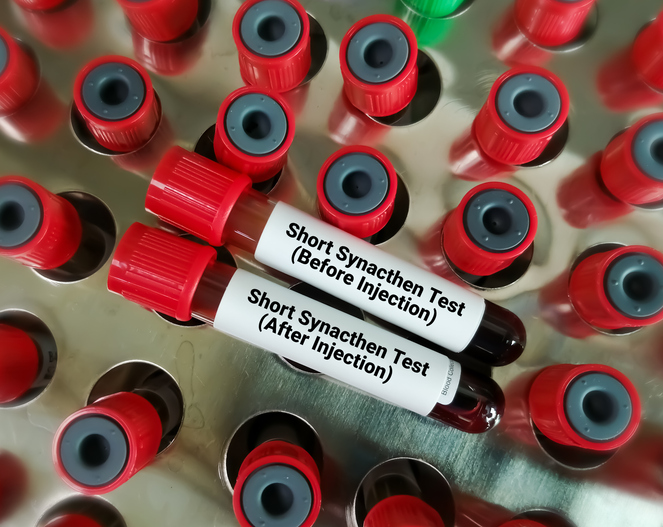
Test Synacthène
Un test de synacthène vérifie la fonction des glandes surrénales. Il peut aider à déterminer si les glandes surrénales produisent suffisamment d'hormones stéroïdes (cortisol). Remarque : les informations ci-dessous sont uniquement une indication générale. Les modalités et la façon dont les tests sont effectués peuvent varier d'un hôpital à l'autre. Suivez toujours les instructions données par votre médecin ou votre hôpital local.
par Dr Philippa Vincent, MRCGP
Tests et investigations
Test sanguin de routine pour la fonction rénale
Il existe différentes manières de mesurer l'efficacité du fonctionnement des reins. La méthode la plus courante consiste à mesurer une substance appelée créatinine par un test sanguin, et à calculer quelque chose appelé le taux de filtration glomérulaire estimé (eGFR). Habituellement, d'autres substances telles que l'urée et les sels dans le sang (potassium et sodium) sont également mesurées.
par Dr Doug McKechnie, MRCGP
Questions fréquemment posées
What are antigens and antibodies in relation to red blood cells?
Red blood cells have specific proteins on their surface called antigens. The liquid part of your blood, called plasma, contains special proteins called antibodies. Antibodies are designed to attack particular antigens if they are present. Normally, antigens identify foreign substances that shouldn't be in the body, triggering the immune system to respond. However, in some conditions, your immune system can mistakenly attack your own body's red blood cells.
Why is blood type matching so crucial for transfusions?
Blood is grouped according to the specific types of antigens found on the surface of red blood cells. When you receive a blood transfusion, the donated blood must belong to the same blood group as yours, meaning it has the same antigens. If you receive blood with different antigens (incompatible blood), your immune system will recognise these as foreign and destroy the transfused red blood cells. This is known as a transfusion reaction and can lead to serious illness or even be fatal.
What is haemolytic anaemia?
Haemolytic anaemia is a condition where the body doesn't have enough red blood cells. This happens because something in the body is causing the red blood cells to be destroyed prematurely. The direct Coombs test can help determine if the immune system is responsible for this destruction of red blood cells.
Lectures complémentaires et références
- Tests de Laboratoire en Ligne® - Royaume-Uni
- Zantek ND, Koepsell SA, Tharp DR Jr, et al; The direct antiglobulin test: a critical step in the evaluation of hemolysis. Am J Hematol. 2012 Jul;87(7):707-9. doi: 10.1002/ajh.23218. Epub 2012 May 6.
À propos de l'auteurVoir la biographie complète

Dr Rosalyn Adleman, MRCGP
MRCGP
Dr Rosalyn Adleman est médecin généraliste du NHS travaillant dans le nord de Londres.
À propos du critiqueVoir la biographie complète

Dr Colin Tidy, MRCGP
Médecin généraliste, Auteur médical
MBBS, MRCGP, MRCP (Paediatrics), DCH
Le Dr Colin Tidy est un médecin du NHS, basé dans l'Oxfordshire.
Historique de l'article
Les informations sur cette page sont rédigées et examinées par des cliniciens qualifiés.
Article également disponible en Anglais, Allemand, Espagnol, Français, Italien, Portugais, Hindi, Hébreu, Arabe, and Suédois.
Prochaine révision prévue : 4 mai 2028
20 juin 2023 | Dernière version

Demandez, partagez, connectez-vous.
Parcourez les discussions, posez des questions et partagez vos expériences sur des centaines de sujets de santé.

Vous ne vous sentez pas bien ?
Évaluez vos symptômes en ligne gratuitement
Inscrivez-vous à la newsletter Patient
Votre dose hebdomadaire de conseils de santé clairs et fiables - rédigés pour vous aider à vous sentir informé, confiant et maître de la situation.
En vous abonnant, vous acceptez notre Politique de confidentialité. Vous pouvez vous désabonner à tout moment. Nous ne vendons jamais vos données.