Analyses de sang
Revu par Dr Toni Hazell, FRCGPDernière mise à jour par Dr Hayley Willacy, FRCGP Dernière mise à jour 13 fév 2023
Respecte les directives éditoriales
- TéléchargerTélécharger
- Partager
- Language
- Discussion
- Version audio
- Ajouter aux sources préférées sur Google
Dans cette série :Groupes sanguins et typesAnalyses de sang pour détecter l'inflammationTest de CoombsNumération formule sanguine et frottis sanguin
Les principales raisons de connaître votre groupe sanguin sont si vous devez subir une transfusion sanguine ou si vous êtes enceinte. Vous ne pouvez pas demander un test sanguin juste pour connaître votre groupe sanguin sur le NHS.
En un coup d'œil
Blood is made up of blood cells (red, white, and platelets) and plasma.
Red blood cells carry oxygen, white blood cells fight infection, and platelets help blood to clot.
Blood tests are done for many reasons, including diagnosing conditions or monitoring treatments.
A small amount of blood is usually taken from a vein in your arm.
You may need to fast before some blood tests.
After a blood test, a bruise may develop, or rarely, you might feel faint.
See a doctor if the site of the blood test becomes red and inflamed.
What is blood made up of?
Blood cells
These can be seen under a microscope and make up about 40% of the blood's volume. Blood cells are made in the bone marrow by blood 'stem' cells. Blood cells are divided into three main types:
Red cells (erythrocytes)
These make blood a red colour. One drop of blood contains about five million red cells. A constant new supply of red blood cells is needed to replace old cells that break down. Millions of red blood cells are made each day. Red cells contain a chemical called haemoglobin. This binds to oxygen and takes oxygen from the lungs to all parts of the body.
White cells (leukocytes)
There are different types of white cells which are called neutrophils (polymorphs), lymphocytes, eosinophils, monocytes and basophils. They are part of the système immunitaire. Their main role is to defend the body against infection.
Neutrophils engulf germs (bacteria) and destroy them with special chemicals.
Eosinophils and monocytes also work by swallowing up foreign particles in the body.
Basophils help to intensify inflammation.
Inflammation makes blood vessels leaky. This helps specialised white blood cells get to where they are needed. Lymphocytes have a variety of different functions. They attack viruses and other germs (pathogens). They also make antibodies which help to destroy pathogens.
Plaquettes
These are tiny and help the blood to clot if we cut ourselves.
Plasma
This is the liquid part of blood and makes up about 60% of the blood's volume. Plasma is mainly made from water but also contains many different proteins and other chemicals, such as:
Hormones.
Antibodies.
Enzymes.
Glucose.
Fat particles.
Salts.
In order to constantly make blood cells, haemoglobin and the constituents of plasma, you need a healthy bone marrow and nutrients from food including iron and certain vitamins.
When blood spills from your body (or a blood sample is taken into a plain glass tube) the cells and certain plasma proteins clump together to form a clot. The remaining clear fluid is called serum.
How is a blood test normally done?
The vein used for blood sampling is usually on the inside of your elbow or the back of your wrist.
A tight band (tourniquet) is usually placed around your upper arm. This makes the vein fill with blood and makes it easier for the blood sample to be taken.
The skin over the vein may be cleaned with an antiseptic wipe.
A needle is then inserted into the vein through the clean skin, causing a sharp pricking sensation. The needle is connected either to a syringe, or directly to blood sample bottles.
The tourniquet is undone. When the required amount of blood is taken, the needle is removed. The small wound is pressed on with cotton wool for a few minutes to stop the bleeding and prevent bruising. A sticking plaster may be put on. The blood is placed in bottles. There may be a slight ache following a blood test.
How much blood is normally taken?
This depends on the sort of tests you are having done. Many tests can be done on the same sample of blood so you do not need to have a single bottle for each one: The bottles do not necessarily have to be completely filled either.
Purple bottle - 3 ml - used for a full blood count (FBC) and ESR. An FBC needs 1 ml; a full 2.5 ml is needed if an ESR is also performed.
Yellow bottle - 2.5 ml - this is used for a lot of different chemical tests, so it is usually completely filled.
Other less common tests come in bottles up to 6 ml in volume and blood culture bottles are the largest size at 10 ml.
If you need a lot of tests therefore, you could end up having about 30 ml of blood (about six medicine teaspoons) taken out of your arm. It's worth saying that the body can well cope with this, as the volume is soon made up by the blood production system in the bone marrow. Considering that about 500 ml of blood are given by blood donors during each donation, this is certainly not an excuse for tea and biscuits!
Variations of blood taking
Some blood tests require several samples taken over a period of time. For example, they may be done to check how you respond to something. If you require repeated samples fairly close to each other (over the following few hours or so), a doctor may insert a 'butterfly' needle into the vein, which can be taped to the skin. Samples of blood can then be taken without using a needle each time.
If only a small amount of blood is needed then a few drops of blood can be squeezed out from a small prick in the tip of the finger or earlobe. For example, only a small amount of blood is needed for checking the blood sugar (glucose) level, using a test strip of paper.
Some blood tests are taken from an artery in the wrist. For example, to measure the level of oxygen in the artery. This is usually only done in hospital in certain circumstances.
Children who need a blood test may be given cream to put on at home before the test to numb the skin.
Fasting blood test
You may be told not to eat or drink anything except water before certain blood tests. The amount of time you will be requested to fast varies from test to test and even sometimes from doctor to doctor. The fasting time for a blood glucose test for example is usually 8 to 10 hours. For a fasting cholesterol test it can be 9 to 12 hours. Fasting tests are usually done in the morning so you can fast through the night. Recent guidelines advise that fasting may not be necessary when having a cholesterol check, but be guided by your doctor.
Are there any complications from blood taking?
Sometimes a bruise develops where the needle was inserted. This is much less likely to happen if you press over the site with cotton wool for several minutes with your arm left straight (not bent).
As with any wound, an infection may develop where the needle was inserted. See your doctor if the wound site becomes red and inflamed. Rarely, some people feel faint during a blood test. Tell the person doing the test if you feel faint, as you should immediately lie down to prevent fainting.
Different blood samples
Blood can be tested for many different things. The person who requests the blood test will write on the form which tests they want the laboratory to do. Different blood bottles are used for different tests. For example, for some tests the blood needs to clot and the test is looking for something in the serum. For some tests, the blood is added to some chemicals to prevent it from clotting. If the blood glucose is being measured then the blood is added to a special preservative, etc. This is why you may see your blood added to blood bottles of different sizes and colours.
Blood tests are taken for many different reasons - for example, to:
Help diagnose certain conditions, or to rule them out if symptoms suggest possible conditions.
Monitor the activity and severity of certain conditions. For example, a blood test may help to see if a condition is responding to treatment.
Check the body's functions such as liver function and kidney function when you are taking certain medicines which may affect the liver or the kidneys.
Check your blood group before receiving a blood transfusion.
Common blood tests
FBC blood test - this is also called a full blood count. It checks for anaemia and other conditions which affect the blood cells.
UE blood test - this is often written as 'U+E', U and Es' or 'U&E' and stands for urea and electrolytes. It is used as a measure of kidney function.
GFR blood test - this is another measure of kidney function.
LFT blood test - this stands for liver function test.
Blood sugar (glucose) level.
HbA1c blood test - this is a test used in the diagnosis and management of diabetes.
GTT.
Immunologie - such as checking for antibodies to certain viruses and germs (bacteria).
TSH blood test - this stands for thyroid-stimulating hormone and is one of the tests for thyroid function.
CA 125 blood test - this is a test for cancer de l'ovaire.
PSA blood test - this is a test for cancer de la prostate.
BNP blood test - this is a test for une insuffisance cardiaque.
ANA blood test - this is a test for autoimmune conditions.
MCH blood test - this is used in the investigation of l'anémie.
MCV blood test - this is used in the investigation of l'anémie.
INR blood test - this is a test for blood clotting for people on anticoagulants.
CK blood test - this is a test for crises cardiaques, and muscle and brain conditions.
FSH blood test - a test for ovarian function and le syndrome des ovaires polykystiques.
CEA blood test - a test for cancer de l'intestin.
LDH blood test- a test for tissue damage in the body.
Sélections des patients pour Analyses de sang
Tests et investigations
Osmolalité, osmolarité et homéostasie des fluides
L'osmolalité est une mesure du nombre de particules dans un kg de liquide dans lequel elles sont dissoutes. L'osmolarité est une mesure du nombre de particules dans un litre de liquide dans lequel elles sont dissoutes. L'homéostasie des fluides est le terme utilisé pour maintenir la concentration des fluides dans le corps sans changement. On parle parfois aussi d'équilibre hydrique.
par Dr Hayley Willacy, FRCGP
Tests et investigations
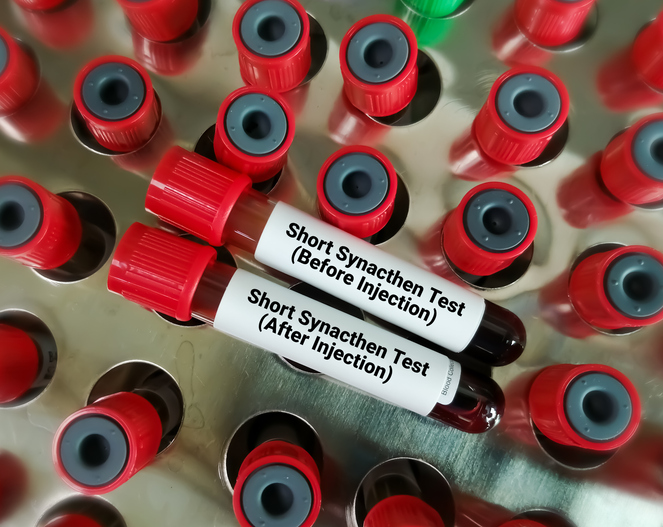
Test Synacthène
Un test de synacthène vérifie la fonction des glandes surrénales. Il peut aider à déterminer si les glandes surrénales produisent suffisamment d'hormones stéroïdes (cortisol). Remarque : les informations ci-dessous sont uniquement une indication générale. Les modalités et la façon dont les tests sont effectués peuvent varier d'un hôpital à l'autre. Suivez toujours les instructions données par votre médecin ou votre hôpital local.
par Dr Philippa Vincent, MRCGP
Questions fréquemment posées
Why are different coloured bottles used for blood samples?
Different coloured bottles are used because some tests require the blood to clot, while others need chemicals added to prevent clotting for specific analyses. For instance, if blood glucose is being measured, a special preservative is added to the blood in the bottle. This ensures the sample is correctly prepared for the specific tests ordered.
Can children have a blood test without feeling a prick?
Yes, for children needing a blood test, a doctor may suggest using a special cream that can be applied at home before the test. This cream helps to numb the skin, which can reduce the sensation of the needle prick during the blood draw.
What is 'serum' and how is it different from plasma?
Serum is the clear fluid that remains after blood has clotted and the cells and some plasma proteins have clumped together. Plasma, on the other hand, is the liquid part of blood that makes up about 60% of its volume and contains water, proteins, hormones, antibodies, enzymes, glucose, fat particles, and salts. When blood clots, certain components are removed, leaving serum.
Lectures complémentaires et références
- Tests de Laboratoire en Ligne® - Royaume-Uni
- Nordestgaard BG, Langsted A, Mora S, et al; Fasting is not routinely required for determination of a lipid profile: clinical and laboratory implications including flagging at desirable concentration cut-points-a joint consensus statement from the European Atherosclerosis Society and European Federation of Clinical Chemistry and Laboratory Medicine. Eur Heart J. 2016 Jul 1;37(25):1944-58. doi: 10.1093/eurheartj/ehw152. Epub 2016 Apr 26.
- Jorgensen HL, Lind BS; Blood tests - too much of a good thing. Scand J Prim Health Care. 2022 Jun;40(2):165-166. doi: 10.1080/02813432.2022.2104436.
À propos de l'auteurVoir la biographie complète

Dr Hayley Willacy, FRCGP
Médecin généraliste, Auteur médical
MBChB (1992), DRCOG, DFFP, MRCOG (Part 1) MRCGP (2007), DFSRH (2013), MSc - medical education (2020)
Le Dr Hayley Willacy était médecin généraliste au NHS travaillant dans le nord-ouest de l'Angleterre, qui a pris sa retraite de la pratique clinique en 2022 après 30 ans.
À propos du critiqueVoir la biographie complète

Dr Toni Hazell, FRCGP
MBBS, BSc, FRCGP, DFSRH, Dip GU med, DRCOG, DCH (London, UK, 2000)
Le Dr Toni Hazell a obtenu son diplôme de l'École de médecine de l'hôpital St. Mary et a effectué son VTS à l'hôpital Northwick Park.
Historique de l'article
Les informations sur cette page sont rédigées et examinées par des cliniciens qualifiés.
Article également disponible en Anglais, Allemand, Espagnol, Français, Italien, Portugais, Hindi, Hébreu, Arabe, and Suédois.
Prochaine révision prévue : 12 fév. 2028
13 fév 2023 | Dernière version

Demandez, partagez, connectez-vous.
Parcourez les discussions, posez des questions et partagez vos expériences sur des centaines de sujets de santé.

Vous ne vous sentez pas bien ?
Évaluez vos symptômes en ligne gratuitement
Inscrivez-vous à la newsletter Patient
Votre dose hebdomadaire de conseils de santé clairs et fiables - rédigés pour vous aider à vous sentir informé, confiant et maître de la situation.
En vous abonnant, vous acceptez notre Politique de confidentialité. Vous pouvez vous désabonner à tout moment. Nous ne vendons jamais vos données.
Plus dans les tests et enquêtes
- Électrocardiogramme ambulatoire
- Scintigraphie osseuse
- Gènes BRCA
- Dépistage du sein
- Enzymes cardiaques
- Angiographie cérébrale
- Cystoscopie
- Échocardiogramme
- Test d'effort
- Urographie intraveineuse
- Biopsie hépatique
- IRM
- Nasoendoscopie
- Test de dépistage néonatal
- Programme de dépistage du NHS
- Vérificateur de symptômes
- Test Synacthène
- Test de bandelette urinaire
- Test urodynamique
- Cystourethrogramme mictionnel