Numération formule sanguine et frottis sanguin
Revu par Dr Caroline Wiggins, MRCGP Dernière mise à jour par Dr Rachel Hudson, MRCGPDernière mise à jour 30 oct. 2024
Respecte les directives éditoriales
- TéléchargerTélécharger
- Partager
- Language
- Discussion
- Version audio
- Ajouter aux sources préférées sur Google
Dans cette série :Analyses de sangGroupes sanguins et typesAnalyses de sang pour détecter l'inflammationTest de Coombs
Différentes conditions peuvent provoquer une anomalie dans une numération sanguine. Par conséquent, si une anomalie est détectée, vous avez souvent besoin de tests supplémentaires pour en trouver la cause. Ces tests incluent une numération formule sanguine complète et un frottis sanguin. Aux États-Unis, une numération formule sanguine complète est appelée 'complete blood count' (CBC en abrégé) et vous pourriez donc voir des références à cela dans des articles ou émissions de télévision américains.
En un coup d'œil
A full blood count (FBC) is a common test that counts different types of cells in your blood.
It can detect conditions like anaemia, too many or too few red or white blood cells, or platelet issues.
The test measures red cells, white cells, platelets, and haemoglobin levels.
Abnormal results may lead to further tests to find the cause.
What is a full blood count test?
A full blood count (FBC) test is one of the most common analyses de sang done. A blood sample is taken which is prevented from clotting by using a preservative in the blood bottle. The sample is put into a machine which automatically:
Counts the number of red cells, white cells and platelets per millilitre of blood.
Measures the size of the red blood cells and calculates their average (mean) size.
Calculates the proportion of blood made up from red blood cells (the haematocrit).
Measures the amount of haemoglobin in the red blood cells.
What does a full blood count test look for?
The main abnormalities which can be detected are:
Anémie - this means that you have fewer red blood cells than normal, or have less haemoglobin than normal in each red blood cell. The most common reason for an FBC to be done is to check for anaemia. There are many causes of anaemia. The average size of the red cells can give a clue as to the cause of some anaemias. For example, the most common cause of anaemia in the UK is a lack of iron. (Iron is needed to make haemoglobin.) With this type of anaemia, the average size of the red blood cells is smaller than normal. The cause of iron deficiency can be benign (for example, heavy periods), or very serious (for example bowel (colorectal) or stomach cancer).
Too many red cells - this is called polycythaemia and can be due to various causes.
Too few white cells - this is called leukopenia. Depending on which type of white cell is reduced it can be called neutropenia, lymphopenia or eosinopenia. There are various causes.
Too many white blood cells - this is called leucocytosis. Depending on which type of white cell is increased it is called neutrophilia, lymphocytosis, eosinophilia, monocytosis or basophilia. There are various causes - for example:
Various infections can cause an increase of white blood cells.
Certain allergies can cause an eosinophilia.
Leucémie is a type of blood cancer where there is a large number of abnormal cells, usually white blood cells. The type of leukaemia depends on the type of white cell affected.
Too few platelets - this is called thrombocytopenia. This may make you bruise or bleed easily. There are various causes.
Too many platelets - this is called thrombocythaemia ( or thrombocytosis). This is due to disorders which affect cells in the bone marrow which make platelets. Thrombocytosis is a 'soft' indicator for cancer ie it is linked with an increased likelihood of there being a cancer somewhere, but does not tell us where the cancer is, or if there definitely is one.
What are the normal values for a full blood count test?
The FBC test provides a number of results that provide information about red and white blood cells and platelets. The normal values for each of these three main blood cells are:
Hémoglobine: the normal adult range in the UK is:
130-170 g/L for men.
115-150 g/L for women.
White blood cell count: the normal adult range in the UK is 4.0-10.0 x 10⁹/L.
Platelet count: the normal range in the UK for adults is 150-400 x 109/L.
These 'normal ranges' provide a guide. However haemoglobin, white blood cell and platelet levels can vary with factors such as age, pregnancy and with different hospital laboratories. The importance of the test result therefore needs to be considered in the context of each individual person.
What is a blood film?
This is a thin film of blood which is examined under a microscope. This is used to look for abnormal shapes of cells which cannot be detected by the automated machine. For example, to detect the characteristic 'sickle' shape of the red blood cells which occur in anémie falciforme. Also, infecting germs such as the paludisme parasite can be seen on a blood film.
Do I need further tests?
Lots of different conditions can cause an abnormality in a blood count. Therefore, if an abnormality is found, you often need further tests to find the cause. For example, anaemia is the most common abnormality.
If you are found to have anaemia, you may be advised to have another blood test to check on the level of iron or certain vitamins in your blood (B12 and folic acid). And, if these tests are normal then other tests may be needed - it is important to work out the reason for the anaemia, rather than just treating it.
Des bone marrow biopsy is sometimes needed to find the cause of anaemia and other blood cell problems. It is in the bone marrow that the blood cells are made from blood 'stem' cells. A sample (biopsy) of bone marrow can be examined under the microscope and tested to help to find the cause of the abnormality.
Various other tests may be advised, depending on the abnormality found in the blood count.
Sélections des patients pour Analyses de sang
Tests et investigations
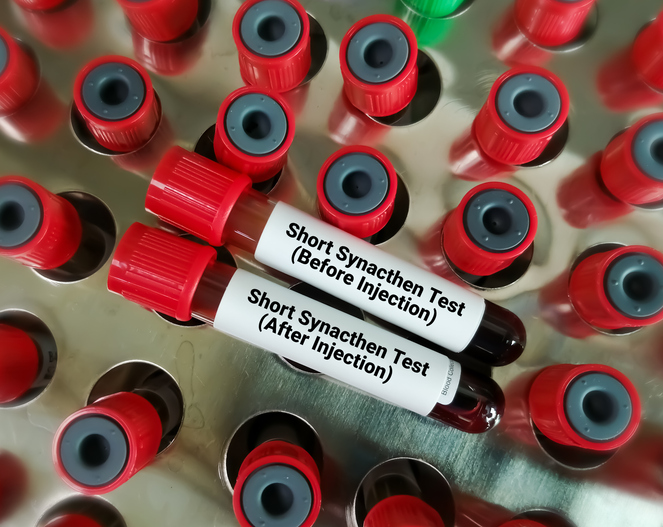
Test Synacthène
Un test de synacthène vérifie la fonction des glandes surrénales. Il peut aider à déterminer si les glandes surrénales produisent suffisamment d'hormones stéroïdes (cortisol). Remarque : les informations ci-dessous sont uniquement une indication générale. Les modalités et la façon dont les tests sont effectués peuvent varier d'un hôpital à l'autre. Suivez toujours les instructions données par votre médecin ou votre hôpital local.
par Dr Philippa Vincent, MRCGP

Tests et investigations
Tests de la fonction thyroïdienne
Les tests de fonction thyroïdienne sont des analyses de sang qui aident à vérifier le fonctionnement de votre glande thyroïde. Ils sont principalement utilisés pour détecter une glande thyroïde sous-active (hypothyroïdie) et une glande thyroïde hyperactive (hyperthyroïdie). Beaucoup d'informations de base sur la glande thyroïde peuvent être trouvées dans la brochure séparée intitulée Problèmes de Thyroïde (incluant également les Glandes Parathyroïdes). Cette brochure traitera uniquement du test sanguin qui mesure le fonctionnement de votre thyroïde, et non des maladies spécifiques, telles que la maladie de Basedow, qui affectent la thyroïde. Remarque : les informations ci-dessous ne sont qu'un guide général. Les dispositions et la manière dont les tests sont effectués peuvent varier entre différents hôpitaux. Quelqu'un peut passer son test de fonction thyroïdienne dans un hôpital et cela pourrait donner des résultats légèrement différents de ceux mesurés dans un autre hôpital. Il est important d'interpréter les résultats de votre test de fonction thyroïdienne avec le médecin qui les a demandés - donc si le test a été demandé par votre médecin généraliste, il vous donnera le résultat. S'il a été demandé par un consultant hospitalier, vous devez obtenir le résultat de leur part et votre médecin généraliste ne l'aura pas.
par Dr Toni Hazell, FRCGP
Questions fréquemment posées
Why is a full blood count test done?
A full blood count (FBC) test is a very common blood test used to check for various conditions that affect your blood cells. It helps to identify potential issues such as having too few red blood cells (anaemia), too many red cells (polycythaemia), too few or too many white blood cells (leukopenia or leucocytosis), or problems with platelets (thrombocytopenia or thrombocythaemia). It's a broad screening test that can indicate a need for further investigation.
Can infections affect my full blood count results?
Yes, various infections can cause an increase in your white blood cells, which would be detected by a full blood count test. This is because white blood cells are a key part of your immune system and their numbers often rise when your body is fighting off an infection.
What is the difference between a full blood count and a blood film?
A full blood count (FBC) is an automated test that counts different types of blood cells and measures their characteristics. A blood film, on the other hand, involves taking a thin smear of your blood and examining it directly under a microscope. This allows a healthcare professional to visually check for abnormal cell shapes that a machine might miss, or to identify disease-causing organisms like the malaria parasite.
What does it mean if my full blood count result is outside the normal range?
If a full blood count result is outside the normal range, it indicates an abnormality in your red blood cells, white blood cells, or platelets. This could point to various conditions, such as anaemia, polycythaemia, infections, certain allergies, bleeding disorders, or, in some cases, more serious conditions like leukaemia or other cancers. Further tests are usually needed to determine the exact cause.
Why would further tests be needed after an abnormal full blood count?
If your full blood count shows an abnormality, further tests are often needed because many different conditions can cause similar changes in blood cell counts. For example, if anaemia is detected, additional tests might check iron levels or vitamins like B12 and folic acid to pinpoint the underlying reason, rather than just treating the symptom. Sometimes, a bone marrow biopsy may be necessary to understand why blood cells are abnormal.
Lectures complémentaires et références
- Kaferle J, Strzoda CE; Evaluation of macrocytosis. Am Fam Physician. 2009 Feb 1;79(3):203-8.
- Tests de Laboratoire en Ligne® - Royaume-Uni
- Warner MJ, Kamran MT; Iron Deficiency Anemia.
À propos de l'auteurVoir la biographie complète

Dr Rachel Hudson, MRCGP
Médecin généraliste et auteur médical
MBChB, MRCGP (2008), BSc (Medical Science), DFSRH, DRCOG, DCH
Dr Rachel Hudson est médecin généraliste du NHS travaillant dans le nord-ouest de l'Angleterre.
À propos du critiqueVoir la biographie complète

Dr Caroline Wiggins, MRCGP
Médecin généraliste, Auteur médical
MBBS Honours (with Distinction), MRCGP (2016), MSc.SEM (with Distinction), BSc (Hons)
Dr Caroline Wiggins est médecin généraliste remplaçante actuellement dans le sud-ouest de l'Angleterre.
Historique de l'article
Les informations sur cette page sont rédigées et examinées par des cliniciens qualifiés.
Article également disponible en Anglais, Allemand, Espagnol, Français, Italien, Portugais, Hindi, Hébreu, Arabe, and Suédois.
Next review due: 29 Oct 2027
30 oct. 2024 | Dernière version

Demandez, partagez, connectez-vous.
Parcourez les discussions, posez des questions et partagez vos expériences sur des centaines de sujets de santé.

Vous ne vous sentez pas bien ?
Évaluez vos symptômes en ligne gratuitement
Inscrivez-vous à la newsletter Patient
Votre dose hebdomadaire de conseils de santé clairs et fiables - rédigés pour vous aider à vous sentir informé, confiant et maître de la situation.
En vous abonnant, vous acceptez notre Politique de confidentialité. Vous pouvez vous désabonner à tout moment. Nous ne vendons jamais vos données.