Laparoscopie et chirurgie laparoscopique
Revu par des pairs par Dr Rachel Hudson, MRCGPDernière mise à jour par Dr Caroline Wiggins, MRCGP Dernière mise à jour 7 août 2023
Respecte les directives éditoriales
- TéléchargerTélécharger
- Partager
- Language
- Discussion
- Version audio
- Ajouter aux sources préférées sur Google
La laparoscopie est une procédure chirurgicale qui utilise un instrument chirurgical spécial appelé laparoscope pour examiner l'intérieur du corps ou effectuer certaines opérations.
En un coup d'œil
A laparoscopy uses a thin telescope with a light to look inside your tummy.
Laparoscopic surgery, also called keyhole surgery, uses small cuts to perform operations.
It can be used to diagnose conditions or perform procedures like removing a gallbladder.
Compared to traditional surgery, it usually causes less pain and has a quicker recovery.
You will typically be asleep under general anaesthesia for the procedure.
Recovery time varies depending on the procedure and you may have shoulder tip pain.
Seek medical advice if you experience concerning symptoms after the surgery.
When compared with traditional surgery, laparoscopic surgery usually has:
Less pain following the procedure.
Lower risk of complications.
A shorter hospital stay and a quicker recovery.
A much smaller scar.
Remarque: les informations ci-dessous ne sont qu'un guide général. Les dispositions et la manière dont les tests sont effectués peuvent varier d'un hôpital à l'autre. Suivez toujours les instructions données par votre médecin ou votre hôpital local.
What is a laparoscopy?
Laparoscopy is a procedure to look inside your tummy (abdomen) by using a laparoscope. A laparoscope is like a thin telescope with a light source. It is used to light up and magnify the structures inside the abdomen. A laparoscope is passed into the abdomen through a small cut in the skin.
What is laparoscopic surgery?
As well as simply looking inside (laparoscopy), a doctor can use fine instruments to operate (laparoscopic surgery). These are passed into the tummy (abdomen) through another small cut in the skin. These instruments are used to cut or trim tissues, perform biopsies, grasp organs, etc, inside the abdomen. This laparoscopic surgery is sometimes called 'keyhole surgery' or 'minimally invasive surgery'.
Laparoscopic surgery
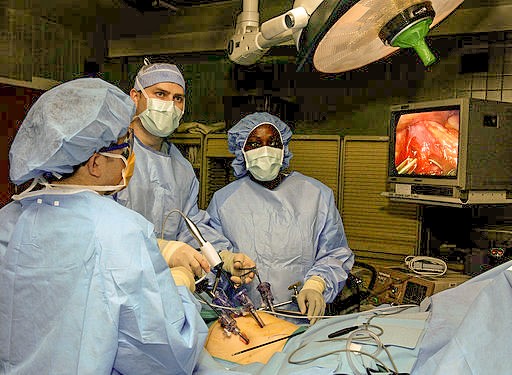
© By Samuel Bendet, US Air Force, via Wikimedia Commons
Why is laparoscopic surgery done?
A laparoscopy may be done to find the cause of symptoms such as abdominal pain, pelvic pain or swelling of the abdomen or pelvic region. A laparoscopy enables a doctor to see clearly inside your abdomen. This enables certain conditions to be diagnosed eg, endometriosis.
Laparoscopic surgery can be used for various procedures which include:
Removal of the gallbladder. This is sometimes called a laparoscopic cholecystectomy, or 'lap choly', for short. It is now the most common way for a gallbladder to be removed, usually for les calculs biliaires which are causing pain.
Removal of the appendix.
Removal of areas of endometriosis.
Removal of parts of the intestines.
Treating grossesse extra-utérine.
Taking a biopsy of tissues inside the abdomen.
How is laparoscopy done?
Laparoscopy and laparoscopic surgery are usually done whilst you are asleep under general anaesthesia. The skin over the tummy is cleaned.
In a laparoscopy, the surgeon makes a small cut about 0.5-2 cm long near to the belly button. Some gas is injected through the cut to inflate the abdomen slightly. This makes it easier to see the internal organs with the laparoscope which is gently pushed through the incision into the abdominal cavity. The operator then looks down the laparoscope, or looks at pictures on a TV monitor connected to the laparoscope.
If you have a surgical procedure, one or more separate small incisions may be made in the abdominal skin. These allow thin instruments to be pushed into the abdominal cavity. The surgeon can see the ends of these instruments with the laparoscope and so can perform procedures.
A more recent technique called single-port laparoscopy involves operating through the same incision through which the laparoscope was passed and does not require additional cuts to the abdomen.
When the surgeon has finished, the laparoscope and other instruments are removed. The incisions are stitched and dressings are applied. The dressings will cover the incisions and should be kept on until the incisions have healed.
What preparation might I need?
As you will usually be under a general anaesthetic, your hospital should give you instructions about not eating or drinking before the operation.
Depending on the reason for your operation or what medication you normally take, there may be other, more specific instructions. Your doctor will give you this information if necessary.
Laparoscopy recovery
The length of time to recover can vary. It depends on why the procedure was done and what operations were performed. A simple investigation to 'look around' will leave you a little uncomfortable for a few days.
You may need a day or up to a week to feel completely well after the general anaesthetic. You may take longer to feel well if you were under anaesthetic for a long time. Before you leave the hospital you will be given advice about recovering after anaesthesia. This should include information about driving.
You are able to eat and drink as normal after laparoscopy. You may have some pain in your shoulder tip. This is caused by the gas that was pumped inside. It can irritate your diaphragm which has the same nerve supply as the shoulder tip and makes it feel as though your shoulder hurts. This should soon wear off.
What are other possible complications?
There may be some minor bleeding or bruising around the skin incisions. In most cases there are no complications. Before the operation your surgeon will discuss the possible complications with you so you understand the risks involved.
Possible complications of laparoscopy include:
Accidental damage to structures inside your tummy (abdomen), such as the intestines or blood vessels. This is rare but if it occurs, an emergency traditional (open) operation may be needed.
As with any operation, there is a small risk of complications of anaesthesia.
Occasionally the incisions become infected which may require a course of antibiotiques.
If you have laparoscopic surgery (rather than only a laparoscopy), the risk of complications may increase depending on what operation is performed. Before leaving hospital you will be given information about what symptoms should prompt you to seek medical advice (in case they are a complication of the surgery) and who to contact.
The key advantages of laparoscopic surgery are the quicker recovery times and reduced need for pain relief, compared to traditional (open) surgery.
When compared with traditional surgery, laparoscopic surgery usually has:
Less pain following the procedure.
Lower risk of complications.
A shorter hospital stay and a quicker recovery.
A much smaller scar.
Remarque: les informations ci-dessous ne sont qu'un guide général. Les dispositions et la manière dont les tests sont effectués peuvent varier d'un hôpital à l'autre. Suivez toujours les instructions données par votre médecin ou votre hôpital local.
Sélections des patients pour Chirurgie générale et procédures

Chirurgie et procédures
Drains chirurgicaux
Un drain chirurgical est un petit tube en plastique qui est parfois utilisé après une opération. Il est placé à l'intérieur de vous pendant la chirurgie par le médecin et restera à l'extérieur de votre corps jusqu'à ce qu'il soit retiré, généralement quelques jours plus tard. Il est relié à un petit sac en plastique qui recueille tout liquide ou air qui s'est écoulé de l'endroit où vous avez été opéré. Toutes les opérations ne nécessitent pas un drain : votre chirurgien vous conseillera si cela est nécessaire.
par Dr Rachel Hudson, MRCGP

Chirurgie et procédures
Stérilisation féminine
La stérilisation féminine est une méthode de contraception. C'est une procédure réalisée pour empêcher les ovules d'atteindre les spermatozoïdes.
par Dr Toni Hazell, FRCGP
Questions fréquemment posées
What is the difference between laparoscopy and laparoscopic surgery?
Laparoscopy is a procedure where a thin telescope with a light source (laparoscope) is inserted into the abdomen through a small cut to simply look inside and diagnose conditions. Laparoscopic surgery, also known as 'keyhole surgery' or 'minimally invasive surgery,' uses additional fine instruments passed through other small cuts to perform operations like cutting tissues, taking biopsies, or removing organs.
What is 'single-port laparoscopy'?
Single-port laparoscopy is a newer technique where both the laparoscope and the surgical instruments are inserted through the same incision. This means that no additional cuts to the abdomen are required beyond the initial one.
How long does a laparoscopy procedure take?
The article states that recovery can vary depending on the procedure, but it does not specify how long the actual procedure itself takes.
Lectures complémentaires et références
- Rao PP, Rao PP, Bhagwat S; Single-incision laparoscopic surgery - current status and controversies. J Minim Access Surg. 2011 Jan;7(1):6-16. doi: 10.4103/0972-9941.72360.
- Rockall TA, Demartines N; Laparoscopy in the era of enhanced recovery. Best Pract Res Clin Gastroenterol. 2014 Feb;28(1):133-42. doi: 10.1016/j.bpg.2013.11.001. Epub 2013 Dec 1.
À propos de l'auteurVoir la biographie complète

Dr Caroline Wiggins, MRCGP
Médecin généraliste, Auteur médical
MBBS Honours (with Distinction), MRCGP (2016), MSc.SEM (with Distinction), BSc (Hons)
Dr Caroline Wiggins est médecin généraliste remplaçante actuellement dans le sud-ouest de l'Angleterre.
À propos du critiqueVoir la biographie complète

Dr Rachel Hudson, MRCGP
Médecin généraliste et auteur médical
MBChB, MRCGP (2008), BSc (Medical Science), DFSRH, DRCOG, DCH
Dr Rachel Hudson est médecin généraliste du NHS travaillant dans le nord-ouest de l'Angleterre.
Historique de l'article
Les informations sur cette page sont rédigées et examinées par des cliniciens qualifiés.
Article également disponible en Anglais, Allemand, Espagnol, Français, Italien, Portugais, Hindi, Hébreu, Arabe, and Suédois.
Prochaine révision prévue : 5 août 2028
7 août 2023 | Dernière version

Demandez, partagez, connectez-vous.
Parcourez les discussions, posez des questions et partagez vos expériences sur des centaines de sujets de santé.

Vous ne vous sentez pas bien ?
Évaluez vos symptômes en ligne gratuitement
Inscrivez-vous à la newsletter Patient
Votre dose hebdomadaire de conseils de santé clairs et fiables - rédigés pour vous aider à vous sentir informé, confiant et maître de la situation.
En vous abonnant, vous acceptez notre Politique de confidentialité. Vous pouvez vous désabonner à tout moment. Nous ne vendons jamais vos données.
Plus en chirurgie et procédures
- Arthroscopie et chirurgie arthroscopique
- Biopsie
- Botox
- Augmentation mammaire
- Colposcopie et traitements cervicaux
- Angioplastie coronarienne
- Biopsie de l'endomètre
- CPRE
- Stérilisation féminine
- Hystéroscopie
- Biopsie rénale
- Chirurgie oculaire au laser
- Épilation au laser
- Anesthésie locale pour votre opération des yeux
- Céphalée post-ponction durale
- Infection pulmonaire post-opératoire
- Embolie pulmonaire
- Sigmoïdoscopie
- Abdominoplastie
- Chirurgie thoracoscopique assistée par vidéo