Appendicite
Revu par Dr Hayley Willacy, FRCGP Dernière mise à jour par Dr Colin Tidy, MRCGPDernière mise à jour 10 fév 2023
Respecte les directives éditoriales
- TéléchargerTélécharger
- Partager
- Language
- Discussion
- Ask Patient
- Version audio
- Ajouter aux sources préférées sur Google
Dans cette série :Symptômes de l'appendicite
L'appendicite est une inflammation de l'appendice, une petite poche sur la paroi intestinale reliée au gros intestin. C'est une urgence médicale car, si elle n'est pas traitée, l'appendice peut éclater ou se perforer.
En un coup d'œil
L'appendice est un petit tube fermé qui se prolonge à partir du gros intestin, généralement dans le bas-ventre droit.
Les symptômes courants incluent une douleur qui se déplace vers le bas du ventre à droite, des nausées et une température élevée.
L'appendicite est courante et peut toucher n'importe qui, bien qu'elle soit plus fréquente entre 10 et 30 ans.
Si une appendicite est suspectée, un traitement précoce est nécessaire pour éviter qu'elle n'éclate, ce qui est très grave.
Le traitement implique généralement une opération pour retirer l'appendice, souvent par chirurgie laparoscopique.
What is the appendix?
The appendix is a small, blind-ended tube that comes off the caecum, which is the very first part of the large bowel (large intestine). In the vast majority of people the appendix is located in the bottom, right-hand quarter of the tummy.
The appendix is normally about 5-10 cm long, but quite narrow. It has muscular walls, like the intestine, and there is some immune tissue in those walls. Scientists used to believe that the appendix had no useful role in modern humans. They thought that our ancestors had needed the appendix only to digest tough food like tree bark. However, more recently it has been suggested that the appendix may contain a reservoir of helpful digestive bacteria and that, in early childhood, the immune tissues in the appendix are important in the development of the immune system. Despite all this it seems that removing the appendix leaves no ill effects.
What causes appendicitis?
Appendicitis is thought most often to be caused by blockage of the appendix 'tube' either by something stuck on the inside, or by swelling of the appendix wall. Blockage may be by trapped seeds, indigestible food remnants or hard stools (faeces) that get stuck in the appendix, or by lymph glands in the appendix wall which have swollen in response to signs of infection elsewhere in the body.
If the appendix is inflamed and swollen, and cannot empty, then germs (bacteria) may thrive and cause inflammation in the wall and behind the blockage in the 'dead end' of the appendix.
Can stress cause appendicitis?
There is no evidence to suggest that stress can cause appendicitis. However it has been suggested that long-term stress can affect the normal function of the bowel and also reduce defences to infection (immunity), and so be a factor in causing appendicitis.
How common is appendicitis?
Appendicitis is common and can affect anyone of any age. Teenagers and young adults are the most commonly affected.
About 1 in every 7 people in the UK have appendicitis at some time in their lives. Appendicitis can develop at any age but it is most common between ages 10 and 30. It is very rare under the age of 2 years.
It is slightly more common in women than in men and is much more common in western countries. This is thought to be partly due to the western diet which is often low in fibre. It is rare in rural parts of the developing world.
Appendicitis symptoms
Diagram of the bowel showing an inflamed appendix
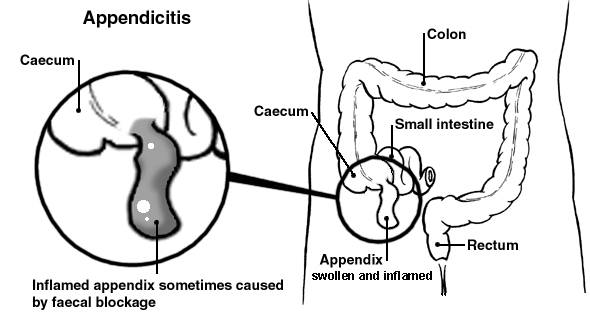
The common symptoms of appendicitis include:
Pain, often starting as a dull ache around the tummy button, getting worse and more constant over several hours and moving to the lower right tummy.
Perte d'appétit.
Température élevée (fièvre).
Ballonnements.
Appendicitis is painful, although the severity of the pain can vary. The inflamed appendix becomes infected with germs (bacteria) from the intestine. Once it becomes inflamed, the appendix gradually swells and fills with pus.
Eventually, if not treated, the swollen appendix becomes weakened, and can burst (perforate). A burst appendix is very serious, as the contents of the intestine can then leak into the abdominal cavity (tummy). Here they may cause a serious infection of the membrane that lines the abdomen (a condition called peritonitis), or a collection of pus (an abcès) in the abdomen. So, if appendicitis is suspected, early treatment is needed before it bursts.
The signs of appendicitis in children often differ from those seen in adults, to learn more about the specific symptoms in children, read our article Appendicitis in children: what are the signs?
How is appendicitis diagnosed?
A doctor may diagnose appendicitis quite easily if you have the typical appendicitis symptoms. However, not everyone has typical symptoms of appendicitis.
There is no easy, foolproof test that can confirm appendicitis. A surgeon often has to make the final judgement about whether to operate, based on their assessment of you. It therefore depends on whether your symptoms, and the findings when you are examined, suggest that appendicitis is the probable diagnosis.
Examen abdominal
Your tummy (abdomen) will be examined to assess where you are tender. This includes pushing into the tender areas to see if your muscles can relax, and where you are most tender. Blood tests may also help when diagnosing appendicitis.
Test urinaire
Urine testing is done to rule out a urinary tract infection, and women are usually offered pregnancy tests.
Imaging tests
Imaging tests are often used to help decide on the diagnosis, if it is not clear. For example, an échographie ou un tomodensitométrie (TDM) may help to clarify the cause of the symptoms. If the diagnosis seems obvious or there is concern that your appendix has, or is about to, burst (perforate), you are likely to go straight to surgery. This will avoid the delay caused by taking you for a scan first.
Suivi
Sometimes a surgeon advises to wait and see for a few hours or so while you are being monitored in hospital. This allows some time to see if your symptoms progress to a more definite diagnosis, or even if they change or go away. Antibiotic medicine will usually be given in this time.
Qu'est-ce que cela pourrait être d'autre ?
Some people develop abdominal pain that is similar to appendicitis symptoms but which is caused by other conditions. For example:
Infection des voies urinaires (cystite).
Passing a kidney stone (ureteric colic).
Inflammation of the large bowel (large intestine) - a condition called colite.
Inflammation of the first part of the large bowel (the caecum) itself - sometimes seen in maladie de Crohn.
In women the right ovary lies near to the appendix, so pain in this area could come from either organ. A leaking ovarian cyst, or the normal pain of ovulation (sometimes called Mittelschmerz) can mimic appendicitis.
Grossesse extra-utérine (when a pregnancy starts to develop outside the womb, usually in one of the Fallopian tubes) can mimic appendicitis.
In children swollen glands in the tummy around the bowel (mesenteric adenitis), often associated with viral infections can mimic appendicitis.
Occasionally pain from les calculs biliaires or from inflammation of the gallbladder (cholecystitis) can mimic appendicitis.
Some people have surgery only to find that the appendix is normal and not inflamed.
Appendicitis treatment
The normal, established way to treat appendicitis is an operation to remove the inflamed appendix. The aim is to do this before it bursts (perforates), as a perforated appendix is a very serious condition.
Surgery to remove the appendix
In a surgical removal of the appendix, the inflamed appendix is found and cut off at the first part of the large bowel (large intestine) - the caecum. The hole this leaves in the caecum is stitched up to stop contents from the gut leaking out. Antibiotic medicine is given before surgery to reduce the risk of infection developing at the site of the operation.
Sometimes antibiotics are used to delay surgery until the appendicitis has calmed a little. This may make the surgery safer and reduces the risk that the appendix will burst at operation.
Removal of the appendix is one of the most commonly performed operations in the UK. This is usually a straightforward and successful operation with a short recovery time. Surgery is commonly done by a keyhole operation, as the recovery is quicker compared to having an open operation. The keyhole operation is performed through three tiny cuts, the largest of which is only around 1.5 cm in size.
Sometimes keyhole surgery isn't recommended and open surgery on the tummy (abdomen) area is performed instead. This is likely to be needed if the appendix has already burst and caused a severe abdominal infection (peritonitis) or formed a lump called an appendix mass. It is also more likely if:
You have had other abdominal surgery and have scarring.
During the keyhole surgery a blood vessel is damaged by the instruments and needs repair.
Your appendix is not situated in the usual place.
Vous êtes enceinte.
There are usually no long-term complications with appendicitis after the operation. As with any operation, there is a small risk of complications from the operation itself (including bleeding and infection) and from the anaesthetic. You will usually be able to go home within 24 hours of uncomplicated surgery. You can expect some pain, and often constipation, but these should start to improve within a few days. You should be able to resume your normal activities a couple of weeks after keyhole surgery.
However, if you don't have an operation, an inflamed appendix is likely to burst and cause peritonitis. This can be life-threatening. Untreated burst appendix with peritonitis has caused many deaths in history. The famous magician, Harry Houdini, used to invite members of the audience to punch him in the stomach to demonstrate his strong abdominal muscles. Unfortunately, someone did this when he was unprepared. Even more unhappily, he had appendicitis at the time. His appendix burst and this resulted in his death some hours later.
Treatment of an appendix mass
If an appendix mass has formed then surgeons sometimes suggest postponing surgery whilst they drain the mass and treat with antibiotics, before doing a full appendicectomy a few weeks later. This allows patients to have surgery when they are less unwell, and the surgery is less difficult, as the inflammation has started to settle.
Antibiotics for appendicitis
Some studies have suggested that in some cases of appendicitis, it can be treated with antibiotics alone, without the need for surgery. This removes the risks associated with surgery. However, larger studies have not supported the use of antibiotics instead of surgery and so antibiotic treatment is not recommended for routine practice.
Dr Mary Lowth est l'auteur ou l'auteur original de ce dépliant.
Sélections des patients pour Douleur abdominale

Santé digestive
Ulcère de l'estomac
Les ulcères d'estomac (également appelés ulcères gastriques) sont des déchirures dans la muqueuse de l'estomac qui se développent en raison de dommages. Ils peuvent provoquer une sensation de brûlure ou de grignotement dans le haut et le milieu de l'abdomen. Les traitements incluent des médicaments anti-acides et l'évitement des aliments déclencheurs.
par Dr Philippa Vincent, MRCGP

Santé digestive
Douleur dans le quadrant inférieur droit
La douleur du quadrant inférieur droit (QID) est une douleur abdominale qui se situe principalement dans la moitié inférieure du côté droit. Il existe de nombreuses causes de douleur au QID.
par Dr Hayley Willacy, FRCGP
Questions fréquemment posées
Quel est le rôle de l'appendice dans le corps ?
L'appendice est un petit organe en forme de tube attaché au gros intestin. Bien qu'on ait autrefois pensé qu'il n'avait aucun rôle utile, des suggestions récentes indiquent qu'il pourrait stocker des bactéries digestives bénéfiques et que ses tissus immunitaires sont importants pour le développement du système immunitaire dans la petite enfance. Malgré ces rôles potentiels, son ablation ne cause aucun effet indésirable connu.
Comment commence l'appendicite ?
L'appendicite commence le plus souvent lorsque l'appendice devient obstrué. Cette obstruction peut être causée par diverses choses, telles que des graines piégées, des particules alimentaires non digérées ou des selles durcies. Le gonflement des glandes lymphatiques dans la paroi de l'appendice, souvent en réponse à une infection ailleurs dans le corps, peut également entraîner une obstruction. Une fois obstruées, les bactéries peuvent proliférer à l'intérieur, entraînant une inflammation et un gonflement.
Puis-je prévenir l'appendicite ?
L'article suggère que l'appendicite est plus courante dans les pays occidentaux, en partie à cause d'un régime souvent pauvre en fibres. Bien qu'il n'offre pas de méthodes de prévention explicites, maintenir un régime riche en fibres pourrait être un facteur à considérer compte tenu de cette information.
Existe-t-il de nouveaux traitements pour l'appendicite en dehors de la chirurgie ?
Le traitement standard de l'appendicite est l'ablation chirurgicale. Bien que certaines études aient exploré le traitement de certains cas avec des antibiotiques seuls pour éviter les risques chirurgicaux, des études plus larges n'ont pas soutenu cette approche pour la pratique courante. Par conséquent, la chirurgie reste le traitement principal recommandé.
Que se passe-t-il si l'appendicite n'est pas traitée ?
Si elle n'est pas traitée, une appendice enflammée risque de se rompre (éclater ou se perforer). C'est une condition très grave car le contenu de l'intestin peut alors s'écouler dans la cavité abdominale, entraînant une infection sévère de la paroi abdominale appelée péritonite, ou la formation d'une collection de pus (un abcès). Ces complications peuvent être mortelles.
Lectures complémentaires et références
- Jaschinski T, Mosch CG, Eikermann M, et al; Laparoscopic versus open surgery for suspected appendicitis. Cochrane Database Syst Rev. 2018 Nov 28;11:CD001546. doi: 10.1002/14651858.CD001546.pub4.
- Becker P, Fichtner-Feigl S, Schilling D; Clinical Management of Appendicitis. Visc Med. 2018 Dec;34(6):453-458. doi: 10.1159/000494883. Epub 2018 Nov 24.
- Appendicite; NICE CKS, mai 2021 (accès réservé au Royaume-Uni)
- Baird DLH, Simillis C, Kontovounisios C, et al; Acute appendicitis. BMJ. 2017 Apr 19;357:j1703. doi: 10.1136/bmj.j1703.
- Herrod PJJ, Kwok AT, Lobo DN; Randomized clinical trials comparing antibiotic therapy with appendicectomy for uncomplicated acute appendicitis: meta-analysis. BJS Open. 2022 Jul 7;6(4):zrac100. doi: 10.1093/bjsopen/zrac100.
À propos de l'auteurVoir la biographie complète
Mis à jour par

Dr Colin Tidy, MRCGP
Médecin généraliste, Auteur médical
MBBS, MRCGP, MRCP (Paediatrics), DCH
Le Dr Colin Tidy est un médecin du NHS, basé dans l'Oxfordshire.
À propos du critiqueVoir la biographie complète

Dr Hayley Willacy, FRCGP
Médecin généraliste, Auteur médical
MBChB (1992), DRCOG, DFFP, MRCOG (Part 1) MRCGP (2007), DFSRH (2013), MSc - medical education (2020)
Le Dr Hayley Willacy était médecin généraliste au NHS travaillant dans le nord-ouest de l'Angleterre, qui a pris sa retraite de la pratique clinique en 2022 après 30 ans.
Historique de l'article
Article également disponible en Anglais, Allemand, Espagnol, Français, Italien, Portugais, Hindi, Hébreu, Arabe, and Suédois.
Prochaine révision prévue : 9 févr. 2028
10 fév 2023 | Dernière version
Professionnels de la santé
Looking for more in-depth clinical detail? Our Professional Reference articles are written for doctors, nurses and other healthcare professionals. They include comprehensive clinical guidance, diagnostic information and UK/European evidence summaries. If you need the clinical version, you can read the Professional Reference article on this topic.
Partagez vos pensées ou expériences avec les autres dans notre communautés de patients.
Accès simple à des traitements fiables et à des services de santé en ligne.
Common conditions
Get help with common conditions through the NHS, without a GP appointment.





Inscrivez-vous à la newsletter Patient
Votre dose hebdomadaire de conseils de santé clairs et fiables - rédigés pour vous aider à vous sentir informé, confiant et maître de la situation.
En vous abonnant, vous acceptez notre Politique de confidentialité. Vous pouvez vous désabonner à tout moment. Nous ne vendons jamais vos données.