Stérilisation féminine
Revu par Dr Hayley Willacy, FRCGP Dernière mise à jour par Dr Toni Hazell, FRCGPDernière mise à jour 19 mai 2023
Respecte les directives éditoriales
- TéléchargerTélécharger
- Partager
- Language
- Discussion
- Version audio
- Ajouter aux sources préférées sur Google
Dans cette série :StérilisationVasectomie
La stérilisation féminine est une méthode de contraception. C'est une procédure réalisée pour empêcher les ovules d'atteindre les spermatozoïdes.
En un coup d'œil
Female sterilisation is a permanent contraceptive method.
It involves cutting or blocking the Fallopian tubes to prevent eggs from reaching sperm.
The procedure usually takes about 20 minutes and is often done as a day-case.
It is 99.5% effective, meaning 1 in 200 women may become pregnant within a year.
Recovery from a keyhole procedure typically takes a few days.
Sterilisation does not protect against sexually transmitted infections.
If you have pain or unexplained bleeding after sterilisation, see a doctor quickly.

How is female sterilisation done?
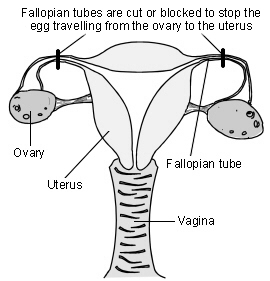
The tubes between the ovary and the womb (the Fallopian tubes) are cut or blocked with rings or clips. This stops the eggs which are released by the ovary from reaching the sperm.
Organes reproducteurs féminins
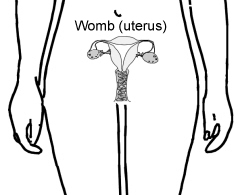
Diagram showing how female sterilisation is performed
The operation is usually done under general anaesthetic but can be done with a local or regional anaesthetic while you are awake. For most women the operation is done with the help of a special telescope called a laparoscope.
The laparoscope is inserted through a very small cut in your tummy (abdomen). It allows the surgeon to see what they are doing. Another small cut is then made to insert an instrument to block the tubes. A number of ways are used to do this. Most often clips or rings are applied to your tubes. The clips or rings provide a block in the tubes and prevent the egg from meeting sperm.
A larger cut may have to be made, and a more traditional operation done, in some women. This is more likely if laparoscopie is too risky, such as if you have had multiple previous operations, or if you are overweight. This is called a mini-laparotomy.
If blocking the Fallopian tubes doesn't work then either part or all of the tubes can be removed. This is called a salpingectomy.
Sterilisation can be performed at the same time as a césarienne, when a segment of the tube is removed. This is done after the delivery of the baby. It has a higher failure rate than a sterilisation which is not done at the time of caesarean delivery.
How long does the procedure take?
The procedure itself usually takes about 20 minutes, and should be done as a day-case, so you arrive at hospital early in the morning and go home the same day (unless there are unexpected complications).
How reliable is female sterilisation?
The failure rate of female sterilisation is 0.5%, so 1 in 200 women will get pregnant within one year As a comparison, when no contraception is used, more than 800 out of 1,000 sexually active women will become pregnant within one year. This failure rate is much higher than for some long-acting reversible contraceptive (LARC) methods (for example only 1 woman in 2000 will get pregnant per year on the implant) and so a LARC should always be offered to a woman who is considering sterilisation.
After sterilisation, women can become pregnant if the tubes come back together again after being cut. If clips were used to block the tubes, the clips can occasionally work their way off - even when they have been put on correctly.
Advantages of female sterilisation
Do you still have periods after being sterilised?
It is permanent and you (and your partner) don't have to think about contraception again. There are no hormones involved, so you do not have the side-effects of many other types of contraception.
Disadvantages of female sterilisation
Sterilisation is permanent and very difficult to reverse. Some women may regret having the operation in future years, particularly if their circumstances change. Periods may become heavier after sterilisation - sometimes this is because you have stopped using another method, such as the pill, which lightens your periods, but it can also happen if you have not moved from another method.
In the rare event that the procedure fails and you become pregnant, you are more likely to have an grossesse extra-utérine. This occurs when the pregnancy develops outside of the womb, usually in the Fallopian tube. You would need emergency treatment if this were to happen. If you think you are pregnant after a sterilisation, or have unexplained bleeding or pain in your tummy (abdomen), then see a doctor quickly.
Laparoscopic sterilisation is also not as easy to do or as effective as male sterilisation (vasectomy). There is a small risk from the insertion of the laparoscope which has to be done 'blind' (ie without any image guidance). This means the surgeon cannot see exactly where they are putting the instrument in the tummy to gain access to the tubes.
It may at times damage organs like bowel or a blood vessel inside the abdomen. This sounds worrying. However, the surgeon takes many precautions to make the procedure safe and to avoid causing damage to any other organ and, in most cases, this does not happen.
Sterilisation doesn't protect against sexually transmitted infection (STIs) so you may need to use condoms if you think you may be at risk of STI.
As with any operation there is a risk of a wound infection and the slight risk from a general anaesthetic. There may be some tummy discomfort or bloating, or mild discomfort or pain at the site of the cut.
How soon is female sterilisation effective?
For laparoscopic sterilisation it depends on when you have it done in your menstrual cycle. If it is done whilst you have your period, you will not have produced an egg yet. In this case the procedure is effective immediately.
At any other time in your cycle, you will usually be advised to continue your previous method of contraception until your next period.
(The procedure is only done after checking you are not pregnant. That is, a pregnancy test would be done. If you have had sex without using contraception in the previous three weeks it is not possible to be sure you will not be pregnant. In this case, the operation would be delayed.)
Does female sterilisation affect sex drive?
No. Sex may seem more enjoyable, as the worry of pregnancy and contraception is removed.
How long does it take to recover from female sterilisation?
It usually takes a few days to recover from a laparoscopic sterilisation and most people can return to work within five days, but should avoid heavy lifting for a week. If a mini-laparotomy (open surgery rather than keyhole) was needed then recovery will be longer, and you may need to be off work for 3-4 weeks and avoid heavy lifting for 6 weeks. It is always important to care for yourself after surgery.
Points to consider
Don't consider having the operation unless you and your partner are sure you do not want children, or further children. It is wise not to make the decision at times of crisis or change - for example, after a new baby or termination of pregnancy. Don't make the decision if there are any major problems in your relationship with your partner. It will not solve any sexual problems.
Doctors normally like to be sure that both partners are happy with the decision before doing this permanent procedure. However, it is not a legal requirement to get your partner's permission. If you have any doubts and questions, make sure you discuss these with your doctor or practice nurse.
Have you considered the alternatives? Female sterilisation is not 100% effective. Other reversible methods of contraception are often more effective, such as the système intra-utérin (SIU), contraceptive implants et contraceptive injections. Also, male sterilisation is easier and safer to do and is more effective.
Sélections des patients pour General surgery and procedures

Chirurgie et procédures
Chirurgie de la ménorragie
Les règles abondantes sont courantes. Dans la plupart des cas, aucune cause ne peut être trouvée. Dans certains cas, une cause est identifiée, comme l'endométriose ou les fibromes. Dans la plupart des cas, le traitement est efficace en utilisant des médicaments ou un système intra-utérin (SIU) pour réduire les saignements. Cependant, certaines femmes auront besoin d'une intervention chirurgicale. Les différents types de chirurgie disponibles seront discutés ici.
par Dr Colin Tidy, MRCGP

Chirurgie et procédures
Vasectomie
La vasectomie est une méthode de contraception où un homme subit une petite opération pour couper l'extrémité du canal déférent. C'est le tube qui transporte les spermatozoïdes des testicules (testicules) vers le pénis. Les spermatozoïdes sont produits dans les testicules. Une fois le canal déférent coupé, les spermatozoïdes ne peuvent plus entrer dans le sperme qui est éjaculé lors des rapports sexuels. La vasectomie est très fiable - mais pas tout à fait à 100 %. Même après une opération réussie, environ 1 homme sur 2 500 ayant subi une vasectomie redeviendra fertile à un moment donné dans le futur. Cela est dû au fait que, rarement, les deux extrémités du canal déférent coupé se rejoignent à nouveau avec le temps.
par Dr Philippa Vincent, MRCGP
Questions fréquemment posées
What is the advantage of sterilisation compared to other methods of contraception?
The main advantage of female sterilisation is that it is permanent, meaning you and your partner do not have to think about contraception again. Additionally, it involves no hormones, so you avoid the side-effects associated with many other types of hormonal contraception.
Is female sterilisation a completely safe procedure?
While surgeons take many precautions to ensure safety, there are some risks associated with female sterilisation. These include a small risk of damage to organs like the bowel or blood vessels during the insertion of the laparoscope. As with any operation, there's also a risk of wound infection and a slight risk from general anaesthesia. There might be some temporary tummy discomfort, bloating, or pain at the incision site.
Does female sterilisation offer protection against sexually transmitted infections (STIs)?
No, female sterilisation does not protect against sexually transmitted infections. If you believe you may be at risk of STIs, you will still need to use condoms.
Are there any specific situations where the decision to have a sterilisation should be delayed?
It is advised not to make the decision to have a sterilisation during times of crisis or significant life changes, such as after a new baby or a termination of pregnancy. Also, if there are major problems in your relationship, it is recommended to delay the decision. The procedure should not be undertaken with the expectation that it will resolve sexual problems.
Who typically makes the decision for female sterilisation, and is a partner's consent required?
While doctors usually prefer that both partners are in agreement with the decision due to the permanent nature of the procedure, it is not a legal requirement to obtain your partner's permission for female sterilisation.
Lectures complémentaires et références
- Trussell J; Échec contraceptif aux États-Unis, Contraception, 2011
- Stérilisation masculine et féminine; Faculté de Santé Sexuelle et Reproductive (septembre 2014)
- Contraception - sterilization; NICE CKS, mai 2021 (accès réservé au Royaume-Uni)
À propos de l'auteurVoir la biographie complète

Dr Toni Hazell, FRCGP
MBBS, BSc, FRCGP, DFSRH, Dip GU med, DRCOG, DCH (London, UK, 2000)
Le Dr Toni Hazell a obtenu son diplôme de l'École de médecine de l'hôpital St. Mary et a effectué son VTS à l'hôpital Northwick Park.
À propos du critiqueVoir la biographie complète

Dr Hayley Willacy, FRCGP
Médecin généraliste, Auteur médical
MBChB (1992), DRCOG, DFFP, MRCOG (Part 1) MRCGP (2007), DFSRH (2013), MSc - medical education (2020)
Le Dr Hayley Willacy était médecin généraliste au NHS travaillant dans le nord-ouest de l'Angleterre, qui a pris sa retraite de la pratique clinique en 2022 après 30 ans.
Historique de l'article
Les informations sur cette page sont rédigées et examinées par des cliniciens qualifiés.
Article également disponible en Anglais, Allemand, Espagnol, Français, Italien, Portugais, Hindi, Hébreu, Arabe, and Suédois.
Prochaine révision prévue : 12 mai 2028
19 mai 2023 | Dernière version

Demandez, partagez, connectez-vous.
Parcourez les discussions, posez des questions et partagez vos expériences sur des centaines de sujets de santé.

Vous ne vous sentez pas bien ?
Évaluez vos symptômes en ligne gratuitement
Inscrivez-vous à la newsletter Patient
Votre dose hebdomadaire de conseils de santé clairs et fiables - rédigés pour vous aider à vous sentir informé, confiant et maître de la situation.
En vous abonnant, vous acceptez notre Politique de confidentialité. Vous pouvez vous désabonner à tout moment. Nous ne vendons jamais vos données.
Plus en chirurgie et procédures
- Biopsie
- Biopsie et aspiration de la moelle osseuse
- Botox
- Coloscopie
- Complications postopératoires courantes
- Pontage aortocoronarien
- Thrombose veineuse profonde
- Biopsie de l'endomètre
- Soulagement de la douleur par epidurale après la chirurgie
- Lifting du visage
- Gastroscopie
- Biopsie rénale
- Transplantation rénale
- Épilation au laser
- Biopsie hépatique
- Chirurgie de la ménorragie
- Chirurgie de réduction du nez (rhinoplastie)
- Céphalée post-ponction durale
- Sigmoïdoscopie
- Abdominoplastie