Ascaris
Nematodes
Revu par Dr Hayley Willacy, FRCGP Dernière mise à jour par Dr Colin Tidy, MRCGPDernière mise à jour 13 déc. 2022
Respecte les directives éditoriales
- TéléchargerTélécharger
- Partager
- Language
- Discussion
- Version audio
- Ajouter aux sources préférées sur Google
Professionnels de la santé
Les articles de référence professionnelle sont conçus pour être utilisés par les professionnels de la santé. Ils sont rédigés par des médecins britanniques et basés sur des preuves de recherche, des directives britanniques et européennes. Vous pouvez trouver le Ascaris article plus utile, ou l'un de nos autres articles de santé.
What are roundworms (nematodes)?
Roundworms (nematodes) have elongated, bilaterally long cylindrical bodies which contain an intestinal system and a large body cavity. Parasitic nematodes vary in length from several millimetres to approximately 2 metres and have larval stages and adult worms of both sexes. Approximately 60 species of roundworms are parasites of humans.1
Some roundworm infections can be transmitted directly from person to person but, in others, the nematode eggs must mature outside the host. The parasites may spend a part of their life cycle in the soil before becoming infective to humans. Nematodes commonly parasitic on humans include (click links below for separate articles which provide more detail):
Ascaris Lumbricoides.
Roundworm ascaris lumbricoides
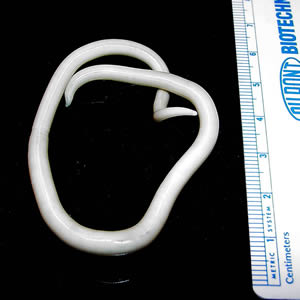
© CDC, Public Domain, via Wikimedia Commons
Filariasis, which is caused by thread-like filarial roundworms (nematodes) in the family Filarioidea (also known as 'filariae'). There are eight known filarial roundworms which use humans as the host. These are divided into three groups:
Filariose lymphatique - caused by the worms Wuchereria bancrofti, Brugia malayi, and Brugia timori.
Filariose cutanée - caused by Loa loa (le ver de l'œil africain), Mansonella streptocerca et Onchocerca volvulus.
Filariose de la cavité corporelle - caused by the worms Mansonella perstans et Mansonella ozzardi.
Trichuriasis (Whipworm).
Trichinellosis.
Angiostrongyliasis.
Strongyloidiasis.
Gnathostomiasis.
Anisakiasis.
Larva migrans cutanée is caused by skin penetration and subsequent migration of larvae of various roundworm parasites.
Helminth infections can affect the immune system in positive and negative ways. The host can benefit from suppression of collateral damage during parasite infection and from reduced allergic, autoimmune, and inflammatory reactions. However, helminth infection can also be detrimental in reducing vaccine responses, increasing susceptibility to co-infection and potentially reducing the body's protection against tumours.2
How common are roundworms (nematodes)?
The bowel of a child living in poverty in a developing country is likely to be parasitised with at least one nematode and, in many cases, multiple infection (eg, whipworms, ascaris, and hookworms), with resultant impairments in physical, intellectual, and cognitive development.1 3
The prevalence of roundworm infections throughout the world is generally increasing but varies according to levels of poverty, natural disasters and human conflicts.4
The spread of infection is also increasing in line with increased travel and mobility (eg, angiostrongyliasis and anisakiasis). However, some eradication programmes (notably for guinea worm disease) have been effective in reducing the burden of infection.
Roundworm infections are rare in the UK. Infections diagnosed in the UK are likely to have been acquired abroad. Travellers and migrant populations are most often affected. It is estimated that up to 20% of migrants from endemic countries may have helminth infections at the time of their arrival in the UK.5
Roundworm (nematode) treatment3
Control of roundworm (nematode) infections is based on drug treatment, improved sanitation and health education.
Antihelmintic drugs (eg, mebendazole, albendazole and tiabendazole) are often used for both symptomatic infections and for large-scale prevention of morbidity in children living in endemic areas. This has resulted in improvements in child health and education after deworming.
Concerns about the sustainability of periodic deworming with available drugs and the emergence of resistance mean that a great deal more needs to be done in terms of new drugs and developing effective vaccines, as well as education and alleviating poverty.
See the British National Formulary (BNF) treatment summary for helminth infections for further recommendations for treatment, and contact details for further advice on prophylaxis and treatment in the UK.6
Mises à jour exclusives pour les professionnels de la santé
Restez informé des dernières mises à jour cliniques, des perspectives professionnelles et des conseils fondés sur des preuves. La newsletter Patient Pro sélectionne des contenus essentiels pour les professionnels de santé—livrés directement dans votre boîte de réception.
En vous abonnant, vous acceptez notre Politique de confidentialité. Vous pouvez vous désabonner à tout moment. Nous ne vendons jamais vos données.
Lectures complémentaires et références
- Parasites de A à Z; Centres pour le contrôle et la prévention des maladies
- Cox FEG; History of Human Parasitology
- Stepek G, Buttle DJ, Duce IR, et al; Human gastrointestinal nematode infections: are new control methods required? Int J Exp Pathol. 2006 Oct;87(5):325-41.
- Maizels RM, McSorley HJ; Regulation of the host immune system by helminth parasites. J Allergy Clin Immunol. 2016 Sep;138(3):666-675. doi: 10.1016/j.jaci.2016.07.007. Epub 2016 Jul 29.
- Bethony J, Brooker S, Albonico M, et al; Infections par helminthes transmis par le sol : ascaridiose, trichocéphalose et ankylostomiase. Lancet. 6 mai 2006;367(9521):1521-32.
- Beyrer C, Villar JC, Suwanvanichkij V, et al; Neglected diseases, civil conflicts, and the right to health. Lancet. 2007 Aug 18;370(9587):619-27.
- Roundworm; NICE CKS, mars 2018 (accès réservé au Royaume-Uni)
- Helminth infections; British National Formulary (BNF).
À propos de l'auteurVoir la biographie complète

Dr Colin Tidy, MRCGP
Médecin généraliste, Auteur médical
MBBS, MRCGP, MRCP (Paediatrics), DCH
Le Dr Colin Tidy est un médecin du NHS, basé dans l'Oxfordshire.
À propos du critiqueVoir la biographie complète

Dr Hayley Willacy, FRCGP
Médecin généraliste, Auteur médical
MBChB (1992), DRCOG, DFFP, MRCOG (Part 1) MRCGP (2007), DFSRH (2013), MSc - medical education (2020)
Le Dr Hayley Willacy était médecin généraliste au NHS travaillant dans le nord-ouest de l'Angleterre, qui a pris sa retraite de la pratique clinique en 2022 après 30 ans.
Historique de l'article
Les informations sur cette page sont rédigées et examinées par des cliniciens qualifiés.
Article également disponible en Anglais, Allemand, Espagnol, Français, Italien, Portugais, Hindi, Hébreu, Arabe, and Suédois.
Prochaine révision prévue : 12 déc. 2027
13 déc. 2022 | Dernière version

Demandez, partagez, connectez-vous.
Parcourez les discussions, posez des questions et partagez vos expériences sur des centaines de sujets de santé.

Vous ne vous sentez pas bien ?
Évaluez vos symptômes en ligne gratuitement
Plus en gastroentérologie
- Amibiase
- Abcès anorectal
- Tumeurs carcinoïdes
- Diarrhée infantile
- Choléra et vaccination contre le choléra
- Constipation chez les adultes
- Syndrome de Dubin-Johnson
- Cholangiopancréatographie rétrograde endoscopique
- Œsophagite à éosinophiles
- Diverticule de Meckel
- Entérocolite nécrosante
- Varices œsophagiennes
- Syndrome d'Ogilvie
- Syndrome d'Osler-Weber-Rendu
- Cancer du pancréas
- Proctalgie fugace et douleur anale
- Gastro-entérite à Salmonella
- Shigellose
- Colite ulcéreuse