Tympan perforé
Revu par Dr Toni Hazell, FRCGPDernière mise à jour par Dr Surangi Mendis, MRCGPDernière mise à jour 5 août 2024
Respecte les directives éditoriales
- TéléchargerTélécharger
- Partager
- Language
- Discussion
- Ask Patient
- Version audio
- Ajouter aux sources préférées sur Google
Dans cette série :Perte auditivePerte auditive chez les personnes âgéesCérumenOtite séreuseOtoscléroseCholestéatome
Un tympan perforé (perforé) n'est généralement pas grave et guérit souvent en quelques semaines sans intervention. Des complications peuvent parfois survenir, telles qu'une perte auditive et une infection de l'oreille moyenne. Une petite intervention pour réparer le tympan peut être envisagée si la perforation ne guérit pas d'elle-même, surtout si celle-ci entraîne une perte auditive.
En un coup d'œil
A perforated eardrum is a tear or hole in the eardrum.
Les symptômes peuvent inclure des changements d'audition, des bourdonnements dans l'oreille, des douleurs auriculaires ou des écoulements de liquide.
Les causes courantes sont les infections de l'oreille moyenne, les blessures directes, les bruits soudains et forts, ou les changements de pression atmosphérique.
Most perforated eardrums heal on their own within 6-8 weeks.
See your GP if you have symptoms of a perforated eardrum.
Consultez un médecin si vous présentez des signes d'infection ou une perte auditive qui ne s'améliore pas.
Qu'est-ce qu'une tympan perforé?
A perforated eardrum is a tear or hole in the eardrum. It can affect hearing. The extent of hearing loss can vary greatly. For example, small holes may only cause minimal loss of hearing. Larger holes may affect hearing more severely. Also, if the tiny bones (ossicles) behind the eardrum are damaged in addition to the perforation, then the hearing loss would be greater than, for example, one caused by a small perforation away from the ossicles.
With a perforation, there is greater risk of developing an ear infection. This is because the eardrum normally acts as a barrier to prevent bacteria and other germs entering the middle ear.
Perforated eardrum symptoms
There may be no symptoms, or there may be symptoms associated with the cause of the perforation. The most common cause of perforation is infection.
Possible symptoms and signs of a perforated eardrum include:
Changes in how you hear, that may range from slightly muffled hearing to significant loss.
Noises in your ear - ringing or buzzing (tinnitus).
Aching or pain in your ear.
Itching in your ear.
Fluid leaking from your ear.
Vertiges.
The feeling of air coming out of the ear when the nose is blown - blowing the nose usually causes the eardrum to balloon outwards a little but if there is a hole, air will be pushed out of the ear instead.
If your perforated eardrum is caused by a middle ear infection, you may have mal d'oreille which suddenly gets worse when the drum perforates but then quickly improves or even completely resolves. This is because the perforation usually allows pus to be released from behind the eardrum, relieving pressure.
The symptoms will usually pass once your eardrum has healed and any infection has been treated.
When to see a doctor about a perforated eardrum
See your GP if you have symptoms of a perforated eardrum. They can usually confirm whether a perforation is present. If you have symptoms of infection, such as fluid leaking from the ear or a high temperature, antibiotic medications may be required. If you have hearing loss that does not improve over time, a hearing test or referral to an ear specialist may be requested.
How is a perforated eardrum diagnosed?
A doctor can usually diagnose a torn (perforated) eardrum simply by looking into the ear with a special torch called an otoscope. However, sometimes it is difficult to see the eardrum if there is a lot of inflammation, wax, or infection present in the ear.
If a hearing test is performed for any reason, for example, if there is also suspected hearing loss, a test of the middle ear known as tympanometry is also usually performed. This can confirm whether a perforation is present.
Perforated eardrum causes
Les causes incluent :
Infections de l'oreille moyenne, which can damage the eardrum. In this situation there is often discharge as pus runs out from the middle ear.
Direct injury to the ear - for example, a punch to the ear.
A sudden loud noise - for example, from a nearby explosion. The shock waves and sudden sound waves can tear (perforate) the eardrum. This is often the most severe type of perforation and it can lead to significant hearing loss and ringing in the ear (tinnitus).
Barotrauma. This occurs when there is a sudden change in air pressure, creating a sharp difference between the air pressure outside the ear and in the middle ear, for example, when descending in an aircraft or whilst scuba diving. Pain in the ear due to a tense eardrum is common during height (altitude) changes when flying. However, a perforated eardrum only happens rarely in extreme cases.
See the separate leaflet called Barotrauma to the ear for more detailsPoking foreign objects, such as a cotton bud, into the ear. This can sometimes damage the eardrum.
Grommets. These are tiny tubes that are placed through the eardrum. They allow air to pass in and out of the middle ear to stop production of the fluid that causes glue ear. When a grommet falls out, there is a tiny hole left in the eardrum. This heals quickly in most cases.
What is the eardrum and how do we hear?
Coupe transversale de l'oreille
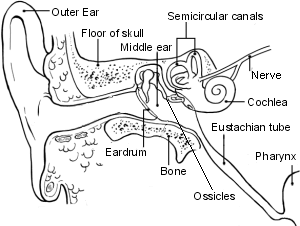
The eardrum (also called the tympanic membrane) is a thin skin-like structure in the ear. It lies between the outer (external) ear and the middle ear.
The ear is divided into three parts - the outer, middle, and inner ear. Sound waves enter the outer ear and hit the eardrum, causing the eardrum to vibrate.
Behind the eardrum are three tiny bones (ossicles). The vibrations pass from the eardrum to the bones of the middle ear. The bones then transmit the vibrations to the cochlea in the inner ear. The cochlea converts the vibrations to sound signals which are sent down a nerve to the brain, which we 'hear'.
The middle ear behind the eardrum is normally filled with air. The middle ear is connected to the back of the nose by the Eustachian tube. This allows air to move in and out of the middle ear.
Perforated eardrum treatment
Treatment is usually only required if the eardrum does not heal after a few weeks or if complications arise, such as hearing loss or ear infections.
No treatment is needed in most cases
A torn (perforated) eardrum will usually heal by itself within 6-8 weeks. It is a skin-like structure and, like skin that is cut, it will usually heal. In some cases, a doctor may prescribe antibiotic medicines, usually drops, if there is an infection or risk of infection developing in the middle ear whilst the eardrum is healing.
What happens if water passes through a perforated eardrum?
It is best to avoid water getting into the ear whilst it is healing. For example, you may be advised to put a large ball of cotton wool covered with petroleum jelly (eg, Vaseline™) into your outer ear whilst showering or washing your hair. It is best not to swim until the eardrum has healed.
Traitement médical
Occasionally, a perforated eardrum gets infected and needs antibiotiques. It is thought that some antibiotic ear drops can occasionally damage the nerve supply to the ear. Your doctor will select a type that does not have this risk.
Traitement chirurgical
A small operation may be required to treat a perforated drum that does not heal by itself. Various techniques can be used to repair the eardrum, depending on how severe the damage is. This operation may be called a myringoplasty (repair of the perforated eardrum only) or a tympanoplasty (repair of perforated eardrum and inspection of the middle ear bones, the ossicles). These operations are usually successful in fixing the perforation and improving hearing.
However, not all people with an unhealed perforation need medical treatment or surgery. Some people have a small permanent perforation with no symptoms and no significant hearing loss. Treatment is mainly considered if there is hearing loss, as this may improve if the perforation is fixed. Also, swimmers may prefer to have a perforation repaired, as getting water in the middle ear can increase the risk ear infections.
If you have a perforation that has not healed by itself, a doctor who is an ear specialist can discuss options to help decide whether treatment is necessary.
Sélections des patients pour Problèmes d'audition

Oreille, nez et gorge
Cholestéatome
Le cholestéatome est le nom donné à un amas de cellules cutanées qui forment une masse d'apparence graisseuse et blanc nacré, profondément dans l'oreille, généralement au sommet de la zone derrière le tympan.
par Dr Doug McKechnie, MRCGP
Oreille, nez et gorge
Perte auditive
Dans cet article, nous parlons des différentes causes de la perte auditive, de leurs caractéristiques et de ce que vous pouvez faire à leur sujet. La perte auditive est courante. Elle peut être très pénible, surtout si elle s'aggrave ou si elle affecte les deux oreilles. L'audition de tout le monde se détériore avec l'âge. Cependant, il existe de nombreux types de perte auditive et elles ne sont pas toutes limitées aux personnes âgées.
par Dr Surangi Mendis, MRCGP
Questions fréquemment posées
Puis-je encore entendre si mon tympan est perforé ?
Oui, vous pouvez encore entendre, mais votre audition peut être affectée. De petits trous peuvent causer une perte d'audition minimale, tandis que des trous plus grands peuvent l'affecter plus sévèrement. Si les petits os derrière le tympan sont également endommagés, la perte d'audition serait encore plus importante.
Un tympan perforé guérit-il tout seul ?
La plupart des tympans déchirés (perforés) guérissent généralement d'eux-mêmes en 6 à 8 semaines. C'est une structure semblable à la peau, et comme la peau qui est coupée, elle se répare généralement d'elle-même. Dans certains cas, un médecin peut prescrire des médicaments antibiotiques, généralement sous forme de gouttes, s'il y a une infection ou un risque d'infection pendant que le tympan guérit.
Comment dois-je me laver les cheveux si j'ai un tympan perforé ?
Il est préférable d'éviter que de l'eau ne pénètre dans votre oreille pendant qu'elle guérit. Lors de la douche ou du lavage de vos cheveux, il peut vous être conseillé de placer une grosse boule de coton recouverte de gelée de pétrole (comme la Vaseline™) dans votre oreille externe pour la protéger.
Que se passe-t-il si de l'eau pénètre dans un tympan perforé ?
Si de l'eau passe à travers un tympan perforé, il y a un risque accru de développer une infection de l'oreille. Le tympan agit normalement comme une barrière pour empêcher les bactéries et autres germes de pénétrer dans l'oreille moyenne. Par conséquent, vous devriez essayer d'empêcher l'eau de pénétrer dans votre oreille pendant qu'elle guérit.
Puis-je aller nager avec un tympan perforé ?
Il est préférable de ne pas nager jusqu'à ce que votre tympan soit guéri. L'eau dans l'oreille moyenne en cas de perforation peut augmenter le risque d'infections de l'oreille.
Quel est le rôle du tympan ?
Le tympan, également connu sous le nom de membrane tympanique, est une structure fine semblable à la peau située entre l'oreille externe et l'oreille moyenne. Lorsque les ondes sonores pénètrent dans l'oreille externe, elles frappent le tympan, le faisant vibrer. Ces vibrations sont ensuite transmises à de petits os derrière le tympan, qui les transmettent à l'oreille interne, nous permettant ainsi d'« entendre ».'
Existe-t-il des options chirurgicales si mon tympan ne guérit pas ?
Oui, une petite opération peut être nécessaire si un tympan perforé ne guérit pas de lui-même. La technique spécifique utilisée pour réparer le tympan dépend de la gravité des dommages. Cette opération peut être appelée une myringoplastie (réparation uniquement du tympan) ou une tympanoplastie (réparation du tympan et inspection des os de l'oreille moyenne). Ces chirurgies réussissent généralement à réparer la perforation et à améliorer l'audition.
Lectures complémentaires et références
- Formulaire National Britannique (BNF); Services de Preuves NICE (accès réservé au Royaume-Uni)
- Leis JA, Rutka JA, Gold WL; Aminoglycoside-induced ototoxicity. CMAJ. 2015 Jan 6;187(1):E52. doi: 10.1503/cmaj.140339. Epub 2014 Sep 15.
- Illes K, Gergo D, Keresztely Z, et al; Factors influencing successful reconstruction of tympanic membrane perforations: a systematic review and meta-analysis. Eur Arch Otorhinolaryngol. 2023 Jun;280(6):2639-2652. doi: 10.1007/s00405-023-07831-2. Epub 2023 Feb 22.
- Nicholas Jungbauer W Jr, Jeong S, Nguyen SA, et al; Comparing Myringoplasty to Type I Tympanoplasty in Tympanic Membrane Repair: A Systematic Review and Meta-analysis. Otolaryngol Head Neck Surg. 2023 May;168(5):922-934. doi: 10.1002/ohn.191. Epub 2023 Feb 8.
- Ear, Treatment summary; BNF/NICE
À propos de l'auteurVoir la biographie complète
Mis à jour par

Dr Surangi Mendis, MRCGP
Consultant et Auteur Médical
MBBS, BSc (1st), MRCGP (2014), DFSRH, PGcert otology and audiology
Surangi Mendis est consultante en médecine audiovestibulaire et neuro-otologie aux hôpitaux Royal National ENT et Eastman Dental, UCLH.
À propos du critiqueVoir la biographie complète

Dr Toni Hazell, FRCGP
MBBS, BSc, FRCGP, DFSRH, Dip GU med, DRCOG, DCH (London, UK, 2000)
Le Dr Toni Hazell a obtenu son diplôme de l'École de médecine de l'hôpital St. Mary et a effectué son VTS à l'hôpital Northwick Park.
Historique de l'article
Article également disponible en Anglais, Allemand, Espagnol, Français, Italien, Portugais, Hindi, Hébreu, Arabe, and Suédois.
Prochaine révision prévue : 4 août 2027
5 août 2024 | Dernière version
Partagez vos pensées ou expériences avec les autres dans notre communautés de patients.
Accès simple à des traitements fiables et à des services de santé en ligne.
Common conditions
Get help with common conditions through the NHS, without a GP appointment.





Inscrivez-vous à la newsletter Patient
Votre dose hebdomadaire de conseils de santé clairs et fiables - rédigés pour vous aider à vous sentir informé, confiant et maître de la situation.
En vous abonnant, vous acceptez notre Politique de confidentialité. Vous pouvez vous désabonner à tout moment. Nous ne vendons jamais vos données.