Earache
Ear pain
Peer reviewed by Dr Toni Hazell, FRCGPLast updated by Dr Philippa Vincent, MRCGPLast updated 28 Jul 2023
Meets Patient’s editorial guidelines
- DownloadDownload
- Share
- Language
- Discussion
- Audio Version
- Add to preferred sources on Google
In this series:Eustachian tube dysfunctionMiddle ear infection (otitis media)Outer ear infection (otitis externa)Fungal ear infectionBoil in the ear canalBarotrauma to the ear
Earache, or pain in the ear, is very common. It is particularly common in children. There are many causes of earache but the most common cause is infection. This often clears up on its own without any treatment. However, if it is not getting better or if there are other more serious symptoms, clinical help might be needed
The ear is involved in hearing and balance. So, problems with the ear may cause other symptoms such as loss of hearing, dizziness or a ringing in the ear.
This leaflet provides an overview of some of the more common problems related to the ears. It will direct you towards leaflets with more detailed information on the individual conditions.
At a glance
Earache is pain in the ear, which can come with reduced hearing, ringing, or fluid discharge.
Common causes include middle or outer ear infections, earwax, colds, or foreign objects.
Middle ear infection in children often follows a cold and usually improves with painkillers.
Outer ear infections are more common in adults and swimmers and are often treated with ear drops.
You should see a doctor if earache doesn't improve after three days, is very severe, or if you have a discharge.
Seek medical help if a baby under 6 months has earache, or a child under 2 years has pain in both ears.
Earache symptoms
Ear pain.
Impaired hearing and ringing in ears.
Fluid drainage from ear.
What are the causes of earache?
There are many causes of earache. Some of the more common ones are explained briefly below. For many of them you will find links to leaflets with more detailed information. Common causes of earache include:
Middle ear infection (otitis media).
Infection in the ear canal (otitis externa).
Ear wax.
Common cold.
Foreign bodies.
Trauma or injury.
Flying or driving.
Boils, spots and pimples.
Pain coming from somewhere else (referred pain).
Shingles.
Middle ear infection (otitis media)
Otitis media is an extremely common cause of earache in children. It can occur in adults, but is unusual.
It is most common in children of preschool age. It often occurs following a common cold. Children with otitis media have a painful ear (due to pressure in the middle ear) and often a high temperature (fever).
Treatment
Mostly otitis media gets better on its own and should be treated with painkillers only for at least 48 hours before seeking medical help. However, if it is not improving after a few days or if a child is under two years old, a doctor may consider antibiotic medication.
For more details about otitis media, see the separate leaflet called Ear Infection (Otitis Media).
Infection in the ear canal (otitis externa)
Otitis externa is an infection of the outer part of the ear, the ear canal. This type of infection is more common in:
Adults than in children.
People who swim.
People who have skin conditions around the ear (such as eczema).
In otitis externa, the ear may feel sore or itchy. There may be a discharge coming out of the ear. The ear may feel blocked and it may be difficult to hear as well as usual.
Treatment
The treatment for otitis externa is usually ear drops or an ear spray which will usually need to be prescribed. However, there are ear drops called acetic acid ear drops (EarCalm®) available over the counter which can treat most mild cases of otitis externa.
Acetic acid drops make the inside of the ear more acidic. This has antifungal and antibacterial effects but for more severe infections an anti-infective medicine such as antibiotic ear drops may be needed.
See the separate leaflets called Ear Infection (Otitis Externa) and Fungal Ear Infection for more detailed information.
Wax
Ears produce a waxy substance to protect the ear canals. Normally this naturally moves out of the ear on its own. However, sometimes a plug of wax can form, blocking the ear canal. This may cause hearing reduction on one or both sides and can be uncomfortable.
There may also be popping sounds or a ringing in the ear when there is wax stuck in the ear. Occasionally it can cause a dizziness feeling.
Treatment
It is important never to try to remove earwax with cotton swabs. This can push the wax further into the canal and cause a blockage.
Wax can be removed with oils or ear drops to help prevent earache. Warmed olive oil or sodium bicarbonate ear drops (available from a pharmacy) applied three times a day usually help within a few days.
If this does not remove the wax, you may need to seek further help. Ear irrigation (flushing the ear canal out with warm water) is usually no longer recommended and most surgeries no longer offer this. Microsuction is the best treatment nowadays (sucking the wax from the ear canal). This is not always available on the NHS (dependent on area) and might need to be accessed privately.
For further information, see the separate leaflet called Earwax.
A common cold
Sometimes a common cold can cause earache without there being an infection in the ear itself. This is due to the excessive mucus produced during a cold. Some of this may collect and cause pressure in the middle ear and on the eardrum, causing earache. This will normally improve on its own.
Treatment
Steam inhalation.
Decongestants (not suitable for children under 6 years; for children under 12 years only with advice from a doctor).
Simple painkillers.
For further information, see the separate leaflet called Eustachian Tube Dysfunction.
Foreign bodies
All sorts of objects can get stuck in ears. This is particularly common in children but can also occur in adults. Foreign bodies which can get into ears include beads, seeds, toys, bits of cotton bud and insects.
Putting objects in the ear may cause earache, deafness, or a discharge. It may be possible to see the foreign body in the ear canal.
Treatment
A foreign body should not be removed at home unless it is very superficial as it may be pushed deeper into the ear canal causing potential damage to the eardrum. An urgent care centre or emergency department will usually be able to remove it. Foreign bodies can usually be removed with forceps or by flushing them out with water (irrigation).
Trauma or injury
Poking things into the ear, such as cotton buds or sharp objects, can cause damage to the ear canal. This can cause soreness which usually goes away on its own. It may go on to become infected, however. So if the pain does not settle, or if a discharge develops, medical advice should be sought.
To avoid damage nothing should be poked in the ear, even if it itches or feels blocked.
The eardrum can be torn (perforated) by objects poked into the ear. This can also happen due to other injuries such as a very loud noise or a slapped or boxed ear. Other more serious head injuries can also cause damage to the eardrum.
A perforated eardrum usually causes a very sudden and severe pain. There may be some bleeding from the ear as well as hearing loss.
A perforated eardrum usually heals up on its own very well. However, if the pain or other symptoms do not settle after a couple of weeks, medical advice should be sought
See the separate leaflet called Perforated Eardrum for more information.
Flying and diving
The changes in pressure as a plane starts to descend commonly cause pain in the ear. This usually settles quickly. Similar problems can happen when scuba diving or even when going down in a lift. Chewing gum or sucking sweets can sometimes help to reduce this change in pressure. Swallowing or yawning can also help; the valsalva manoeuvre can be used - to do this, block the nostrils by pinching the nose and close the mouth and then blow gently. Babies should be encouraged to suckle during ascent/descent on a plane - this is easiest with a dummy.
For more information, and tips about how to improve this type of earache, see the separate leaflets called Ears and Flying and Barotrauma of the Ear.
Boils, spots and pimples
Boils, spots and pimples can occur on the ear just like anywhere else on your body. If they are on the outside of the ear, they will be visible but if they are in the ear canal it may not be possible to see where the pain is coming from.
Treatment
A small spot or boil will usually improve on its own with warm bathing. However, if it is very large or red or painful, it may need an antibiotic medicine, or lancing with a needle.
See the separate leaflet called Boil in the Ear Canal for more information.
Pain coming from somewhere else (referred pain)
Referred pain is pain felt in one part of the body from a problem elsewhere in the body. Sometimes a pain in the ear is nothing to do with the ear but is coming from somewhere else. Causes of referred pain in the ear include:
Problems with teeth, such as teething in children, an emerging wisdom tooth or dental abscesses.
Sore throats and tonsillitis.
Problems with the gullet (oesophagus), such as reflux or inflammation.
Problems with the salivary glands, such as stones or infections.
Problems with the jaw joint, such as arthritis.
Problems with the temporomandibular joint.
Shingles
Shingles is a condition where the virus which causes chickenpox (the varicella-zoster virus) is reactivated in just one nerve. It causes pain and a rash in the area of skin which that nerve supplies. Occasionally shingles can affect the nerve which supplies the ear. Symptoms may include:
Pain inside the ear or on the outer ear, or both.
A blistery rash on the ear.
Hearing loss.
Dizziness.
Ringing in the ear (tinnitus).
Weakness of one side of the face, so the face looks lopsided.
Treatment
If shingles around the ear is suspected, then medical attention should be sought as soon as possible. If treatment is required, it works best if it is started early. However, not all cases of shingles need treatment.
See the separate leaflet called Shingles (Herpes Zoster) for more information.
How to help an earache
An earache should be treated yourself with simple painkillers. Paracetamol or ibuprofen usually works well for ear pain. However, a person with earache should see a doctor if:
They are unwell with other symptoms such as a high temperature (fever), a rash, being sick (vomiting), confusion or drowsiness.
They are younger than 6 months.
They are younger than 2 years and have pain in both ears.
The earache has not improved after three days.
The ear is discharging.
There is something stuck in the ear.
The pain is very severe and simple painkillers are not helping.
They have other illnesses which might affect their ability to fight off an infection.
Structure and functions of the ear
Cross-section of the ear
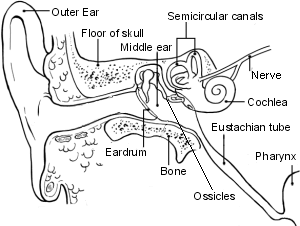
The ear is roughly divided into three parts.
The outer (external) ear includes:
The part you can see, called the pinna.
A narrow tube-like structure - the ear canal.
The eardrum which is at the end of the canal. This separates the external ear from the middle ear. The eardrum is a tightly stretched membrane, a bit like the skin of a drum.
The middle ear is an air-filled compartment. Inside it are three of the smallest bones in the body, called malleus, incus and stapes. These bones are connected to each other. The last in the group, stapes, also makes contact with the internal (inner) ear. The air space of the middle ear connects to the back of the nose by the Eustachian tube.
The inner ear is made up of two components:
The cochlea - a snail-shaped chamber filled with fluid. It is lined with special hair cells. These cells transform sound waves into electrical signals. These signals are then passed by nerves to the brain.
The vestibular system, which helps with balance. The vestibular system is made up of a network of tubes, called the semicircular canals, plus the vestibule. The vestibular system detects movement instead of sound.
The ear is important for hearing and for balance.
Other ear problems
Discharge from the ear
A number of different conditions can cause discharge from the ear. Many of these are discussed in the sections above. The more common ones include:
A burst (perforated) eardrum. This is discussed above in the trauma and injury section. Another common cause of a perforated eardrum is otitis media, also discussed above. In this condition the inflamed eardrum becomes so stretched that it bursts. The infected pus (mucus) in the middle ear then leaks out along the ear canal and can be seen. Typically, when this happens, a child has had an earache for a few days and then it suddenly becomes a lot better as the discharge (pus) becomes visible. This is because the eardrum is not being stretched so tightly anymore. An eardrum burst in this way usually heals up very well. However, antibiotics may be prescribed for the infection.
Outer ear infections (otitis externa).
A foreign body in the ear.
Rare causes include:
A cholesteatoma. This is the name for a build-up of cells causing a lump behind the eardrum. For more information, see the separate leaflet called Cholesteatoma.
Skull fractures.
Tumours.
Usually with a discharge from the ear, medical attention should be sought.
Glue ear
This is discussed in full in a separate leaflet called Glue Ear. It is a condition where the middle ear fills up with a glue-like fluid instead of air. It usually occurs in children who have had a number of middle ear infections. It causes dulled hearing. Occasionally it can cause earache.
Tinnitus
Tinnitus is a ringing or buzzing noise heard inside the ear. It is discussed in full in a separate leaflet called Tinnitus. The most common cause for this is age-related changes in the ear. This occurs commonly along with age-related hearing loss. Sometimes it is caused by another condition, such as Ménière's disease, noise damage or ear infections.
Hearing loss (deafness)
Many of the conditions discussed elsewhere in this leaflet can cause hearing loss. One of the main functions of your ear is to allow hearing. Therefore almost anything that goes wrong with it can affect hearing. Depending on the condition this can be temporary or permanent, treatable or not.
If the hearing loss comes on suddenly with earache and/or discharge, it is most likely to be due to an infection. If it comes on gradually with age, it is more likely to be due to age-related hearing loss (presbycusis). Wax is a common, easily treated cause of hearing loss. In children, glue ear is a common cause of hearing loss.
Hearing loss due to infection or wax can be treated as discussed above. In permanent hearing loss, even if it can't be treated (for example, age-related hearing loss), hearing aids can be used which an make an enormous difference to quality of life.
See the separate leaflets called Hearing Problems and Hearing Tests for more information.
Patient picks for Earache
/og.png)
Ear, nose and throat
Middle ear infection (otitis media)
Ear infection is very common in children although it can occur in people of any age. The main symptoms are earache and feeling unwell. Painkillers are the main treatment. Antibiotics are not usually helpful but are prescribed in some cases. The infection usually clears within a few days.
by Dr Philippa Vincent, MRCGP
Ear, nose and throat
Barotrauma to the ear
Barotrauma to the ear occurs when the eardrum becomes stretched and tense. It causes ear pain and dulled hearing. It is due to unequal pressures that develop either side of the eardrum. This most commonly occurs when descending to land in a plane and is also experienced by scuba divers.
by Dr Hayley Willacy, FRCGP
Frequently asked questions
Can earache indicate a problem with my teeth or throat?
Yes, sometimes pain felt in the ear can actually originate from other areas of the body, a phenomenon known as referred pain. Problems with teeth, such as teething or a dental abscess, sore throats like tonsillitis, issues with salivary glands, or even problems with the jaw joint such as arthritis, can all cause earache-like symptoms.
How can I tell if my earache is caused by something stuck in my ear?
If there's something stuck in the ear, it might cause earache, deafness, or a discharge. It may sometimes be visible if it's in the outer part of the ear canal. This is particularly common in children but can also occur in adults.
What should I do if a boil or pimple in or around my ear is causing pain?
A small spot, boil, or pimple on or in the ear will often improve on its own with warm bathing. However, if it's very large, red, or significantly painful, it might need antibiotic medication or a medical procedure to lance it with a needle.
Does it matter if an older child or adult has a middle ear infection?
Middle ear infections (otitis media) are extremely common in preschool-aged children and often follow a common cold. While they can occur in adults, they are unusual in this age group. Most cases get better on their own and should be managed with painkillers for at least 48 hours before seeking medical advice, unless symptoms worsen or persist.
When should I be concerned about discharge coming from my ear?
Discharge from the ear usually warrants medical attention. It can be a sign of a burst eardrum, outer ear infection (otitis externa), or a foreign body in the ear. Less common but serious causes include a cholesteatoma, skull fractures, or tumours. If you notice discharge, it's best to seek medical advice.
What is 'glue ear' and can it cause earache?
Glue ear is a condition where the middle ear fills with a thick, glue-like fluid instead of air, commonly seen in children who have had several middle ear infections. This typically causes dulled hearing. Occasionally, it can also lead to earache.
Further reading and references
- Earwood JS, Rogers TS, Rathjen NA; Ear Pain: Diagnosing Common and Uncommon Causes. Am Fam Physician. 2018 Jan 1;97(1):20-27.
- Otitis media with effusion; NICE CKS, June 2021 (UK access only)
- Otitis externa; NICE CKS, May 2024 (UK access only)
- Earwax; NICE CKS, May 2023 (UK access only)
About the authorView full bio

Dr Philippa Vincent, MRCGP
General Practitioner, Medical Author
MB BS, Bsc, MRCGP (2000), DCH, DFSRH, DRCOG
Dr Philippa Vincent is an NHS GP working in North London.
About the reviewerView full bio

Dr Toni Hazell, FRCGP
MBBS, BSc, FRCGP, DFSRH, Dip GU med, DRCOG, DCH (London, UK, 2000)
Dr. Toni Hazell qualified from St. Mary’s Hospital Medical School and did her VTS at Northwick Park Hospital.
Article history
The information on this page is written and peer reviewed by qualified clinicians.
Article also available in English, German, Spanish, French, Italian, Portuguese, Hindi, Hebrew, Arabic, and Swedish.
Next review due: 26 Jul 2028
28 Jul 2023 | Latest version
Join the conversation
Share your thoughts or experiences with others in our patient communities.

Ask, share, connect.
Browse discussions, ask questions, and share experiences across hundreds of health topics.

Feeling unwell?
Assess your symptoms online for free
Sign up to the Patient newsletter
Your weekly dose of clear, trustworthy health advice - written to help you feel informed, confident and in control.
By subscribing you accept our Privacy Policy. You can unsubscribe at any time. We never sell your data.
More in ear, nose and throat
- Acoustic neuroma
- Acute sinusitis
- Auditory processing disorder
- Blocked nose in babies
- Boil in the ear canal
- Cholesteatoma
- Chronic sinusitis
- Globus sensation
- Glue ear
- Hearing loss of older people
- Hearing tests
- Nosebleed
- Outer ear infection (otitis externa)
- Perforated eardrum
- Sore throat
- Stopping a nose bleed
- Throat cancer
- Tonsil stones
- Tonsillectomy
- Tonsillitis