Abcès dentaire
Revu par Dr Colin Tidy, MRCGPDernière mise à jour par Dr Toni Hazell, FRCGPDernière mise à jour 16 mai 2023
Respecte les directives éditoriales
- TéléchargerTélécharger
- Partager
- Language
- Discussion
- Version audio
- Ajouter aux sources préférées sur Google
Un abcès dentaire est une accumulation de pus qui peut provoquer des maux de dents et d'autres symptômes. Si vous pensez avoir un abcès dentaire, consultez un dentiste dès que possible pour un traitement. Sans traitement, la condition risque de s'aggraver et vous pourriez perdre la dent affectée. Les complications sont rares mais peuvent être graves et même mettre la vie en danger. Les médecins généralistes ne sont pas formés ou assurés pour traiter les problèmes dentaires - n'appelez pas votre médecin généraliste si vous avez mal aux dents.
En un coup d'œil
Un abcès dentaire est une accumulation de pus dans une dent ou les structures avoisinantes, généralement causée par une infection bactérienne.
Les symptômes incluent une douleur intense et lancinante, un gonflement des gencives ou du visage, une sensibilité et un malaise général.
See a dentist as soon as possible for diagnosis and treatment.
Le traitement implique généralement le drainage du pus, suivi éventuellement d'un traitement de canal ou d'autres procédures dentaires.
Les abcès non traités peuvent entraîner des complications graves, il est donc essentiel de recevoir un traitement professionnel.
Une bonne hygiène bucco-dentaire, des visites régulières chez le dentiste et une alimentation saine peuvent aider à prévenir les abcès.

What is a dental abscess?
Normal tooth
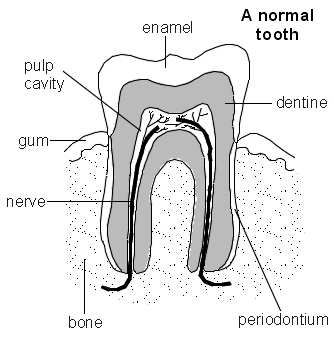
A dental abscess is a localised collection of pus in a tooth or in nearby structures. Pus is a thick fluid that usually contains white blood cells, dead tissue and germs (bacteria). The usual cause of an abscess is a bacterial infection. They are classified into two main types.
Types of dental abscess
Periapical abscess
This type of abscess starts in the centre of the tooth (the dental pulp). This is the most common type. This type of abscess usually develops as a complication of tooth decay (caries). Dental decay is very common. It damages and breaks down (erodes) the protective layers of the tooth (the enamel and dentine). The damage to the tooth allows bacteria to invade the pulp to cause an infection.
An infection in the pulp can progress to form an abscess. Sometimes a periapical abscess develops if the nerve to the tooth dies for any reason. For example, from injury. The dead tissue inside a tooth is more prone to infection.
Periodontal abscess
This type of abscess starts in the supporting structures of the teeth, such as the periodontium which is between the tooth and the gum. It most commonly develops as a complication of gum disease (periodontal disease), which is infection or inflammation of the tissues that surround the teeth.
Gum disease often causes the gum to become slightly detached from the tooth. This causes pockets to form which may get filled with bacteria and progress to form an abscess. A periodontal abscess may also develop as a complication of injury to the gums or periodontium. A periodontal abscess is sometimes called a gum boil as the abscess causes a swelling to develop next to a tooth.
What is a tooth abscess?
Dental abscess symptoms
Symptoms typically include one or more of the following:
Pain (toothache) which can quickly become worse. It can be severe and throbbing.
Swelling of the gum, which can be tender.
Swelling of the face. The skin over an abscess may become red and inflamed.
The affected tooth may become tender to touch, and may even become loose.
Température élevée (fièvre) and feeling generally unwell.
In severe cases, there may be spasm of the jaw muscles.
Sensitivity to hot or cold temperatures.
Dental abscess treatment
Traitement initial
See a dentist as soon as possible. A dentist will normally drain the pus and this often gives great relief of symptoms. This is done either by piercing (lancing) the abscess or by drilling a small hole in the tooth to let the pus escape.
Sometimes, if the infection is not contained, an antibiotique medicine is prescribed for a few days after draining the pus to clear any remaining infection. However, in most cases an antibiotic is probably not needed once the pus is drained. A GP cannot make the decision as to whether an antibiotic is appropriate, and should not prescribe antibiotics for this - it has to be a dentist.
Traitement supplémentaire
Other treatment for a dental abscess includes the following:
Root canal
Root canal treatment is normally given to treat a periapical abscess. This treatment aims to save and restore the damaged or dead inner part of a tooth (the pulp). Briefly - a dentist will drill into the dead tooth and allow pus to escape through the tooth, and then remove the dead pulpal tissue.
A root filling is then placed into the tooth to fill the space and prevent further infection. (Remarque: even if pain has gone with an initial emergency drainage of the pus, you are still likely to need root canal treatment. This is because the infection and abscess will almost certainly return unless the dead pulp tissue is dealt with.)
If the infection persists despite root canal treatment, the dentist may have to remove (extract) the tooth.
Draining the abscess
For a periodontal abscess the pus is usually drained. A dentist may also clean the pocket where the abscess had formed. Following this a dentist may smooth out the root surfaces of the tooth to encourage the gum to close back on to the tooth and for any pocket to disappear.
This helps to prevent a recurrence of infection. If you develop repeated periodontal abscesses you may be referred to an oral surgeon. The oral surgeon may carry out a procedure to reshape the gum tissue.
Do you need to see a doctor?
Your GP cannot do anything to help apart from recommend painkillers, which can be bought over the counter. Primary care in the UK is under unprecedented pressure and you should not ring your GP for dental problems, because it takes up a phone call or face to face appointment which could have gone to someone who the GP can help.
You may need painkillers such as paracétamol ou ibuprofène until the abscess is drained and treated. These are both available over the counter. (Remarque: paracetamol and ibuprofen can be taken together if pain relief with either alone is not enough. Some people require stronger painkillers prescribed by a dentist)
Dental abscess causes
Dental abscesses may occur because a tooth has not properly grown out of the gum (is impacted), because there is tooth decay or gum disease, or because of an injury to the teeth, gums or mouth. They may be more common in those who are having radiotherapy or chemotherapy.
Complications of a dental abscess
Other complications are uncommon. However, they can be serious, even fatal in rare situations, for example, if the infection has spread. They include:
Ostéomyélite - an infection of the nearby bone.
Sinusite - spread of infection to the nearby sinus in the face bone.
A dental fluid-filled cavity (cyst) which may develop.
Cavernous sinus thrombosis - this is an infection and clotting of a blood vessel in the brain. It is very serious.
A serious, potentially life-threatening infection of the floor of the mouth. This could spread to the face, brain or neck (symptoms of serious infection are listed below).
So, the take home message is - if you have a dental abscess then you should have it treated. This is not only to relieve pain but to prevent possible serious complications. Symptoms that may indicate that a complication is developing and where you should seek medical help urgently are:
If you feel very unwell with a high temperature.
Having difficulty opening your mouth, swallowing or breathing.
Having swelling of the floor of your mouth, face or jaw.
Being in severe pain despite taking painkillers at maximum dose.
Having a spreading infection of your face.
Complications are more likely to develop in people with diabetes and in those with a poorly functioning immune system. For example:
Personnes avec VIH/SIDA.
People taking chemotherapy.
People who have had their spleen removed.
People taking steroids.
Personnes avec anémie falciforme (not sickle cell trait).
Outlook
If treated, the outlook (prognosis) is good. The pus can usually be drained and the tooth can be saved if it is not badly broken down. If left untreated, the abscess may burst on to the skin of the face or into the mouth. This may leave a channel (a sinus tract) between a persistent focus of infection and the skin or mouth, which can discharge pus from time to time.
Preventing a dental abscess
Most dental abscesses are preventable, as most are a complication of tooth decay or gum disease. Both of these can be prevented with good oral hygiene. Briefly, this means regularly brushing your teeth and flossing.
Autres choses qui pourraient aider incluent :
Using mouthwash.
Cleaning your tongue.
Eating a healthy diet.
Limiting sugary drinks and foods.
Stopping smoking (this will improve oral hygiene).
Faire un contrôle dentaire au moins une fois par an.
See the separate leaflet called Oral Hygiene for more details.
How to see a dentist
If you suspect that you have a dental abscess, you should see a dentist as soon as possible. To access emergency dental care:
See your own dentist if you are registered with one; ou
Go to the Accident and Emergency department of a dental hospital (if available); ou
Go to the local Dental Access Centre (if available); ou
Dial NHS 111.
Check the NHS Choices 'Find Dentist Services' site online (see link in Further reading below).
If none of the above is available, go to your nearest general hospital Accident and Emergency department; for severe/urgent problems, they may refer you to a hospital oral surgeon.
Dental fees
Sélections des patients pour Problèmes dentaires

Soin bucco-dentaire
Plaque dentaire et maladie des gencives
Une accumulation de plaque et de tartre peut entraîner des gencives enflammées et infectées. Une maladie des gencives légère est appelée gingivite et n'est généralement pas grave. Une maladie des gencives plus sévère (parodontite) peut entraîner la chute des dents. Une bonne hygiène bucco-dentaire comprend un brossage régulier des dents et un nettoyage entre les dents - par exemple, en utilisant du fil dentaire. Cela peut généralement prévenir les maladies des gencives et traiter les maladies des gencives légères à modérées. Des traitements dentaires spécialisés peuvent être nécessaires pour les maladies des gencives sévères.
par Dr Ben Williams, MB ChB

Soin bucco-dentaire
Caries dentaires
La carie dentaire (caries) est la destruction du tissu dentaire par l'action des bactéries cariogènes. Ce sont des germes qui provoquent la carie dentaire.
par Dr Ben Williams, MB ChB
Questions fréquemment posées
Un abcès dentaire peut-il être mortel ?
Bien que les complications soient rares, certaines peuvent être très graves, voire mortelles dans des situations rares si l'infection se propage. Celles-ci incluent des infections des os voisins (ostéomyélite), des sinus (sinusite), ou un caillot sanguin dangereux dans le cerveau (thrombose du sinus caverneux). Une infection sévère du plancher de la bouche peut également se propager au visage, au cerveau ou au cou, et ces situations nécessitent une attention médicale urgente.
Qu'est-ce qui expose une personne à un risque plus élevé de complications dues à un abcès dentaire ?
Les complications sont plus susceptibles de se développer chez les personnes atteintes de diabète ou celles ayant un système immunitaire affaibli. Cela inclut les personnes vivant avec le VIH/SIDA, celles subissant une chimiothérapie, les individus ayant subi une ablation de la rate, ceux prenant des stéroïdes, et les personnes atteintes d'anémie falciforme.
Quel est le résultat à long terme si un abcès dentaire est traité ?
Si un abcès dentaire est traité, le pronostic est généralement bon. Le pus peut généralement être drainé, et dans la plupart des cas, la dent affectée peut être sauvée si elle n'a pas été trop gravement endommagée.
Que se passe-t-il si un abcès dentaire n'est pas traité ?
Si un abcès n'est pas traité, il peut éventuellement éclater soit sur la peau du visage, soit à l'intérieur de la bouche. Cela peut créer un canal, appelé trajet sinusien, qui peut périodiquement décharger du pus de l'infection persistante.
Comment puis-je prévenir la récurrence d'un abcès dentaire ?
Prévenir la récidive implique principalement de bonnes pratiques d'hygiène bucco-dentaire comme le brossage et l'utilisation de fil dentaire réguliers. D'autres mesures utiles incluent l'utilisation de bain de bouche, le nettoyage de la langue, le maintien d'une alimentation saine, la limitation des aliments et boissons sucrés, l'arrêt du tabac, et un contrôle dentaire au moins une fois par an.
Lectures complémentaires et références
- Robertson DP, Keys W, Rautemaa-Richardson R, et al; Management of severe acute dental infections. BMJ. 2015 Mar 24;350:h1300. doi: 10.1136/bmj.h1300.
- Find a dentist (England); NHS
- Abcès dentaire; NICE CKS, December 2022 (UK Access only)
À propos de l'auteurVoir la biographie complète

Dr Toni Hazell, FRCGP
MBBS, BSc, FRCGP, DFSRH, Dip GU med, DRCOG, DCH (London, UK, 2000)
Le Dr Toni Hazell a obtenu son diplôme de l'École de médecine de l'hôpital St. Mary et a effectué son VTS à l'hôpital Northwick Park.
À propos du critiqueVoir la biographie complète

Dr Colin Tidy, MRCGP
Médecin généraliste, Auteur médical
MBBS, MRCGP, MRCP (Paediatrics), DCH
Le Dr Colin Tidy est un médecin du NHS, basé dans l'Oxfordshire.
Historique de l'article
Les informations sur cette page sont rédigées et examinées par des cliniciens qualifiés.
Article également disponible en Anglais, Allemand, Espagnol, Français, Italien, Portugais, Hindi, Hébreu, Arabe, and Suédois.
Prochaine révision prévue : 14 avr. 2028
16 mai 2023 | Dernière version

Demandez, partagez, connectez-vous.
Parcourez les discussions, posez des questions et partagez vos expériences sur des centaines de sujets de santé.

Vous ne vous sentez pas bien ?
Évaluez vos symptômes en ligne gratuitement
Inscrivez-vous à la newsletter Patient
Votre dose hebdomadaire de conseils de santé clairs et fiables - rédigés pour vous aider à vous sentir informé, confiant et maître de la situation.
En vous abonnant, vous acceptez notre Politique de confidentialité. Vous pouvez vous désabonner à tout moment. Nous ne vendons jamais vos données.
Plus en soins bucco-dentaires
- Fente labiale et palatine
- Causes courantes de la mauvaise haleine
- Plaque dentaire et maladie des gencives
- Bouche sèche
- Dysphagie
- Épiglottite
- Sensation de globus
- Halitose
- Dent expulsée
- Perte de goût et d'odorat
- Cancer de la bouche
- Mucosite
- Oreillons
- Muguet buccal
- Muguet buccal chez les bébés
- Traitements de canal radiculaire
- Troubles des glandes salivaires
- syndrome de Sjögren
- Redressement des dents
- Caries dentaires