Kératose pilaire
Revu par Dr Toni Hazell, FRCGPRédigé par Dr Philippa Vincent, MRCGPPublié à l'origine 3 Aug 2026
Respecte les directives éditoriales
- TéléchargerTélécharger
- Partager
- Language
- Discussion
- Ask Patient
- Version audio
- Ajouter aux sources préférées sur Google
Keratosis pilaris is a very common skin condition which affects children and teenagers more than adults. It causes rough skin, particularly over the upper arms, outer legs and buttocks.
Explore moisturisers for dry skin
Get expert healthcare advice from the comfort of home. Complete a quick online consultation, available 24/7, with your request reviewed by a UK-registered clinician. Next day delivery available on eligible treatments.

Points clés
Keratosis pilaris is a harmless, very common skin condition caused by a build-up of keratin.
It causes rough, small bumps, usually on the upper arms, thighs, face, or buttocks.
Moisturisers and gentle exfoliation can improve its appearance, but there's no cure.
Keratosis pilaris usually improves over time. It often gets worse during colder weather, better in warmer weather.
What is keratosis pilaris?
Keratosis pilaris is a very common skin condition which causes rough skin with raised red bumps. It is caused by "keratin" - the protein that makes your hair, nails, and the outer layer of your skin - building up in the pores of your skin, instead of shedding as normal.
Who gets keratosis pilaris?
Keratosis pilaris is very common. Between five and eight in ten of all teenagers have keratosis pilaris but it is also common in babies and younger children. It tends to settle down after your teenage years; about four in ten adults have keratosis pilaris.
People with all skin types get keratosis pilaris but it seems to be more common in girls and women than in boys and men.
If you have another skin condition, such as eczema or dry skin, you are more likely to get keratosis pilaris. You are also more likely to have keratosis pilaris if other people in your family have it as well.
Can I catch keratosis pilaris?
Keratosis pilaris cannot be caught from someone else. No one knows why it develops or what makes some people get keratosis pilaris and others not.
What does keratosis pilaris look like?
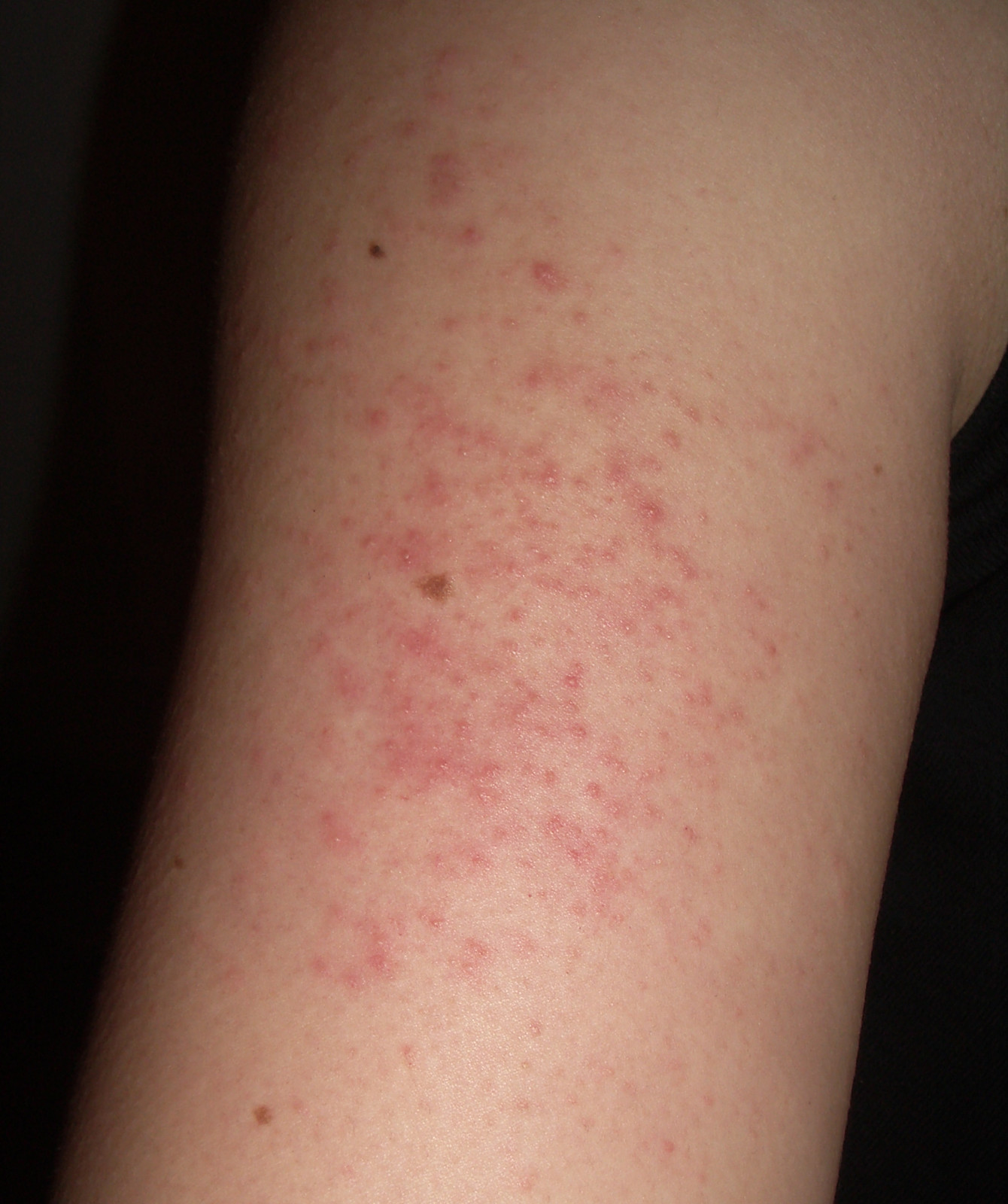
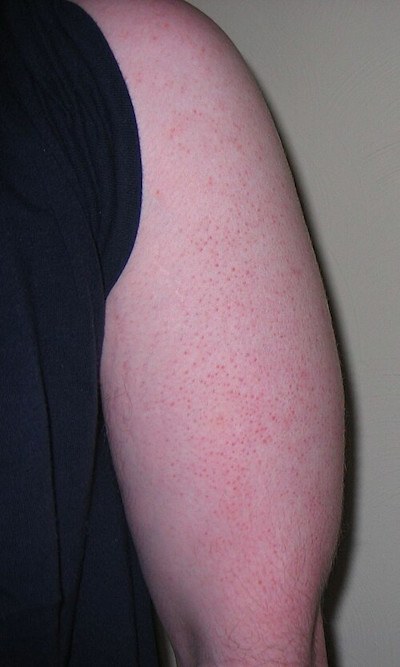
Keratosis pilaris is often described as being like "chicken skin" or "goosebumps". There are lots of tiny bumps over the surface of the skin which feels rough if you run your hand over it. In white or pale skin, these usually look red but in darker skin they can look dark brown or black.
It is most common on the upper arms but it can also occur on:
Face and neck.
Legs, especially thighs.
Back.
Poitrine.
Fesses.
Forearms.
How is keratosis pilaris diagnosed?
There are no tests for keratosis pilaris. You don't need to see a doctor but, if you do, then they will diagnose keratosis pilaris by looking at it.
Treatment of keratosis pilaris
Keratosis pilaris is not harmful. It does not need to be treated. It often gets better in warmer weather and worse in colder weather.
However, some people find that keratosis pilaris makes them feel self-conscious and they want to try and reduce the appearance of it. Although keratosis pilaris can't be cured, there are some treatments which can help.
Some things that can help the appearance of keratosis pilaris include:
Utilisation emollients or moisturisers regularly to try and soften the skin (but avoid scented products).
Using creams that contain urea, salicylic acid, or lactic acid to try and flatten the bumps.
Using exfoliating pads or mittens.
Having lukewarm showers and avoiding hot baths.
Using a humidifier in winter to stop your skin drying out.
Laser treatment has been shown to be beneficial but is not available on the NHS.
Treatments that have doit pas been shown to help include:
Expensive cosmetics which are sold specifically to help with keratosis pilaris.
Vitamin creams.
Scratching or picking at your skin can make keratosis pilaris worse.
How long does it take for keratosis pilaris to get better?
When the treatments above work, it usually takes around six to eight weeks for the skin to start improving. However, even without treatments, it usually gets better with time and is usually much better after the age of 30.
Explore moisturisers for dry skin
Get expert healthcare advice from the comfort of home. Complete a quick online consultation, available 24/7, with your request reviewed by a UK-registered clinician. Next day delivery available on eligible treatments.
Sélections des patients pour Autres affections cutanées

Santé de la peau, des ongles et des cheveux
Hidradénite suppurée
L'hidradénite suppurée est une affection cutanée chronique qui entraîne la formation de bosses douloureuses et répétées de pus (furoncles ou abcès). La cause exacte est inconnue. La suppuration signifie la formation ou l'écoulement de pus. Ces zones (souvent les aisselles et l'aine) fuient du pus et sont difficiles à guérir. Finalement, des cicatrices se forment. Les traitements incluent des lotions ou médicaments antibiotiques, ou une opération pour retirer la zone de peau affectée. Un traitement plus récent agit en bloquant une substance chimique du système immunitaire qui provoque l'inflammation dans le corps.
par Dr Colin Tidy, MRCGP

Santé de la peau, des ongles et des cheveux
Albinisme
L'albinisme est une affection héréditaire (génétique) rare qui réduit la quantité de pigment mélanique dans la peau, les cheveux et/ou les yeux. Les personnes atteintes d'albinisme sont souvent pâles, avec des iris de couleur claire. Cependant, il existe de nombreux types d'albinisme et les personnes peuvent être affectées à des degrés divers.
par Dr Hayley Willacy, FRCGP
Lectures complémentaires et références
- Kératose pilaire; Association Britannique de Dermatologie
- Keratosis Pilaris; DermNet
À propos de l'auteurVoir la biographie complète
Rédigé par

Dr Philippa Vincent, MRCGP
Médecin généraliste, Auteur médical
MB BS, Bsc, MRCGP (2000), DCH, DFSRH, DRCOG
Dr Philippa Vincent est un médecin généraliste du NHS travaillant dans le nord de Londres.
À propos du critiqueVoir la biographie complète

Dr Toni Hazell, FRCGP
MBBS, BSc, FRCGP, DFSRH, Dip GU med, DRCOG, DCH (London, UK, 2000)
Le Dr Toni Hazell a obtenu son diplôme de l'École de médecine de l'hôpital St. Mary et a effectué son VTS à l'hôpital Northwick Park.
Historique de l'article
Article également disponible en Anglais, Allemand, Espagnol, Français, Italien, Portugais, Hindi, Hébreu, Arabe, and Suédois.
Next review due: 2 Feb 2031
3 Aug 2026 | Publié à l'origine
Écrit par :
Dr Philippa Vincent, MRCGPRevu par
Dr Toni Hazell, FRCGP
Partagez vos pensées ou expériences avec les autres dans notre communautés de patients.
Accès simple à des traitements fiables et à des services de santé en ligne.
Common conditions
Get help with common conditions through the NHS, without a GP appointment.





Inscrivez-vous à la newsletter Patient
Votre dose hebdomadaire de conseils de santé clairs et fiables - rédigés pour vous aider à vous sentir informé, confiant et maître de la situation.
En vous abonnant, vous acceptez notre Politique de confidentialité. Vous pouvez vous désabonner à tout moment. Nous ne vendons jamais vos données.