Tests de la fonction thyroïdienne
Revu par Dr Hayley Willacy, FRCGP Dernière mise à jour par Dr Toni Hazell, FRCGPDernière mise à jour 15 sept 2023
Respecte les directives éditoriales
- TéléchargerTélécharger
- Partager
- Language
- Discussion
- Ask Patient
- Version audio
- Ajouter aux sources préférées sur Google
Dans cette série :Glande thyroïde hyperactiveGoitrela maladie oculaire thyroïdienneScintigraphies thyroïdiennes et tests d'absorptionMédicaments antithyroïdiens
Thyroid function tests are blood tests which help to check the function of your thyroid gland. They are mainly used to detect an underactive thyroid gland (hypothyroidism) and an overactive thyroid gland (hyperthyroidism).
Lots of basic information about the thyroid gland can be found in the separate leaflet called Thyroid Problems (also including Parathyroid Glands). This leaflet will only deal with the blood test that measures how your thyroid is working, not the specific diseases, such as Graves' disease, that affect the thyroid.
Remarque: the information below is a general guide only. The arrangements, and the way tests are performed, may vary between different hospitals. Someone can have their thyroid function test in one hospital and it could give slightly different results to having it measured in another hospital. It is important to interpret the results of your thyroid function test with the doctor who requested them - so if the test was requested by your GP, they will give you the result. If it was requested by a hospital consultant, you need to get the result from them and your GP will not have it.
En un coup d'œil
A thyroid function test is a blood test that measures hormones from your thyroid and pituitary glands.
It is mainly used to diagnose underactive or overactive thyroid glands.
You do not need to fast before the test.
Tell your doctor if you are taking any medication or are pregnant.
Test results usually take 1-3 days to come back.
What is a thyroid function test?
A thyroid function test is a blood test measuring the levels of the hormones made by your thyroid gland. The test also checks the level of a hormone made by the pituitary gland in your brain, which acts on your thyroid gland.
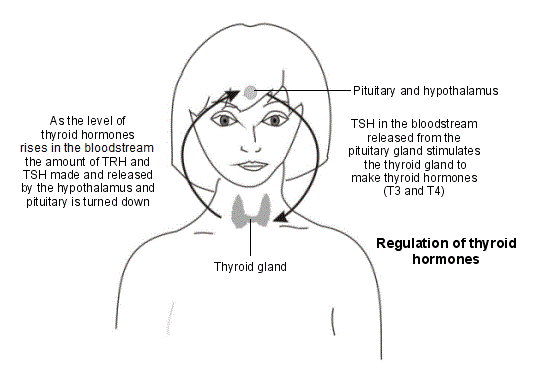
The two hormones, thyroxine (T4) and thyroid-stimulating hormone (TSH), work together and are usually in balance. In a healthy person the brain produces just the right amount of TSH to keep the thyroid gland ticking over. The thyroid gland then produces just the right amount of thyroxine.
This is called a feedback loop: if the thyroid gland makes too much thyroxine it will feed back to the brain to make less TSH. This diagram shows the feedback loop between the thyroid gland in your neck and the pituitary gland in the brain:
Régulation des hormones thyroïdiens
What are thyroid function tests used for?
Thyroid function tests are usually done to find out whether the thyroid gland is working properly. This is mainly to diagnose an underactive thyroid gland (hypothyroidism) et une glande thyroïde hyperactive (hyperthyroïdie).
People with some conditions have an increased risk of autoimmune thyroid problems and so are often advised to have thyroid function tests undertaken each year. This conditions include:
Certain medicines can also affect the function of your thyroid - for example, amiodarone et lithium.
Thyroid function tests can also be done to:
Monitor treatment with thyroid replacement medicine for people who have hypothyroidism.
Check thyroid gland function in people who are being treated for hyperthyroidism.
Screen newborn babies for inherited problems with the thyroid gland.
Sponsorisé
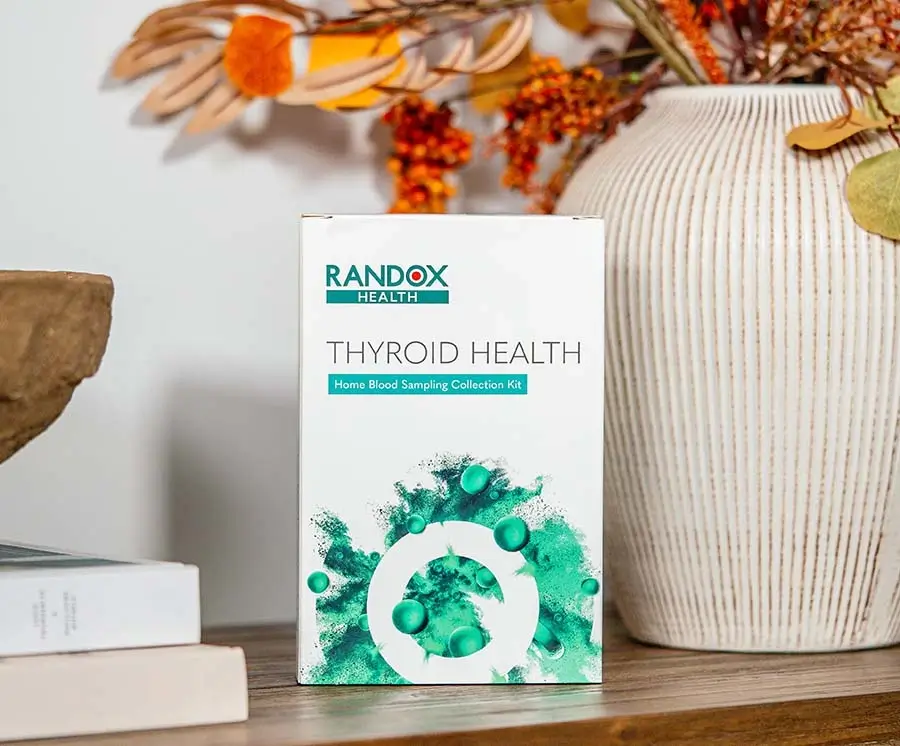
At home thyroid blood test
Understand your thyroid function with a simple blood test at Randox Health. Weight fluctuation, trouble sleeping and sensitivity to heat or cold can all be indicative of a thyroid disorder. They test for 5 key markers to give you a comprehensive overview of your thyroid health.
What happens during a thyroid function test?
A thyroid function test is a simple blood test. The blood sample is then sent to the laboratory for analysis and the results are sent back to the doctor who asked for the tests. The results usually take 1-3 days to come back.
What should I do to prepare for a thyroid function test?
Thyroid function tests usually require very little preparation. Things to consider:
You don't need to fast before the blood test. And it doesn't matter if you have taken your thyroid medicine just before the blood test.
Tell your doctor if you are taking any medication, as some medicines can alter the test results and how they are interpreted.
It is also important to mention if you have had any X-ray tests that have used a special contrast dye, either injected or if you have been asked to swallow a small amount of dye, as this may contain iodine which can affect the results.
Levels of thyroid chemicals (hormones) also change in pregnancy, so tell your doctor if you are pregnant when the test is taken.
Remarque: all newborn children have their thyroid function tested as part of the heel prick test which is offered to all babies and undertaken when they are 5 days old. See the separate leaflet called Newborn Baby Screening Tests for more information.
Thyroid function test results explained
The thyroid usually changes slowly. It hardly ever changes quickly to being overactive or underactive: it usually takes a few weeks at least, or even a few months. If you have a thyroid function test that shows something is wrong, it's usually worth repeating it in 6-8 weeks. That is because there's always the chance that your thyroid gland could have gone back to normal by itself.
The second thing to bear in mind about thyroid function tests is that medications, and even herbal remedies or vitamin supplements, can affect the accuracy of thyroid results.
For these two reasons it's always recommended to have a thyroid function test if it is recommended to you by a doctor, rather than having it done privately or without a doctor suggesting it.
Normal range
The following are approximate values for what is normal for TSH and thyroxine levels. These are a rough guide only and will vary from hospital to hospital.
Normal range for thyroid-stimulating hormone: 0.4-4.0 mU/L.
Normal range for thyroxine: 9-24 pmol/L.
So in general if your TSH is low and your thyroxine level is high, you may have an hyperactif glande thyroïde.
Conversely if your TSH is high and your thyroxine level is low, you may have an sous-actif glande thyroïde.
There are other options such as having a high TSH but a normal thyroxine and that can indicate something called subclinical hypothyroidism. If this is the case then a thyroid antibody test may also be requested, to help with the decision about whether or not treatment is indicated.
Be aware that there are other conditions that can cause abnormalities with the thyroid function tests (such as adrenal insufficiency) and so the pointers above are a guide only: you should discuss your thyroid function tests with your doctor before reaching any conclusions.
Sélections des patients pour Analyses de sang

Tests et investigations
Test PSA
Le test PSA (antigène prostatique spécifique) est un test sanguin qui évalue la probabilité de cancer de la prostate. Il est également utilisé pour surveiller le traitement du cancer de la prostate. Le taux sanguin de PSA peut également être augmenté dans d'autres conditions. Avoir un résultat de test PSA élevé ne signifie donc pas que le diagnostic est un cancer de la prostate. Actuellement, il n'existe pas de programme national de dépistage du cancer de la prostate au Royaume-Uni, mais des études sont en cours pour déterminer si le dépistage serait approprié pour le cancer de la prostate. L'essai contrôlé randomisé TRANSFORM est prévu pour commencer en 2024. Cela inclura un test PSA, entre autres, pour évaluer si un programme de dépistage du cancer de la prostate est possible ou approprié.
par Dr Philippa Vincent, MRCGP
Tests et investigations
Test sanguin de routine pour la fonction rénale
Il existe différentes manières de mesurer l'efficacité du fonctionnement des reins. La méthode la plus courante consiste à mesurer une substance appelée créatinine par un test sanguin, et à calculer quelque chose appelé le taux de filtration glomérulaire estimé (eGFR). Habituellement, d'autres substances telles que l'urée et les sels dans le sang (potassium et sodium) sont également mesurées.
par Dr Doug McKechnie, MRCGP
Questions fréquemment posées
How long does it take to get thyroid blood test results back?
The blood sample is sent to a laboratory for analysis, and the results are typically sent back to the requesting doctor within 1 to 3 days.
Lectures complémentaires et références
- Maladie de la thyroïde : évaluation et prise en charge; Orientations NICE (novembre 2019 - dernière mise à jour octobre 2023)
- Hypothyroïdie; NICE CKS, mai 2021 (accès réservé au Royaume-Uni)
- CKS Hyperthyroïdie; NICE CKS, janvier 2021 (accès réservé au Royaume-Uni)
À propos de l'auteurVoir la biographie complète
Mis à jour par

Dr Toni Hazell, FRCGP
MBBS, BSc, FRCGP, DFSRH, Dip GU med, DRCOG, DCH (London, UK, 2000)
Le Dr Toni Hazell a obtenu son diplôme de l'École de médecine de l'hôpital St. Mary et a effectué son VTS à l'hôpital Northwick Park.
À propos du critiqueVoir la biographie complète

Dr Hayley Willacy, FRCGP
Médecin généraliste, Auteur médical
MBChB (1992), DRCOG, DFFP, MRCOG (Part 1) MRCGP (2007), DFSRH (2013), MSc - medical education (2020)
Le Dr Hayley Willacy était médecin généraliste au NHS travaillant dans le nord-ouest de l'Angleterre, qui a pris sa retraite de la pratique clinique en 2022 après 30 ans.
Historique de l'article
Article également disponible en Anglais, Allemand, Espagnol, Français, Italien, Portugais, Hindi, Hébreu, Arabe, and Suédois.
Prochaine révision prévue : 13 sept. 2028
15 sept 2023 | Dernière version
Partagez vos pensées ou expériences avec les autres dans notre communautés de patients.
Accès simple à des traitements fiables et à des services de santé en ligne.
Common conditions
Get help with common conditions through the NHS, without a GP appointment.





Inscrivez-vous à la newsletter Patient
Votre dose hebdomadaire de conseils de santé clairs et fiables - rédigés pour vous aider à vous sentir informé, confiant et maître de la situation.
En vous abonnant, vous acceptez notre Politique de confidentialité. Vous pouvez vous désabonner à tout moment. Nous ne vendons jamais vos données.