Doigt à ressort
Revu par Dr Colin Tidy, MRCGPDernière mise à jour par Dr Hayley Willacy, FRCGP Dernière mise à jour 10 Apr 2025
Respecte les directives éditoriales
- TéléchargerTélécharger
- Partager
- Language
- Discussion
- Version audio
- Ajouter aux sources préférées sur Google
Un doigt à ressort ne se redresse pas facilement. La cause n'est pas claire. Parfois, cela se résout et disparaît sans traitement. Une injection de corticostéroïdes guérit généralement le problème. Une petite opération est nécessaire dans un petit nombre de cas.
En un coup d'œil
Le doigt à ressort est une condition qui provoque le blocage ou le claquement de votre doigt ou de votre pouce lorsque vous essayez de le redresser.
Elle est causée par l'inflammation et l'épaississement d'un tendon ou de sa gaine dans le doigt affecté.
Les symptômes incluent une douleur à la base du doigt, une raideur, et une sensation de claquement ou de blocage.
C'est plus fréquent chez les femmes de plus de 40 ans et peut être lié à des mouvements répétitifs de la main ou à d'autres problèmes de santé.
Les options de traitement incluent le repos, l'attelle, les injections de stéroïdes ou la chirurgie si les autres traitements échouent.
What is trigger finger?
Trigger finger (also known as stenosing tenosynovitis) is a condition that affects the tendons in your fingers or thumb, causing them to become inflamed and thickened. This can lead to difficulty in straightening or bending the affected finger, often resulting in it "locking" or "catching" in a bent position, like a trigger being pulled and released. It is difficult to straighten out without pulling on it by the other hand. When the finger "snaps" back into place, it can be painful.
You may hear a popping or clicking sound when it is pulled straight. This clicking may be worse in the morning. Sometimes there is mild pain and/or a small swelling at the base of the affected finger or thumb.
One or more fingers may be affected. Trigger finger most commonly affects your little finger, ring finger or thumb. It is actually more common in the right hand.
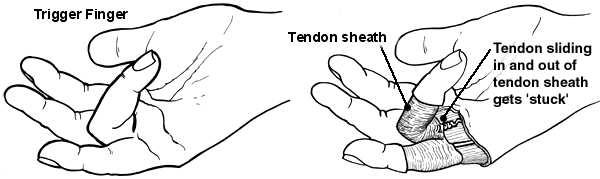
Diagram: trigger finger
What causes trigger finger?
The cause is often not clear. It is thought to be due to some inflammation which causes swelling of a tendon or the covering of the tendon (tendon sheath).
A tendon is a strong tissue that attaches a muscle to a bone. In this case the tendon comes from a muscle in the forearm. It passes through the palm and attaches to the finger bone. The muscle pulling on this tendon bends (flexes) the finger towards the palm.
A tendon sheath is like a tunnel that covers and protects parts of a tendon. Normally, the tendon slides easily in and out of the sheath as you bend and straighten the finger. In trigger finger the tendon can slide out of the sheath when you bend your finger. However, it cannot easily slide back in due to the swelling. The finger then remains bent (flexed) unless you pull it straight with your other hand.
Most cases occur for no apparent reason in healthy people. Around 2 in 100 people develop trigger finger. It is more common if you are aged over 40 and if you are female. It may also be more likely to develop if you have had a previous injury to your palm or finger.
In some cases it occurs after you have used your palm a lot - for example, it can happen:
After jobs which involve a lot of screwdriver use.
After working with tools that press on the palm.
These may cause some inflammation in the palm.
Sometimes trigger finger occurs as a feature of another disease. For example, trigger finger is more common in people with polyarthrite rhumatoïde, amyloidosis, diabète, hypothyroïdie gland, Maladie de Dupuytren et syndrome du canal carpien and in people on dialysis. In these situations you will have other symptoms of the condition and the trigger finger is just one feature.
Remarque: most people with trigger finger do pas have any of these conditions.
What are the symptoms of trigger finger?
Symptoms can vary from mild to severe and typically affect one finger or the thumb. They may include:
Pain or tenderness: Pain is often felt at the base of the finger or thumb, particularly when bending or straightening the finger.
Stiffness: The finger may feel stiff, especially in the morning.
Snapping or clicking sensation: The finger may make a snapping or clicking sound as it moves, particularly when it is being straightened after being bent.
Locking or catching: The finger may "lock" in a bent position and may need help to straighten it. This can be painful.
Swelling: The affected area may be swollen or appear thicker than usual.
How is trigger finger diagnosed?
Your doctor will diagnose trigger finger based on your medical history, symptoms, and a physical examination. During the exam, they may ask you to move your fingers in different ways to assess for pain, stiffness, or clicking. In some cases, your doctor may use an ultrasound or an X-ray to rule out other conditions.
What is the treatment for trigger finger?
Not treating is an option at first
Around one in five people will improve without any treatment. Simply resting the hand and fingers, allowing any inflammation to settle, may resolve the problem without the need for treatment. You may be advised to take a painkiller (for example, paracetamol or ibuprofen) to relieve the pain.
Splinting
Your symptoms may improve if your finger (or trigger thumb) is strapped to a plastic splint so that it is completely straight. Some people wear a splint just at night.
Une injection de stéroïdes
A steroid injection into the tendon sheath is one treatment if the condition does not settle. The steroid is combined with a local anaesthetic to make the injection less painful.
Steroids work by reducing inflammation. A finger splint may be advised for a few days after the injection to rest the finger. This treatment works in about 9 in 10 cases. A second injection may be needed if the first does not work.
Chirurgie
An operation done under local anaesthetic may be advised if the above does not work. A small cut is usually made at the base of the finger and the tendon sheath is widened. The surgical treatment of trigger finger is usually very successful.
An alternative operation is a percutaneous trigger finger release. A needle is used to release the tight mouth of the tunnel so an open operation is avoided.
If you have rheumatoid arthritis, these types of surgery may not be suitable for you. If you do need surgery, you may be offered an operation to remove part of the tendon sheath instead.
However, with an operation there is a small risk of damaging the tiny finger nerve and causing some numbness to the finger. Also, as with any operation, there is a small risk of any wound becoming infected.
Preventing trigger finger
While trigger finger may not always be preventable, you can reduce your risk by:
Taking breaks from repetitive hand movements.
Stretching your fingers and wrists regularly if you do activities that involve gripping or bending.
Using ergonomic tools that reduce strain on your hands.
Maintaining a healthy lifestyle to reduce the risk of conditions such as diabetes and arthritis, which can contribute to trigger finger.
Outlook for trigger finger (prognosis)
In most cases, trigger finger improves with treatment. Non-surgical treatments, such as rest, splinting, and corticosteroid injections, are often effective in reducing symptoms. Surgery is rarely necessary and is typically only recommended if other treatments fail. Most people recover fully and regain normal hand function.
Sélections des patients pour les troubles du tissu conjonctif

Os, articulations et muscles
Maladie de Dupuytren
La contracture de Dupuytren provoque un épaississement des tissus (fascia) dans la paume. Un fascia est une bande ou une feuille de tissu sous la peau. Si la contracture de Dupuytren progresse, un ou plusieurs doigts se plient (se contractent) vers la paume et vous ne pouvez pas redresser le ou les doigts. La cause n'est pas connue. Dans de nombreux cas, elle reste bénigne et ne nécessite pas de traitement. Si la condition devient plus grave ou si la fonction de la main est affectée, un spécialiste peut recommander un traitement. La contracture de Dupuytren porte le nom du baron Dupuytren, qui a décrit cette affection (et inventé une opération pour la traiter) en 1831.
par Dr Toni Hazell, FRCGP

Os, articulations et muscles
Troubles du spectre de l'hypermobilité
Les troubles du spectre de l'hypermobilité incluent toutes les personnes qui avaient ce qu'on appelait auparavant le syndrome d'hypermobilité articulaire, et avant cela le syndrome d'hypermobilité articulaire bénigne. Toute personne présentant des symptômes dus à des articulations hypermobiles, mais qui ne présente pas toutes les caractéristiques du syndrome d'Ehlers-Danlos, a un trouble du spectre de l'hypermobilité. Ces problèmes affectent principalement les enfants et les jeunes adolescents ayant des articulations extra-flexibles (hypermobiles) qui développent des douleurs lors de l'exercice, lesquelles persistent au repos. Ces conditions peuvent avoir un impact majeur sur la vie scolaire et sportive. Bien qu'elles ne causent généralement pas de dommages à long terme, elles peuvent être associées à des blessures et parfois persister à l'âge adulte. Le traitement vise à augmenter la force musculaire et la résilience articulaire sans causer de blessure.
par Dr Colin Tidy, MRCGP
Questions fréquemment posées
Le doigt à ressort peut-il affecter plus d'un doigt ?
Oui, un ou plusieurs doigts peuvent être affectés par le doigt à ressort. Il touche le plus souvent le petit doigt, l'annulaire ou le pouce, et est souvent observé dans la main droite.
Le doigt à ressort provoque-t-il un gonflement dans la zone affectée ?
Oui, le gonflement est un symptôme possible du doigt à ressort. La zone affectée peut sembler enflée ou plus épaisse que d'habitude à la base du doigt ou du pouce.
Comment un médecin diagnostique-t-il le doigt à ressort ?
Votre médecin diagnostiquera le doigt à ressort en examinant votre historique médical, en évaluant vos symptômes et en effectuant un examen physique. Pendant l'examen, il pourrait vous demander de bouger vos doigts pour vérifier la douleur, la raideur ou le claquement. Parfois, une échographie ou une radiographie peut être utilisée pour exclure d'autres conditions.
Y a-t-il des risques associés à la chirurgie pour le doigt à ressort ?
Oui, il existe de petits risques associés à la chirurgie du doigt à ressort. Ceux-ci incluent une légère chance d'endommager un petit nerf du doigt, ce qui pourrait entraîner un certain engourdissement du doigt. De plus, comme pour toute intervention chirurgicale, il y a un petit risque que la plaie s'infecte.
Comment puis-je réduire le risque de développer un doigt à ressort ?
Vous pouvez réduire votre risque de développer un doigt à ressort en faisant des pauses lors de mouvements répétitifs des mains, en étirant régulièrement vos doigts et poignets si vos activités impliquent de saisir ou de plier, en utilisant des outils ergonomiques pour diminuer la tension sur les mains, et en maintenant un mode de vie sain pour réduire le risque de conditions comme le diabète et l'arthrite qui peuvent contribuer au doigt à ressort.
Lectures complémentaires et références
- Peters-Veluthamaningal C, van der Windt DA, Winters JC, et al; Corticosteroid injection for trigger finger in adults. Cochrane Database Syst Rev. 2009 Jan 21;(1):CD005617. doi: 10.1002/14651858.CD005617.pub2.
- Jeanmonod R, Harberger S, Waseem M; Trigger Finger. StatPearls.
- Fiorini HJ, Tamaoki MJ, Lenza M, et al; Surgery for trigger finger. Cochrane Database Syst Rev. 2018 Feb 20;2:CD009860. doi: 10.1002/14651858.CD009860.pub2.
- Merry SP, O'Grady JS, Boswell CL; Trigger Finger? Just Shoot! J Prim Care Community Health. 2020 Jan-Dec;11:2150132720943345. doi: 10.1177/2150132720943345.
- Ferrara PE, Codazza S, Maccauro G, et al; Physical therapies for the conservative treatment of the trigger finger: a narrative review. Orthop Rev (Pavia). 2020 Jun 26;12(Suppl 1):8680. doi: 10.4081/or.2020.8680. eCollection 2020 Jun 29.
- Abdulsalam AJ, Mezian K, Ricci V, et al; Injecting the Trigger Finger: Target (With Ultrasound), Then Shoot! J Prim Care Community Health. 2021 Jan-Dec;12:21501327211000237. doi: 10.1177/21501327211000237.
À propos de l'auteurVoir la biographie complète

Dr Hayley Willacy, FRCGP
Médecin généraliste, Auteur médical
MBChB (1992), DRCOG, DFFP, MRCOG (Part 1) MRCGP (2007), DFSRH (2013), MSc - medical education (2020)
Le Dr Hayley Willacy était médecin généraliste au NHS travaillant dans le nord-ouest de l'Angleterre, qui a pris sa retraite de la pratique clinique en 2022 après 30 ans.
À propos du critiqueVoir la biographie complète

Dr Colin Tidy, MRCGP
Médecin généraliste, Auteur médical
MBBS, MRCGP, MRCP (Paediatrics), DCH
Le Dr Colin Tidy est un médecin du NHS, basé dans l'Oxfordshire.
Historique de l'article
Les informations sur cette page sont rédigées et examinées par des cliniciens qualifiés.
Article également disponible en Anglais, Allemand, Espagnol, Français, Italien, Portugais, Hindi, Hébreu, Arabe, and Suédois.
Prochaine révision prévue : 9 avr. 2028
10 Apr 2025 | Dernière version

Demandez, partagez, connectez-vous.
Parcourez les discussions, posez des questions et partagez vos expériences sur des centaines de sujets de santé.

Vous ne vous sentez pas bien ?
Évaluez vos symptômes en ligne gratuitement
Inscrivez-vous à la newsletter Patient
Votre dose hebdomadaire de conseils de santé clairs et fiables - rédigés pour vous aider à vous sentir informé, confiant et maître de la situation.
En vous abonnant, vous acceptez notre Politique de confidentialité. Vous pouvez vous désabonner à tout moment. Nous ne vendons jamais vos données.
Plus sur les os, les articulations et les muscles
- Kyste de Baker
- Médicaments biologiques pour la polyarthrite rhumatoïde
- Bisphosphonates
- Chondromalacie rotulienne
- syndrome d'Ehlers-Danlos
- Blessure aux ischio-jambiers
- Syndrome de vibration main-bras
- Fracture de la hanche
- Problèmes de hanche
- blessures des ligaments du genou
- Les déchirures méniscales
- Maladie du motoneurone
- dystrophie musculaire
- Maladie d'Osgood-Schlatter
- Polymyalgie rhumatismale
- Lésion par effort répétitif
- Anesthésie spinale
- les blessures sportives
- Sclérodermie systémique
- Torticolis