Hémorragie sous-arachnoïdienne
Revu par Dr Krishna Vakharia, MRCGPDernière mise à jour par Dr Colin Tidy, MRCGPDernière mise à jour 13 Dec 2022
Respecte les directives éditoriales
- TéléchargerTélécharger
- Partager
- Language
- Discussion
- Version audio
A subarachnoid haemorrhage (SAH) is a form of stroke in which bleeding occurs into the fluid-filled space surrounding the brain (called the subarachnoid space). It is usually caused by the rupture of a small berry-like swelling (called a berry aneurysm) on one of the arteries in the brain.
SAH is a medical emergency. The risk of a further bleed is greatest during the first 24 hours from when the symptoms started.
Dans cet article:
Sélections de vidéos pour Traumatisme crânien
Continuez à lire ci-dessous
What is a subarachnoid haemorrhage?
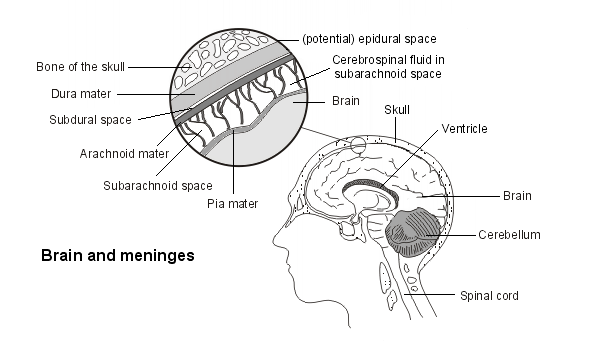
A subarachnoid haemorrhage (SAH) occurs when there is bleeding around the brain into the subarachnoid space. This is a space between two of the protective layers which surround the brain. These are the pia mater, which covers the brain directly, and the arachnoid mater, which is separated from the pia mater by a space filled with fluid. This fluid, the cerebrospinal fluid, is there to cushion and protect the brain from injury.
The bleeding usually comes from a burst (ruptured) berry aneurysm, most commonly at the back of the brain. Berry aneurysms are small berry-shaped swellings on the arteries which supply the brain, usually at a junction where an artery divides into two. These are relatively common in the general population, particularly in older patients, although most never rupture.
Brain and meninges
How serious is a subarachnoid haemorrhage?
Retour au sommaireSubarachnoid haemorrhage (SAH) is very serious. More than 1 in 4 people with a subarachnoid haemorrhage will die within the first six months after the subarachnoid haemorrhage. Of the survivors, about 1 in 3 are unable to live independently.
Continuez à lire ci-dessous
Who is affected by subarachnoid haemorrhage?
Retour au sommaireSAH usually affects adults under the age of 60 years, with the average age of affected patients around 50 years. Children are not usually affected.
Women are affected slightly more often than men.
Patients of African descent are slightly more commonly affected than patients of white descent.
The condition is also more common in Finland and Japan, where the rates are around three times those in Europe.
Patients who smoke, use excessive alcohol or have high blood pressure are at greater risk.
First-degree relatives of people who have had an SAH are at greater risk.
How common is subarachnoid haemorrhage?
Retour au sommaireAround 8 people out of every 100,000 per year will have an SAH.
SAH causes around 6 out of 100 of all strokes.
Continuez à lire ci-dessous
How does subarachnoid haemorrhage occur?
Retour au sommaireMore than 8 out of 10 cases of SAH are caused by the bursting (rupture) of berry aneurysms. About 1 in every 25 adults will have one or more berry aneurysms. However, an SAH rupturing is a relatively rare event.
Larger berry aneurysms (bigger than 7 mm) are more likely to rupture (smaller ones can grow larger over time). Rupture is more likely to occur if the elastic tissue in the walls of the berry aneurysm is weakened or strained by:
Uncontrolled high blood pressure.
High alcohol use.
Tabagisme.
Consommation de cocaïne.
Certain inherited conditions which cause weakening of the blood vessels. These include autosomal dominant polycystic kidney disease (ADPKD). These conditions cause only 1-2 in every 100 cases of SAH.
Other causes of SAH, accounting for fewer than 2 out of every 10 cases, include:
Head and neck trauma, when bleeding from injury to the brain or the structures around it can track into the subarachnoid space.
Abnormal blood vessels such as those that may be present in a brain tumour.
Brain infection such as encéphalite.
Vasculitis, when blood vessels inside the brain become swollen and inflamed. This can occur either due to infection or to conditions affecting the immune system.
Subarachnoid haemorrhage symptoms
Retour au sommaireMaux de tête
The most characteristic feature is a sudden explosive headache.
The headache is severe, often described as the most severe headache ever experienced. It is sometimes referred to as a thunderclap headache. However, the term thunderclap headache is more commonly used for some other types of sudden headache, including primary sexual headache.
Usually the headache lasts for a week or two. It is usually a dull, all-over headache. It may occasionally last only a few seconds or even less. The person may even look round and accuse someone of hitting him or her on the back of the head.
About 1 in 10 sudden explosive headaches are found to be due to SAH.
If you have an episode of sudden severe headache - coming on in minutes or less and being worse than headaches you have normally experienced - seek medical advice at once.
Être malade (vomissements)
Vomiting is very common in SAH. Vomiting also occurs with migraine and with other severe headaches. However, if you have an unusually severe sudden headache with vomiting you should seek medical advice.
Seizures and altered consciousness
A few people with SAH have a seizure due to irritation of the brain by the bleeding. Confusion or altered consciousness may also develop. If someone is unconscious they cannot tell you they have a headache. If someone complains of a severe headache then becomes unexpectedly drowsy, make sure that medical attendants are aware that the headache came first, as this suggests SAH.
Are there warning symptoms for subarachnoid haemorrhage?
Retour au sommaireSome people with SAH will have had some warning signs in the days or hours before the SAH occurs. The most common are:
Brief sudden headaches (the most common symptom).
Vertiges.
Eye pain.
Double vision or lost vision.
Loss of sensation or movement.
These symptoms may be caused by early small leaks of blood from the aneurysm as it starts to burst (rupture). However, they may not last long, and of course they may not be recognised as possibly serious by doctors or patients.
Subarachnoid haemorrhage CT scan
Retour au sommaireIf a subarachnoid haemorrhage is suspected then a tomodensitométrie (TDM) should be performed as soon as possible. This will nearly always confirm the diagnosis.
Other investigations may include cerebral angiography. A lumbar puncture (spinal tap) may be needed if the CT scan is normal but a subarachnoid haemorrhage is still suspected.
Subarachnoid haemorrhage treatment
Retour au sommaireTreatment of SAH
Initial treatment is aimed at:
Stabilising the person.
Preventing further bleeding
Preventing further brain injury.
Medicines are used - for example, to:
Improve blood supply to damaged parts of the brain.
Prevent seizures which can worsen brain damage.
Surgery is used in some patients:
People with SAH are usually referred to a specialist neurosurgical unit.
Treatment usually consists of blocking off the aneurysm, either:
Through blocking it from the inside by using a special platinum coil (endovascular coiling); ou
Through clipping it closed (neurosurgical clipping).
Patients need to be monitored for some time to avoid complications. These are fluid on the brain (hydrocephalus), further shortage of oxygen to the brain and low blood pressure.
Long-term management of SAH
This is aimed at:
Reducing risk of recurrence - treating high blood pressure, reducing alcohol intake and, if the person smokes, stopping smoking.
Specialist rehabilitation service for disabilities.
What is the outlook for patients with subarachnoid haemorrhage?
Retour au sommaireAbout 1 in 4 people die within the first six months after a subarachnoid haemorrhage. About 1 in 8 people die before reaching hospital. However more than 8 out of every 10 people admitted to a neurosurgical unit with a confirmed subarachnoid haemorrhage will survive.
Improvement will continue for about 18 months after the SAH.
Most affected people will have some impairment but some do well.
The things which increase the chance of doing better are:
A smaller bleed.
A younger age.
Remaining conscious at the time of the SAH.
About 1 in 2 people report changes with memory, mood or speech one year after a subarachnoid haemorrhage.
Can subarachnoid haemorrhage be prevented?
Retour au sommaireIt is not known why some people with berry aneurysms in the brain go on to develop SAH. However, it is known that certain avoidable risk factors make it more likely:
Hypertension artérielle
Tabagisme
Excessive alcohol intake
Cocaine use
Avoiding these risk factors is the first way to reduce the risk of SAH.
The factors that affect the health of the walls of your brain's (cerebral) blood vessels are the same factors that affect your risk of heart disease (cardiovascular risk). Therefore, lifestyle measures which generally reduce cardiovascular risk will help prevent SAH. These include:
Healthy diet, suivre un five-a-day healthy eating plan.
Keeping a healthy indice de masse corporelle (IMC), which will help prevent SAH.
What should I do if I know I have an aneurysm?
Retour au sommaireBerry aneurysms are common. They are present in around 4 in every 100 adults, being more common with greater age. They are probably the result of wear and tear on the cerebral arteries at their point of greatest weakness - the point where they divide into two.
Aneurysms less than 7 mm in diameter tend not to burst (rupture). If you have an aneurysm which is less than 7 mm in size, you may be advised that, as long as you keep your blood pressure well controlled and maintain a healthy lifestyle, your risk of SAH is no greater than that of the general population. The decision is more difficult if your aneurysm is larger than 7 mm, or you have several aneurysms. You might be offered repeat scanning, at intervals, to see if your aneurysm is growing, and to review the decision.
The alternative is to clip or block the aneurysm, even whilst it is small. The risks of surgery are significant, particularly if you are older. The risk of rupture also increases with age. These are not easy decisions.
Incidentally found aneurysms
Because they are common, berry aneurysms are often found incidentally. That is, you are found to have a berry aneurysm when having a CT scan for another reason. If this happens you will need specialist advice as to whether you need to consider operative treatment for your aneurysm. Many factors will be taken into account when advising you, including:
Votre âge.
The number of aneurysms you have.
Where the aneurysms are.
How large they are.
Any underlying conditions that might put you at greater risk.
People who have had an SAH and who have unruptured aneurysms
Those who have already had an SAH are usually offered treatment for other aneurysms, which is again an option between blocking the aneurysm from the inside using a platinum coil (endovascular coiling) or clipping it closed (neurosurgical clipping).
Screening for aneurysms
Retour au sommaireRoutine testing to check for aneurysms in relatives has not been shown to be of any benefit. Any testing is based on an assessment of each relative's own risk and is usually limited to people with at least two first-degree relatives (father, mother, sister or brother) who have had a subarachnoid haemorrhage.
Dr Mary Lowth est l'auteur ou l'auteur original de ce dépliant.
Sélections de patients pour Traumatisme crânien

Cerveau et nerfs
Hématome sous-dural
Un hématome sous-dural est une accumulation de sang coagulé qui se forme dans l'espace sous-dural. C'est l'espace entre deux des méninges, qui forment la membrane protectrice qui recouvre le cerveau. Il survient généralement à la suite d'une blessure à la tête. C'est une condition grave et un traitement d'urgence peut être nécessaire. Un scanner peut montrer un hématome sous-dural. Une opération pour retirer l'hématome peut être nécessaire. De nombreuses personnes avec un petit hématome sous-dural peuvent se rétablir rapidement et complètement.
par Dr Gurvinder Rull, MBBS

Cerveau et nerfs
Commotion cérébrale
Une commotion cérébrale est une lésion cérébrale traumatique légère qui peut survenir après un coup à la tête ou une secousse soudaine et violente.
par Dr Philippa Vincent, MRCGP
Lectures complémentaires et références
- Ziu E, Mesfin FB; Subarachnoid Hemorrhage. StatPearls, 2022.
- Etminan N, Chang HS, Hackenberg K, et al; Worldwide Incidence of Aneurysmal Subarachnoid Hemorrhage According to Region, Time Period, Blood Pressure, and Smoking Prevalence in the Population: A Systematic Review and Meta-analysis. JAMA Neurol. 2019 May 1;76(5):588-597. doi: 10.1001/jamaneurol.2019.0006.
- Accident vasculaire cérébral et AIT; NICE CKS, août 2020 (accès uniquement au Royaume-Uni)
- Céphalée - évaluation; NICE CKS, mars 2022 (accès réservé au Royaume-Uni)
- Subarachnoid haemorrhage caused by a ruptured aneurysm: diagnosis and management; NICE guideline (November 2022)
Continuez à lire ci-dessous
Historique de l'article
Les informations sur cette page sont rédigées et examinées par des cliniciens qualifiés.
Next review due: 12 Dec 2027
13 Dec 2022 | Dernière version
14 Jan 2015 | Publié à l'origine
Écrit par :
Dr Mary Elisabeth Lowth, FRCGP

Demandez, partagez, connectez-vous.
Parcourez les discussions, posez des questions et partagez vos expériences sur des centaines de sujets de santé.

Vous ne vous sentez pas bien ?
Évaluez vos symptômes en ligne gratuitement
Inscrivez-vous à la newsletter Patient
Votre dose hebdomadaire de conseils de santé clairs et fiables - rédigés pour vous aider à vous sentir informé, confiant et maître de la situation.
En vous abonnant, vous acceptez notre Politique de confidentialité. Vous pouvez vous désabonner à tout moment. Nous ne vendons jamais vos données.