
Quelles sont les meilleures formes d'exercice si vous avez de l'asthme ?
Évalué par des pairs Dr Sarah JarvisDernière mise à jour par Abi MillarDernière mise à jour 26 janv. 2018
Respecte les directives éditoriales
- TéléchargerTélécharger
- Partager
- Language
- Discussion
- Version audio
- Ajouter aux sources préférées sur Google
L'activité physique est bénéfique pour les personnes atteintes de asthme. Il améliore la fonction pulmonaire, soutient le système immunitaire et aide à maintenir le poids des personnes, réduisant ainsi le risque d'un crise d'asthme. Cependant, comme certaines personnes asthmatiques constatent que l'exercice déclenche leurs symptômes, ils peuvent se sentir réticents à commencer.

Enquête sportive du patient
Dans une récente enquête de Patient auprès de 281 professionnels de santé, la communauté médicale était quelque peu divisée sur les sports qu'ils recommanderaient aux personnes asthmatiques. Les activités les plus recommandées étaient le yoga et le Pilates (recommandés par 60% des médecins), le tir à l'arc et le tir (recommandés par 51%) et le cyclisme (recommandé par 49%). À l'inverse, les activités les moins recommandées étaient tous des sports de compétition - squash (22%), hockey (21%) et rugby (18%).
Nous avons demandé aux professionnels de la santé quels sont les meilleurs sports pour l'asthme
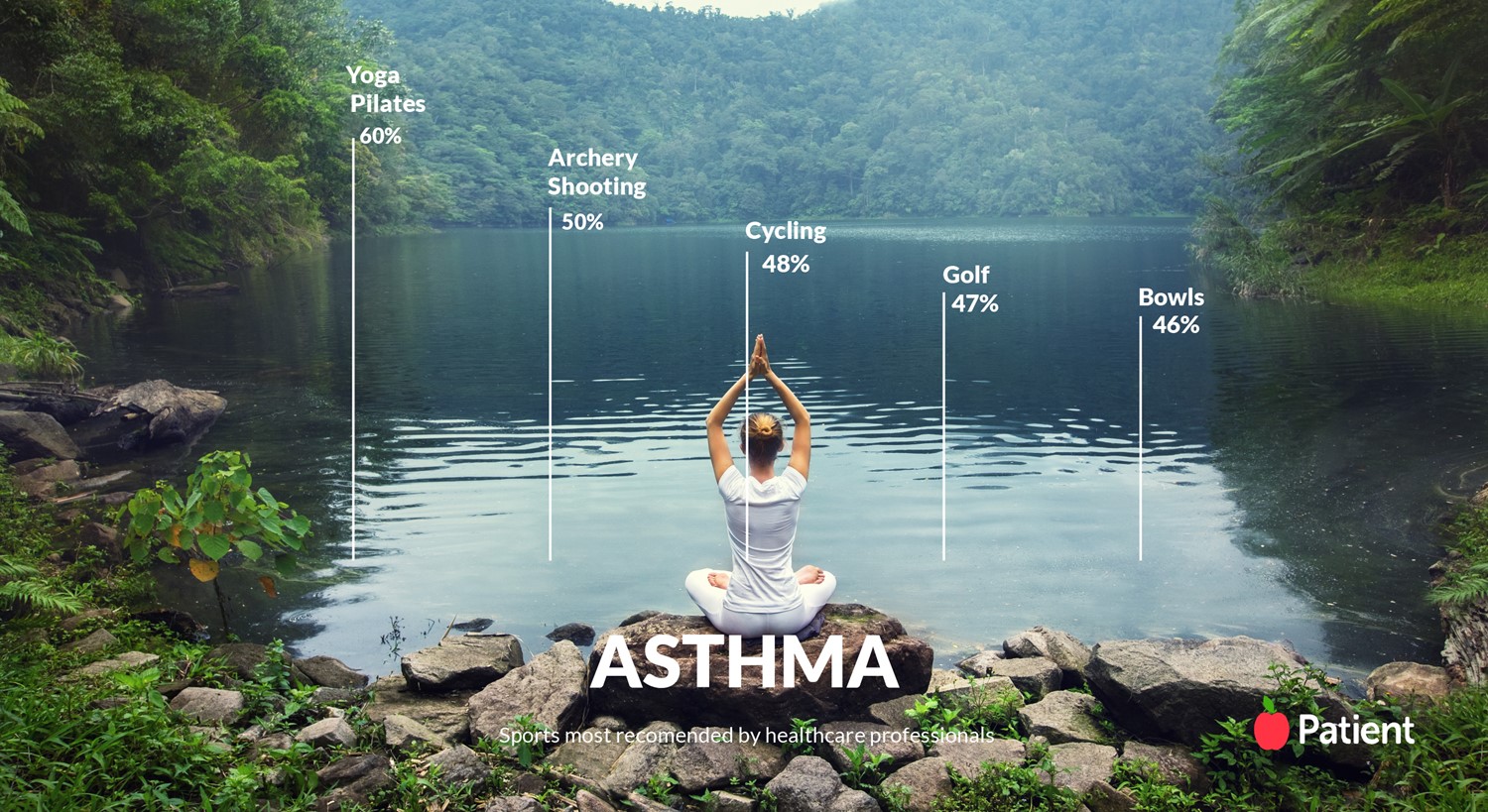
Faire de l'exercice avec de l'asthme
Cette image plutôt complexe reflète les nuances impliquées dans l'exercice avec l'asthme. Bien qu'il y ait de nombreux avantages à rester en forme, il est essentiel que la condition soit correctement gérée et que vous ayez une bonne conscience de vos déclencheurs personnels.
"Si les personnes prennent bien soin de leur asthme et que leurs symptômes sont sous contrôle, elles devraient pouvoir profiter de tout type d'exercice, que ce soit la natation, la course ou même le sport de compétition," déclare le Dr Andy Whittamore, Asthme UK'Responsable clinique et médecin généraliste en exercice. "Si l'asthme d'une personne n'est pas sous contrôle, si elle débute dans l'exercice ou n'en a pas fait depuis un certain temps, il pourrait être préférable de commencer par des activités aérobies moins intenses comme le yoga ou la marche."
De toute évidence, les recommandations varieront en fonction de vos circonstances personnelles. Par exemple, la natation (recommandée par 45 % des médecins) est souvent bénéfique, car l'air chaud et humide autour des piscines est généralement bon pour les voies respiratoires sensibles. D'autre part, certaines personnes trouvent que le chlore utilisé dans les piscines peut être un déclencheur.
Selon l'utilisation répandue Directives SIGN/BTS, pour la plupart des personnes asthmatiques, les symptômes déclenchés par l'exercice sont une indication que le contrôle global est médiocre ou au moins insuffisant. Cela signifie que votre médication, y compris 'Inhalateurs 'préventifs', devrait être examiné. Cependant, certaines personnes présentent peu ou pas de symptômes sauf lorsqu'elles font de l'exercice. Pour elles, les directives recommandent de prendre une dose de 'Inhalateur 'soulageant' immédiatement avant l'exercice pour garder les voies respiratoires ouvertes et prévenir l'apparition des symptômes.
Les athlètes asthmatiques
Dans le même ordre d'idées, la course à pied (recommandée par seulement 29% des médecins) est excellente pour la condition physique générale, et il y a un certain nombre d'athlètes de classe mondiale, tels que Paula Radcliffe et Jo Pavey, qui ont constaté que l'asthme n'est pas un obstacle. Cependant, il est impératif de bien s'échauffer et de se refroidir, et d'avoir toujours votre inhalateur de secours avec vous.
"Le froid peut irriter les voies respiratoires sensibles, donc vous pourriez essayer de faire de l'exercice à l'intérieur pendant l'hiver ou envisager de faire des exercices moins vigoureux les jours froids," dit le Dr Whittamore. "Il est également probable qu'il y ait autres déclencheurs d'asthme que les gens rencontrent, comme le pollen."
Activités modérées
Si vous n'avez pas fait d'exercice depuis un certain temps, ou votre asthme est sévère, il peut être préférable de commencer par une activité plus modérée. Ce n'est peut-être pas un hasard si les leaders du sondage, le yoga et le Pilates, se pratiquent généralement en intérieur, mettent l'accent sur la respiration contrôlée et peuvent être adaptés à votre propre niveau d'intensité.
Lynne Robinson, fondatrice et directrice de Pilates de Contrôle Corporel et auteur de La Bible du Pilates et Pilates pour la vie, souligne que Joseph Pilates lui-même (le fondateur du Pilates) souffrait d'asthme dans son enfance.
"C'est probablement pourquoi l'enseignement d'une respiration efficace est central dans notre méthode," dit-elle. "On vous apprend la respiration thoracique latérale pour maximiser l'efficacité de la respiration. Vous apprenez également à coordonner votre respiration avec vos mouvements. Cela, associé à l'élément de relaxation des cours, le rend idéal pour les asthmatiques, les aidant à apprendre à rester calmes et à respirer profondément pendant une crise."
Gagnez en confiance
Le message clé est que, tant que vous vous sentez généralement bien et que vous prenez vos médicaments préventifs comme prescrit, rien ne vous empêche vraiment de profiter de l'activité physique de votre choix. En une enquête par Asthma UK, 37% des personnes asthmatiques ont déclaré que faire de l'exercice les rendait globalement plus heureuses et en meilleure santé. Parmi les parents ayant des enfants asthmatiques, 83% ont affirmé que l'exercice aidait leur enfant à se sentir plus confiant face à sa condition.
Cependant, si vous avez des difficultés à faire de l'exercice à cause de l'asthme, il est important de parler à votre médecin généraliste ou à votre infirmière spécialisée en asthme, qui pourra évaluer votre traitement. Ils vous aideront à développer un plan d'action écrit pour l'asthme à jour qui détaille ce que vous devez faire si vos symptômes s'aggravent.
"C'est une bonne idée pour les gens de prendre une photo de cela sur leur téléphone afin d'avoir toujours une copie lorsqu'ils sont en déplacement," dit le Dr Whittamore. "Si vous avez des symptômes lorsque vous faites de l'exercice, arrêtez-vous, prenez votre inhalateur de secours et attendez de vous sentir mieux avant de recommencer."
Sélections des patients pour Asthme

Poitrine et poumons
Que faire en cas de crise d'asthme
Une crise d'asthme peut être une situation effrayante. Cependant, ne pas paniquer est la clé pour la traiter et s'assurer que les symptômes disparaissent aussi rapidement que possible. De même, si vous n'avez pas d'asthme vous-même, savoir quoi faire pourrait vous aider à sauver une vie.
par Emily Jane Bashforth

Poitrine et poumons
Les produits de nettoyage sont-ils mauvais pour votre santé ?
Nous connaissons tous les dangers de la pollution extérieure, mais saviez-vous que vous pourriez être exposé à des produits chimiques nocifs à l'intérieur même de votre maison ? Nous consultons des experts sur les produits de nettoyage qui pourraient provoquer des symptômes nuisibles et comment garder votre maison impeccable sans compromettre votre santé.
par Natalie Healey
À propos de l'auteurVoir la biographie complète

Abi Millar
Journaliste indépendant
BA (Hons), MA
Abi est une journaliste indépendante avec un intérêt particulier pour l'écriture sur la santé et la médecine.
À propos du critiqueVoir la biographie complète

Dr Sarah Jarvis
Consultant Clinique
MA (Cantab), BM, BCh (Oxon), DRCOG, FRCGP, MBE
Après avoir suivi une formation en médecine à Cambridge et Oxford, le Dr Sarah Jarvis MBE est devenue médecin généraliste.
Historique de l'article
Les informations sur cette page sont examinées par des cliniciens qualifiés.
Article également disponible en Anglais, Allemand, Espagnol, Français, Italien, Portugais, Hindi, Hébreu, Arabe, and Suédois.
26 janv. 2018 | Dernière version

Demandez, partagez, connectez-vous.
Parcourez les discussions, posez des questions et partagez vos expériences sur des centaines de sujets de santé.

Vous ne vous sentez pas bien ?
Évaluez vos symptômes en ligne gratuitement
Inscrivez-vous à la newsletter Patient
Votre dose hebdomadaire de conseils de santé clairs et fiables - rédigés pour vous aider à vous sentir informé, confiant et maître de la situation.
En vous abonnant, vous acceptez notre Politique de confidentialité. Vous pouvez vous désabonner à tout moment. Nous ne vendons jamais vos données.
Plus dans la poitrine et les poumons
- 7 habitudes quotidiennes pour améliorer la santé de vos poumons
- Pollution de l'air et asthme : comment se protéger cet été
- La pollution de l'air responsable d'un tiers des nouveaux cas d'asthme en Europe
- Les produits de nettoyage sont-ils mauvais pour votre santé ?
- Un nouveau test sanguin peut-il détecter le cancer du poumon précocement ?
- Peut-on vraiment 'guérir' de l'asthme en grandissant ?
- Erreurs courantes à éviter avec un inhalateur pour l'asthme
- Comment la physiothérapie peut aider les personnes atteintes de maladies pulmonaires
- Comment gérer l'asthme pendant les mois d'hiver
- Comment vivre sainement avec la BPCO
- Est-ce la coqueluche ou juste un rhume ?
- Le cancer du poumon chez les non-fumeurs est plus courant que vous ne le pensez
- Devriez-vous aller travailler lorsque vous avez un rhume ?
- L'effet de la pollution de l'air sur les personnes asthmatiques
- Quels sont les différents types d'inhalateurs pour l'asthme ?
- Quelles sont les causes du sifflement ?
- Que se passe-t-il lors d'une crise d'asthme ?
- Qu'est-ce que l'asthme sévère et comment savoir si vous en souffrez ?
- Quelle est la différence entre une double pneumonie et une pneumonie ?
- Pourquoi votre parfum préféré pourrait déclencher une crise d'asthme