
Que se passe-t-il lors d'une crise d'asthme ?
Revu par Dr Hayley Willacy, FRCGP Rédigé par Dr Laurence KnottPublié à l'origine 24 avr. 2019
Respecte les directives éditoriales
- TéléchargerTélécharger
- Partager
- Language
- Discussion
- Version audio
- Ajouter aux sources préférées sur Google
L'asthme est une affection courante qui affecte les petites voies respiratoires (bronchioles). De temps en temps, les voies respiratoires se rétrécissent chez les personnes asthmatiques. Les symptômes typiques sont la respiration sifflante, la toux, la sensation d'oppression thoracique et l'essoufflement. L'ampleur du rétrécissement, ainsi que la durée de chaque épisode, peuvent varier considérablement.
Get help managing your asthma
Get expert healthcare advice from the comfort of home. Complete a quick online consultation, available 24/7, with your request reviewed by a UK-registered clinician. Next day delivery available on eligible treatments.

The normal respiratory system
To understand what happens in asthme you need to be familiar with the normal breathing (respiratory) system and how the lungs and airways are arranged.
Normally, air entering through the mouth and nose travels through the main airway (the trachea) through a series of smaller branching airways called bronchi. The bronchi divide up into even smaller airways called bronchioles, which end in millions of tiny air sacs called alveoli.
When air enters the alveoli, the oxygen it contains passes through the thin membrane covering each sac into surrounding blood vessels. The oxygen attaches itself to red blood cells which then circulate around the body, releasing the oxygen into the body tissues.
Que se passe-t-il lors d'une crise d'asthme ?
An asthma attack starts with exposure to an asthma trigger. Triggers that cause an asthma attack vary from person to person but may be something you are allergic to such as animals or pollen. They can also be viral infections, reflux gastro-œsophagien, air pollution, cigarette smoke, and niveaux de stress.
When exposed to a trigger factor, the lining of the airways responds by producing chemicals such as histamine and leukotriene. These chemicals are in part responsible for the changes that happen in the lungs during an asthma attack.
The airway lining becomes inflamed and swells. The production of mucus, normally present in a small amount in the airways, is increased. Typically this results in throat clearing, spitting up phlegm (sputum) and coughing. The muscles wrapped round the bronchioles eventually become constricted or tightened (bronchospasm) and the air passing through the narrowed channels produces a wheeze.
Lungs and alveoli
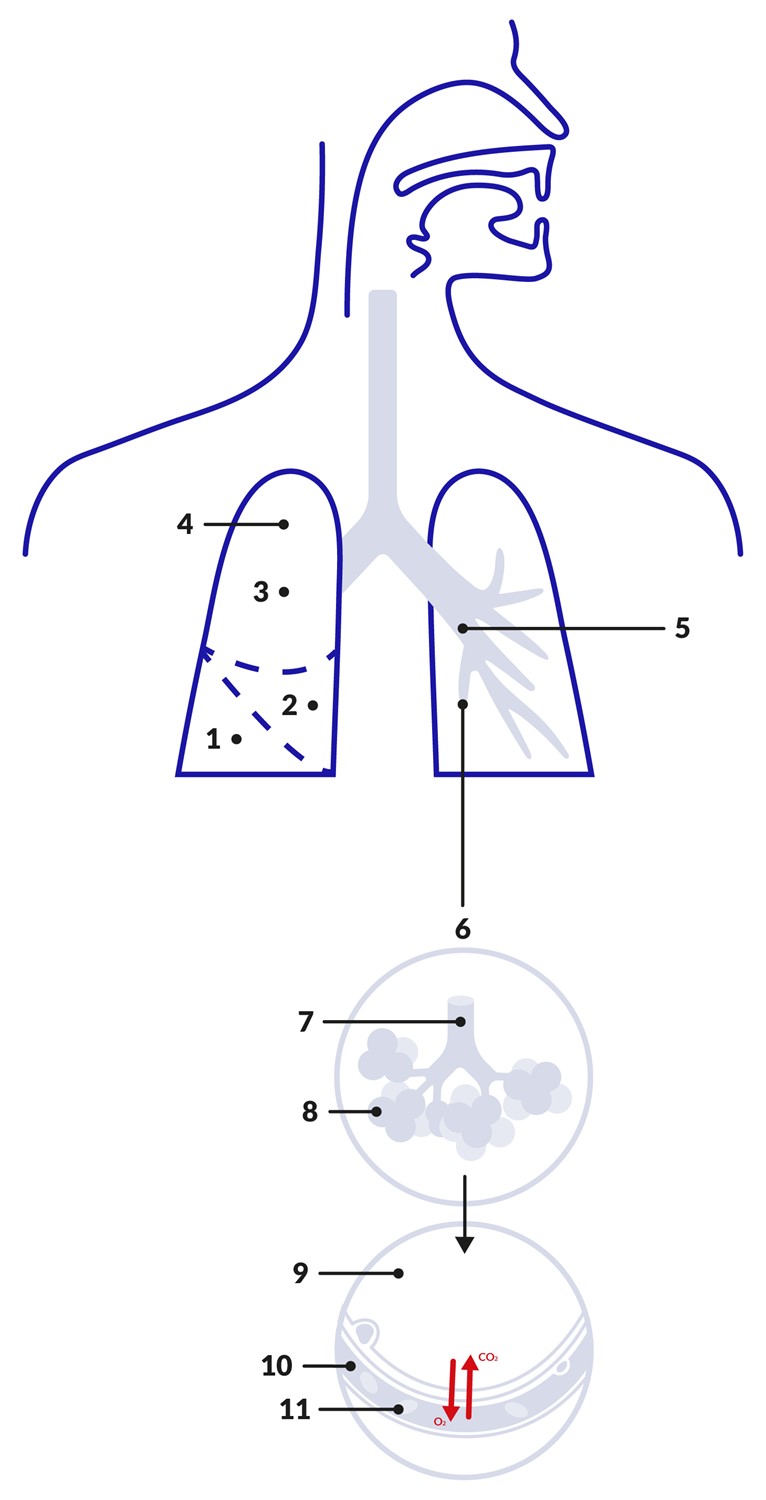
Clé | |
|---|---|
1. Lower lobe | 7. Terminal bronchiole |
Cross-section of normal airway
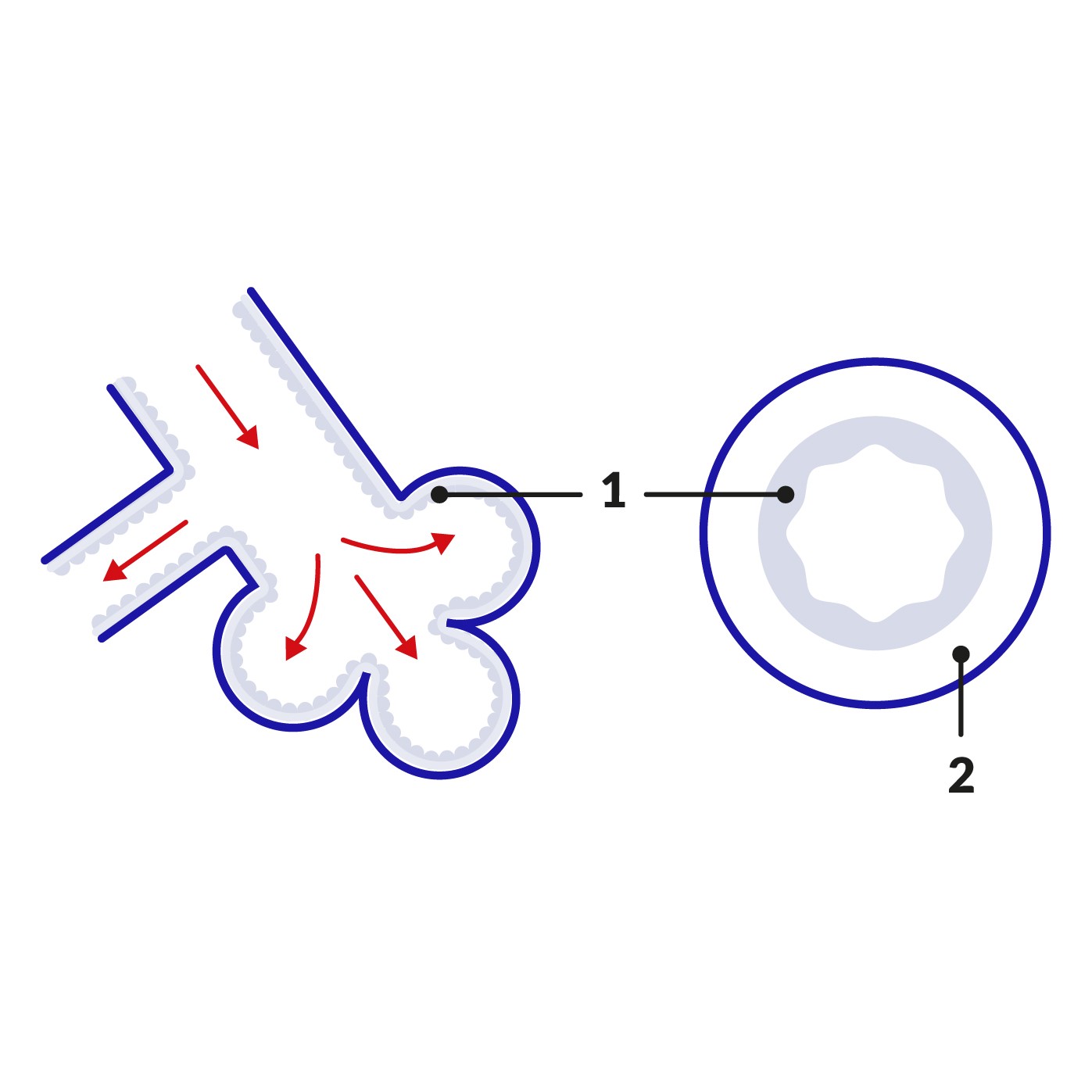
Clé |
|---|
1. Small amount of mucus lines the airways |
Cross-section of airway during asthma attack
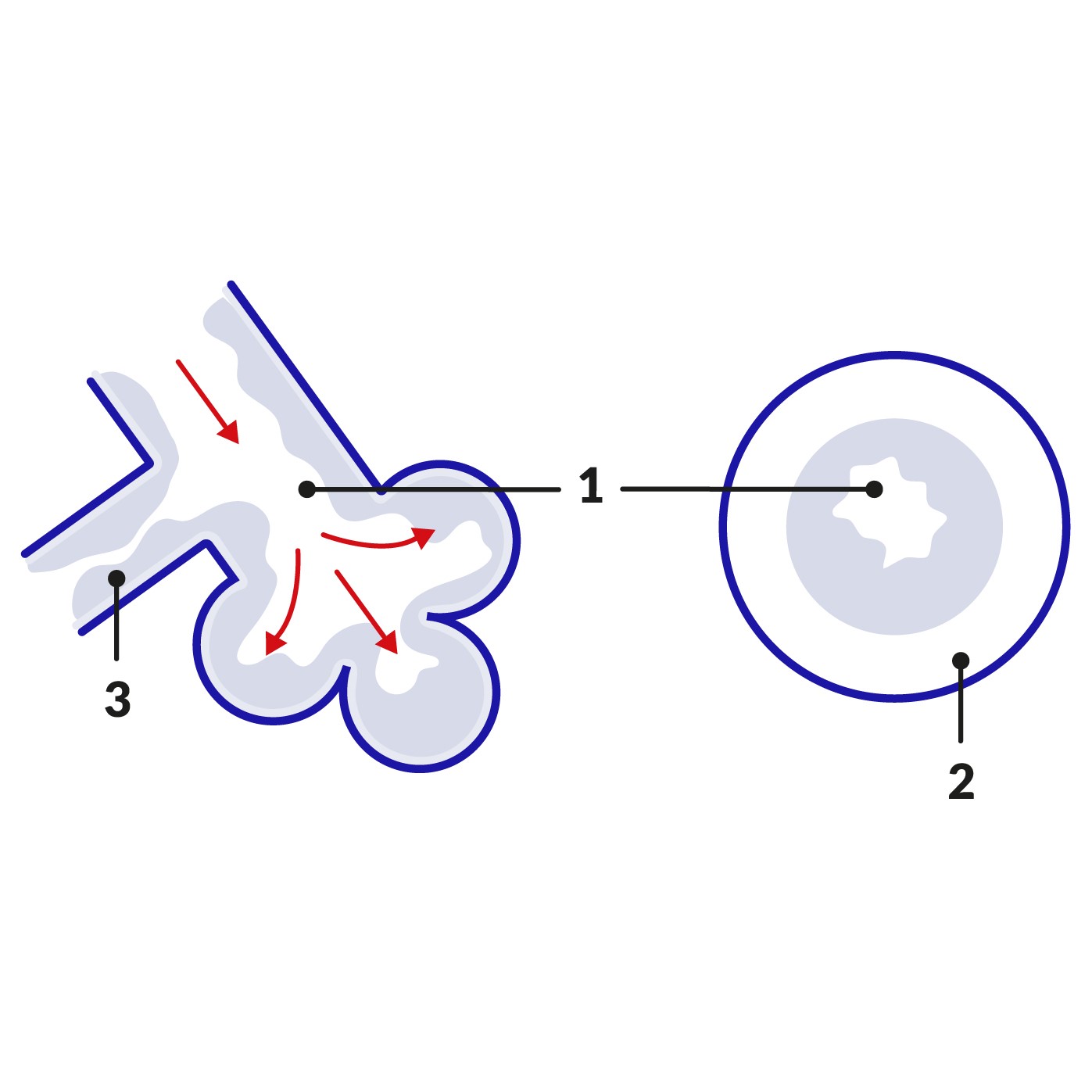
Clé |
|---|
1. Reduced flow of air to the alveoli |
So you can see there are three reasons why people who are having an asthma attack become breathless. The swelling of the lining of the airways, the increased mucus production and the bronchospasm all result in less air than normal entering the alveoli. There is therefore a limited amount of oxygen available to pass on to the red blood cells.
Why asthma treatments work
Bronchodilators
Bronchodilators such as salbutamol work by relaxing the muscle of the bronchioles and widening the channels through which the air passes. They are usually administered in the form of inhalers. Salbutamol starts to work within a few minutes and the effect will last between 3-5 hours. Bronchodilator inhalers are referred to as 'reliever' inhalers or 'blue' inhalers. This is because they relieve symptoms of breathlessness, and the inhalers are usually blue in colour. Although they relieve breathlessness, they do not prevent the breathlessness from happening.
Salmeterol works in a similar way to salbutamol but its effects last for about 12 hours.
Corticostéroïdes
Steroids such as beclometasone work by reducing the inflammation in your airways. When the inflammation has gone, your airways are much less likely to become narrow and cause symptoms such as wheezing. For asthma, steroids are usually prescribed in inhaler form. Although they have no effect during acute asthma attacks, when taken regularly (usually twice daily) they are the inhalers that will stop the attacks from happening. They are usually brown in colour and are known as 'preventer' or 'brown' inhalers. Occasionally, for severe asthma, steroids are prescribed in tablet form.
If your asthma stabilises on steroid and bronchodilator inhalers your doctor may prescribe a combination inhaler to take regularly which contains both medicines.
Autres traitements
Antileukotrienes
Antileukotrienes such as montélukast act by blocking the action of leukotriene. Leukotriene is produced when people with asthma come into contact with trigger factors such as substances they are allergic to (such as pollen), or exercise. Leukotriene causes the lining of the bronchioles to become inflamed and swollen and antileukotrienes help to prevent this. Not every person with asthma gets a significant rise in leukotriene production during an attack, which is why antileukotrienes are usually kept in reserve for asthma which does not respond to standard bronchodilator and steroid therapy.
Omalizumab
Omalizumab is a medicine that is only given by injection. It works by interfering with the immune system to reduce inflammation in the airways which is present in asthma. It is reserved for people with severe asthma who do not respond to standard treatment. It can only be started by a specialist.
Get help managing your asthma
Get expert healthcare advice from the comfort of home. Complete a quick online consultation, available 24/7, with your request reviewed by a UK-registered clinician. Next day delivery available on eligible treatments.
Sélections des patients pour asthme

Poitrine et poumons
Les produits de nettoyage sont-ils mauvais pour votre santé ?
Nous connaissons tous les dangers de la pollution extérieure, mais saviez-vous que vous pourriez être exposé à des produits chimiques nocifs à l'intérieur même de votre maison ? Nous consultons des experts sur les produits de nettoyage qui pourraient provoquer des symptômes nuisibles et comment garder votre maison impeccable sans compromettre votre santé.
par Natalie Healey

Poitrine et poumons
Comment gérer l'asthme en été
L'asthme en été peut être pénible, mais avec les bons médicaments et un plan d'action de bon sens, vous pouvez atténuer les symptômes déclenchés par le pollen et la pollution de l'air. Nos experts vous donnent des conseils pour gérer votre asthme estival.
par Lynn Stephen
À propos de l'auteurVoir la biographie complète
Rédigé par

Dr Laurence Knott
Médecin généraliste, Auteur médical
Licence (Hons) Biochimie, MBBS
Le Dr Laurence Knott a obtenu son diplôme en 1973 et a acquis une vaste expérience en tant que médecin généraliste.
À propos du critiqueVoir la biographie complète

Dr Hayley Willacy, FRCGP
Médecin généraliste, Auteur médical
MBChB (1992), DRCOG, DFFP, MRCOG (Part 1) MRCGP (2007), DFSRH (2013), MSc - medical education (2020)
Le Dr Hayley Willacy était médecin généraliste au NHS travaillant dans le nord-ouest de l'Angleterre, qui a pris sa retraite de la pratique clinique en 2022 après 30 ans.
Historique de l'article
Article également disponible en Anglais, Allemand, Espagnol, Français, Italien, Portugais, Hindi, Hébreu, Arabe, and Suédois.
24 avr. 2019 | Publié à l'origine
Écrit par :
Dr Laurence KnottRevu par
Dr Hayley Willacy, FRCGP
Participez à la conversation
Partagez vos pensées ou expériences avec les autres dans notre communautés de patients.

Demandez, partagez, connectez-vous.
Parcourez les discussions, posez des questions et partagez vos expériences sur des centaines de sujets de santé.

Vous ne vous sentez pas bien ?
Évaluez vos symptômes en ligne gratuitement
Inscrivez-vous à la newsletter Patient
Votre dose hebdomadaire de conseils de santé clairs et fiables - rédigés pour vous aider à vous sentir informé, confiant et maître de la situation.
En vous abonnant, vous acceptez notre Politique de confidentialité. Vous pouvez vous désabonner à tout moment. Nous ne vendons jamais vos données.