Engelures
Revu par Dr Hayley Willacy, FRCGP Dernière mise à jour par Dr Colin Tidy, MRCGPDernière mise à jour 8 sept 2024
Respecte les directives éditoriales
- TéléchargerTélécharger
- Partager
- Language
- Discussion
- Version audio
- Ajouter aux sources préférées sur Google
Les engelures sont de petites bosses qui démangent et sont douloureuses, se développant sur la peau en réponse anormale au froid.
En un coup d'œil
Chilblains are itchy, red or purple lumps on the skin that appear after exposure to cold.
They commonly affect fingers, toes, ear lobes, and the nose.
Chilblains are caused by an abnormal skin reaction when cold skin warms up too quickly.
Symptoms include redness, itching, burning, pain, and tenderness.
Most chilblains usually clear up on their own within one to two weeks.
Keep affected areas warm and avoid warming cold skin too quickly to help prevent them.
What are chilblains?
What are chilblains?
Chilblains are lumps on the skin which come up as an abnormal reaction to the cold. They are usually red or purplish.
They can be itchy or sore. Sometimes they come up when skin is warmed up too quickly after it has been cold. Nobody really knows why some people are prone to chilblains and others are luckier and don't get them.
Anyone can get chilblains at any age. They are as common in children as they are in elderly people.
Engelures
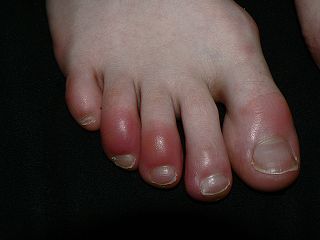
© Sapp, Public domain, via Wikimedia Commons
Chilblains symptoms
Chilblains occur several hours after being exposed to the cold. You may get just one chilblain but often several develop. They may join together to form a larger affected areas, such as swollen, itchy hands and toes.
Common symptoms of chilblains include:
Small, itchy areas of skin.
Une sensation de brûlure.
Red or purple marks on skin.
Pain and tenderness.
Common places for chilblains to develop are:
Fingers.
Toes.
Ear lobes.
Nose.
Cheeks.
Heels.
Shins.
Thighs.
Hips.
Typically, each chilblain lasts for about seven days and then, gradually, goes away over a week or so. Some people have repeated bouts of chilblains each winter.
What causes chilblains?
Chilblains are caused by an abnormal skin reaction to cold. They tend to occur on 'extremities' that easily become cold - that is, your toes, fingers, nose and earlobes. However, other areas of skin sometimes develop chilblains when they become cold. For example, your heels, lower legs and thighs (especially in horse riders).
The tiny blood vessels under the skin narrow (constrict) when the skin becomes cold. The blood supply to areas of skin may then become very slow. As the skin re-warms there is some leakage of fluid from the blood vessels into the tissues. In some way this causes areas of inflammation and swelling, leading to chilblains.
The speed (rate) of temperature change may play a part. Some people get chilblains if they warm up cold skin too quickly. For example, with a hot water bottle or by sitting very close to a fire.
How common are chilblains?
Chilblains are quite common. They can occur at any age. They are most common in children and in older people. They also occur more in women than in men. It is not clear why some people get chilblains when their skin gets cold.
Who's more at risk of chilblains?
Most chilblains occur in people who are otherwise healthy. However, some factors may make some people more prone to chilblains, such as:
Having poor circulation or other problems of your blood vessels. In particular, people who have a connective tissue disease such as lupus érythémateux systémique (LES) are more likely to get chilblains. A condition called maladie artérielle périphérique also affects the circulation to your skin.
Having a family history of chilblains.
Being a smoker.
Avoir diabète.
Avoir anorexie mentale, or other conditions giving you a low indice de masse corporelle (IMC).
Complications of chilblains
Usually there are no complications, and the chilblains vanish in time without trace. Some complications which occasionally occur are described below.
You may develop an infection in the skin affected by the chilblain. This is more common if you scratch it. This allows the germs that are normally harmlessly present on the skin to get inside the skin.
In some cases the skin over a chilblain can blister, which may delay healing.
Occasionally, the skin breaks down to leave a small ulcer which is prone to infection.
In some cases chilblains can become persistent (chronic). This usually occurs in people who are repeatedly exposed to cold conditions. The skin becomes scarred over time. It may develop a different colour to the rest of the skin around it.
How long do chilblains last?
Usually chilblains go away of their own accord within a week or two. You may get more if you are prone to them, and are exposed to cold conditions. Occasionally, they can hang around if you are continually exposed to the cold.
Faut-il faire des examens ?
No. Chilblains can be diagnosed from their typical appearance together with the background of having been exposed to cold.
Chilblains treatment
Although chilblains are uncomfortable, they do not usually cause any permanent damage. They will usually heal on their own if further exposure to the cold is avoided. There is no specific cure for chilblains.
Keep the affected areas warm. This means staying out of the cold, or wearing warm gloves, socks, etc, when outdoors.
No other treatment is normally needed, as they usually go away by themselves.
A range of creams and lotions can be bought from a pharmacy. However, there is no evidence that any of these are of benefit so they are not recommended.
Steroid creams are no longer recommended for the treatment (or prevention) of chilblains.
If you smoke then you should try to stop, as smoking can make chilblains worse.
Medicines are not usually needed. A medicine called nifédipine can open wide (dilate) the small blood vessels and may help to treat chilblains which are not settling within the normal time. Occasionally it may also be used to prevent chilblains in the winter months in people who have repeated symptoms.
Can you prevent chilblains?
If you are prone to chilblains then trying to prevent them by doing the following is sensible:
Keep your hands and feet warm when out in cold weather by using warm gloves and socks. Consider special heated gloves and socks if chilblains are a repeated problem.
Keep your head and ears warm by wearing a hat and scarf.
You should keep as warm as possible in the cold by wearing warm clothing. Wearing several loose layers is ideal to trap body heat. You should also keep as dry as possible.
After being out in the cold, do not heat the skin quickly, such as by wrapping your hands around a cup of coffee, putting them on a hot radiator or applying a hot water bottle. Warm yourself up gradually.
Side-effects to some medicines may narrow (constrict) tiny blood vessels. This may be enough to make you prone to repeated chilblains. For example, bêta-bloquants can have this effect. Tell your doctor if you become prone to chilblains following starting any medication.
Avoiding or limiting exposure to cold, damp environments.
Sélections des patients pour Autres affections cutanées

Santé de la peau, des ongles et des cheveux
Ulcères cutanés
Un ulcère est une rupture de la peau, à travers laquelle les tissus sous-jacents peuvent être vus. Il y a généralement un problème affectant la cicatrisation normale de la peau. Il existe plusieurs types d'ulcères cutanés. Le traitement peut varier en fonction du type d'ulcère.
par Dr Doug McKechnie, MRCGP

Santé de la peau, des ongles et des cheveux
Gelures
Les engelures sont des blessures causées par l'exposition de certaines parties du corps au froid. Il existe différents degrés d'engelures. Lors d'une engelure superficielle, la peau peut récupérer complètement avec un traitement rapide. Cependant, si l'engelure est profonde, les dommages aux tissus peuvent être permanents et une perte de tissu peut survenir. La façon la plus importante de prévenir les engelures est de sortir du froid. Si vous êtes exposé au froid, assurez-vous de porter des vêtements de protection adéquats.
par Dr Toni Hazell, FRCGP
Questions fréquemment posées
Can chilblains develop on any part of the body, or only on fingers and toes?
While chilblains commonly appear on extremities like fingers and toes, they can also form on other areas of the skin when they get cold. These include ear lobes, nose, cheeks, heels, shins, thighs, and hips.
Are chilblains contagious?
The article does not suggest that chilblains are contagious. They are described as an abnormal skin reaction to cold.
If I get chilblains every winter, what does that mean for my long-term health?
Most chilblains usually resolve without leaving any lasting damage. However, if you are repeatedly exposed to cold conditions, chilblains can become persistent or chronic. This may lead to the skin becoming scarred over time, and it might develop a different colour compared to the surrounding skin.
Can hot drinks like coffee help to warm up cold hands and prevent chilblains?
The article advises against warming up cold skin too quickly, such as by wrapping your hands around a hot cup of coffee. Instead, it recommends warming yourself up gradually after being out in the cold to help prevent chilblains.
Are there any specific types of medications that could increase my risk of getting chilblains?
Yes, some medications can narrow the tiny blood vessels, which might make you more prone to chilblains. Beta-blockers are mentioned as an example of medicine that can have this effect. If you become more susceptible to chilblains after starting new medication, you should inform your doctor.
Is it possible for chilblains symptoms to be a sign of a more serious underlying condition?
Most chilblains occur in otherwise healthy individuals. However, being more prone to chilblains can be linked to certain underlying health factors, such as poor circulation, connective tissue diseases like systemic lupus erythematosus (SLE), peripheral arterial disease, diabetes, anorexia nervosa, or Raynaud's phenomenon. If you are concerned, and especially if your chilblains are persistent or severe, it is worth discussing with a doctor.
Lectures complémentaires et références
- Engelures; NICE CKS, juillet 2023 (accès réservé au Royaume-Uni)
- Engelures; DermNet NZ
- Engelures; Société de Dermatologie de Soins Primaires. Novembre 2021.
- Kapnia AK, Ziaka S, Ioannou LG, et al; Population Characteristics, Symptoms, and Risk Factors of Idiopathic Chilblains: A Systematic Review, Meta-Analysis, and Meta-Regression. Biology (Basel). 2022 Nov 11;11(11):1651. doi: 10.3390/biology11111651.
À propos de l'auteurVoir la biographie complète

Dr Colin Tidy, MRCGP
Médecin généraliste, Auteur médical
MBBS, MRCGP, MRCP (Paediatrics), DCH
Le Dr Colin Tidy est un médecin du NHS, basé dans l'Oxfordshire.
À propos du critiqueVoir la biographie complète

Dr Hayley Willacy, FRCGP
Médecin généraliste, Auteur médical
MBChB (1992), DRCOG, DFFP, MRCOG (Part 1) MRCGP (2007), DFSRH (2013), MSc - medical education (2020)
Le Dr Hayley Willacy était médecin généraliste au NHS travaillant dans le nord-ouest de l'Angleterre, qui a pris sa retraite de la pratique clinique en 2022 après 30 ans.
Historique de l'article
Les informations sur cette page sont rédigées et examinées par des cliniciens qualifiés.
Article également disponible en Anglais, Allemand, Espagnol, Français, Italien, Portugais, Hindi, Hébreu, Arabe, and Suédois.
Prochaine révision prévue : 7 sept. 2027
8 sept 2024 | Dernière version

Demandez, partagez, connectez-vous.
Parcourez les discussions, posez des questions et partagez vos expériences sur des centaines de sujets de santé.

Vous ne vous sentez pas bien ?
Évaluez vos symptômes en ligne gratuitement
Inscrivez-vous à la newsletter Patient
Votre dose hebdomadaire de conseils de santé clairs et fiables - rédigés pour vous aider à vous sentir informé, confiant et maître de la situation.
En vous abonnant, vous acceptez notre Politique de confidentialité. Vous pouvez vous désabonner à tout moment. Nous ne vendons jamais vos données.