Cystoscopie
Revu par Dr Colin Tidy, MRCGPDernière mise à jour par Dr Philippa Vincent, MRCGPDernière mise à jour 10 août 2023
Respecte les directives éditoriales
- TéléchargerTélécharger
- Partager
- Language
- Discussion
- Version audio
- Ajouter aux sources préférées sur Google
A cystoscopy is a procedure which looks into the bladder with a special telescope called a cystoscope.
Remarque: les informations ci-dessous ne sont qu'un guide général. Les dispositions et la manière dont les tests sont effectués peuvent varier d'un hôpital à l'autre. Suivez toujours les instructions données par votre médecin ou votre hôpital local.
En un coup d'œil
A cystoscopy uses a thin telescope to examine the bladder via the urethra.
It helps diagnose frequent UTIs, blood in urine, incontinence, and painful urination.
It can also be used to treat conditions like bladder stones or remove bladder tumours.
The procedure usually takes 5-10 minutes and is often done whilst you are awake.
Afterwards, you might feel a mild burning sensation when urinating.
Seek medical help if pain or bleeding is severe or lasts longer than two days.
Also, seek help if you develop a fever or other symptoms of infection.
Why is a cystoscopy done?
To help with diagnosis
A cystoscopy may be done to help to find the cause of symptoms such as:
Unusual cells found in a urine sample.
Persistent pain when passing urine.
Difficulty in passing urine - which may be due to prostate enlargement ou un narrowing (stricture) of the urethra.
Cystoscopy may also be done to monitor progress of conditions. For example, some people have a routine cystoscopy every now and then after treatment for a bladder tumour. This helps to detect any early recurrence which can be treated before it spreads further.
To treat certain conditions, or to do certain procedures
By using various instruments which are passed down the side channels a doctor can:
Remove bladder stones. If a stone is lodged higher - in a ureter - the doctor may extend the cystoscope up into a ureter. The ureters are the tubes that drain urine from the kidneys to the bladder.
Remove small lumps (polyps) or tumours from the lining of the bladder.
Insert a small tube (stent) into a narrowed ureter. This helps the flow of urine if there is a narrowing.
Perform a special X-ray of the ureters and kidneys. A doctor can inject a dye into the ureters up towards the kidney. This shows up on X-ray pictures and helps to show problems of the kidney or ureter.
Remove the prostate gland (by using a special type of cystoscope which 'chips' away at the prostate gland bit by bit).
What is a cystoscope?
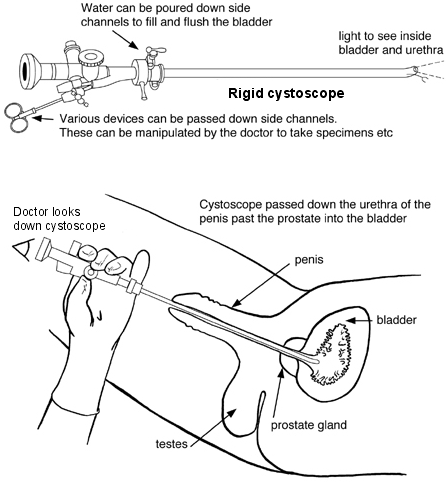
A cystoscope is a thin telescope which is passed into the bladder via the urethra, the tube that takes urine from the bladder to the outside of the body. There are two types. The cystoscope can be looked down but it also transmits pictures to a computer screen so they can be seen by other members of the team. Both types of cystoscope have side channels where various thin instruments can be passed down. For example a small sample (biopsie) may be taken from the bladder wall using an instrument which can pinch tissue and carry it back down the side channel.
Types of cystoscopy
A flexible cystoscope is the most commonly used. It is a thin, flexible, fibre-optic telescope which is about as thick as a pencil. As it is flexible, it passes easily along the curves of the urethra. The flexible tip can also be moved easily so that the whole of the bladder lining can be seen.
Flexible cystoscope
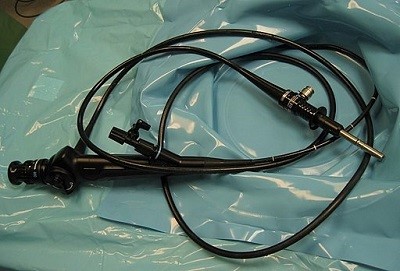
© By Michael Reeve, via Wikimedia Commons
A rigid cystoscope is a thin, solid, straight telescope. It allows a greater variety of devices to pass down the side channels so can be used for a wider variety of procedures.
Diagram of a rigid cystoscope and how a cystoscopy is performed
Cystoscopy procedure
Cystoscopy is usually done as an outpatient procedure. This means people go home the same day and aren't required to stay overnight. It is usually done whilst awake. Some people are given a sedative to help them to relax.
The opening to the urethra (at the end of the penis, or the outside of the vagina) and the nearby skin will be cleaned. Some 'jelly' is then squirted into the opening of the urethra. The jelly usually contains a local anaesthetic to numb the lining of the urethra. This helps the cystoscope to pass into the urethra with as little discomfort as possible.
Male and female cystoscopy
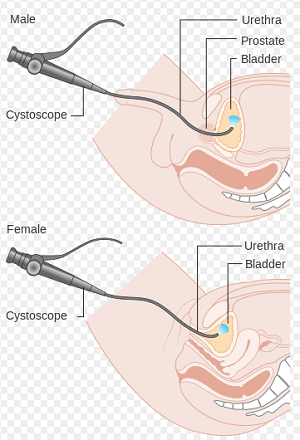
The cystoscope is then gently pushed up into the bladder and the lining of the urethra and bladder is carefully examined. Sterile water is passed down a side channel in the cystoscope to fill the bladder slowly. This makes it easier to see the lining of the bladder and the bladder wall. As the bladder fills it causes the feeling of a need to pass urine which may be uncomfortable.
The cystoscope is then gently pulled out. If a biopsy was taken, the sample would be sent away to be tested and looked at under a microscope. It can take several weeks for the report of the biopsy to come back to the doctor.
In some cases a general anaesthetic is given when a cystoscopy is done, particularly if a rigid cystoscope is used. In some cases a spinal anaesthetic is given which numbs all the lower half of the body.
How long does a cystoscopy take?
A cystoscopy takes about 5-10 minutes if it is just to look inside the bladder. It may last longer if a procedure is being performed - for example, taking a sample (biopsie) from the lining of the bladder.
Is a cystoscopy painful?
Cystoscopies are not usually painful, particularly as local anaesthetic is used to insert the cystoscope. They can be uncomfortable, especially when the bladder has been filled with water.
Complications of a cystoscopy
Most cystoscopies are done without any problem.
For the following 24 hours there may be a mild burning sensation when passing urine and a feeling of a need to pass urine more often than usual. The urine may also look pink due to mild bleeding, particularly if a biopsy was taken.
Occasionally, a infection urinaire develops shortly after a cystoscopy. This can cause a température élevée (fièvre) and pain on passing urine.
Rarely, the cystoscope may damage or perforate the bladder. After having a cystoscopy, medical advice should be sought if:
Pain or bleeding is severe.
Pain or bleeding lasts longer than two days.
Symptoms of infection develop, such as a fever.
Preparing for a cystoscopy
There are not usually any particular preparations needed before a flexible cystoscopy. Usually it is possible to eat and drink as normal beforehand. There is no need to empty the bladder. A rigid cystoscopy normally requires a general anaesthetic so guidance will be given about when to stop eating and drinking and what to do.
After a cystoscopy
After a flexible cystoscopy, it is usual to need to empty the bladder urgently and then to go home without any need for additional support. After a rigid cystoscopy, a catheter may be used to empty the bladder and the normal advice would be given about having a general anaesthetic (to wait in the hospital for a few hours to recover, to be unable to drive home, to need support at home for 24 hours).
Sélections des patients pour Tests d'urine et de vessie
Tests et investigations
Test de bandelette urinaire
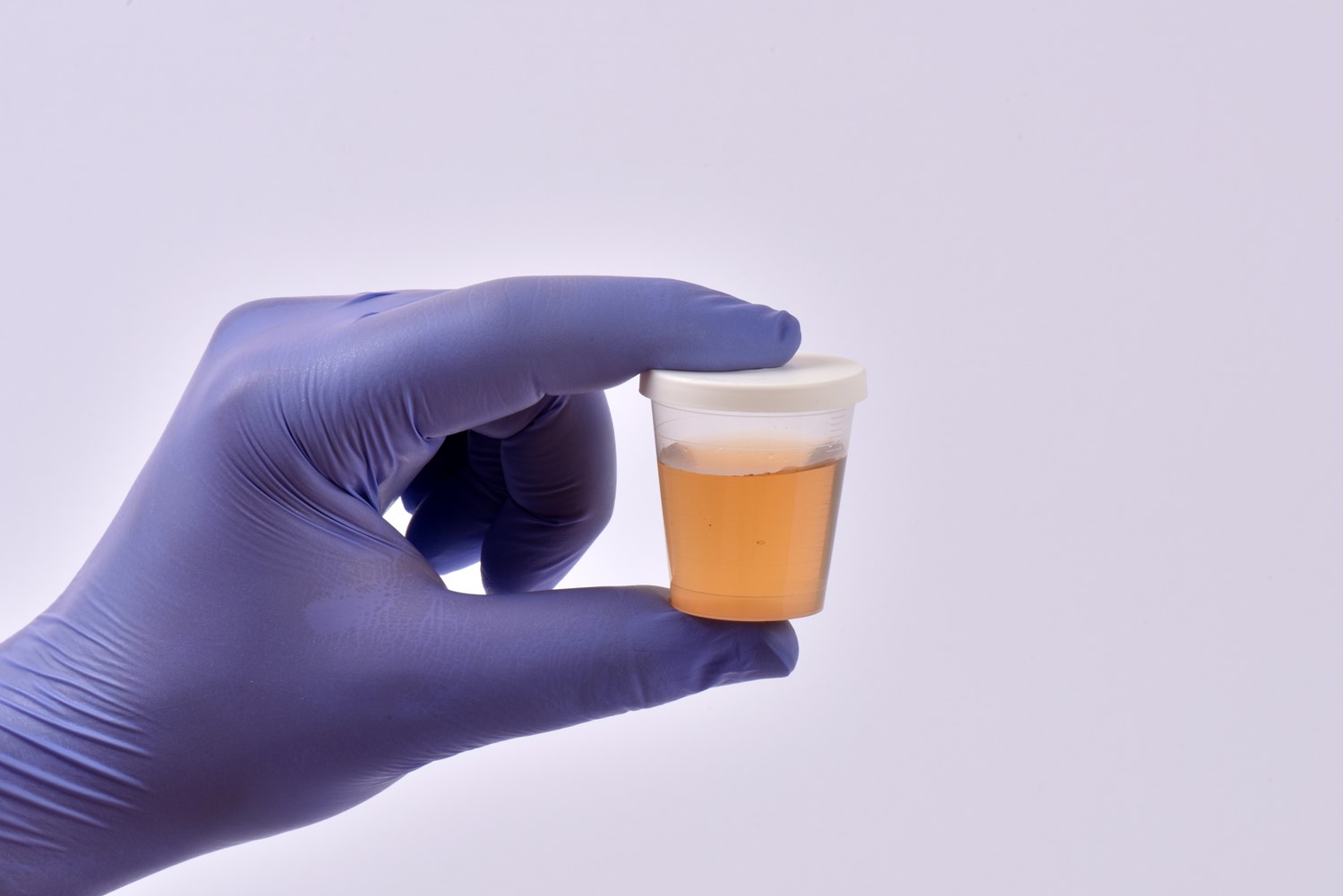
A urine dipstick test tests the urine using a special strip of paper that is dipped into a sample of urine. The result is available almost immediately. It is sometimes called a rapid urine test.
par Dr Philippa Vincent, MRCGP
Tests et investigations
Échantillon d'urine en milieu de jet
Un prélèvement d'urine en milieu de miction (MSU ou MSSU) est généralement analysé pour rechercher une infection, bien que dans certains cas, une maladie autre qu'une infection puisse être diagnostiquée en partie en fonction de ce qui est observé dans un MSU.
par Dr Rachel Hudson, MRCGP
Questions fréquemment posées
What is a cystoscope used for?
A cystoscope is a thin telescope inserted into the bladder via the urethra. It helps doctors to look inside the bladder and urethra, and also has side channels through which various thin instruments can be passed to perform procedures like removing bladder stones or taking biopsies.
How long does a cystoscopy take?
A standard cystoscopy, if only for examination purposes, typically takes about 5-10 minutes. However, if additional procedures are carried out, such as taking a biopsy from the bladder lining or removing small stones, the duration will be longer.
Does a cystoscopy involve any special preparation?
Usually, no specific preparation is needed for a flexible cystoscopy; you can eat and drink as normal and don't need to empty your bladder beforehand. If a rigid cystoscopy is planned, which often involves a general anaesthetic, specific instructions will be provided regarding eating, drinking, and what to do.
What should I expect after a cystoscopy?
Following a flexible cystoscopy, you will likely feel an urgent need to empty your bladder before going home, and usually won't need further support. For a rigid cystoscopy, especially with a general anaesthetic, a catheter might be used, and you'll receive advice about recovering from anaesthesia, such as not driving and needing support at home for 24 hours.
When should I seek medical advice after a cystoscopy?
Although most cystoscopies are problem-free, you should seek medical advice if you experience severe pain or bleeding, or if pain or bleeding lasts for more than two days. You should also contact your doctor if you develop symptoms of an infection, such as a fever.
Lectures complémentaires et références
- Zhang ZS, Wang XL, Xu CL, et al; Music reduces panic: an initial study of listening to preferred music improves male patient discomfort and anxiety during flexible cystoscopy. J Endourol. 2014 Jun;28(6):739-44. doi: 10.1089/end.2013.0705. Epub 2014 Mar 31.
- Gee JR, Waterman BJ, Jarrard DF, et al; Flexible and rigid cystoscopy in women. JSLS. 2009 Apr-Jun;13(2):135-8.
- Engelsgjerd JS, Deibert CM; Cystoscopy
- DeGeorge KC, Holt HR, Hodges SC; Bladder Cancer: Diagnosis and Treatment. Am Fam Physician. 2017 Oct 15;96(8):507-514.
À propos de l'auteurVoir la biographie complète

Dr Philippa Vincent, MRCGP
Médecin généraliste, Auteur médical
MB BS, Bsc, MRCGP (2000), DCH, DFSRH, DRCOG
Dr Philippa Vincent est un médecin généraliste du NHS travaillant dans le nord de Londres.
À propos du critiqueVoir la biographie complète

Dr Colin Tidy, MRCGP
Médecin généraliste, Auteur médical
MBBS, MRCGP, MRCP (Paediatrics), DCH
Le Dr Colin Tidy est un médecin du NHS, basé dans l'Oxfordshire.
Historique de l'article
Les informations sur cette page sont rédigées et examinées par des cliniciens qualifiés.
Article également disponible en Anglais, Allemand, Espagnol, Français, Italien, Portugais, Hindi, Hébreu, Arabe, and Suédois.
Prochaine révision prévue : 8 août 2028
10 août 2023 | Dernière version

Demandez, partagez, connectez-vous.
Parcourez les discussions, posez des questions et partagez vos expériences sur des centaines de sujets de santé.

Vous ne vous sentez pas bien ?
Évaluez vos symptômes en ligne gratuitement
Inscrivez-vous à la newsletter Patient
Votre dose hebdomadaire de conseils de santé clairs et fiables - rédigés pour vous aider à vous sentir informé, confiant et maître de la situation.
En vous abonnant, vous acceptez notre Politique de confidentialité. Vous pouvez vous désabonner à tout moment. Nous ne vendons jamais vos données.
Plus dans les tests et enquêtes
- Lavement baryté
- Test de glycémie (sucre dans le sang) et HbA1c
- Scintigraphie osseuse
- Test de Coombs
- Angiographie coronarienne
- CPRE
- Aspiration à l'aiguille fine
- Gastroscopie
- Tests génétiques
- Test de tolérance au glucose
- Hystérosalpingographie
- IRMCP
- Test auditif néonatal
- Programme de dépistage du NHS
- Test épicutané pour la dermatite de contact
- Test sanguin de routine pour la fonction rénale
- Test de sueur
- Thalassémie
- Scintigraphies thyroïdiennes et tests d'absorption
- Cystourethrogramme mictionnel