Infection urinaire chez les personnes âgées
Évalué par des pairs Dr Rachel Hudson, MRCGPDernière mise à jour par Dr Toni Hazell, FRCGPDernière mise à jour 14 nov. 2024
Respecte les directives éditoriales
- TéléchargerTélécharger
- Partager
- Language
- Discussion
- Version audio
- Ajouter aux sources préférées sur Google
Dans cette série :Infection urinaire chez les hommesÉchantillon d'urine en milieu de jet
Si vous avez une infection urinaire, vous avez des germes (bactéries) dans votre vessie, vos reins ou les tubes de votre système urinaire. Les infections urinaires, également appelées infections de la vessie, sont plus courantes chez les personnes âgées, et il est plus probable qu'il y ait une cause sous-jacente.
En un coup d'œil
A urinary tract infection (UTI) is caused by germs multiplying in the urine.
Lower UTIs affect the bladder and urethra, while upper UTIs affect the kidneys.
Symptoms can include painful or frequent urination, tummy pain, or cloudy urine.
Kidney infections may cause back pain, fever, and feeling sick.
In older people, confusion or feeling generally unwell can be symptoms.
Antibiotics usually treat UTIs, and pain can be eased with paracetamol or ibuprofen.
See a doctor promptly if symptoms worsen or do not improve after a few days.
How the urinary tract works
Urine is made by your two kidneys, one on each side of the tummy (abdomen). Urine drains down tubes called ureters into the bladder. There it is stored and passed out through a tube called the urethra, when you go to the toilet.
Vue latérale des organes génitaux masculins et diagramme en coupe transversale des voies urinaires
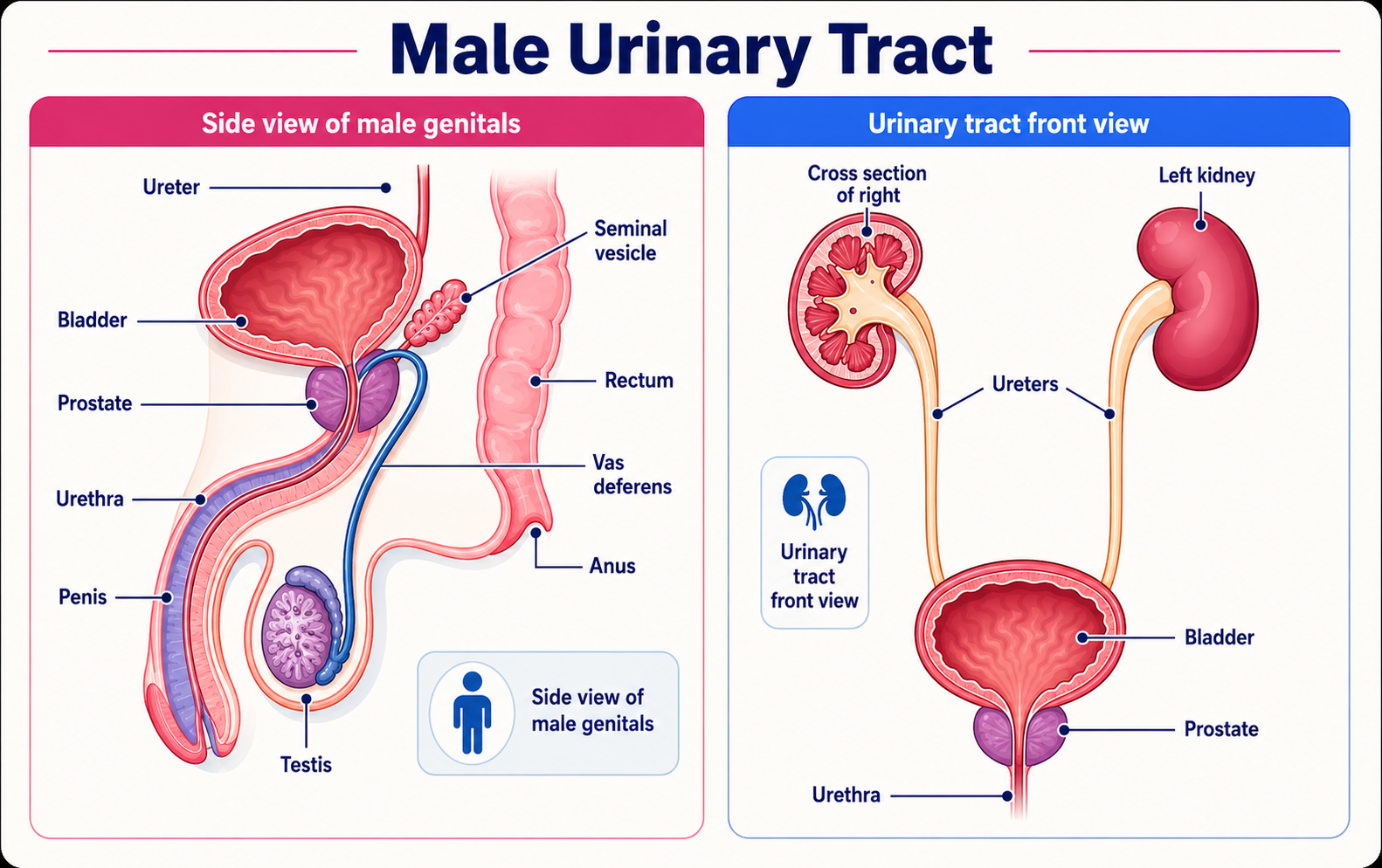
Understanding urine infection
Most urine infections are caused by germs (bacteria) that come from your own bowel. They cause no harm in your bowel but can cause infection if they get into other parts of your body. Some bacteria lie around your back passage (anus) after you pass a stool. These bacteria sometimes travel up the tube called the urethra and into your bladder. Some bacteria thrive in urine and multiply quickly to cause infection.
A urine infection is often called a urinary tract infection (UTI) by healthcare professionals. When the infection is just in the bladder and urethra, this is called a lower UTI. If it travels up to affect one or both kidneys as well then it is called an upper UTI. This can be more serious than lower UTIs, as the kidneys can be damaged by the infection.
UTI causes
In many cases the infection occurs for no apparent reason. There is no problem with the bladder, kidney, prostate gland, or defence (immune) system that can be identified. In other cases, an underlying problem can increase the risk of developing a urine infection.
Urinary tract infection in older women
Après le ménopause the lining of tissues around your genital area may become more fragile. This is called vaginite atrophique, or genitourinary syndrome of the menopause. It is associated with having more urine infections.
Des prolapse of the womb (uterus) or vagina can also increase your risk of infection.
In older men
Une hypertrophie de la prostate may stop the bladder from emptying properly. Some urine may then pool in the bladder. Germs (bacteria) are more likely to multiply and cause infection in a stagnant pool of urine.
In both
Bladder or kidney problems may lead to infections being more likely. For example, calculs rénaux or conditions that cause urine to pool and not drain properly.
Having a thin, flexible, hollow tube (called a catheter) in place to drain urine.
An underlying health condition may also be responsible. A poor immune system increases the risk of having any infection, including urine infections. For example, if you are having la chimiothérapie to treat cancer. Diabetes can also increase your risk of having urine infections.
Être constipez. If your lower gut (bowel) is full and swollen, it may press on the bladder. This may stop it emptying properly, making you more prone to urine infection.
Urinary tract infection symptoms in older people (seniors)
Infection in the bladder (cystitis):
Pain when you pass urine.
You pass urine more frequently.
You may have pain in your lower tummy (abdomen).
Your urine may become cloudy, bloody or offensive-smelling.
You may have a high temperature (fever).
Infection in the kidneys:
It may cause you to feel generally unwell.
There may be a pain in your back; this is usually around the side of the back (the loin), where each kidney is located.
You may have a high fever, which might feel like a chill or make you shake. You may feel sick, or be sick (vomit).
In some older people the only symptoms of the urine infection may be becoming confused or just feeling generally unwell.
The confusion is caused by a combination of factors such as having a fever and having a lack of fluid in the body (dehydration). The confusion should pass when the infection has been treated. An infection which is left untreated can lead to sepsis, which can be very serious, or to long-term kidney damage.
Treatment of UTI in elderly people (male and female)
A course of an médicament antibiotique will usually clear the infection quickly. You should see a doctor if your symptoms are not gone, or nearly gone, after a few days.
Paracétamol ou ibuprofène atténuera généralement toute douleur, inconfort ou température élevée (fièvre).
An underlying cause such as an hypertrophie de la prostate ou de la constipation may be found and need treatment.
It is helpful to drink plenty of water.
Questions Fréquemment Posées
How common are urine infections?
Urine infections are much more common in women than in men. This is because in women the urethra - the tube from the bladder that passes out urine - is shorter. Also it opens nearer the back passage (anus) than in men. Half of all women will have a urine infection that needs treating in their lifetime.
Urine infections are less common in men. They are very uncommon in young and middle-aged men. They are more common in older men. Men who have to use a urinary catheter are at higher risk of a UTI. A catheter is a thin, flexible, hollow tube used to drain urine. Older men are more likely to need a catheter because of prostate problems, which become more common with age.
Urine infections tend to become more common as you get older.
Des tests sont-ils nécessaires ?
In some cases the diagnosis may be obvious and no tests are needed. For a woman who is aged under 65 and is not pregnant, it would be reasonable for a GP to provide antibiotics on the basis of a phone call with appropriate symptoms, though this might not be done if it was a second UTI in a short period of time. A test on a échantillon d'urine is sometimes used to confirm the diagnosis and identify what germ (bacterium) is causing the infection. Sometimes a dipstick test can provide enough information immediately. In other cases the urine sample is sent to a laboratory for further examination under a microscope. This result takes several days.
Further tests are not usually necessary if you are otherwise well and have a one-off infection. However, your doctor may advise tests of your kidney or bladder if an underlying problem is suspected.
An underlying problem is more likely if the infection does not clear with antibiotic medication, or if you have:
Symptoms that suggest a kidney is infected (and not just the bladder).
Recurring urine infections (for example, two or more episodes in a three-month period).
Had problems with your kidney in the past, such as kidney stones or a damaged kidney.
Symptoms that suggest a blockage (an obstruction) to the flow of urine.
Relevant tests may include:
A blood test.
A scan of your kidneys or bladder, such as an échographie.
Tests to see how well your bladder is functioning, called tests urodynamiques.
A look inside your bladder with a special telescope (cystoscopy).
Quel est le pronostic ?
Most people improve within a few days of starting treatment. See a doctor if you do not quickly improve. If your symptoms do not improve despite taking an antibiotic medicine then you may need an alternative antibiotic. This is because some bacteria are resistant to some types of antibiotics. This can be identified from tests done on your urine sample.
Can I prevent urine infections?
There are some measures which may help in some cases:
It makes sense to avoid constipation, by eating plenty of fibre (such as fruit) and drinking enough fluid.
Older women with vaginite atrophique may wish to consider hormone replacement creams or pessaries. These have been shown to help prevent urine infections.
If there is an underlying medical problem, treatment for this may stop urine infections occurring.
For some people with repeated urine infections, a preventative low dose of antibiotic taken continuously may be prescribed.
Women should wipe themselves from front to back after opening their bowels, to avoid getting germs (bacteria) from the bowel into the bladder.
Sélections des patients pour Problèmes urinaires
Santé des hommes
Symptômes des voies urinaires inférieures chez les hommes
Les symptômes du bas appareil urinaire (SBAU) sont un problème très courant, surtout chez les hommes de plus de 65 ans. Ils peuvent être causés par diverses conditions. Ces symptômes peuvent inclure un ralentissement du flux urinaire et le besoin de se lever pour uriner la nuit. Il existe différentes causes de SBAU et le traitement dépendra de la cause. Certains hommes choisissent de ne pas se faire traiter si leurs symptômes ne sont pas trop gênants et que la cause n'est pas grave.
par Dr Philippa Vincent, MRCGP

Santé des femmes
Symptômes des voies urinaires inférieures chez les femmes
Lower urinary tract symptoms (LUTS) are common in women of all ages, especially between the ages of 40-60. For many women, the symptoms come and go. But for some women, the symptoms are ongoing and interfere with normal life. The symptoms may include wetting yourself (incontinence), needing to pass urine frequently, or discomfort passing urine. These and other symptoms can result in poor quality of life. Many women never tell anyone about their symptoms. Your doctor may recommend tests to look for an underlying cause. Referral to a specialist is not usually needed. Often, no specific underlying cause is found. Treatment may help to relieve symptoms.
par Dr Rachel Hudson, MRCGP
Questions fréquemment posées
What is the difference between an upper and lower urinary tract infection?
A lower urinary tract infection (UTI) occurs when the infection is confined to the bladder and urethra. If the infection spreads upwards to affect one or both kidneys, it is then referred to as an upper UTI. Upper UTIs are generally considered more serious than lower UTIs because they can potentially cause damage to the kidneys.
When should an older person with a suspected UTI seek medical attention promptly?
Older people should seek medical attention promptly for a suspected UTI, especially if they experience confusion, a general feeling of being unwell, or symptoms that suggest a kidney infection. An untreated infection can lead to serious complications like sepsis or long-term kidney damage.
Can dehydration contribute to confusion in older people with a urinary tract infection?
Yes, confusion in older people with a urinary tract infection can be caused by a combination of factors, including having a fever and a lack of fluid in the body (dehydration). This confusion should typically resolve once the infection has been successfully treated.
Can lifestyle changes, like diet, help prevent recurrent UTIs?
Yes, avoiding constipation can help prevent urine infections. Eating plenty of fibre, such as fruit, and drinking enough fluid are good ways to achieve this. Constipation can cause the bowel to press on the bladder, preventing it from emptying properly and increasing the risk of infection.
Is there a specific way women should wipe after using the toilet to help prevent UTIs?
Yes, women should wipe themselves from front to back after opening their bowels. This practice helps to prevent germs (bacteria) from the bowel from entering the bladder, thereby reducing the risk of a urinary tract infection.
Lectures complémentaires et références
- Infections urologiques; Association Européenne d'Urologie (2022 - mis à jour 2024)
- Infection des voies urinaires (inférieures) - femmes; NICE CKS, février 2025 (accès réservé au Royaume-Uni)
- Infection des voies urinaires (inférieures) - hommes; NICE CKS, juillet 2022 (accès réservé au Royaume-Uni)
À propos de l'auteurVoir la biographie complète

Dr Toni Hazell, FRCGP
MBBS, BSc, FRCGP, DFSRH, Dip GU med, DRCOG, DCH (London, UK, 2000)
Le Dr Toni Hazell a obtenu son diplôme de l'École de médecine de l'hôpital St. Mary et a effectué son VTS à l'hôpital Northwick Park.
À propos du critiqueVoir la biographie complète

Dr Rachel Hudson, MRCGP
Médecin généraliste et auteur médical
MBChB, MRCGP (2008), BSc (Medical Science), DFSRH, DRCOG, DCH
Dr Rachel Hudson est médecin généraliste du NHS travaillant dans le nord-ouest de l'Angleterre.
Historique de l'article
Les informations sur cette page sont rédigées et examinées par des cliniciens qualifiés.
Article également disponible en Anglais, Allemand, Espagnol, Français, Italien, Portugais, Hindi, Hébreu, Arabe, and Suédois.
Prochaine révision prévue : 13 nov. 2027
14 nov. 2024 | Dernière version

Demandez, partagez, connectez-vous.
Parcourez les discussions, posez des questions et partagez vos expériences sur des centaines de sujets de santé.

Vous ne vous sentez pas bien ?
Évaluez vos symptômes en ligne gratuitement
Inscrivez-vous à la newsletter Patient
Votre dose hebdomadaire de conseils de santé clairs et fiables - rédigés pour vous aider à vous sentir informé, confiant et maître de la situation.
En vous abonnant, vous acceptez notre Politique de confidentialité. Vous pouvez vous désabonner à tout moment. Nous ne vendons jamais vos données.
Plus sur la santé des seniors
- Maladie d'Alzheimer
- Médicaments biologiques pour la polyarthrite rhumatoïde
- Pemphigoïde bulleuse
- Maladie cardiovasculaire
- Causes de la perte de mémoire et de la démence
- Chondrocalcinose
- Maladie rénale chronique
- Maladie pulmonaire obstructive chronique
- Médicaments antirhumatismaux modificateurs de la maladie
- Goutte
- Perte auditive chez les personnes âgées
- Fracture de la hanche
- Médicaments et traitements pour la démence
- Soins palliatifs
- Polyarthrite rhumatoïde
- Protection des adultes
- Diabète de type 2
- Eczéma variqueux
- Varices