la maladie de Kawasaki
Revu par des pairs par Dr Doug McKechnie, MRCGPDernière mise à jour par Dr Colin Tidy, MRCGPDernière mise à jour 13 nov. 2024
Respecte les directives éditoriales
- TéléchargerTélécharger
- Partager
- Language
- Discussion
- Version audio
- Ajouter aux sources préférées sur Google
Kawasaki disease is a rare condition that affects small to medium-sized blood vessels in the body. Kawasaki disease causes the the walls of the blood vessels to become inflamed and swollen (vasculitis). Kawasaki disease mainly affects children less than 5 years old. The exact cause of Kawasaki disease remains unknown. Kawasaki disease causes a high temperature (fever), a rash, and other typical symptoms (listed below).
The most serious complication of Kawasaki disease occurs when the arteries supplying the heart (coronary arteries) are affected. This occurs in about 1 in 4 children with untreated Kawasaki disease. Treatment with intravenous immunoglobulin and aspirin has greatly reduced the proportion of children with Kawasaki disease who develop coronary artery problems.
The outcome for children diagnosed with Kawasaki disease is mainly based on the extent and severity of coronary artery involvement. Kawasaki disease is fatal in less than 1 in 500 of those affected.
En un coup d'œil
La maladie de Kawasaki est une affection rare qui touche principalement les enfants de moins de 5 ans.
Elle provoque une température élevée pendant au moins cinq jours, avec divers autres symptômes dans tout le corps.
There is no specific test; diagnosis relies on typical symptoms.
La cause est inconnue, mais elle n'est pas contagieuse.
Sans traitement, jusqu'à 1 enfant sur 4 peut développer des complications cardiaques.
Le traitement par immunoglobuline et aspirine réduit le risque de complications cardiaques.
Consultez un médecin si votre enfant a de la fièvre pendant cinq jours ou plus.
What is Kawasaki disease and who gets it?
It is an uncommon condition that mainly affects children aged under 5 years. It most commonly affects children aged 18-24 months. It causes various symptoms throughout the body (listed below). Kawasaki disease was first described in the 1960s by a Japanese doctor named Tomisaku Kawasaki. Since then cases have been reported in many countries.
Kawasaki disease is also occasionally known as mucocutaneous lymph node syndrome.
It is much more common in some countries than it is in others. It seems to be particularly common in Japan. It is less common in Europe and the USA. It affects boys more often than it affects girls. It seems to run in families. So it is more common in siblings or children of people who have had the disease in the past.
Kawasaki disease symptoms
A high temperature (fever) which lasts at least five days is usual. If your child has a fever for five days or more, you should see your doctor, who should assess them to see if they might have Kawasaki disease. In addition, at least four of the following normally develop:
Bloodshot eyes
Redness of the eyes (conjunctivitis) without sticky discharge.
Strawberry tongue
Changes in the mouth such as a red throat or tongue, or dry and cracked lips.
Strawberry tongue
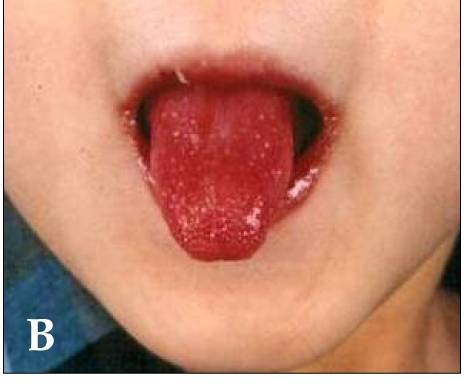
© Kawasaki_symptoms.jpg: Dong Soo Kimderivative work: Natr, CC BY 2.0, via Wikimedia Commons
Kawasaki rash
A rash. This normally fades within a week. There is no specific 'Kawasaki rash' - the appearance may be different in different children. Most often there are raised red blotchy areas. It tends to affect a lot of the body, particularly the chest, tummy, back, groins, hands and feet.
Peeling of fingers
Changes in the hands or feet such as mild swelling or redness. The skin on some of the fingers or toes often peels after about 2-3 weeks.
Ganglions lymphatiques enflés
One or more lymph glands in the neck become swollen.
It's important to remember that some of these symptoms may settle. That means you need to tell your doctor if your child has had any of these symptoms, even if they have gone away on their own.
Children under 1 year old may not have as many other features of Kawasaki disease apart from fever. However, it is very important that they are checked out and referred for tests if the doctor thinks they may have Kawasaki disease.
Also, affected children are commonly very irritable. The diagnosis is based on the above typical group of symptoms. There is no test to confirm the disease. Tests may be done to rule out other diseases that cause similar symptoms, such as rougeole, la scarlatine, etc.
Other symptoms may develop in addition to the above. These are less common and include:
Diarrhée.
Être malade (vomissements).
Douleurs au ventre (abdominales).
Perte d'appétit.
Joint swelling and pains.
Skin going yellow (jaundice).
Typically, fever develops first and then the other symptoms (listed above) develop after a few days. Often, the symptoms that develop after the high temperature (fever) has started develop one after each other rather than all coming on at the same time. This is why the diagnosis may take several days to make after the initial fever starts. In total, symptoms tend to last up to 10 days before easing and going, although complications sometimes develop (see below).
During the illness, some children become very unwell, but others have a mild illness. This may be similar to many common infections that are caused by a virus. However, any child suspected of having Kawasaki disease is normally admitted to hospital, even if they appear to have a mild illness.
What causes Kawasaki disease?
The cause is not known. The symptoms seem rather like many common infections. However, it is not catching (contagious). It is rare for contacts of affected children also to become affected at the same time. This means that the cause is unlikely to be just an infection with a germ such as a bacterium or virus. It may be an unusual or severe reaction to a common virus that usually causes little or no harm to most people. However, no virus or other germ has been proved to cause this disease.
There seems to be some genetic tendency that increases the risk of developing the condition. For example, parents of children with Kawasaki disease are more likely to have had the condition themselves during childhood. Also, brothers and sisters have an increased risk of developing the condition. So, a theory is that affected children may have a genetic make-up that makes them 'overreact' to a common viral infection that does not cause problems in most children.
Kawasaki disease diagnosis
There is no specific test. So it is usually diagnosed on the basis of the typical features. Blood tests may point towards the diagnosis, or be used to rule out other possible diagnoses.
A heart scan (echocardiogram, or echo) is normally done to look for complications (see below). If complications do occur, they usually develop a week or so after the symptoms listed above. If heart complications occur, other types of scans may be used to monitor these over time.
Kawasaki disease treatment
Aspirine. This is one of the few times aspirin is given to children. Aspirin helps to reduce the inflammation in the coronary arteries. It also helps to prevent clots in the blood. The flu jab (influenza vaccination) is usually given to children who have had aspirin treatment if they have not yet had their annual vaccination. This prevents some of the complications which can be caused by aspirin in children.
Immunoglobulin. This is an antibody mixture obtained from human blood. It is given by a slow injection over a few hours (infusion) into the bloodstream. You may see it referred to as IVIg - intravenous immunoglobulin. It is not clear how it works. It may modify the response of the immune system in some way to prevent inflammation in the arteries.
Treatment with immunoglobulin given within 10 days of the onset reduces the chance of heart complications (see below). Without treatment, about 25 in 100 affected children develop an aneurysm. With treatment, this is reduced to fewer than 5 in 100. In some cases the immunoglobulin treatment is not effective and other options are tried.
Other treatments aim to make the child comfortable, such as giving lots to drink and nursing them through the acute feverish illness.
Research continues to search for better treatments. Some treatments which have been tried or are being studied are:
Further research is needed to confirm the role of these medicines in the treatment of Kawasaki disease.
If aneurysms have developed (see complications section below), a specialist heart doctor for children (a paediatric cardiologist) will be involved. In this situation, treatment is needed to prevent heart attacks or other heart problems developing. The child will have regular heart scans to keep an eye on what is happening. He or she may need another medicine to stop a blood clot. Very occasionally an operation is needed on the heart.
Some vaccines - particularly rougeole, oreillons et rubéole (ROR) - may need to be delayed for some months after IVIg treatment, which may cause them to be less effective.
Complications
Problèmes cardiaques
Without treatment, up to 1 in 4 children who have Kawasaki disease develop inflammation of the blood vessels to the heart (coronary arteries). This can cause a swelling of a section of a coronary artery, which is called an aneurysm.
A coronary artery aneurysm usually causes no symptoms. Over time it often goes away and the artery returns to normal. However, the wall of an aneurysm is weakened and abnormal. Serious problems may develop in some children with an aneurysm. The most serious is that a clot (thrombosis) may develop in the aneurysm. The muscle of the heart is supplied with oxygen, carried in the blood of these arteries. If a clot develops, the muscle does not get enough oxygen. The heart muscle can then be damaged, causing a heart attack. Currently fewer than 1 in 100 children with Kawasaki disease die of heart problems.
An aneurysm can be detected by a heart scan (an echocardiogram, or echo). If an aneurysm does occur, it starts to develop a week or more after the fever and other acute symptoms begin. Treatment within 10 days of symptoms starting often prevents an aneurysm developing.
Autres complications
The aneurysm of a coronary artery is caused by inflammation of the artery (a 'vasculitis'). This swelling can occur in other arteries in various parts of the body, causing aneurysms elsewhere - but this is very rare. Various other rare problems have also been reported in some children with Kawasaki disease.
Kawasaki disease in adults
Kawasaki disease usually affects children. However in rare cases, it can occur in adults. Also, children who have had heart complications due to Kawasaki disease may continue to be affected by these when they reach adulthood. For example, women who had Kawasaki disease as children may not be able to have certain contraceptive pills, and may need specialist advice about whether it is safe for them to become pregnant.
Sélections des patients pour General health conditions
Santé des enfants
Douleur dorsale chez les enfants
Les douleurs dorsales chez les enfants sont assez fréquentes et semblent de plus en plus courantes. La plupart du temps, ce n'est pas un problème grave.
par Dr Toni Hazell, FRCGP

Santé des enfants
Obésité infantile
Si votre enfant est en surpoids ou obèse, il présente un risque accru de développer divers problèmes de santé et est plus susceptible de devenir un adulte en surpoids.
par Dr Laurence Knott
Questions fréquemment posées
Pourquoi le traitement retardé de la maladie de Kawasaki dans les 10 jours est-il si important ?
Recevoir un traitement, en particulier avec des immunoglobulines, dans les 10 jours suivant l'apparition des symptômes réduit considérablement le risque de développer des complications cardiaques, telles qu'un anévrisme des artères coronaires. Sans traitement, environ 25 enfants sur 100 touchés développent un anévrisme, mais avec un traitement rapide, ce chiffre est réduit à moins de 5 sur 100.
Que se passe-t-il si un anévrisme se développe dans le cœur à cause de la maladie de Kawasaki ?
Si un anévrisme se développe dans une artère coronaire, il ne provoque généralement pas de symptômes au départ et se résout souvent de lui-même avec le temps. Cependant, la paroi artérielle affaiblie et anormale peut entraîner des problèmes graves, notamment la formation d'un caillot sanguin à l'intérieur de l'anévrisme. Ce caillot peut restreindre le flux sanguin vers le muscle cardiaque, causant potentiellement des dommages et une crise cardiaque. Si un anévrisme est détecté, un cardiologue pédiatrique sera impliqué pour gérer la condition, ce qui peut inclure des examens cardiaques réguliers et des médicaments pour prévenir les caillots sanguins. Dans de très rares cas, une chirurgie cardiaque peut être nécessaire.
La maladie de Kawasaki peut-elle être transmise par d'autres personnes ?
Non, la maladie de Kawasaki n'est pas contagieuse. Il est rare que les personnes en contact étroit avec un enfant atteint développent également la maladie. Bien que les symptômes ressemblent à des infections courantes, la cause n'est pas directement liée à un germe comme une bactérie ou un virus qui peut être transmis de personne à personne.
Qu'est-ce que le syndrome des ganglions lymphatiques mucocutanés ?
Le syndrome des ganglions lymphatiques mucocutanés est un autre nom parfois utilisé pour la maladie de Kawasaki. Il fait référence à l'implication des muqueuses (comme dans la bouche et les yeux) et des ganglions lymphatiques, qui sont des symptômes caractéristiques de la condition.
Quels autres traitements pourraient être envisagés si le traitement initial par immunoglobuline n'est pas efficace ?
Si le traitement par immunoglobulines n'est pas efficace, d'autres options qui ont été essayées ou qui sont actuellement à l'étude incluent des stéroïdes comme la prednisolone, l'infliximab, l'étanercept et le méthotrexate. Cependant, des recherches supplémentaires sont nécessaires pour confirmer le rôle de ces médicaments dans le traitement de la maladie de Kawasaki.
Quelle est la durée typique des symptômes de la maladie de Kawasaki ?
En général, les symptômes de la maladie de Kawasaki durent jusqu'à 10 jours avant de commencer à s'atténuer et à se résoudre. Cependant, des complications peuvent parfois survenir après cette période initiale.
Lectures complémentaires et références
- Owens AM, Plewa MC; Kawasaki Disease. StatPearls, Jan 2024.
- Kuo HC; Diagnosis, Progress, and Treatment Update of Kawasaki Disease. Int J Mol Sci. 2023 Sep 11;24(18):13948. doi: 10.3390/ijms241813948.
- Rife E, Gedalia A; Kawasaki Disease: an Update. Curr Rheumatol Rep. 2020 Sep 13;22(10):75. doi: 10.1007/s11926-020-00941-4.
- Green J, Wardle AJ, Tulloh RM; Corticosteroids for the treatment of Kawasaki disease in children. Cochrane Database Syst Rev. 2022 May 27;5(5):CD011188. doi: 10.1002/14651858.CD011188.pub3.
- Fièvre chez les moins de 5 ans : évaluation et prise en charge initiale; Directives NICE (dernière mise à jour novembre 2021)
À propos de l'auteurVoir la biographie complète

Dr Colin Tidy, MRCGP
Médecin généraliste, Auteur médical
MBBS, MRCGP, MRCP (Paediatrics), DCH
Le Dr Colin Tidy est un médecin du NHS, basé dans l'Oxfordshire.
À propos du critiqueVoir la biographie complète

Dr Doug McKechnie, MRCGP
Rédacteur Médical
MA, MBBS, MSc, DRCOG, MRCP(UK), MRCGP(2021), FHEA
Le Dr Doug McKechnie est un médecin généraliste du NHS travaillant à Londres. Il travaille à plein temps en clinique et est également le chef adjoint du module de Pratique Clinique et Professionnelle à l'École de Médecine de l'University College London.
Historique de l'article
Les informations sur cette page sont rédigées et examinées par des cliniciens qualifiés.
Article également disponible en Anglais, Allemand, Espagnol, Français, Italien, Portugais, Hindi, Hébreu, Arabe, and Suédois.
Next review due: 12 Nov 2027
13 nov. 2024 | Dernière version

Demandez, partagez, connectez-vous.
Parcourez les discussions, posez des questions et partagez vos expériences sur des centaines de sujets de santé.

Vous ne vous sentez pas bien ?
Évaluez vos symptômes en ligne gratuitement
Inscrivez-vous à la newsletter Patient
Votre dose hebdomadaire de conseils de santé clairs et fiables - rédigés pour vous aider à vous sentir informé, confiant et maître de la situation.
En vous abonnant, vous acceptez notre Politique de confidentialité. Vous pouvez vous désabonner à tout moment. Nous ne vendons jamais vos données.
Plus sur la santé des enfants
- Vaccin 6-en-1
- Douleur dorsale chez les enfants
- Énurésie
- Systèmes de récompense pour l'énurésie
- Obésité infantile
- Cancers infantiles
- Cri du chat syndrome
- Dysplasie développementale de la hanche
- syndrome d'Ehlers-Danlos
- Intoxication alimentaire chez les enfants
- Gastro-entérite chez les enfants
- Invagination intestinale et volvulus chez les enfants
- Neuroblastome
- Vulvovaginite pédiatrique
- Polio et vaccin contre la polio
- Protection des enfants
- Drépanocytose
- Testicules non descendus