Érythème fessier
Revu par Dr Philippa Vincent, MRCGPDernière mise à jour par Dr Rachel Hudson, MRCGPLast updated 16 mai 2023
Respecte les directives éditoriales
- TéléchargerTélécharger
- Partager
- Language
- Discussion
- Version audio
- Add to preferred sources on Google
La plupart des bébés développent une érythème fessier à un moment donné. En général, il est léger et ne dérange pas votre bébé. Cependant, il peut être plus sévère et douloureux dans certains cas. Il peut généralement être géré avec les suggestions ci-dessous.
Dans cet article:
Video picks for Bébé et tout-petit
Continuez à lire ci-dessous
What causes nappy rash?
Nappy rash is a skin inflammation. Most cases are due to a reaction of the skin to urine and poo. Babies have sensitive skin which is vulnerable to irritation.
Érythème fessier
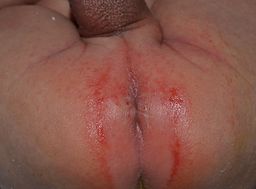
© Dailyboth, CC0, via Wikimedia Commons
In addition, a germ called candida commonly thrives on the inflamed skin. (This is the germ that also causes the infection commonly known as le muguet which most often occurs in the bouche (oral thrush) or around the genital area.) Candida can cause a more inflamed rash which is a brighter or darker red. Sometimes the rash can also become infected with other types of germs called bacteria. This will also make the rash more red and sore.
Nappy rash candida
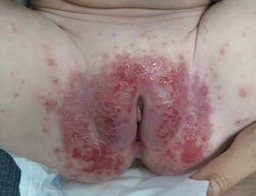
© Elaine C. Siegfried1,†* and Adelaide A. Hebert2,†, CC BY 4.0, via Wikimedia Commons
Nappy rash can occur or worsen when your baby is teething. It is unclear why teething can lead to nappy rash although it is thought that it is due to your baby producing more saliva. This changes the nature of the baby's poo, making it more likely to cause a reaction when it touches the skin.
Most nappy rashes are mild or moderate and are not serious. Occasionally, skin conditions such as eczéma, psoriasis, infections and some rare skin diseases cause unusual nappy rashes.
How can I heal or prevent nappy rash?
Retour au sommaireLeave the nappy off as much as possible
This allows fresh air to get to the skin. Obviously, you cannot leave the nappy off all the time. However, the more fresh air, the better. Try letting the baby lie without a nappy on a towel or disposable absorbent sheet for a period of time each day. However, do change the towel or sheet as soon as it becomes wet.
Change the nappy often
Ideally, change the nappy as soon as it is wet or soiled. The aim is to prevent your baby's skin being in contact with urine and poo (faeces) for long periods of time. This is especially important if your baby is teething and has offensive, runny poo.
Wipes are as effective as water
Studies have shown that using baby wipes has the same effect on your baby's skin as using cotton wool and water. However, it is best to use wipes which are free from fragrance or alcohol.
After washing, make sure the baby's bottom is properly dry
Do this before putting on a new nappy. Dry by patting, not by rubbing, with a towel.
Do not use powder such as talcum powder
This may irritate the skin. Also avoid soaps, bubble baths and lotions.
Use barrier creams or ointments
Available to buy from pharmacies, barrier creams or ointments may help to protect the skin from moisture. They literally form a barrier between your baby's skin and the poo or urine. Ideally, rub on a thin layer of barrier cream or ointment just before putting on each nappy. Do not apply too much, as this may reduce the 'breathability' of the nappy. The recommended ointments are:
Zinc and castor oil ointment.
Metanium®.
White soft paraffin ointment.
Bepanthem® ointment.
Don't use tight-fitting plastic pants over nappies
They keep in moisture and may make things worse.
Continuez à lire ci-dessous
What other treatments may be used?
Retour au sommaireThe above measures are likely to clear a mild rash. If the rash becomes worse, a healthcare professional may advise using one of the following in addition to the above measures:
A mild steroid cream or ointment such as l'hydrocortisone can be used to treat nappy rash. Steroids treat inflammation. Apply sparingly as often as prescribed (before using a barrier cream or ointment) for a few days until the rash has cleared. A steroid cream or ointment should not usually be used for more than seven days.
Une crème antifongique which kills thrush (candida). This is typically applied 2-3 times a day. Unlike a steroid cream, continue to use an antifungal cream for 7-10 days after the rash has cleared, to make sure all the candidal germs have gone. If you are prescribed an antifungal cream, use this without a barrier cream. In this way you clear up the infection first. THEN use the barrier cream to help clear up the nappy rash.
A combination cream containing an antifungal agent and a mild steroid is often given.
Sometimes the inflamed skin of a nappy rash becomes infected with other types of germs (bacteria). This may be suspected if the rash becomes worse, despite use of the above treatments. In these cases an antibiotic medicine may be needed.
Also, as mentioned, occasionally a nappy rash is due to an unusual or more serious skin condition. Therefore, if a nappy rash does not improve with the usual treatment described above then see your doctor.
Patient picks for Bébé et tout-petit

Santé des enfants
Dermatite séborrhéique chez les bébés
Dermatite séborrhéique chez les bébés provoque de fortes pellicules (croûte de lait). Elle peut parfois provoquer une éruption cutanée sur d'autres zones de la peau. Le traitement n'est généralement pas nécessaire, car elle ne cause généralement pas d'inconfort et disparaît souvent d'elle-même.
by Dr Hayley Willacy, FRCGP

Santé des enfants
Ictère néonatal
Jaunisse néonatale est très courante durant les deux premières semaines de vie d'un bébé. Elle est généralement inoffensive, mais peut être due à une cause grave nécessitant un traitement à l'hôpital. La jaunisse néonatale est plus susceptible d'avoir une cause grave si elle apparaît dans les 24 premières heures de vie ou si elle ne disparaît pas avant l'âge de 2 semaines. Tous les bébés présentant une jaunisse doivent être examinés par une sage-femme ou un médecin. Votre bébé peut ne nécessiter aucun traitement. Une photothérapie peut être nécessaire pour traiter la jaunisse. D'autres tests et traitements peuvent également être nécessaires s'il existe une cause plus grave de la jaunisse.
by Dr Hayley Willacy, FRCGP
Lectures complémentaires et références
- Napkin dermatitis; DermNet NZ
- Blume-Peytavi U, Lavender T, Jenerowicz D, et al; Recommendations from a European Roundtable Meeting on Best Practice Healthy Infant Skin Care. Pediatr Dermatol. 2016 May;33(3):311-21. doi: 10.1111/pde.12819. Epub 2016 Feb 26.
- Érythème fessier; NICE CKS, juillet 2022 (accès réservé au Royaume-Uni)
Continuez à lire ci-dessous
About the authorView full bio

Dr Rachel Hudson, MRCGP
General Practitioner and Medical Author
MBChB, MRCGP (2008), BSc (Medical Science), DFSRH, DRCOG, DCH
Dr Rachel Hudson, is an NHS GP working in the North West of England.
About the reviewerView full bio

Dr Philippa Vincent, MRCGP
Médecin généraliste, Auteur médical
MB BS, Bsc, MRCGP (2000), DCH, DFSRH, DRCOG
Dr Philippa Vincent is an NHS GP working in North London.
Historique de l'article
Les informations sur cette page sont rédigées et examinées par des cliniciens qualifiés.
Prochaine révision prévue : 14 mai 2028
16 mai 2023 | Dernière version

Demandez, partagez, connectez-vous.
Parcourez les discussions, posez des questions et partagez vos expériences sur des centaines de sujets de santé.

Vous ne vous sentez pas bien ?
Évaluez vos symptômes en ligne gratuitement
Inscrivez-vous à la newsletter Patient
Votre dose hebdomadaire de conseils de santé clairs et fiables - rédigés pour vous aider à vous sentir informé, confiant et maître de la situation.
By subscribing you accept our Politique de confidentialité. Vous pouvez vous désabonner à tout moment. Nous ne vendons jamais vos données.