Infections virales de la peau
Revu par Dr Colin Tidy, MRCGPDernière mise à jour par Dr Toni Hazell, MRCGPLast updated 3 Aug 2025
Respecte les directives éditoriales
- TéléchargerTélécharger
- Partager
- Language
- Discussion
- Version audio
- Add to preferred sources on Google
Dans cette série :Feux sauvagesInfection primaire par l'herpès labialPityriasis roséMolluscum contagiosum
Viral skin infections are a wide group of conditions. They can be a reaction to a virus intérieur your body, or they can be an actual infection of your skin. They range from the entirely harmless, to the quite serious (but not usually life-threatening). Some are contagious; others you can touch without catching.
At a glance
Viral skin infections are caused by tiny germs called viruses.
Common viral skin infections include chickenpox, cold sores, and hand, foot and mouth disease.
Many viral rashes clear up on their own without specific treatment.
Some viral infections, such as measles, can be prevented by vaccination.
See a doctor if you or your child have a rash and also feel or look unwell.
Dans cet article:
Video picks for Infections cutanées
Continuez à lire ci-dessous
What are viruses?
I'm sure you're used to your doctor saying: 'It's just a virus!' Viruses are tiny germs. You can't see them with the naked eye. They are all around us and are usually harmless (the common cold is caused by viruses, for example). On the other hand, some can be really bad for you if untreated (like HIV).
This leaflet is about how viruses can affect your skin. It will cover the common things that you are likely to see in you and your children.
Which infections are viral?
Retour au sommaireThere are some viral skin infections that you catch by touching someone else. Chickenpox is a common example (although you can also catch chickenpox through the air). Molluscum contagiosum and herpes simplex are probably the other most common examples we see in the UK. In the farming community there is something called 'orf'.
Which conditions cause a rash to come out all over?
Back in the 1970s, doctors in the UK used to see rougeole et German measles: these are viral infection inside your body, but which make a rash come out all over your skin. Vaccination meant that for some years they were practically unheard of in the UK, but sadly, with people choosing not to vaccinate their children, rates of measles are on the rise and some people have died in the last year or two. Before vaccination, hundreds of people died from measles in the UK every year - if you or your children aren't vaccinated, think carefully about whether you really want to be exposed to that risk. They are still common in low- and middle-income countries . More common examples are pityriasis rosea et main, pied et bouche disease.
Why does my child come out in a rash if they are a bit ill?
This is probably the most common type of viral skin condition, referred to sometimes as a 'reactive viral rash'. Family doctors see this all the time. It can come out when your child has a high temperature (fever), or even a couple of days after having an illness. It is pretty harmless and not passed on by physical contact (contagious).
Continuez à lire ci-dessous
What do viral skin infections feel like?
Retour au sommairePityriasis rosé gives you oval-shaped pale red patches scattered pretty much over all your body, apart from your face and head. It usually starts with a slightly bigger oval, typically on your tummy or chest, and then dozens, even hundreds, of tiny ovals come out. Although they look really bad, you can't really feel them at all. If you see a doctor when just the first patch has appeared, it might get misdiagnosed as a fungal infection, because it's very difficult to tell the two things apart at that stage.
Similarly, with the rash of rougeole ou German measles you can't really feel it at all even though it looks really bad: you just feel generally ill from the virus.
Hand, foot and mouth disease causes tiny bumps - on the palms of your hands, the soles of your feet and even in your mouth. They can be a little bit uncomfortable but aren't actually painful or itchy.
Varicelle gives small spots, scattered around the body. They are a bit sore and a bit itchy. They are almost always found on your tummy and chest. If the spots are just on your arms and legs but not on your tummy then it probably isn't chickenpox.
Monkeypox causes a rash that can sometimes be confused with chickenpox, especially in the early stages. However, blisters filled with clear fluid in monkeypox later become filled with cloudy yellow-white liquid. See the separate leaflet on Monkeypox for further details.
Feux sauvages cause a slightly itchy, tingly spot that is usually just on the edge of your lip.
Molluscum contagiosum gives you small spots, usually clustered together on your arm or leg, rather than all over your body. They generally can't be felt at all and aren't itchy. Sometimes they get infected and feel a bit sore but this is unusual.
Herpes simplex gives you tiny red spots which are really painful, more than itchy.
Orf is a viral infection you can catch from infected sheep or goats. The rash most often affects the fingers, hands, forearms or face. It doesn't usually need any treatment and resolves in about six weeks. Orf causes quite a big bump but it's not actually painful.
Herald patch of pityriasis rosea
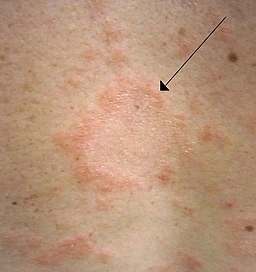
© James Heilman MD (Own work), CC BY-SA 3.0, via Wikimedia Commons
The picture above shows the typical 'herald patch' of pityriasis rosea. The rash will cover almost the whole tummy and chest. It fades in a few weeks to a few months and isn't contagious.
Feu sauvage d'herpès simplex sur la lèvre
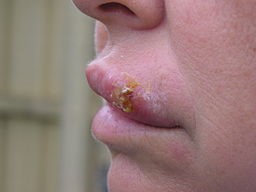
© Ben Tillman (Travail personnel), Domaine public, via Wikimedia Commons
The image above shows a typical cold sore on someone's lip. It is tingly and a bit sore. It'll go away in a few weeks but if you kiss them you can catch it!
Molluscum contagiosum close-up view
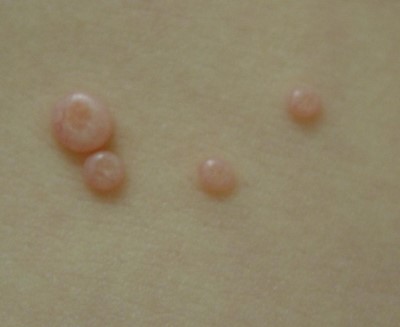
© Dave Bray, MD, Walter Reed Army Medical Center, Public domain, via Wikimedia Commons
Finally, the above close-up image shows the typical spots of molluscum contagiosum: they are harmless and not particularly contagious. They do go away but only after a year or two. They are best left alone.
How does my doctor diagnose a viral skin infection?
Retour au sommaireUsually a doctor can tell what the skin condition is, by what you tell them and by what it looks like.
Very occasionally if there is an unusual skin problem that the doctor can't work out, they may refer you to a doctor who specialises in skin conditions (a dermatologist).
If a rash looks like mumps or measles then your doctor will tell the public health team, who will arrange a test to be sure if you have this virus. This is important so that healthcare services can get early warning when an outbreak is coming.
How do I know which virus has caused my rash?
Blood tests are rarely used, it's often a clinical diagnosis; that means the doctor will listen to what you have to say (take a history) and look at you (examine), and that will be enough to make the diagnosis.
There are a few conditions where a virus is known to cause a specific skin condition.
Chickenpox is caused by varicella zoster. (This virus can lie dormant in your body and then come out years later as zona.)
Pityriasis rosea is caused by a type of herpes virus.
Hand, foot and mouth disease is caused by Coxsackievirus and enterovirus.
Mumps and measles are caused by the mumps and measles viruses (the virus and the illness have the same name).
Molluscum contagiosum is caused by pox virus.
Orf is caused by parapox virus (which starts off in sheep or lambs).
Herpes simplex is caused by the herpes simplex virus type 1 (this is the same virus that causes cold sores); however, herpès génital is caused by herpes simplex type 2.
Continuez à lire ci-dessous
How to treat a viral skin infection
Retour au sommaireThankfully almost all viral skin conditions get better by themselves. Sometimes no treatment at all is needed; sometimes a lotion can be used to soothe your skin (like calamine lotion in chickenpox). Certain skin conditions caused by herpes simplex can be treated with antiviral medicines that are prescribed by a doctor. For infections like measles and chickenpox, those who get very ill with complications in the lung or brain will need to be admitted to hospital, though sadly the brain complications of measles can't really be treated and the person often dies. That's a really important reason to be vaccinated against measles; by the time you get ill, it's too late.
My doctor said my child has a viral rash - what can I do?
If your child has a high temperature (fever) or a mild illness and they've come out with a reactive viral rash then no treatment at all is necessary.
As adults, we see a rash in our children and think 'that must be itchy' but these types of rashes are hardly ever itchy at all.
If it's itchy then something like calamine lotion might help, by the soothing effect - though it doesn't treat the underlying cause.
Antihistamines generally don't work, as the rash isn't caused by histamine (as allergic rashes are).
These rashes fade in a few days by themselves: just be patient.
Other rashes that go away without treatment are hand, foot and mouth disease, pityriasis rosea and molluscum contagiosum.
Is there anything I can do for chickenpox?
Often with chickenpox the spots look really bad but when you ask the child, they say the spots don't really bother them that much: they just feel really ill.
Simple things are best for chickenpox: some cream that you keep in the fridge, like calamine lotion or any other type of moisturiser.
See the separate leaflet called Chickenpox in adults and teenagers.
Why does my cold sore keeping coming back?
Cold sores are caused by a virus called herpes simplex.
It's a very stubborn virus: once it's got inside your system it stays inside you for years.
Although each time you get a cold sore it goes away in a few weeks, the virus lies dormant: it's never fully killed.
If you're a bit run-down, or on any medication that lowers your immune system, the cold sore is likely to come back.
You can treat it each time with an antiviral medicine like aciclovir or famciclovir which helps it go away more quickly.
Quelle est la perspective ?
Retour au sommaireTime is usually the best healer. Chickenpox goes away in a few weeks for example. Other viral skin conditions take a while: pityriasis rosea and molluscum contagiosum can take months to go away. However, almost all viral skin conditions do fade away. Once you have had a viral skin condition, it usually does not come back (the exception being herpes simplex).
When should I seek help for a rash?
Retour au sommaireOccasionally a rash can be a sign of serious illness. The best sign that someone is unwell with a rash is if they feel ill or, in the case of a baby or someone who can't talk, if they look ill. Rare but life-threatening infections like meningococcal septicaemia can cause a rash but by then the person will also be feeling very ill.
In general, seek medical advice if you or your child have a rash but also feel or look ill.
Patient picks for Infections cutanées

Infections
Rougeole
La rougeole est une infection qui touche principalement les enfants, mais peut survenir à tout âge. Elle est rare au Royaume-Uni grâce à la vaccination. La maladie est désagréable, mais la plupart des enfants se rétablissent complètement. Cependant, certains enfants développent des complications graves.
par Dr Toni Hazell, MRCGP
Infections
Éruptions virales
De nombreuses infections virales peuvent provoquer une éruption cutanée en plus d'autres symptômes. Les éruptions cutanées sont très courantes avec les infections virales, surtout chez les jeunes enfants. Il est très important de s'assurer que l'éruption cutanée ne fait pas partie d'une infection grave - par exemple, une infection à méningocoques qui est une infection bactérienne et peut être associée à une méningite.
par Dr Toni Hazell, MRCGP
Questions fréquemment posées
Can viral skin infections be dangerous?
Most viral skin conditions get better by themselves and are harmless, such as the common cold, which is caused by a virus. However, some, like untreated HIV, can be very serious. Severe conditions like measles, while now rarer in the UK due to vaccination, can lead to serious complications and even death. It is important to seek medical advice if you or your child have a rash and also feel or look ill, as this can occasionally signal a more serious underlying illness.
How do doctors usually diagnose viral skin infections?
Generally, a doctor can diagnose a skin condition based on the information you provide and what the rash looks like. This is often referred to as a 'clinical diagnosis'. Blood tests are rarely needed. In unusual cases where a diagnosis is unclear, you might be referred to a dermatologist, a doctor specialising in skin conditions. For rashes resembling mumps or measles, public health teams are informed to arrange testing, helping to detect potential outbreaks.
Are all viral skin rashes contagious?
No, not all viral skin rashes are contagious. Some, like chickenpox and herpes simplex, are easily passed on. However, a common 'reactive viral rash' that children get when ill, or conditions like pityriasis rosea, are not passed on through physical contact. Molluscum contagiosum, while caused by a virus, is not considered particularly contagious, and the spots are best left alone.
What is the typical recovery time for these viral skin conditions?
The recovery time varies by condition. Chickenpox usually clears up within a few weeks. Other viral conditions, such as pityriasis rosea and molluscum contagiosum, can take months to disappear. However, almost all viral skin conditions eventually fade away on their own. The exception to them not returning is herpes simplex, which can lie dormant and re-emerge.
My child has a rash along with a high temperature. What should I do?
If your child has a high temperature or a mild illness and develops a 'reactive viral rash', no specific treatment is usually necessary, as these rashes are generally harmless and not passed on to others. While adults often assume these rashes are itchy, children rarely find them so. They typically fade within a few days on their own. If the rash is itchy, a soothing lotion like calamine may help, but antihistamines are generally ineffective as the rash is not caused by histamine.
Lectures complémentaires et références
- Allmon A, Deane K, Martin KL; Common Skin Rashes in Children. Am Fam Physician. 2015 Aug 1;92(3):211-6.
- Peterson AR, Nash E, Anderson BJ; Infectious Disease in Contact Sports. Sports Health. 2019 Jan/Feb;11(1):47-58. doi: 10.1177/1941738118789954. Epub 2018 Aug 14.
- Viral infections and the skin; DermNet.
- Thandi C, Lindsay Whittam; Diagnosis and management of common viral skin infections. Prescriber, April 2021.
Continuez à lire ci-dessous
About the authorView full bio

Dr Oliver Starr, MRCGP
MBChB, BMedSc, MRCS, MRCGP, DRCOG
Dr Oliver Starr is a general practitioner in Hertfordshire and an undergraduate tutor at University College Medical School.
About the reviewerView full bio

Dr Colin Tidy, MRCGP
Médecin généraliste, Auteur médical
MBBS, MRCGP, MRCP (Paediatrics), DCH
Dr Colin Tidy is an NHS Doctor, based in Oxfordshire.
Historique de l'article
Les informations sur cette page sont rédigées et examinées par des cliniciens qualifiés.
Next review due: 2 Aug 2028
3 Aug 2025 | Dernière version
23 Jul 2017 | Publié à l'origine
Écrit par :
Dr Oliver Starr, MRCGP

Demandez, partagez, connectez-vous.
Parcourez les discussions, posez des questions et partagez vos expériences sur des centaines de sujets de santé.

Vous ne vous sentez pas bien ?
Évaluez vos symptômes en ligne gratuitement
Inscrivez-vous à la newsletter Patient
Votre dose hebdomadaire de conseils de santé clairs et fiables - rédigés pour vous aider à vous sentir informé, confiant et maître de la situation.
By subscribing you accept our Politique de confidentialité. Vous pouvez vous désabonner à tout moment. Nous ne vendons jamais vos données.