Cholécystite
Revu par Dr Colin Tidy, MRCGPDernière mise à jour par Dr Doug McKechnie, MRCGPDernière mise à jour 19 sept. 2023
Respecte les directives éditoriales
- TéléchargerTélécharger
- Partager
- Language
- Discussion
- Version audio
- Ajouter aux sources préférées sur Google
Dans cette série :Calculs biliairesPancréatite aiguëCPRE
La cholécystite est une affection douloureuse causée par une vésicule biliaire enflammée. La cause la plus courante est gallstones.
En un coup d'œil
La cholécystite est une inflammation de la vésicule biliaire, généralement causée par des calculs biliaires.
Symptoms typically include pain in the upper right tummy, feeling sick, vomiting, and fever.
It often requires hospital treatment with painkillers, antibiotics, and fluids.
An ultrasound scan can usually detect gallstones and a thickened gallbladder wall.
Surgery to remove the gallbladder is often recommended to prevent recurrence.
Qu'est-ce que la cholécystite ?
La cholécystite signifie inflammation de la vésicule biliaire. La plupart des cas sont causés par les calculs biliaires. Women are affected more often than men.
People with acute cholecystitis are normally admitted to hospital for treatment with painkillers, antibiotics, and fluids given through a drip into a vein.
The inflammation may settle down with treatment. Surgery to remove the gallbladder is usually advised to prevent further bouts of cholecystitis. For some people, a procedure to drain bile from the gallbladder is needed, particularly if they can't have surgery.
Vous pouvez en savoir plus sur le gallbladder and gallstones in our separate leaflet called Gallstones and Bile.
How do gallstones cause cholecystitis?
La plupart des personnes ayant des calculs biliaires n'ont aucun symptôme ou problème et ne savent pas qu'elles en ont. Généralement, les calculs restent simplement dans la vésicule biliaire et ne causent aucun dommage. Cependant, chez certaines personnes, les calculs biliaires peuvent causer des problèmes. See the separate leaflet called Gallstones and Bile for more details.
Gallstones causing cholecystitis
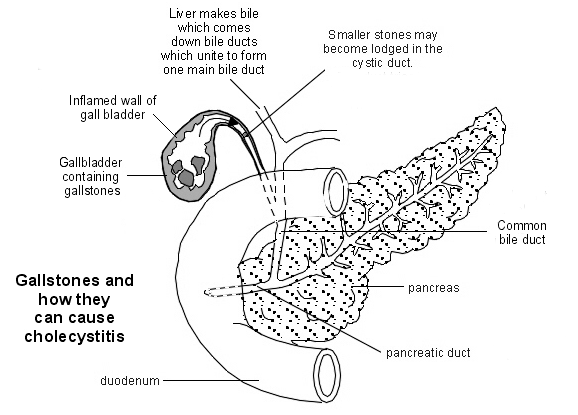
Cholecystitis is one problem that can occur with gallstones. About 19 in 20 cases of cholecystitis are thought to be caused by gallstones.
What seems to happen is that a gallstone becomes stuck in the cystic duct (this is the tube that drains bile out from the gallbladder into the bile duct).
Bile then builds up in the gallbladder, which becomes stretched (distended). Because of this, the walls of the gallbladder become inflamed. In some cases the inflamed gallbladder becomes infected. An infected gallbladder is more likely to lead to complications.
Cholecystitis symptoms
The symptoms of acute cholecystitis tend to be quite characteristic. They usually come on rather quickly and people with it often feel very unwell. They are:
Pain in the upper tummy (abdomen) - the main symptom. It is usually worse on the right side, under the ribs. The pain may travel (radiate) to the back or to the right shoulder and tends to last several hours. The pain tends to be worse on breathing in deeply.
Feeling of sick (nausée).
Des vomissements.
When examining the tummy (abdomen) of someone with cholecystitis, healthcare professionals might find something called 'Murphy's sign', meaning an increase in pain when the doctor places their hand under the ribs on the right hand side, and then asks the person to take a deep breath.
What does an ultrasound scan do?
Une échographie est un test généralement indolore qui utilise des ondes sonores pour examiner le ventre (abdomen). Il faut environ 30 minutes pour réaliser l'examen. Une échographie peut généralement détecter des calculs biliaires et également si la paroi de la vésicule biliaire est épaissie (comme cela se produit avec la cholécystite). Si le diagnostic est incertain, d'autres examens plus détaillés peuvent être effectués.
Are there any other tests I might need?
Other tests that might be done in hospital include:
Blood tests, to look for signs of infection and inflammation, as well as to check the liver.
Des tomodensitométrie (TDM) du ventre (abdomen).
What else could cause cholecystitis symptoms?
Les symptômes de la cholécystite sont assez caractéristiques, mais d'autres affections peuvent parfois sembler similaires. Ceux-ci incluent appendicite, a ulcère de l'estomac, and pancreatitis. Pneumonieof the bottom part of the right lung can cause similar symptoms.
All of these can make you seriously unwell so it's important to get the diagnosis right. The tests performed in hospital will help to check the diagnosis.
Cholecystitis treatment
The main treatments for cholecystitis are:
Soulagement de la douleur.
Intravenous fluids (through a drip).
Antibiotics; usually intravenously at first, and later switched to tablets.
Surgery to remove the gallbladder. This is called a cholecystectomy.
Sometimes, a plastic tube is inserted through the skin to drain infected bile from the gallbladder. This is called a percutaneous cholecystostomy.
This is often done when people are too unwell to have surgery.
Surgery for cholecystitis
For many people, surgery to remove the gallbladder (cholecystectomy) is recommended, because there is a high risk of cholecystitis occurring again, and it may cause serious problems. Removing the gallbladder stops cholecystitis from happening again.
Surgeons used to recommend waiting for 6-8 weeks, or longer, for the inflammation to settle down, before performing a cholecystectomy.
We now know that it's usually better to operate much sooner.
In the UK, the National Institute for Health and Care Excellence (NICE) recommends that people with cholecystitis are offered an operation to remove the gallbladder within a week of diagnosis. However, not all hospitals offer this. Surgeons might also recommend waiting longer if someone is too sick to have an operation.
Different techniques to remove the gallbladder may be used depending on various factors.
La chirurgie par laparoscopie est désormais la méthode la plus courante pour retirer une vésicule biliaire. Le terme médical pour cette opération est laparoscopic cholécystectomie. Elle est appelée chirurgie par laparoscopie car seules de petites incisions sont nécessaires dans le ventre (abdomen) avec de petites cicatrices qui restent ensuite. L'opération est réalisée à l'aide d'un télescope spécial qui est introduit dans l'abdomen par une petite incision. Cela permet au chirurgien de voir la vésicule biliaire. Des instruments introduits par une autre petite incision sont utilisés pour découper et retirer la vésicule biliaire. La chirurgie par laparoscopie ne convient pas à tout le monde.
Some people need a traditional operation to remove the gallbladder. This is called an open cholecystectomy. In this operation a larger cut is needed to get at the gallbladder.
A newer approach called natural orifice transluminal endoscopic surgery (NOTES) is still in the development stage. An operating telescope is inserted into one of the natural openings of the body such as the mouth, anus or vagina to perform the surgery. As yet, there isn't enough evidence to recommend it over other approaches.
Do I have to have surgery?
Surgery is usually recommended for people with cholecystitis. Treatment with antibiotics, fluids, and pain relief can settle down the inflammation from cholecystitis, but there's a high chance of it coming back without surgery. In one study, about 1 in 3 people who had cholecystitis and didn't have surgery developed further problems from gallstones later on.
However, people can choose not to have surgery.
For some people, surgeons may also feel that surgery is too risky (for example, if they have serious medical conditions that mean they won't survive an operation).
Speak to your clinical team to find out what the options are. They should be able to tell you the risks and benefits of having surgery, as well as the risks and benefits of other options, such as not having an operation, to help you decide what's right for you.
Ce à quoi vous pouvez vous attendre après la chirurgie, y compris les complications possibles, est couvert dans notre separate leaflet called Gallstones and Bile.
Sélections des patients pour Foie et vésicule biliaire

Santé digestive
Insuffisance hépatique
L'insuffisance hépatique survient lorsque de grandes parties du foie sont endommagées et ne peuvent pas être réparées. Le foie ne peut pas fonctionner correctement. L'insuffisance hépatique peut vous faire sentir très mal. L'insuffisance hépatique aiguë est une urgence vitale nécessitant des soins médicaux d'urgence. L'insuffisance hépatique se développe souvent lentement sur de nombreuses années. On parle alors de maladie hépatique chronique. Voir la fiche séparée intitulée Cirrhose pour plus d'informations. L'insuffisance hépatique peut également évoluer rapidement en quelques jours seulement (insuffisance hépatique aiguë). Il existe de nombreuses causes d'insuffisance hépatique aiguë. Parmi celles-ci, on trouve l'empoisonnement au paracétamol, les infections (par exemple, l'hépatite B ou C), la stéatose hépatique aiguë de la grossesse et plusieurs maladies génétiques rares. Chez certaines personnes atteintes d'insuffisance hépatique, la cause n'est pas connue.
par Dr Hayley Willacy, FRCGP
Santé digestive
Stéatose hépatique non alcoolique
La maladie du foie gras non alcoolique (NAFLD) décrit une gamme d'états causés par une accumulation de graisse dans les cellules du foie.
par Dr Doug McKechnie, MRCGP
Questions fréquemment posées
Can I choose not to have surgery?
While surgery is generally recommended for cholecystitis due to a high chance of it reoccurring and potentially causing serious problems, it is possible to choose not to have surgery. However, studies show that approximately 1 in 3 people who don't have surgery experience further problems from gallstones later. Your clinical team will discuss the risks and benefits of all options with you to help you make an informed decision.
When is surgery typically performed after a cholecystitis diagnosis?
Current recommendations from the National Institute for Health and Care Excellence (NICE) suggest that surgery to remove the gallbladder should ideally be offered within a week of diagnosis. This is a change from older practices where surgeons would wait 6-8 weeks, or longer, for inflammation to settle. However, the timing can vary, as some hospitals may not offer immediate surgery, and surgeons might delay the operation if a person is too unwell.
What if I'm too unwell for surgery?
If you are too unwell to undergo surgery, your clinical team might recommend alternative procedures to manage the condition. One such procedure involves inserting a plastic tube through the skin to drain infected bile from the gallbladder. This is known as a percutaneous cholecystostomy, and it's often used when surgery is deemed too risky.
What is 'Murphy's sign' and why do healthcare professionals look for it?
'Murphy's sign' is a clinical indicator that healthcare professionals look for when examining someone with suspected cholecystitis. It involves an increase in pain when the doctor places their hand under the ribs on the right side and then asks the person to take a deep breath. This sign helps to confirm the diagnosis of cholecystitis.
What is keyhole surgery for cholecystitis?
Keyhole surgery, medically known as laparoscopic cholecystectomy, is the most common method for removing the gallbladder. It involves making small cuts in the abdomen, through which a special telescope allows the surgeon to view the gallbladder, and instruments are inserted through additional small cuts to remove it. This technique results in smaller scars compared to traditional open surgery.
Lectures complémentaires et références
- Maladie des calculs biliaires; Ligne directrice clinique NICE (octobre 2014)
- Maladie des calculs biliaires; Norme de qualité NICE, décembre 2015
- Calculs biliaires; NICE CKS, juin 2024 (accès réservé au Royaume-Uni)
- Cholécystite - aiguë; NICE CKS, juillet 2021 (accès réservé au Royaume-Uni)
À propos de l'auteurVoir la biographie complète

Dr Doug McKechnie, MRCGP
Rédacteur Médical
MA, MBBS, MSc, DRCOG, MRCP(UK), MRCGP(2021), FHEA
Le Dr Doug McKechnie est un médecin généraliste du NHS travaillant à Londres. Il travaille à plein temps en clinique et est également le chef adjoint du module de Pratique Clinique et Professionnelle à l'École de Médecine de l'University College London.
À propos du critiqueVoir la biographie complète

Dr Colin Tidy, MRCGP
Médecin généraliste, Auteur médical
MBBS, MRCGP, MRCP (Paediatrics), DCH
Le Dr Colin Tidy est un médecin du NHS, basé dans l'Oxfordshire.
Historique de l'article
Les informations sur cette page sont rédigées et examinées par des cliniciens qualifiés.
Article également disponible en Anglais, Allemand, Espagnol, Français, Italien, Portugais, Hindi, Hébreu, Arabe, and Suédois.
Prochaine révision prévue : 31 août 2028
19 sept. 2023 | Dernière version

Demandez, partagez, connectez-vous.
Parcourez les discussions, posez des questions et partagez vos expériences sur des centaines de sujets de santé.

Vous ne vous sentez pas bien ?
Évaluez vos symptômes en ligne gratuitement
Inscrivez-vous à la newsletter Patient
Votre dose hebdomadaire de conseils de santé clairs et fiables - rédigés pour vous aider à vous sentir informé, confiant et maître de la situation.
En vous abonnant, vous acceptez notre Politique de confidentialité. Vous pouvez vous désabonner à tout moment. Nous ne vendons jamais vos données.
Plus sur la santé digestive
- Pancréatite chronique
- Diarrhée
- Diverticules
- Œsophagite à éosinophiles
- Dyspepsie fonctionnelle
- Gastrite
- Hépatite A
- Maladie inflammatoire de l'intestin
- Prurit anal
- Laxatifs
- Douleur abdominale du côté gauche chez les enfants
- Insuffisance hépatique
- Médicament contre la nausée
- Prévention des infections après une splénectomie
- Inhibiteurs de la pompe à protons
- Douleur dans le quadrant inférieur droit
- Douleur dans le quadrant inférieur droit chez les enfants
- Salmonella
- Douleur à la rate
- Colite ulcéreuse