Érythème toxique du nouveau-né
Baby acne
Revu par Dr Doug McKechnie, MRCGPDernière mise à jour par Dr Hayley Willacy, FRCGP Dernière mise à jour 20 déc. 2023
Respecte les directives éditoriales
- TéléchargerTélécharger
- Partager
- Language
- Discussion
- Version audio
- Ajouter aux sources préférées sur Google
Dans cette série :Éruptions cutanéesCelluliteFolliculiteDermatite périoraleRosacéeGale
L'érythème toxique du nouveau-né (ETN) est une éruption cutanée courante qui affecte les nouveau-nés en bonne santé. Ce n'est pas grave, cela ne cause aucun dommage au bébé et disparaît sans aucun traitement. Il est parfois connu sous le nom d'érythème toxique, d'acné du nourrisson ou d'érythème toxique du nouveau-né.
En un coup d'œil
Erythema toxicum neonatorum (ETN) is a common, harmless rash in newborns, also called baby acne.
It appears as red blotches, small raised spots, or pus-filled spots, mainly on the face and body.
The rash is not toxic, not an infection, and generally does not cause discomfort to the baby.
ETN affects up to 4 or 5 out of 10 babies, usually beginning a few days after birth.
There is no specific treatment for ETN, and it clears up by itself within a few days to two weeks.
Do not pick or squeeze the spots, and continue with normal baby washing and skincare routines.
If your baby is unwell or you are worried about any rash, seek medical advice.
What is erythema toxicum neonatorum?
Baby acne is small, inflamed bumps that can appear on a baby's neck, face, back and chest shortly after birth. The name erythema toxicum neonatorum is confusing because the condition is not toxic. It is also not the same as the acne that affects young people and adults.
Erythema is the medical word for redness. Neonatorum refers to the fact that the rash occurs in the neonatal period. The neonatal period is the time between birth and 28 days after birth. A baby in this age range is called a neonate.
What does baby acne look like?
Erythema toxicum neonatorum: baby acne
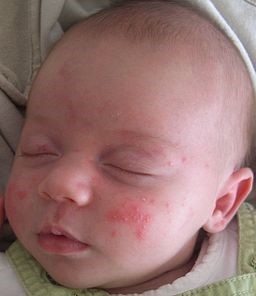
© Own image [selbst erstellt] (Fragegeist), Public domain, via Wikimedia Commons
The rash of ETN generally looks like red blotches, mainly affecting the face and body (trunk). It does occur on the arms and legs too (but is rare on the palms and soles of the feet). Characteristics of baby acne include:
Little, raised spots called papules are common.
Little pus-filled spots (pustules) or fluid-filled small blisters (vesicles).
There may be many spots or very few.
The different spots vary in size.
The spots blanch with light pressure (this means that they become pale and fade when pressed).
The rash can be temporary (very transient) and sometimes individual spots can disappear within hours while new ones will appear somewhere else.
The baby appears well and the rash does not seem to cause any bother.
Remarque: if there is any doubt as to the cause of a skin rash in any baby or child, it is essential that you seek medical advice and a firm diagnosis for any other potential skin conditions. This is especially important if your baby seems unwell in any way. For example, if your baby has a temperature (fever), is not feeding, is lacking in energy (lethargic) or is inconsolable and not the same as normal. Other rashes can occur in babies and may be the sign of serious illness.
What causes baby acne?
The exact cause is unknown. It is not due to an infection, even though pus-filled spots (pustules) are often present.
Various ideas have been suggested, including the possibility that it is a normal effect of a baby's immune system reacting to the first microbes from the skin travelling down the hair follicles. It is pas thought to be an allergic problem. It is also not related to whether the baby is breast-fed or bottle-fed.
How common is baby acne?
Erythema toxicum neonatorum is a very common rash. Up to 4 or 5 in every 10 babies develop baby acne. It seems to be more common in full term newborn babies(between 37 and 40 weeks of gestation) compared with premature babies.
Which babies get baby acne?
On average, baby acne occurs in healthy babies born at full term, between 3 and 14 days of life. The rash can occur in the first 48 hours of life but 9 out of 10 cases are in babies more than 2 days old.
Overall, it seems to be more common in babies who are heavier at birth, in babies born in the summer or autumn and in babies who are fed milk powder substitute or a mixed diet.
Diagnosing baby acne
Usually, no tests are needed to diagnose baby acne. The rash is generally easily recognisable by doctors and midwives. Tests may be needed if there is any uncertainty as to the cause of the rash, particularly if your baby is unwell.
What is the treatment for baby acne?
There is no specific treatment needed for baby acne. The rash settles completely without any treatment.
Que dois-je faire ?
If your baby develops erythema toxicum neonatorum, there is no need to worry. Your baby will not be in any discomfort or have any distress related to the rash. The skin may look red and angry (and your baby may look less than perfect temporarily) but do your best to ignore it.
Avoid over-washing the baby - babies have delicate skin that can dry out easily with detergents (soaps) so continue to wash as normal using warm water. Resist any temptation to pick, squeeze or burst any pus-filled spots (pustules). This would make a skin infection more likely to occur and may lead to scarring.
Creams and lotions are not required for the rash. If you are already using products to moisturise and wash your baby it is fine to continue them but ensure they are fragrance-free and designed for use in babies.
How long does baby acne last?
Typically, baby acne lasts for a few days only. In almost all cases it has completely gone within two weeks of life. Very occasionally the rash can return (recur). This can happen up to 6 weeks of age. Usually recurrences are mild.
Are there any long-term effects?
There are no long-term problems associated with ETN. The rash settles spontaneously, leaving normal skin. Of course, some babies develop dry skin, eczéma or other skin problems but these are not related to ETN.
Sélections des patients pour Bébé et tout-petit

Santé des enfants
Mort subite du nourrisson
La cause du décès inattendu du nourrisson n'est pas connue. Cependant, vous pouvez réduire le risque de décès inattendu du nourrisson en suivant les mesures décrites ci-dessous. Les plus importantes sont de coucher votre bébé sur le dos pour dormir (et non sur le ventre ou le côté) et de créer une zone sans fumée pour votre bébé.
par Dr Toni Hazell, FRCGP

Santé des enfants
Érythème fessier
La plupart des bébés développent une érythème fessier à un moment donné. En général, il est léger et ne dérange pas votre bébé. Cependant, il peut être plus sévère et douloureux dans certains cas. Il peut généralement être géré avec les suggestions ci-dessous.
par Dr Rachel Hudson, MRCGP
Questions fréquemment posées
Can baby acne make my baby uncomfortable or distressed?
No, if your baby develops erythema toxicum neonatorum, there is no need to worry. Your baby will not be in any discomfort or have any distress related to the rash, even though the skin may look red and inflamed.
Aside from the rash, what else should I look out for that might indicate a more serious problem?
You should seek medical advice if your baby seems unwell in any way. For example, if your baby has a temperature (fever), is not feeding, is lacking in energy (lethargic), or is inconsolable and not acting normally. These could be signs of other rashes or serious illnesses not related to erythema toxicum neonatorum.
What specifically should I avoid doing to the spots?
You should resist any temptation to pick, squeeze, or burst any pus-filled spots (pustules). Doing so could increase the likelihood of a skin infection and may lead to scarring.
Is it possible for baby acne to come back after it clears?
Very occasionally, the rash can return (recurrence). This can happen up to 6 weeks of age, but these recurrences are usually mild.
Does baby acne have any connection to future skin conditions like eczema?
No, there are no long-term problems associated with erythema toxicum neonatorum. The rash settles spontaneously, leaving normal skin. While some babies do develop dry skin, eczema, or other skin problems, these are not related to ETN.
Lectures complémentaires et références
- Toxic erythema of the newborn; DermNet NZ
- Roques E, Ward R, Mendez MD; Erythema Toxicum. StatPearls, Jan 2023.
À propos de l'auteurVoir la biographie complète

Dr Hayley Willacy, FRCGP
Médecin généraliste, Auteur médical
MBChB (1992), DRCOG, DFFP, MRCOG (Part 1) MRCGP (2007), DFSRH (2013), MSc - medical education (2020)
Le Dr Hayley Willacy était médecin généraliste au NHS travaillant dans le nord-ouest de l'Angleterre, qui a pris sa retraite de la pratique clinique en 2022 après 30 ans.
À propos du critiqueVoir la biographie complète

Dr Doug McKechnie, MRCGP
Rédacteur Médical
MA, MBBS, MSc, DRCOG, MRCP(UK), MRCGP(2021), FHEA
Le Dr Doug McKechnie est un médecin généraliste du NHS travaillant à Londres. Il travaille à plein temps en clinique et est également le chef adjoint du module de Pratique Clinique et Professionnelle à l'École de Médecine de l'University College London.
Historique de l'article
Les informations sur cette page sont rédigées et examinées par des cliniciens qualifiés.
Article également disponible en Anglais, Allemand, Espagnol, Français, Italien, Portugais, Hindi, Hébreu, Arabe, and Suédois.
Prochaine révision prévue : 18 déc. 2028
20 déc. 2023 | Dernière version

Demandez, partagez, connectez-vous.
Parcourez les discussions, posez des questions et partagez vos expériences sur des centaines de sujets de santé.

Vous ne vous sentez pas bien ?
Évaluez vos symptômes en ligne gratuitement
Inscrivez-vous à la newsletter Patient
Votre dose hebdomadaire de conseils de santé clairs et fiables - rédigés pour vous aider à vous sentir informé, confiant et maître de la situation.
En vous abonnant, vous acceptez notre Politique de confidentialité. Vous pouvez vous désabonner à tout moment. Nous ne vendons jamais vos données.
Plus sur la santé des enfants
- Difficultés respiratoires chez les enfants
- Reflux gastro-œsophagien chez l'enfant
- Pied bot
- Nourrir votre bébé
- Gastro-entérite chez les enfants
- Poux de tête et lentes
- Traitement et prévention des poux de tête
- Maladie de Hirschsprung
- Immunisation
- Érythème fessier
- Nausées et vomissements
- Polio et vaccin contre la polio
- Virus respiratoire syncytial (VRS)
- Rétinoblastome
- Dermatite séborrhéique chez les bébés
- Bégaiement
- Dentition
- Le tétanos et le vaccin contre le tétanos
- Traiter les problèmes de santé des nouveau-nés
- Syndrome de Turner