Genoux cagneux
Revu par Dr Doug McKechnie, MRCGPDernière mise à jour par Dr Hayley Willacy, FRCGP Last updated 15 juin 2023
Respecte les directives éditoriales
- TéléchargerTélécharger
- Partager
- Language
- Discussion
- Version audio
- Add to preferred sources on Google
Les genu valgum décrivent un angle inhabituel des jambes inférieures. La plupart du temps, il s'agit d'une forme normale lors du développement des jambes chez les enfants, mais parfois, chez les enfants ou les adultes, cela peut causer des problèmes ou avoir une cause sous-jacente. La majorité des enfants atteints de genu valgum dépassent cette condition en grandissant.
At a glance
Knock knees (genu valgum) is when your knees touch but your ankles are apart.
It is a normal part of development in children between the ages of 2 and 8 years old.
In most cases, knock knees correct themselves without treatment as a child grows.
You should see a doctor if only one leg is affected or if your child has pain or walking difficulties.
See a doctor if knock knees are present before age 2 years or after age 8 years.
Dans cet article:
Video picks for Développement
Continuez à lire ci-dessous
What are knock knees?
The medical term for knock knees is 'genu valgum' - genu meaning 'knee' in Latin, and valgum meaning 'bending outwards'. In knock knees, if the knees touch it is the lower leg which seems bent outwards. So if you have knock knees you are unable to stand with your knees AND your ankles together.
As children grow up, they tend to start off 'bow-legged'. This means if their feet are together, their knees are apart, leaving a diamond shape between the legs. This is normal in babies and toddlers until the age of about 2 years.
As the child's leg bones grow and develop, they then tend to take on a 'knock-kneed' shape. Now if their knees are together, their feet and ankles are apart. It tends to be most obvious around the age of 3 or 4 years, usually gradually improving to the correct position after that, as the child stands for longer periods of time. Knock knees are normal up to the age of 7 or 8 years, although the condition may last longer.
Valgus
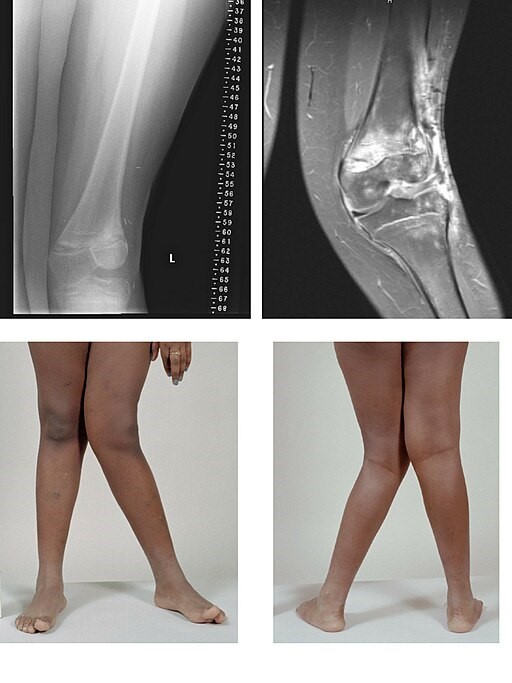
© BioMed Central, CC BY 2.0, via Wikimedia Commons
Do knock knees cause any problems?
Retour au sommaireKnock knees in children do not cause problems. If the condition is severe, or caused by an underlying problem, it may cause pain or difficulty walking.
Continuez à lire ci-dessous
Causes of knock knees
Retour au sommaireIn most cases, knock knees are purely caused by the normal phase of growth and development. Occasionally - in either older children or adults - there can be an underlying problem causing the condition. For example:
Vitamin deficiency (particularly vitamin D deficiency causing rickets). Vitamin C and calcium deficiency can also affect the way bones grow.
Operations or injuries to the knee or legs.
Inherited (genetic) conditions which affect the way that the knees develop.
Do I need to see a doctor about knock knees?
Retour au sommaireYou do not need to see a doctor if your child is at an age where having knock knees is normal (aged more than 2 years and less than 8 years) and if the deformity is not very severe. If your child lies on their back with their knees together, you can measure the distance between their ankles.
If it is less than 10 cm around age 4 years, this is likely to correct itself as they grow. If you take photos of your child every 3-6 months, standing with their knees together, you should see that the legs gradually become straighter from the age of 4 years or so.
See a doctor if:
Only one leg is affected.
Your child has knock knees before the age of 2 years or after the age of 8 years.
There is a larger gap between the ankles than that described above.
Your child has pain in the lower legs or knees.
Your child has problems walking or walks with a limp.
You develop knock knees as an adult.
Continuez à lire ci-dessous
How are knock knees diagnosed?
Retour au sommaireThe diagnosis of knock knees can be made by just looking at a child. If it is particularly severe, or if it occurs outside the normal age range, then further tests may be needed. This might include les radiographies ou analyses de sang.
The severity of the knock knees can be assessed by measuring the distance between the ankles when the child is standing with knees together. or by measuring other angles of the legs.
Treatment for knock knees
Retour au sommaireIn most cases no treatment is needed. For children who develop knock knees as a normal part of their childhood growth, the condition corrects itself as they continue to grow. They do not need any special shoes or braces, and do not need to avoid any sporting activities. They do not need any physiotherapy or other special treatment.
If the condition is severe, or caused by an underlying problem, then treatment may be needed. This will then depend on the underlying condition, the severity of the deformity and the stage of growth that the child is in.
If the knock knees are caused by a metabolic problem, such as Vitamin D deficiency, the deformity may correct with vitamin replacement.
If the angle of bone growth is around 15-20 degrees in a child who is less than 10 years old, guided growth may be suitable to treat knock knees. Plates, or screws or staples may be implanted into the bone to aid correct growth.
Occasionally an operation to correct the deformity is needed. This is called an osteotomy and is usually followed by physiotherapy.
What is the outlook for children with knock knees?
Retour au sommaireChildren who have knock knees as part of their normal growth pattern do very well without any medical assistance. Children who have an underlying condition can also do very well as long as their condition is recognised and treated. Complications only usually occur when an underlying condition is missed.
Patient picks for Développement

Santé des enfants
Douleurs de croissance
Les douleurs de croissance sont des douleurs, généralement dans les jambes, courantes chez les enfants. On ne sait pas ce qui cause ces douleurs, mais malgré leur nom, elles ne sont pas liées à la croissance. Elles ne sont pas graves et disparaissent d'elles-mêmes avec le temps. Un simple soulagement de la douleur suffit. Consultez un médecin si vous remarquez quelque chose d'anormal sur les jambes, ou si les douleurs font que votre enfant boîte.
par Dr Toni Hazell, MRCGP

Santé des enfants
Adrénarche
Cette brochure a été initialement fournie par Miriam Leach (écrite lorsqu'elle était étudiante en 4e année de médecine à l'Université de Manchester), utilisée ici avec permission.
par Dr Toni Hazell, MRCGP
Questions fréquemment posées
My child was bow-legged as a baby; is it normal for them to now have knock knees?
Yes, it is common for children to start off bow-legged, where their knees are apart when their feet are together, up to about 2 years of age. As they grow, their leg bones develop, and they typically transition to having knock knees, where their knees touch but their ankles are apart. This knock-kneed phase is usually most noticeable around ages 3 or 4 and is considered normal up to about 7 or 8 years.
Can knock knees affect my child's ability to participate in sports or other activities?
In most cases where knock knees are a normal part of a child's growth, they do not need to avoid any sporting activities. Special shoes, braces, or physiotherapy are also not usually needed when the condition is naturally correcting itself.
What kind of doctor should I see if I am concerned about my child's knock knees?
If you are concerned about your child's knock knees and believe they meet the criteria for needing medical attention (e.g., severe deformity, pain, problems walking, or occurring outside the normal age range), you should see a doctor. They can assess the condition and determine if any further investigations or treatment are necessary.
Could adult knock knees be a sign of another health issue?
Yes, if knock knees develop in adulthood, it can be a sign of an underlying problem. Potential causes in adults include conditions like rheumatoid arthritis, osteoarthritis, obesity, or issues resulting from previous operations or leg injuries. Inherited conditions affecting knee development can also be a factor.
How do doctors determine the severity of knock knees?
Doctors can assess the severity of knock knees by measuring the distance between the ankles when a child stands with their knees together. They may also measure other angles of the legs. If the condition is severe or outside the normal age range, further tests like X-rays or blood tests might be performed.
What is 'guided growth' treatment for knock knees?
Guided growth is a treatment suitable for children under 10 years old where the angle of bone growth is around 15-20 degrees. It involves implanting plates, screws, or staples into the bone to help guide correct growth. This can correct the deformity as the child continues to grow.
Lectures complémentaires et références
- Rerucha CM, Dickison C, Baird DC; Lower Extremity Abnormalities in Children. Am Fam Physician. 2017 Aug 15;96(4):226-233.
- Patel M, Nelson R; Genu Valgum.
- Soheilipour F, Pazouki A, Mazaherinezhad A, et al; The Prevalence of Genu Varum and Genu Valgum in Overweight and Obese Patients: Assessing the Relationship between Body Mass Index and Knee Angular Deformities. Acta Biomed. 2020 Oct 5;91(4):ahead of print. doi: 10.23750/abm.v91i4.9077.
Continuez à lire ci-dessous
About the authorView full bio

Dr Hayley Willacy, FRCGP
Médecin généraliste, Auteur médical
MBChB (1992), DRCOG, DFFP, MRCOG (Part 1) MRCGP (2007), DFSRH (2013), MSc - medical education (2020)
Dr Hayley Willacy was an NHS GP working in northwest England, who retired from clinical practice in 2022 after 30 years.
About the reviewerView full bio

Dr Doug McKechnie, MRCGP
Medical Writer
MA, MBBS, MSc, DRCOG, MRCP(UK), MRCGP(2021), FHEA
Dr Doug McKechnie is an NHS GP working in London. He works full-time clinically and is also the Deputy Lead for the Clinical and Professional Practice module at University College London Medical School.
Historique de l'article
Les informations sur cette page sont rédigées et examinées par des cliniciens qualifiés.
Prochaine révision prévue : 12 mai 2028
15 juin 2023 | Dernière version

Demandez, partagez, connectez-vous.
Parcourez les discussions, posez des questions et partagez vos expériences sur des centaines de sujets de santé.

Vous ne vous sentez pas bien ?
Évaluez vos symptômes en ligne gratuitement
Inscrivez-vous à la newsletter Patient
Votre dose hebdomadaire de conseils de santé clairs et fiables - rédigés pour vous aider à vous sentir informé, confiant et maître de la situation.
By subscribing you accept our Politique de confidentialité. Vous pouvez vous désabonner à tout moment. Nous ne vendons jamais vos données.