Irak
Conseils de santé pour les voyages, vaccins et risques
Revu par Réseau et Centre National de Santé de Voyage (NaTHNaC)Dernière mise à jour par Réseau et Centre National de Santé de Voyage (NaTHNaC)Dernière mise à jour 3 juin 2026
Respecte les directives éditoriales
- TéléchargerTélécharger
- Partager
- Language
- Discussion
- Version audio
- Ajouter aux sources préférées sur Google
Travellers are drawn to Iraq for Tigris river heritage, archaeological sites and date-palm groves. Give yourself time to explore local culture and landscapes as distances and climates can vary. For peace of mind, look over vaccine advice and other health precautions before travelling.
Fiche d'information sur le pays
Pays | Irak |
Langue officielle | Arabic; Kurdish |
Capitale | Baghdad |
Unité monétaire | Iraqi dinar (ID) |
Longitude | 43.679291 |
Latitude | 33.223191 |
Conseils de voyage du ministère des Affaires étrangères |
Informations générales
Les informations sur ces pages doivent être utilisées pour rechercher les risques pour la santé et pour informer la consultation pré-voyage.
Les voyageurs devraient vérifier le Page de conseils de voyage spécifiques par pays du Bureau des Affaires étrangères, du Commonwealth et du Développement (FCDO) (lorsque disponible) qui fournit des informations sur les exigences d'entrée pour les voyages en plus des conseils de sécurité.
Les voyageurs devraient idéalement prendre rendez-vous avec leur professionnel de santé au moins quatre à six semaines avant le voyage. Cependant, même si le temps est court, un rendez-vous est toujours utile. Ce rendez-vous offre l'occasion d'évaluer les risques pour la santé en tenant compte de plusieurs facteurs, y compris la destination, les antécédents médicaux et les activités prévues. Pour ceux ayant des problèmes de santé préexistants, un rendez-vous plus tôt est recommandé.
Tous les voyageurs doivent s'assurer qu'ils ont assurance santé voyage adéquate.
Une liste de ressources utiles, y compris des conseils sur la façon de réduire le risque de certains problèmes de santé, est disponible ci-dessous
Ressources
What vaccinations do I need for Iraq?
Les détails des recommandations et exigences en matière de vaccination sont fournis ci-dessous.
Tous les voyageurs
Les voyageurs doivent être à jour avec les vaccinations de routine et les rappels recommandés au Royaume-Uni en fonction de leur âge, de leurs antécédents médicaux et de leurs risques individuels.
Calendrier actuel de vaccination de routine au Royaume-Uni
La consultation de santé voyage offre l'occasion de vérifier si les vaccinations de routine sont à jour, telles que les vaccins ROR/RORV et diphtérie-tétanos-polio. Le lien suivant fournit des informations sur les recommandations actuelles calendrier de vaccination recommandé au Royaume-Uni.
Les recommandations spécifiques à chaque pays concernant la diphtérie ne sont pas fournies ici. La diphtérie, le tétanos et la polio sont combinés en un seul vaccin au Royaume-Uni. Par conséquent, lorsqu'un rappel de tétanos est recommandé pour les voyageurs, le vaccin contre la diphtérie est également administré. En cas d'épidémie de diphtérie dans un pays, des conseils spécifiques sur la vaccination contre la diphtérie seront fournis.
Vaccination des personnes avec une immunisation incertaine ou incomplète
Pour les personnes ayant un historique de vaccination incertain ou incomplet, veuillez trouver des conseils pour les professionnels de santé ici Vaccination des personnes avec une immunisation incertaine ou incomplète.
L'UKHSA fournit un outil de comparaison des vaccinations pour les personnes qui ont pu être vaccinées à l'étranger Outil de comparaison des calendriers de vaccination du Royaume-Uni et internationaux.
Programmes de vaccination sélective
Les personnes qui peuvent être à risque accru de contracter une maladie infectieuse en raison de leur travail, de leur mode de vie ou de certains problèmes de santé sous-jacents devraient être à jour avec les vaccins supplémentaires recommandés. Voir les recommandations de vaccination pour ces groupes en bas de la 'Calendrier complet de vaccination systématique' document. Les chapitres individuels sur les maladies du 'Livre Vert' Immunisation contre les maladies infectieuses fournit plus de détails.
Exigences en matière de certificat
Il n'y a pas d'exigences de certificat selon le Règlement sanitaire international.
La plupart des voyageurs
Les vaccins dans cette section sont recommandés pour la plupart des voyageurs visitant ce pays. Des informations sur ces vaccins peuvent être trouvées en cliquant sur la flèche bleue. Les vaccins sont listés par ordre alphabétique.
Hépatite A
L'hépatite A est une infection virale transmise par des aliments et de l'eau contaminés ou par contact direct avec une personne infectieuse. Les symptômes sont souvent légers ou absents chez les jeunes enfants, mais la maladie peut être plus grave avec l'âge. La guérison peut varier de quelques semaines à plusieurs mois. Après une infection par l'hépatite A, l'immunité est à vie.
Prévention
Tous les voyageurs doivent faire attention à l'hygiène personnelle, alimentaire et de l'eau.
Vaccination contre l'hépatite A
Comme le vaccin contre l'hépatite A est bien toléré et offre une protection durable, il est recommandé pour tous les voyageurs non vaccinés auparavant.
Tétanos
Le tétanos est causé par une toxine libérée par Clostridium tetani les bactéries et se produisent dans le monde entier. Les bactéries du tétanos sont présentes dans le sol et le fumier et peuvent être introduites par des plaies ouvertes telles qu'une plaie par perforation, une brûlure ou une éraflure.
Prévention
Les voyageurs doivent nettoyer soigneusement toutes les plaies et consulter un médecin pour des blessures telles que des morsures/griffures d'animaux, des brûlures ou des plaies contaminées par de la terre.
Vaccination contre le tétanos
Les voyageurs devraient avoir terminé un cycle de vaccination contre le tétanos selon le calendrier du Royaume-Uni.
Si vous voyagez dans un pays ou une région où les installations médicales peuvent être limitées, une dose de rappel d'un vaccin contenant le tétanos est recommandée si la dernière dose remonte à plus de dix ans, même si cinq doses de vaccin ont déjà été administrées.
Des informations spécifiques par pays sur les installations médicales peuvent être trouvées dans la section 'santé' du Conseils de voyage à l'étranger du FCDO pages.
Typhoïde
La typhoïde est une infection bactérienne transmise par des aliments et de l'eau contaminés. Une précédente maladie de la typhoïde peut ne protéger que partiellement contre une réinfection.
La vaccination est recommandée pour la plupart des voyageurs, en particulier ceux qui rendent visite à des amis et à des proches, ceux en contact avec une personne infectée, les jeunes enfants, les voyageurs fréquents ou de longue durée visitant des zones où l'assainissement et l'hygiène alimentaire sont susceptibles d'être médiocres, et le personnel de laboratoire qui peut manipuler les bactéries dans le cadre de leur travail.
Prévention
Tous les voyageurs doivent faire attention à l'hygiène personnelle, alimentaire et de l'eau.
Vaccination contre la typhoïde
Des vaccins contre la typhoïde, oraux et injectables, sont disponibles.
Certains voyageurs
Les vaccins dans cette section sont recommandés pour certains voyageurs visitant ce pays. Les vaccins sont listés par ordre alphabétique.
Choléra
Le choléra est une infection bactérienne transmise par des aliments et de l'eau contaminés. Le choléra peut provoquer une diarrhée aqueuse sévère, bien que les infections légères soient courantes. Le risque de choléra pour la plupart des voyageurs est faible.
Prévention
Tous les voyageurs doivent faire attention à l'hygiène personnelle, alimentaire et de l'eau.
Vaccination contre le choléra
Ce vaccin oral est recommandé pour ceux dont les activités ou les antécédents médicaux les exposent à un risque accru d'infection ou de complications. Cela inclut :
travailleurs humanitaires
personnes se rendant dans des zones de flambées de choléra ayant un accès limité à l'eau potable et aux soins médicaux
autres voyageurs se rendant dans des zones à risque de choléra, pour lesquels la vaccination est considérée comme potentiellement bénéfique (par exemple, en raison de leur profession, de leurs activités ou de problèmes de santé sous-jacents)
Hépatite B
L'hépatite B est une infection virale qui se propage par le sang, le sperme et les fluides vaginaux. Cela se produit principalement lors de contacts sexuels ou à la suite d'un contact sang à sang (par exemple à partir d'équipements contaminés lors de procédures médicales et dentaires, de tatouages ou de piercings corporels, et du partage d'aiguilles intraveineuses). Les mères porteuses du virus peuvent également transmettre l'infection à leur bébé lors de l'accouchement.
Ce pays est considéré comme ayant une prévalence intermédiaire ou élevée de l'hépatite B.
Prévention
Les voyageurs doivent éviter tout contact avec le sang ou les fluides corporels. Cela inclut :
Éviter les rapports sexuels non protégés.
Éviter le tatouage, le perçage, le rasage public et l'acupuncture (sauf si du matériel stérile est utilisé).
Ne pas partager les aiguilles ou autre matériel d'injection.
Suivre les précautions universelles si vous travaillez dans un établissement de santé ou un autre environnement à haut risque.
Un kit d'équipement médical stérile peut être utile lors de voyages dans des zones à faibles ressources.
Vaccination contre l'hépatite B
La vaccination pourrait être envisagée pour tous les voyageurs et est recommandée pour ceux dont les activités ou les antécédents médicaux les exposent à un risque accru. Cela inclut :
Ceux qui peuvent avoir des rapports sexuels non protégés.
Ceux qui peuvent être exposés à des aiguilles contaminées par l'utilisation de drogues injectables.
Ceux qui peuvent être exposés au sang ou aux fluides corporels dans le cadre de leur travail (par exemple, les travailleurs de la santé et de l'aide).
Ceux à haut risque de nécessiter des procédures médicales ou dentaires ou une hospitalisation, par exemple ceux ayant des conditions médicales préexistantes, ceux qui peuvent avoir besoin de voyager pour des soins médicaux à l'étranger, ou ceux qui voyagent pour rendre visite à des familles ou des proches.
Voyageurs de longue durée.
Ceux qui participent à des sports de contact.
Familles adoptant des enfants de ce pays.
Rougeole
La rougeole est une maladie virale hautement contagieuse, transmise par voie aérienne ou par gouttelettes (toux, éternuements, gouttes de la bouche/du nez). La rougeole commence généralement par des symptômes similaires à ceux d'un rhume, par exemple fièvre, toux, nez qui coule et conjonctivite (yeux rouges et douloureux). Cela est suivi par une éruption cutanée tachetée commençant sur le visage/la tête et se propageant au reste du corps.
Les complications de l'infection par la rougeole peuvent inclure des infections de l'oreille, la diarrhée, la pneumonie et des convulsions (crises). Des complications potentiellement mortelles telles que l'encéphalite (inflammation du cerveau) peuvent survenir dans de rares occasions. La rougeole peut avoir des conséquences graves, en particulier chez les enfants de moins de 1 an, les personnes immunodéprimées (celles ayant un système immunitaire affaibli) et pendant la grossesse.
La rougeole est soit 'endémique' (transmission continue sur une période de 12 mois) et/ou le risque de rougeole est évalué comme étant supérieur à celui du Royaume-Uni en raison des épidémies actuelles, des conflits, des infrastructures endommagées, des cas liés aux voyages ou d'une couverture vaccinale insuffisante.
Prévention
Tous les voyageurs doivent suivre bonne hygiène respiratoire règles et évitez le contact avec les personnes infectées par la rougeole.
Vaccination contre la rougeole
Tous les voyageurs doivent s'assurer qu'ils sont à jour avec le rougeole, oreillons et rubéole (ROR) ou rougeole, oreillons, rubéole et varicelle (RORV) vaccins, selon recommandations actuelles du Royaume-Uni.
Les conseils sur la vaccination des adultes peuvent être trouvés dans Rougeole : le chapitre du livre vert – GOV.UK.
Envisagez une vaccination précoce contre la rougeole, les oreillons et la rubéole (ROR)/rougeole, oreillons, rubéole et varicelle (RORV) pour les nourrissons et les enfants.
Les nourrissons âgés de six mois qui sont susceptibles de côtoyer des habitants locaux devraient recevoir un ROR vaccin. Le MMRV le vaccin peut être administré à partir de neuf mois si le ROR n'est pas disponible au moment du rendez-vous.
Tous les enfants ne répondront pas au ROR/RORV administré au cours de la première année de vie. Lorsque le vaccin a été administré avant l'âge d'un an, cette dose doit être ignorée et deux doses supplémentaires de ROR/RORV doivent être administrées aux âges recommandés.
Les enfants qui voyagent et ont déjà reçu une dose de ROR/RORV à l'âge habituel devraient avancer la deuxième dose à au moins un mois après la première.
Si un enfant reçoit la deuxième dose moins de trois mois après la première dose et a moins de 18 mois, alors la dose de routine de 18 mois (qui constituerait une troisième dose) doit être administrée afin de fournir une protection optimale.
Rage
La rage est une infection virale qui est généralement transmise par contact avec la salive d'un animal infecté, le plus souvent par une morsure, une égratignure ou un léchage d'une plaie ouverte ou d'une muqueuse (comme sur l'œil, le nez ou la bouche). Bien que de nombreux animaux différents puissent transmettre le virus, la plupart des cas suivent une morsure ou une égratignure d'un chien infecté. Dans certaines parties du monde, les chauves-souris sont une source importante d'infection.
Les symptômes de la rage peuvent mettre un certain temps à se développer, mais lorsqu'ils apparaissent, la condition est presque toujours fatale.
Le risque d'exposition est accru par certaines activités et la durée du séjour (voir ci-dessous). Les enfants sont plus à risque car ils sont moins susceptibles d'éviter le contact avec les animaux et de signaler une morsure, une égratignure ou un léchage.
Rabies in Iraq
La rage est considérée comme un risque et a été signalée chez les animaux domestiques dans ce pays. Les chauves-souris peuvent également porter des virus similaires à la rage.
Prévention
Les voyageurs doivent éviter tout contact avec les animaux. La rage est évitable avec un traitement post-exposition rapide.
Après une exposition possible, les plaies doivent être soigneusement nettoyées et une évaluation médicale locale urgente doit être recherchée, même si la plaie semble insignifiante.
Le traitement et les conseils après exposition doivent être conformes à directives nationales.
Vaccination contre la rage
Un cycle complet de vaccins pré-exposition simplifie et raccourcit le traitement post-exposition et élimine le besoin d'immunoglobuline antirabique, qui est en pénurie mondiale.
Les vaccinations pré-exposition sont recommandées pour les voyageurs dont les activités les exposent à un risque accru, y compris :
ceux à risque en raison de leur travail (par exemple, le personnel de laboratoire travaillant avec le virus, ceux travaillant avec des animaux ou les professionnels de santé qui peuvent s'occuper de patients infectés).
ceux qui voyagent dans des régions où l'accès au traitement post-exposition et aux soins médicaux est limité.
ceux qui prévoient des activités à risque plus élevé telles que la course à pied ou le cyclisme.
voyageurs de longue durée (plus d'un mois).
Tuberculose
La tuberculose est une infection bactérienne qui affecte le plus souvent les poumons, mais peut toucher n'importe quelle partie du corps. Lorsqu'une personne atteinte de tuberculose dans les poumons ou la gorge tousse ou éternue, elle peut transmettre la tuberculose à d'autres personnes. La tuberculose est curable mais peut être grave si elle n'est pas traitée.
La vaccination par le BCG aide à protéger certaines personnes, en particulier les bébés et les jeunes enfants qui sont à risque accru de tuberculose.
Ce pays a signalé une incidence annuelle de la tuberculose supérieure ou égale à 40 cas pour 100 000 habitants au moins une fois au cours des cinq dernières années (plus de détails).
Prévention
Les voyageurs doivent éviter tout contact étroit avec des personnes connues pour avoir une tuberculose pulmonaire (poumon) ou laryngée (gorge) infectieuse.
Les personnes à risque dans le cadre de leur travail (comme les professionnels de santé) doivent prendre des précautions appropriées de contrôle et de prévention des infections.
Vaccination contre la tuberculose (BCG)
Le vaccin BCG est recommandé pour les personnes présentant un risque accru de développer une maladie grave et/ou d'exposition à l'infection par la tuberculose. Voir l'Agence de sécurité sanitaire du Royaume-Uni Immunisation contre les maladies infectieuses, le 'Livre Vert'.
Pour les voyageurs, le vaccin BCG est recommandé pour :
Non vaccinés, les enfants de moins de 16 ans, qui vont vivre plus de 3 mois dans ce pays. Un test cutané à la tuberculine est requis avant la vaccination pour tous les enfants à partir de 6 ans et peut être recommandé pour certains enfants plus jeunes.
Individus non vaccinés, négatifs au test cutané à la tuberculine, à risque en raison de leur travail, tels que les travailleurs de la santé ou de laboratoire qui ont un contact direct avec des patients atteints de tuberculose ou du matériel clinique potentiellement infectieux, ainsi que les vétérinaires et les travailleurs d'abattoirs qui manipulent du matériel animal pouvant être infecté par la tuberculose.
Il existe des contre-indications spécifiques au vaccin BCG. Les professionnels de santé doivent être formés et évalués comme compétents pour administrer ce vaccin par voie intradermique.
Après l'administration, aucun autre vaccin ne doit être administré dans le même membre pendant 3 mois.
Le vaccin BCG est administré une seule fois, les doses de rappel ne sont pas recommandées.
Is there a malaria risk in Iraq?
Le paludisme est une maladie grave causée par l'infection des globules rouges par un parasite appelé Plasmodium. La maladie est transmise par des moustiques qui se nourrissent principalement entre le crépuscule et l'aube.
Les symptômes commencent généralement par une fièvre (température élevée) de 38°C (100°F) ou plus. D'autres symptômes peuvent inclure des frissons, des maux de tête, des nausées, des vomissements et des douleurs musculaires. Les symptômes peuvent apparaître entre huit jours et un an après la piqûre du moustique infecté.
Un diagnostic et un traitement rapides sont nécessaires car les personnes atteintes de paludisme peuvent se détériorer rapidement. Les personnes à risque plus élevé de paludisme, ou de complications graves dues au paludisme, incluent les femmes enceintes, les nourrissons et les jeunes enfants, les personnes âgées, les voyageurs qui n'ont pas de rate fonctionnelle et ceux qui rendent visite à des amis et à la famille.
Prévention
Les voyageurs doivent suivre un guide ABCD pour prévenir le paludisme :
DesConscience du risque – Le risque dépend de l'emplacement spécifique, de la saison de voyage, de la durée du séjour, des activités et du type d'hébergement.
PPrévention des piqûres – Les voyageurs doivent prendre des mesures pour éviter les piqûres de moustiques.
Chémoprophylaxie – Les voyageurs devraient prendre des antipaludéens (comprimés de prévention du paludisme) si cela est approprié pour la région (voir ci-dessous). Aucun antipaludéen n'est efficace à 100 %, mais les prendre en combinaison avec des mesures d'évitement des piqûres de moustiques offrira une protection substantielle contre le paludisme.
DDiagnostic – Les voyageurs qui développent une fièvre de 38°C [100°F] ou plus, plus d'une semaine après avoir été dans une zone à risque de paludisme, ou qui présentent des symptômes évocateurs de paludisme dans l'année suivant leur retour, doivent consulter immédiatement un médecin. Un traitement d'urgence de secours peut être envisagé pour ceux qui se rendent dans des zones reculées avec un accès limité aux soins médicaux.
Zones à risque
There is a very low risk of malaria in the rural northern area of Iraq below 1,500m, from May to November: conscience du risque et prévention des piqûres recommandé.
There is no risk in the rest of Iraq.
Carte des recommandations antipaludiques
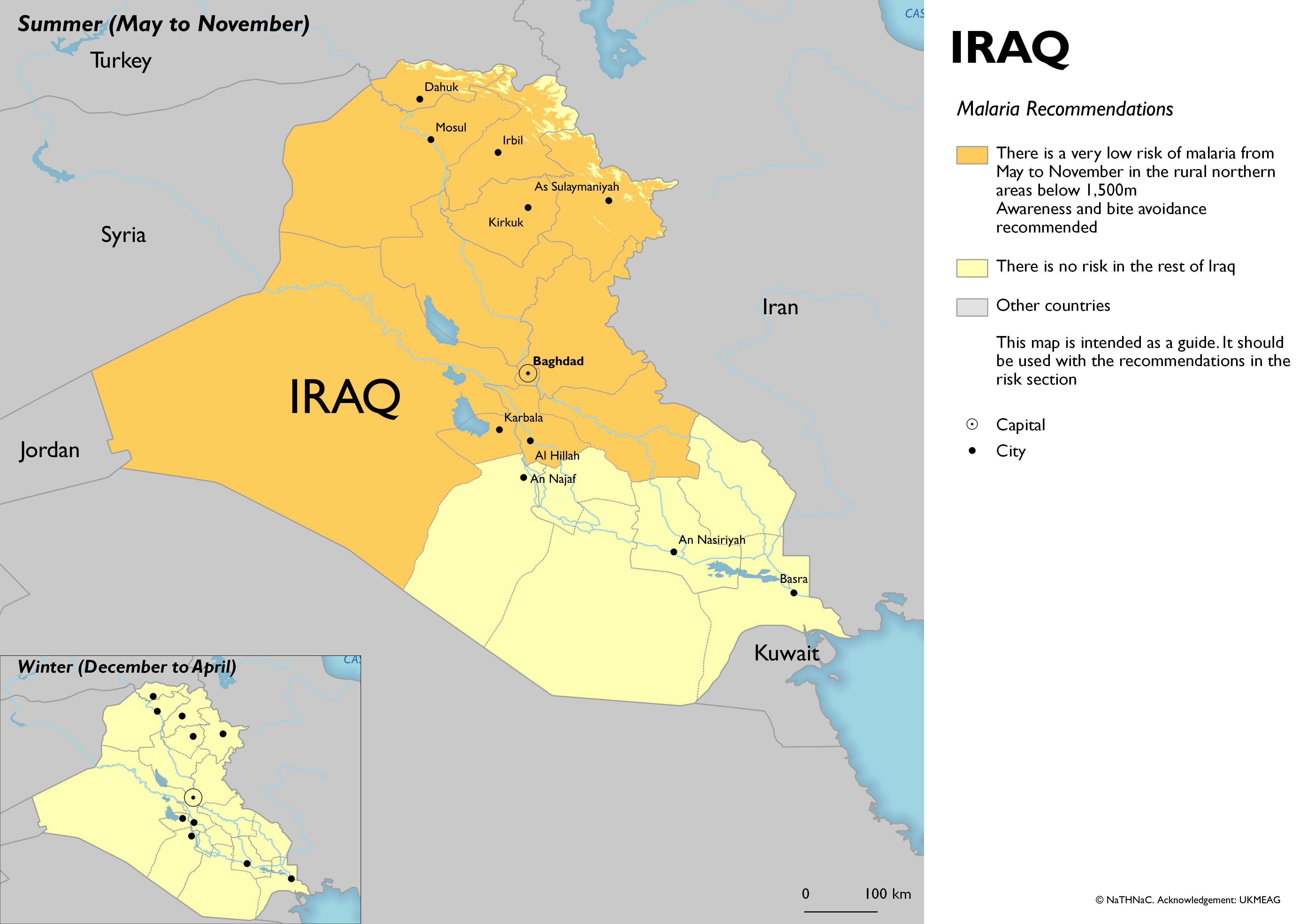
Cliquez sur la carte pour l'ouvrir dans une nouvelle fenêtre
There are no antimalarial drugs recommended for Iraq.
Ressources
What other health risks are there in Iraq?
Il existe certains risques qui concernent tous les voyageurs, quel que soit leur destination. Ceux-ci peuvent inclure, par exemple, les accidents de la route et autres accidents, les maladies transmises par les insectes ou les tiques, les maladies transmises par des aliments ou de l'eau contaminés, ou les problèmes de santé liés à la chaleur ou au froid.
Certains risques supplémentaires (qui peuvent être présents dans tout ou partie de ce pays) sont mentionnés ci-dessous et sont présentés par ordre alphabétique.
Altitude
Il existe un risque de mal d'altitude lors de voyages vers des destinations de 2 500 mètres (8 200 pieds) ou plus. Les facteurs de risque importants sont l'altitude atteinte, le taux d'ascension et l'altitude de sommeil. Une ascension rapide sans période d'acclimatation expose le voyageur à un risque plus élevé.
Il existe trois syndromes : le mal aigu des montagnes (MAM), l'œdème cérébral de haute altitude (OCHA) et l'œdème pulmonaire de haute altitude (OPHA). L'OCHA et l'OPHA nécessitent une descente immédiate et un traitement médical.
Altitude illness in Iraq
Il y a un point d'élévation dans ce pays supérieur à 2 500 mètres.
Prévention
Les voyageurs devraient passer quelques jours à une altitude inférieure à 3 000 m.
Dans la mesure du possible, les voyageurs devraient éviter de passer d'altitudes inférieures à 1 200 m à des altitudes supérieures à 3 500 m en une seule journée.
L'ascension au-dessus de 3 000 m doit être progressive. Les voyageurs doivent éviter d'augmenter l'altitude de sommeil de plus de 500 m par jour et s'assurer d'une journée de repos (à la même altitude) tous les trois ou quatre jours.
L'acétazolamide peut être utilisé pour aider à l'acclimatation, mais ne doit pas remplacer une ascension progressive.
Les voyageurs qui développent des symptômes du MAM (maux de tête, fatigue, perte d'appétit, nausées et troubles du sommeil) devraient éviter de monter davantage. En l'absence d'amélioration ou en cas d'aggravation des symptômes, la première réponse devrait être de redescendre.
Le développement des symptômes du MAM ou de l'OMPE nécessite une descente immédiate et un traitement médical d'urgence.
Insectes piqueurs ou tiques
Les piqûres d'insectes ou de tiques peuvent provoquer des irritations et des infections de la peau à l'endroit de la piqûre. Elles peuvent également transmettre certaines maladies.
Maladies en Asie de l'Ouest
Il existe un risque de maladies transmises par les insectes ou les tiques dans certaines régions de l'Asie occidentale. Cela inclut des maladies telles que la fièvre hémorragique de Crimée-Congo, la leishmaniose, fièvre de la vallée du Rift et virus du Nil occidental.
Prévention
Tous les voyageurs doivent éviter les piqûres d'insectes et de tiques jour et nuit.
Il n'existe pas de vaccins (ou de médicaments) pour prévenir ces maladies.
Des informations supplémentaires sur les maladies spécifiques transmises par les insectes ou les tiques pour ce pays peuvent être trouvées, le cas échéant, sur cette page, dans d'autres sections des pages d'information sur le pays et le Fiche d'information sur la prévention des piqûres d'insectes et de tiques.
Grippe
La grippe saisonnière est une infection virale des voies respiratoires qui se propage facilement d'une personne à l'autre par les gouttelettes respiratoires lors de la toux et des éternuements. Les symptômes apparaissent rapidement et incluent fièvre, douleurs musculaires, maux de tête, malaise (sensation de mal-être), toux, mal de gorge et nez qui coule. Chez les individus en bonne santé, les symptômes s'améliorent sans traitement en deux à sept jours. Une maladie grave est plus fréquente chez les personnes âgées de 65 ans ou plus, celles de moins de 2 ans, ou celles qui ont des conditions médicales sous-jacentes augmentant leur risque de complications de la grippe.
Seasonal influenza in Iraq
La grippe saisonnière se manifeste dans le monde entier. Dans l'hémisphère nord (y compris le Royaume-Uni), la plupart des cas de grippe surviennent dès octobre jusqu'en mars. Dans l'hémisphère sud, la grippe se manifeste principalement entre avril et septembre. Dans les tropiques, la grippe peut survenir tout au long de l'année.
Prévention
Tous les voyageurs devraient :
Évitez les contacts rapprochés avec les personnes symptomatiques
Évitez les endroits bondés autant que possible
Se laver les mains fréquemment
Pratiquez l'hygiène de la toux : éternuez ou toussez dans un mouchoir, jetez-le rapidement en toute sécurité et lavez-vous les mains
Évitez de voyager si vous êtes malade avec des symptômes grippaux
Un vaccin est disponible dans certaines circonstances (voir ci-dessous)*
*Au Royaume-Uni, le vaccin contre la grippe saisonnière est proposé chaque année de manière routinière aux personnes présentant un risque plus élevé de développer une maladie grave après une infection grippale, ainsi qu'à certains groupes supplémentaires tels que les professionnels de santé et les enfants dans le cadre du programme national du Royaume-Uni (voir informations sur la vaccination). Pour ceux qui ne font pas partie de ces groupes, la vaccination peut être disponible en privé.
Si des personnes à risque élevé de maladie grave après une infection grippale voyagent dans un pays où la grippe est susceptible de circuler, elles doivent s'assurer d'avoir reçu un vaccin contre la grippe au cours des 12 derniers mois.
Le vaccin utilisé au Royaume-Uni protège contre les souches prévues pour se manifester pendant les mois d'hiver de l'hémisphère nord. Il n'est pas possible d'obtenir le vaccin pour l'hémisphère sud au Royaume-Uni, mais le vaccin utilisé pendant la saison grippale au Royaume-Uni devrait tout de même offrir une protection importante contre les souches susceptibles de se manifester pendant la saison grippale de l'hémisphère sud, ainsi que dans les tropiques.
Grippe aviaire
Les virus de la grippe aviaire peuvent rarement infecter et causer des maladies chez les humains. Ces cas sont généralement associés à une exposition étroite à des populations d'oiseaux ou d'animaux infectés. Le cas échéant, des informations à ce sujet seront disponibles dans les sections sur les épidémies et les actualités des pages des pays concernés. Les vaccins contre la grippe saisonnière ne fourniront pas de protection contre la grippe aviaire.
Coronavirus du syndrome respiratoire du Moyen-Orient
Le MERS-CoV est une infection virale transmise par contact direct ou indirect avec des chameaux infectés ou des produits dérivés de chameaux. Une transmission limitée de personne à personne par la toux et les éternuements de personnes infectées, généralement dans des établissements de santé, a également été signalée.
Les symptômes incluent la fièvre et la toux qui peuvent évoluer vers un essoufflement sévère et des difficultés respiratoires. Des décès ont été signalés, le risque augmentant avec l'âge avancé ou des conditions médicales sous-jacentes.
On suppose que le MERS-CoV représente un risque dans ce pays.
Prévention
Tous les voyageurs, en particulier ceux ayant des problèmes de santé chroniques, devraient adopter de bonnes mesures de santé générales, telles que le lavage régulier des mains avec du savon et de l'eau en tout temps, mais surtout après avoir visité des fermes, des granges ou des marchés. Ils devraient :
Évitez le contact avec les chameaux.
Évitez le lait de chamelle cru et/ou les produits à base de chamelle.
Évitez la consommation de tout type de lait cru, de produits à base de lait cru et de tout aliment pouvant être contaminé par des sécrétions animales, à moins qu'ils ne soient pelés et nettoyés et/ou bien cuits.
Il n'existe actuellement aucun vaccin pour prévenir le MERS-CoV.
Qualité de l'air extérieur
La mauvaise qualité de l'air est un problème de santé publique important dans de nombreuses régions du monde. L'exposition à des niveaux élevés de pollution de l'air sur de courtes périodes (par exemple, minutes/heures/jours) et sur de plus longues périodes (par exemple, années) est liée à de nombreux problèmes de santé aigus et chroniques. Ces effets concernent principalement les systèmes respiratoire (poumons et voies respiratoires) et cardiovasculaire (fonction cardiaque et circulation sanguine).
Les informations actuelles sur la qualité de l'air dans le monde sont disponibles auprès de projet d'indice de qualité de l'air mondial.
Prévention
Les voyageurs ayant des problèmes de santé qui pourraient les rendre plus vulnérables aux effets de la pollution de l'air et qui se rendent dans des zones de forte pollution devraient :
discuter de leurs projets de voyage avec leur médecin et emporter des quantités suffisantes de leurs médicaments habituels.
prendre des précautions sensées pour minimiser leur exposition à des niveaux élevés de pollution de l'air.
vérifier les données locales sur la qualité de l'air et adapter leurs activités en conséquence.
prenez note de tous les avis de santé publiés par le ministère local de la Santé et le département de l'Environnement, et suivez les conseils fournis.
Il n'est pas clair si les masques faciaux sont bénéfiques pour réduire l'exposition et peuvent rendre la respiration plus difficile pour ceux qui ont des problèmes pulmonaires préexistants. Ceux qui choisissent d'en utiliser un doivent s'assurer que le masque est bien ajusté et savoir comment le porter correctement.
Qualité de l'air extérieur en bref
Schistosomiase
La schistosomiase est une infection parasitaire. Les larves de Schistosoma sont libérées par des escargots d'eau douce infectés et peuvent pénétrer la peau humaine intacte après un contact avec de l'eau douce contaminée. Les voyageurs peuvent être exposés lors d'activités telles que patauger, nager, se baigner ou laver des vêtements dans des ruisseaux, rivières ou lacs d'eau douce.
L'infection par la schistosomiase peut ne pas provoquer de symptômes, mais les premiers symptômes peuvent inclure une éruption cutanée et des démangeaisons de la peau ('démangeaisons du nageur'), de la fièvre, des frissons, de la toux ou des douleurs musculaires. Si elle n'est pas traitée, elle peut entraîner de graves problèmes de santé à long terme, tels que des maladies intestinales ou vésicales.
Il existe un risque de schistosomiase dans ce pays.
Prévention
Il n'existe pas de vaccin ni de comprimés pour prévenir la schistosomiase.
Tous les voyageurs devraient éviter de patauger, nager ou se baigner dans l'eau douce. Nager dans de l'eau correctement chlorée ou dans l'eau de mer ne présente pas de risque de schistosomiase.
Buvez de l'eau qui est bouillie, filtrée ou en bouteille.
L'application de répulsif anti-insectes avant l'exposition à l'eau douce, ou le séchage à la serviette après une exposition possible à la schistosomiase, ne sont pas fiables pour prévenir l'infection.
Tous les voyageurs qui ont pu être exposés à la schistosomiase devraient passer un examen de santé pour tester une infection à la schistosomiase.
Infections sexuellement transmissibles
Les infections sexuellement transmissibles (IST) sont un groupe d'infections virales, bactériennes et parasitaires qui se propagent lors des rapports sexuels ou par contact intime. Certaines IST peuvent être plus difficiles à traiter en raison de niveaux plus élevés de résistance aux antibiotiques et certaines IST qui sont rares au Royaume-Uni peuvent être plus courantes dans d'autres régions du monde.
Quiconque est sexuellement actif court le risque de contracter une IST, où qu'il soit dans le monde.
Le risque est plus élevé pour les voyageurs qui :
avoir des rapports sexuels sans préservatif
avoir des relations sexuelles avec de nouveaux partenaires ou des partenaires occasionnels
s'engager dans le tourisme sexuel
avoir des relations sexuelles sous l'influence de drogues ou d'alcool
Les symptômes des IST varient en fonction du type d'infection ; certains peuvent ne provoquer que des symptômes légers ou imperceptibles. Si des symptômes apparaissent, ils peuvent inclure une éruption cutanée, des écoulements, des démangeaisons, des cloques, des plaies ou des verrues dans les zones génitales et/ou anales, des douleurs lors de la miction et des symptômes grippaux.
Si elles ne sont pas traitées, les IST peuvent causer des problèmes de santé graves à long terme, tels que des problèmes de fertilité, une maladie inflammatoire pelvienne et des complications pendant la grossesse.
Prévention
Utiliser des préservatifs de manière constante et correcte avec de nouveaux partenaires ou des partenaires occasionnels est le moyen le plus efficace de réduire le risque d'IST.
Les voyageurs peuvent également réduire leur risque d'IST en :
s'assurer qu'ils sont à jour pour tous les vaccins recommandés au Royaume-Uni, y compris si approprié gonorrhée, hépatite B, mpox et virus du papillome humain (VPH) les vaccins
envisageant Prophylaxie Pré-Exposition au VIH (PrEP) si approprié
Les voyageurs devraient consulter un médecin et fournir leur historique de voyage s'ils pensent qu'ils pourraient avoir une IST, même s'ils n'ont pas de symptômes. Ils devraient également passer un test de dépistage des IST s'ils ont eu des relations sexuelles sans préservatif avec un nouveau partenaire ou un partenaire occasionnel à l'étranger.
Au Royaume-Uni les tests IST est gratuit et confidentiel.
Source et avertissement
Ces informations sur la santé en voyage sont basées sur des données fournies par NaTHNaC (le Réseau et Centre National de Santé en Voyage). Tous les droits de propriété intellectuelle sur les données appartiennent à NaTHNaC. Elles ne doivent pas être copiées, reproduites, distribuées, modifiées ou mises en vente sans le consentement écrit préalable de NaTHNaC.
Patient.info veille à ce que ces informations soient examinées et mises à jour au moins une fois par semaine. Cependant, les données de NaTHNaC sont exactes uniquement à la date à laquelle elles ont été préparées, et Patient.info est seul responsable de maintenir leur exactitude et leur exhaustivité après cette date. NaTHNaC n'accepte aucune responsabilité pour l'utilisation de ces données par Patient.info ou ses utilisateurs.
Sélections des patients pour Santé en voyage par pays
Voyages et vaccinations
Conseils de santé pour voyager à l'étranger
Voyager à l'étranger signifie rencontrer des lieux et des situations inconnus qui peuvent comporter des risques inattendus. Une bonne planification et une évaluation des risques nous permettent d'anticiper et d'éviter de nombreuses difficultés possibles. Ce dépliant aborde la préparation au voyage, les aspects de la sécurité personnelle et la santé lors des déplacements. Il indique des sources d'information et de conseils pour aider à la planification.
par Dr Toni Hazell, FRCGP

Voyages et vaccinations
Vaccinations de voyage
Les vaccinations de voyage sont une partie essentielle de la planification des vacances et des voyages, en particulier si votre voyage vous emmène vers une destination exotique ou 'hors des sentiers battus'. Les risques ne se limitent pas aux voyages tropicaux, bien que la plupart des vaccins de voyage soient ciblés sur des maladies plus courantes sous les tropiques. Pour des informations plus générales sur les voyages, consultez la brochure séparée intitulée Conseils de santé pour les voyages à l'étranger. Cette brochure discute des vaccinations disponibles et donne une idée du temps nécessaire pour compléter un cycle de vaccination protecteur complet. Des informations supplémentaires spécifiques à votre destination peuvent être obtenues auprès de votre cabinet médical (s'ils ont les ressources pour offrir ce service), des cliniques spécialisées en voyages et de plusieurs sites web. Vous trouverez une sélection de ceux-ci listés au bas de cette brochure et sous les références.
par Dr Toni Hazell, FRCGP
À propos de l'auteurVoir la biographie complète

Réseau et Centre National de Santé de Voyage (NaTHNaC)
NaTHNaC a été créé par le ministère de la Santé en 2002 dans le but général de 'Protéger la santé des voyageurs britanniques'. Ils cherchent à améliorer la qualité des conseils de santé de voyage donnés par les cabinets de médecins généralistes, les cliniques de voyage, les pharmacies et autres prestataires de soins de santé, et à fournir des informations à jour et fiables pour le voyageur international, l'industrie du voyage et le gouvernement national.
À propos du critiqueVoir la biographie complète
Réseau et Centre National de Santé de Voyage (NaTHNaC)
NaTHNaC a été créé par le ministère de la Santé en 2002 dans le but général de 'Protéger la santé des voyageurs britanniques'. Ils cherchent à améliorer la qualité des conseils de santé de voyage donnés par les cabinets de médecins généralistes, les cliniques de voyage, les pharmacies et autres prestataires de soins de santé, et à fournir des informations à jour et fiables pour le voyageur international, l'industrie du voyage et le gouvernement national.
Historique de l'article
Les informations sur cette page sont rédigées et examinées par des cliniciens qualifiés.
Article également disponible en Anglais, Allemand, Espagnol, Français, Italien, Portugais, Hindi, Hébreu, Arabe, and Suédois.
3 juin 2026 | Dernière version
Dernière mise à jour par
Réseau et Centre National de Santé de Voyage (NaTHNaC)Revu par
Réseau et Centre National de Santé de Voyage (NaTHNaC)23 oct. 2025 | Publié à l'origine
Écrit par :
Réseau et Centre National de Santé de Voyage (NaTHNaC)

Demandez, partagez, connectez-vous.
Parcourez les discussions, posez des questions et partagez vos expériences sur des centaines de sujets de santé.

Vous ne vous sentez pas bien ?
Évaluez vos symptômes en ligne gratuitement
Inscrivez-vous à la newsletter Patient
Votre dose hebdomadaire de conseils de santé clairs et fiables - rédigés pour vous aider à vous sentir informé, confiant et maître de la situation.
En vous abonnant, vous acceptez notre Politique de confidentialité. Vous pouvez vous désabonner à tout moment. Nous ne vendons jamais vos données.