Unités de bout de doigt pour les stéroïdes topiques
Revu par Dr Colin Tidy, MRCGPDernière mise à jour par Dr Doug McKechnie, MRCGPDernière mise à jour 19 janv. 2023
Respecte les directives éditoriales
- TéléchargerTélécharger
- Partager
- Language
- Discussion
- Version audio
- Ajouter aux sources préférées sur Google
Dans cette série :CorticostéroïdesInjections de stéroïdesCorticostéroïdes orauxStéroïdes topiquesSprays nasaux stéroïdiens
Les stéroïdes topiques sont utilisés pour diverses affections cutanées. La quantité de stéroïde topique que vous devez appliquer est généralement mesurée en unités de bout de doigt.
En un coup d'œil
Topical steroids are creams, ointments, or lotions containing steroid drugs for skin conditions.
They reduce inflammation in the skin.
A fingertip unit (FTU) is a standard measure for topical steroids.
One FTU is the amount of steroid from a tube along an adult's fingertip.
One FTU covers an area twice the size of an adult's handprint.
The article provides guidance for measuring FTUs for adults and children.

Vous n'êtes pas sûr de mélanger des médicaments ?
Vérifiez les interactions possibles entre les médicaments, les compléments et les aliments avant de les prendre ensemble.
What are topical steroids?
Topical steroids are creams, ointments and lotions which contain steroid drugs. Topical steroids work by reducing inflammation in the skin. They are used for various skin conditions, such as l'eczéma atopique. Unlike many other creams and ointments, it is important to get the dose right when using topical steroids, to avoid giving too much, or too little. This is why a standard measure is often used - the fingertip unit (FTU).
See the separate leaflet called Topical Steroids for Eczema for more information.
Fingertip units
Picture of a fingertip unit of a topical steroid
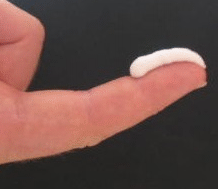
One FTU is the amount of topical steroid that is squeezed out from a standard tube along an adult's fingertip. (This assumes the tube has a standard 5 mm nozzle.) A fingertip is from the very end of the finger to the first crease in the finger. One FTU is enough to treat an area of skin twice the size of the flat of an adult's hand with the fingers together (ie a 'handprint').
Two FTUs are about the same as 1 g of topical steroid. Therefore, for example, say you treat an area of skin the size of eight adult hands. You will need four FTUs for each dose. (This is 2 g per dose. If the dose is once a day, then a 30 g tube should last for about 15 days of treatment.)
The following are further examples:
Area of skin to be treated (adults) | Size is roughly | FTUs each dose (adults) |
A hand and fingers (front and back) | About 2 adult hands | 1 FTU |
Front of chest and abdomen | About 14 adult hands | 7 FTUs |
Back and buttocks | About 14 adult hands | 7 FTUs |
Face and neck | About 5 adult hands | 2.5 FTUs |
An entire arm and hand | About 8 adult hands | 4 FTUs |
An entire leg and foot | About 16 adult hands | 8 FTUs |
Fingertip units and children
An FTU of cream or ointment is measured on an adult index finger before being rubbed on to a child. Again, one FTU is used to treat an area of skin on a child, equivalent to twice the size of the flat of an adult's hand with the fingers together. You can gauge the amount of topical steroid to use by using your (adult) hand to measure the amount of skin affected on the child. From this you can work out the amount of topical steroid to use.
The following gives a rough guide:
For a child aged 3-6 months
Entire face and neck - 1 FTU.
An entire arm and hand - 1 FTU.
An entire leg and foot - 1.5 FTUs.
The entire front of chest and tummy (abdomen) - 1 FTU.
The entire back including buttocks - 1.5 FTUs.
For a child aged 1-2 years
Entire face and neck - 1.5 FTUs.
An entire arm and hand - 1.5 FTUs.
An entire leg and foot - 2 FTUs.
The entire front of chest and abdomen - 2 FTUs.
The entire back including buttocks - 3 FTUs.
For a child aged 3-5 years
Entire face and neck - 1.5 FTUs.
An entire arm and hand - 2 FTUs.
An entire leg and foot - 3 FTUs.
The entire front of chest and abdomen - 3 FTUs.
The entire back including buttocks - 3.5 FTUs.
For a child aged 6-10 years
Entire face and neck - 2 FTUs.
An entire arm and hand - 2.5 FTUs.
An entire leg and foot - 4.5 FTUs.
The entire front of chest and abdomen - 3.5 FTUs.
The entire back including buttocks - 5 FTUs.
Sélections des patients pour Médicaments pour la peau
Traitement et médicaments
Corticostéroïdes topiques pour l'eczéma
Les stéroïdes topiques sont des crèmes stéroïdiennes médicamenteuses appliquées sur la peau. Ils sont utilisés en complément des hydratants (également appelés émollients) pour traiter l'eczéma. Les stéroïdes topiques réduisent l'inflammation de la peau. Un traitement de courte durée éliminera généralement une poussée d'eczéma. Les effets secondaires sont peu probables avec des traitements de courte durée.
par Dr Toni Hazell, FRCGP

Traitement et médicaments
Émollients et crèmes pour l'eczéma
Emollients (moisturisers) are commonly used to treat eczema as they prevent the skin from becoming dry. You can apply emollients as often as you need. This may be 2-3 times a day or more if your skin becomes very dry. Applying emollients regularly is hard work and tedious but worthwhile as it can prevent eczema from flaring up.
par Dr Philippa Vincent, MRCGP
Questions fréquemment posées
What does a fingertip unit (FTU) actually look like?
A fingertip unit (FTU) is the amount of topical steroid squeezed out from a standard tube (with a 5 mm nozzle) along an adult's fingertip. This is measured from the very end of the finger to the first crease.
How much skin area does one fingertip unit (FTU) cover?
One FTU is enough topical steroid to treat an area of skin that is twice the size of the flat of an adult's hand with their fingers held together, often referred to as a 'handprint'.
How many grams of topical steroid are in one fingertip unit (FTU)?
Approximately two fingertip units (FTUs) are equivalent to 1 gram of topical steroid.
How long will a 30g tube of topical steroid last if I apply it once a day?
If you are applying 2 grams of topical steroid per dose once a day, a 30-gram tube should last for about 15 days of treatment.
When applying topical steroids to a child, whose fingertip should be used to measure the dose?
When applying topical steroids to a child, the dose (FTU) should always be measured on an adult's index finger before being rubbed onto the child's skin. You can then use your own adult hand to estimate the size of the affected area on the child to determine how many FTUs are needed.
Lectures complémentaires et références
- Long CC, Finlay AY; The finger-tip unit - a new practical measure. Clin Exp Dermatol. 1991 Nov;16(6):444-7.
- Bewley A; Expert consensus: time for a change in the way we advise our patients to use topical corticosteroids. Br J Dermatol. 2008 May;158(5):917-20. Epub 2008 Feb 22.
- Formulaire National Britannique (BNF); Services de Preuves NICE (accès réservé au Royaume-Uni)
- Corticosteroids - topical (skin), nose, and eyes; NICE CKS, juin 2022 (accès réservé au Royaume-Uni)
- Eczéma - atopique; NICE CKS, avril 2022 (accès réservé au Royaume-Uni)
À propos de l'auteurVoir la biographie complète

Dr Doug McKechnie, MRCGP
Rédacteur Médical
MA, MBBS, MSc, DRCOG, MRCP(UK), MRCGP(2021), FHEA
Le Dr Doug McKechnie est un médecin généraliste du NHS travaillant à Londres. Il travaille à plein temps en clinique et est également le chef adjoint du module de Pratique Clinique et Professionnelle à l'École de Médecine de l'University College London.
À propos du critiqueVoir la biographie complète

Dr Colin Tidy, MRCGP
Médecin généraliste, Auteur médical
MBBS, MRCGP, MRCP (Paediatrics), DCH
Le Dr Colin Tidy est un médecin du NHS, basé dans l'Oxfordshire.
Historique de l'article
Les informations sur cette page sont rédigées et examinées par des cliniciens qualifiés.
Article également disponible en Anglais, Allemand, Espagnol, Français, Italien, Portugais, Hindi, Hébreu, Arabe, and Suédois.
Prochaine révision prévue : 18 janv. 2028
19 janv. 2023 | Dernière version

Demandez, partagez, connectez-vous.
Parcourez les discussions, posez des questions et partagez vos expériences sur des centaines de sujets de santé.

Vous ne vous sentez pas bien ?
Évaluez vos symptômes en ligne gratuitement
Inscrivez-vous à la newsletter Patient
Votre dose hebdomadaire de conseils de santé clairs et fiables - rédigés pour vous aider à vous sentir informé, confiant et maître de la situation.
En vous abonnant, vous acceptez notre Politique de confidentialité. Vous pouvez vous désabonner à tout moment. Nous ne vendons jamais vos données.
Plus sur le traitement et les médicaments
- Traitements de l'acné
- Antiacides
- Anticoagulants
- Antidépresseurs
- Audiologie
- Benzodiazépines et médicaments Z
- Respiration contrôlée
- Bêta-lactamases à spectre étendu
- Traitement à l'azote liquide
- Médicaments et traitements pour la démence
- Médicament pour l'hypertension
- Médicaments pour l'urgence urinaire et l'incontinence
- Vaccin méningococcique contre la méningite
- Bronchodilatateurs oraux
- Corticostéroïdes oraux
- Diurétiques épargneurs de potassium
- Thérapie par ondes de choc
- Comprimés pour dormir
- Analgésiques anti-inflammatoires topiques
- Utilisation de l'oxygénothérapie dans la BPCO