Kimchi et choucroute : Quels sont les bienfaits de la consommation d'aliments fermentés ?
Revu par Dr Krishna Vakharia, MRCGPDernière mise à jour par Amberley DavisLast updated 12 Oct 2023
Respecte les directives éditoriales
- TéléchargerTélécharger
- Partager
- Language
- Discussion
- Version audio
- Add to preferred sources on Google
TikTok et Instagram regorgent d'influenceurs qui prétendent que toutes sortes d'aliments sont des superaliments — certains ne sont même pas sains, encore moins super. Mais en ce qui concerne le kimchi et la choucroute, la recherche suggère que ces aliments fermentés pourraient en fait contribuer à un système digestif sain. Mais pourquoi ?
Dans cet article:
Video picks for Vitamines et compléments alimentaires
Continuez à lire ci-dessous
What are fermented foods?
Long before we had fridges, fermentation was used to preserve goods to give them a longer life. Fermentation is when bacteria and yeast - microorganisms - break down carbohydrates such as starch or sugar and turns them into alcohol or acids. This acts as a natural preservative and gives the foods a stronger, tangy taste. Fermentation also creates good bactérie, which help to promote a healthy gut.
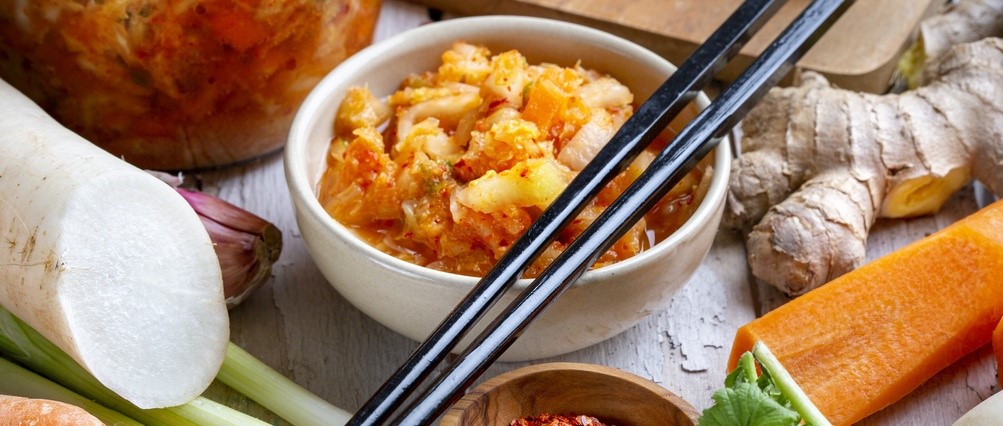
People across the world ferment foods. Kimchi is a traditional, slightly spicy Korean dish made from fermented vegetables. Usually, the ingredients include raw cabbage, daikon radish, carrots, garlic, ginger, and gochugaru - a Korean chilli. The mix is then lacto-fermented in brine, which is salted water. The water is salty enough to kill off harmful bactérie, leaving behind the good bacteria - in this case, lactobacillus organisms. Kimchi is usually eaten as a side dish to a meal.
Sauerkraut is a similar European dish made from cabbage and other vegetables, such as carrots. It is popular in Germany, but it is also a traditional dish in other eastern European countries including Poland and Ukraine. The vegetables are fermented in the same way as Kimchi, using salted water. It is eaten in a similar way too, often as a side dish to make a meal more interesting.
Why are kimchi and sauerkraut healthy?
Retour au sommaireReema Patel, a registered dietitian at Dietitian Fit, explains that these dishes are healthy for a number of reasons. Firstly, they are made from vegetables - typically cabbage, but can also contain onions, carrots, radish, as well as garlic and ginger. She says: "All of these are great for our health and provide a range of nutrients, such as Vitamins A, B, C, and K, as well as being a good source of fibres."
Fermented foods are also useful because they help provide a spectrum of des probiotiques. "Probiotics are the healthy bacteria that are found in our body, especially our gut. These help our les réponses immunitaires function, santé mentale, digestion of foods, and so much more,"
Patel says.
The body is home to trillions of microorganisms, including bacteria, known as the microbiome. Probiotiques are living microorganisms that are thought to boost your microbiome's diversity by introducing bacteria that can help promote healthy digestion and immunity and keep bad bacteria at bay.
The gut microbiome has been linked to having an affect on our health - including behaviour, mood, appetite, immunity, and weight - as well as having anti-inflammatory properties, which can reduce the risk of health issues such as diabète de type 2 and high blood pressure.
Research has also linked the gut microbiome to mental health. This is because the brain and gastrointestinal system are connected by the gut-brain axis - a term for the communication network that links the pair1.
Some studies suggest fermented foods like kimchi can improve symptoms of le syndrome du côlon irritable and help with digestive issues such as brûlures d'estomac, les ballonnements et reflux2. This may be because it is high in fibre and contains lactic acid.
Research suggests that fermented foods may also help to reduce the risk of cancer3. However, other studies have linked the high salt content of fermented foods such as kimchi to stomach cancer4.
Continuez à lire ci-dessous
Are there any downsides to fermented foods?
Retour au sommaireFermented foods like kimchi and sauerkraut may offer healthy benefits, but they may not be suitable for everyone. Firstly, the process of fermentation in brine means these foods are often quite salty. "We need to keep in mind that kimchi can be high in sodium, so it is important to include it as part of an overall balanced and varied diet in moderation," says Patel.
Also, fermented foods are high in substances called amines and people who are sensitive to these may experience headaches and other issues after eating them5.
However, there is a significant body of research to suggest that fermented foods can help to boost your health when eaten as part of a balanced diet.
Best ways to eat kimchi and sauerkraut
Retour au sommaireKimchi is often eaten as a side dish, but it can also be added to stews, soups or dumplings. It is delicious served alongside cooked meats, fish or rice dishes. A popular way to eat sauerkraut is alongside meat, such as German sausage, and potatoes.
For a healthy option, try vegetarian sausages, lean or low-salt sausages or look for nitrate-free meat. Nitrates, often found in processed meats to preserve the food for longer, have been linked to cancer6.
Both kimchi and sauerkraut are versatile dishes and can be eaten however you like, or as a healthy snack.
Continuez à lire ci-dessous
Pour en savoir plus
Retour au sommaireClapp et al: Gut microbiota’s effect on mental health: The gut-brain axis.
Sehadet-Tasdemir et al: An insight into the anti-cancer effects of fermented foods: A review.
Hong-Nei Nan et al: Kimchi and soybean pastes are risk factors of gastric cancer.
Skowron et al:Two Faces of Fermented Foods—The Benefits and Threats of Its Consumption.
An insight into the anticancer effects of fermented foods: A review.
Patient picks for Vitamines et compléments alimentaires

Régime et nutrition
Le kombucha peut-il améliorer votre santé ?
Kombucha - once a niche health drink - has become a mainstream staple, thanks to its unique combination of hydration, flavour and fizz. But beyond its distinctive taste, find out if the health benefits of kombucha live up to its reputation.
par Victoria Raw
Régime et nutrition
10 aliments quotidiens riches en vitamine D
Vitamin D plays an essential role in bone health, immunity, and mood, yet many people in the UK don’t get enough, especially during the darker months. While sunlight is the main source, certain foods can also help to boost your levels naturally. In this article, we explore vitamin D foods you might not expect and how to include them in your diet.
par Josh Alderman
Continuez à lire ci-dessous
About the author

Lydia Smith
Feature writer
BA, MA, MSc
Lydia Smith is an award-winning journalist and feature writer who has written extensively on women's health and mental health. She is currently studying for an MSc in psychology.
About the reviewerView full bio

Dr Krishna Vakharia, MRCGP
Chief Medical Officer for Health, Optum UK
MBChB, MRCGP(2013), BMedSci (hons), DFSRH, DRCOG, PGDipDerm (Distn)
Dr Krishna Vakharia is an NHS GP. She is also a regular examiner for the postgraduate Diploma in Practical Dermatology at Cardiff University as well as being the Chief Medical Officer for health at Optum UK.
Historique de l'article
Les informations sur cette page sont examinées par des cliniciens qualifiés.
12 Oct 2023 | Dernière version
4 juil. 2023 | Publié à l'origine
Écrit par :
Lydia Smith

Demandez, partagez, connectez-vous.
Parcourez les discussions, posez des questions et partagez vos expériences sur des centaines de sujets de santé.

Vous ne vous sentez pas bien ?
Évaluez vos symptômes en ligne gratuitement
Inscrivez-vous à la newsletter Patient
Votre dose hebdomadaire de conseils de santé clairs et fiables - rédigés pour vous aider à vous sentir informé, confiant et maître de la situation.
By subscribing you accept our Politique de confidentialité. Vous pouvez vous désabonner à tout moment. Nous ne vendons jamais vos données.