Indigestion
Dyspepsie
Revu par Dr Rachel Hudson, MRCGPDernière mise à jour par Dr Philippa Vincent, MRCGPDernière mise à jour 21 août 2023
Respecte les directives éditoriales
- TéléchargerTélécharger
- Partager
- Language
- Discussion
- Version audio
- Ajouter aux sources préférées sur Google
Dans cette série :GastriteDyspepsie fonctionnelleUlcère de l'estomacUlcère duodénalHelicobacter pyloriGastroscopie
La dyspepsie (indigestion) est un terme qui décrit la douleur et parfois d'autres symptômes provenant de la partie supérieure du tube digestif (l'estomac, l'œsophage ou le duodénum). Il existe diverses causes (décrites ci-dessous). Le traitement dépend de la cause probable.
En un coup d'œil
L'indigestion, également connue sous le nom de dyspepsie, est une gêne ou une douleur dans le haut de l'abdomen.
Les symptômes courants incluent des ballonnements, des éructations, des nausées et une sensation de satiété rapide.
Elle peut être causée par divers facteurs, y compris certains médicaments et une infection à H. pylori.
Des changements de mode de vie, comme manger des repas réguliers et ne pas fumer, peuvent aider.
Les antiacides peuvent offrir un soulagement rapide pour une indigestion légère ou peu fréquente.
Vous devriez consulter un médecin si vous avez une indigestion persistante ou inexpliquée, surtout si vous avez plus de 55 ans.
Des tests supplémentaires peuvent être nécessaires si vous présentez des symptômes tels qu'une perte de poids inexpliquée ou des difficultés à avaler.
Qu'est-ce que l'indigestion ?
Indigestion (dyspepsia) is a term which includes symptoms that come from a problem in the upper gut. The gut (gastrointestinal tract) is the tube that starts at the mouth and ends at the anus. The upper gut includes the oesophagus, stomach and duodenum.
Indigestion symptoms
The main symptom of indigestion is usually stomach pain or discomfort in the upper abdomen. Other symptoms include:
Ballonnements.
Roter.
Se sentir rapidement rassasié après avoir mangé.
Sensation de nausée.
Être malade (vomissements).
Symptoms are often related to eating. Heartburn (a burning sensation felt in the lower chest area) and bitter-tasting liquid coming up into the back of the throat (sometimes called 'waterbrash') used to be considered as symptoms of dyspepsia. However, these are now considered to be features of a condition called gastro-oesophageal reflux disease (GORD) - see below.
Symptoms tend to occur in bouts which come and go rather than being present all the time. Most people have a bout of dyspepsia, often called indigestion, from time to time - for example, after a large spicy meal. In most cases it soon goes away and is of little concern. However, some people have frequent bouts of dyspepsia which can affect their quality of life.
What causes indigestion?
Causes courantes
Most cases of repeated (recurring) dyspepsia are due to one of the following:
Non-ulcer dyspepsia. This is sometimes called functional dyspepsia. It means that no cause can be found for the symptoms. It often overlaps with symptoms of irritable bowel syndrome. See the separate leaflet called Non-ulcer Dyspepsia (Functional Dyspepsia) for more detail.
Duodenal and stomach (gastric) ulcers. An ulcer occurs when the lining of the gut is damaged and the underlying tissue is exposed. See the separate leaflets called Duodenal Ulcer et Stomach Ulcer (Gastric Ulcer) for more detail.
Duodenitis and gastritis (inflammation of the duodenum and/or stomach) - which may be mild or more severe and may lead to an ulcer. See the separate leaflet called Gastritis.
Acid reflux, oesophagitis and GORD. Acid reflux occurs when some acid leaks up (refluxes) into the oesophagus from the stomach. See the separate leaflets called Acid Reflux and Oesophagitis et Eosinophilic Oesophagitis for more detail.
Hernie hiatale. This occurs when the top part of the stomach pushes up into the lower chest through a defect in the diaphragm. See the separate leaflet called Hiatus Hernia for more detail.
Infection with H. pylori - see below.
Médication. Some medicines may cause dyspepsia as a side-effect:
Médicaments anti-inflammatoires are the most common culprits. These are medicines that many people take for l'arthrite, muscular pains, sprains, period pains, etc. For example: aspirine, ibuprofène, and diclofénac - but there are others. Anti-inflammatory medicines sometimes affect the stomach lining and allow acid to cause inflammation and ulcers.
Various other medicines sometimes cause dyspepsia, or make dyspepsia worse. They include: digoxine, antibiotiques, stéroïdes, de fer, calcium antagonists, nitrates et bisphosphonates.
(Remarque: this is not a full list. Check with the leaflet that comes with any medication for a list of possible side-effects.)
H. pylori and dyspepsia
A bacteria called H. pylori can infect the lining of the stomach and duodenum. It is one of the most common infections in the UK. More than 1 in 4 people in the UK become infected with H. pylori at some stage in their lives. Once infected, unless treated, the infection usually stays permanently.
Most people with H. pylori have no symptoms and do not know that they are infected. However, H. pylori is the most common cause of duodenal and stomach ulcers. See the separate leaflet called Helicobacter Pylori for more detail.
Other uncommon causes of dyspepsia
Other problems of the upper gut, such as un cancer de l'estomac et cancer de l'œsophage, can cause dyspepsia when they first develop.
There are separate leaflets which describe the above conditions in more detail. The rest of this leaflet gives an overview of how dyspepsia is usually managed.
Diagnosing indigestion
A clinician is likely to do an initial assessment by asking about symptoms and examining the abdomen. The examination is usually normal with any of the common causes of dyspepsia. It is important to review any medicines being taken in case one may be causing the symptoms or making them worse.
Comment se débarrasser de l'indigestion
Following the initial assessment, depending on the severity and frequency of symptoms, one or more of the following plans of action may be suggested.
Changements de mode de vie
For all types of dyspepsia, the National Institute for Health and Care Excellence (NICE) recommends the following lifestyle changes:
Make sure to eat regular meals.
Stop smoking.
For dyspepsia which is likely to be due to acid reflux, when heartburn is a major symptom, the following may also be worth considering:
Posture. Lying down or bending forwards a lot during the day encourages reflux. Sitting hunched or wearing tight belts may put extra pressure on the stomach, which may make any reflux worse.
Heure du coucher. If symptoms return most nights, the following may help:
Aller au lit avec un estomac vide et sec - ne pas manger dans les trois heures précédant le coucher et ne pas boire dans les deux heures précédant le coucher.
Raising the head of the bed by 10-20 cm (for example, with books or bricks under the mattress or the legs of the bed if this can be done safely). This helps gravity to keep acid from refluxing into the oesophagus.
Antacids taken as required
Antiacides are alkali liquids or tablets that can neutralise the stomach acid. A dose may give quick relief. There are many brands which can be bought and some are available on prescription. People with mild or infrequent bouts of dyspepsia may find that antacids used when needed are sufficient to manage their symptoms.
A change or alteration in your current medication
This may be possible if a medicine is thought to be causing the symptoms or making them worse.
Test for Helicobacter pylori (H. pylori) infection and treat if it is present
A test to detect H. pylori is commonly done if you have frequent bouts of dyspepsia. As mentioned, it is the underlying cause of most duodenal and stomach ulcers and many cases of gastritis, duodenitis and non-ulcer dyspepsia. This test is via a stool sample. For more information about the diagnosis and treatment of H. pylori, see the separate leaflet called Helicobacter Pylori.
Acid-suppressing medication
A one-month trial of full-dose medication which reduces stomach acid may be considered - in particular, if:
Symptoms are more suggestive of acid reflux or oesophagitis. H. pylori does not cause these problems.
Infection with H. pylori has been ruled out.
H. pylori has been treated but symptoms persist.
See the separate leaflet called Indigestion Medication for more information.
Tests supplémentaires
Further tests are not needed in most cases. One or more of the above options will usually manage the problem. Reasons why further tests may be advised include:
If additional symptoms suggest that the dyspepsia may be caused by a serious disorder such as stomach or oesophageal cancer or a complication from an ulcer such as bleeding; for example if:
Passing blood with stools (blood can cause black tarry stools).
Bringing up (vomit) blood.
Losing weight unintentionally.
Sensation de malaise général.
Vomiting persistently.
Developing anaemia.
Having an abnormality on examination, such as a lump in the abdomen.
If aged over 55 and develop persistent or unexplained dyspepsia.
If the symptoms are not typical and may be coming from outside the gut, for example, to rule out problems of the gallbladder, pancreas, liver, etc.
If the symptoms are severe and do not respond to treatment.
If there is a risk factor for stomach or oesophageal cancer, such as Œsophage de Barrett, dysplasia, or atrophic gastritis, or had ulcer surgery over 20 years earlier.
Tests advised may include:
Gastroscopy (endoscopy). In this test a clinician looks inside the oesophagus, stomach and duodenum. They do this by passing a thin, flexible telescope down the oesophagus. See the separate leaflet called Gastroscopy (Endoscopy) for more detail.
A blood test to check for anaemia. Anaemia may be due to a bleeding ulcer or to a bleeding stomach cancer. The bleeding might not be noticed if it is not heavy, as the blood can be passed out unnoticed in the stools.
Tests of the gallbladder, pancreas, etc, if the cause of the symptoms is not clear.
Treatment depends on what is found or ruled out by the tests.
Preventing indigestion
The most important factors in preventing indigestion are:
Maintaining a healthy weight.
Not smoking - or stopping smoking.
Drinking alcohol within recommended limits.
Eating a balanced diet.
Eating small regular meals instead of large meals.
Avoiding eating too late at night before going to bed.
Avoiding foods that trigger the indigestion - in some people, they find that certain foods such as onions, garlic, tomatoes or spicy foods will trigger a bout of indigestion. Those people should avoid those triggers.
Understanding digestion
Le tube digestif supérieur
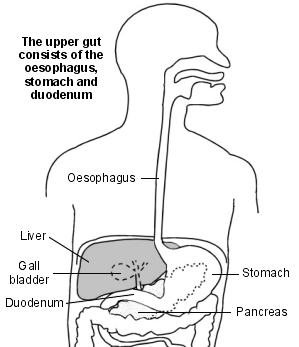
Food passes down the gullet (oesophagus) into the stomach. The stomach makes acid which is not essential but helps to digest food. Food then passes gradually into the first part of the small intestine (the duodenum).
In the duodenum and the rest of the small intestine, food mixes with chemicals called enzymes. The enzymes come from the pancreas and from cells lining the intestine. The enzymes break down (digest) the food. Digested food is then absorbed into the body from the small intestine.
Sélections des patients pour Indigestion et brûlures d'estomac

Santé digestive
Dyspepsie fonctionnelle
La dyspepsie fonctionnelle (dyspepsie non ulcéreuse) provoque des douleurs et parfois d'autres symptômes dans le haut de votre ventre (abdomen). La cause n'est souvent pas claire. Les médicaments pour réduire l'acidité de l'estomac aident dans certains cas. L'infection par Helicobacter pylori (H. pylori) peut causer un petit nombre de cas. Éliminer cette infection, si elle est présente, aide certaines personnes.
par Dr Rosalyn Adleman, MRCGP
Santé digestive
Reflux acide et œsophagite
Lorsque l'acide de l'estomac remonte dans l'œsophage (tube transportant la nourriture de la bouche à l'estomac), la condition est connue sous le nom de reflux acide. Cela peut provoquer des brûlures d'estomac et d'autres symptômes. Un médicament qui réduit la quantité d'acide produite dans l'estomac est un traitement courant et fonctionne généralement bien. Certaines personnes prennent des traitements de courte durée lorsque les symptômes s'aggravent. Certaines personnes ont besoin d'un traitement quotidien à long terme pour éloigner les symptômes.
par Dr Doug McKechnie, MRCGP
Questions fréquemment posées
Quand devrais-je m'inquiéter de mes symptômes d'indigestion ?
Vous devriez consulter un médecin si vous présentez des symptômes supplémentaires tels que la présence de sang dans vos selles (qui peuvent apparaître noires et goudronneuses), des vomissements de sang, une perte de poids involontaire, un malaise général, des difficultés à avaler, des vomissements persistants ou le développement d'une anémie. De plus, si vous avez plus de 55 ans et développez une indigestion persistante ou inexpliquée, ou si vous avez des antécédents familiaux de cancer de l'estomac ou de l'œsophage, des investigations supplémentaires peuvent être conseillées.
Certains médicaments peuvent-ils aggraver l'indigestion ?
Oui, certains médicaments peuvent provoquer ou aggraver l'indigestion comme effet secondaire. Les médicaments anti-inflammatoires comme l'aspirine, l'ibuprofène et le diclofénac sont des coupables courants. Divers autres médicaments, tels que la digoxine, les antibiotiques, les stéroïdes, le fer, les antagonistes du calcium, les nitrates et les bisphosphonates, peuvent également parfois provoquer ou exacerber les symptômes d'indigestion. Vérifiez toujours la notice qui accompagne votre médicament pour une liste des effets secondaires possibles.
Quelle est la différence entre l'indigestion et le reflux acide ?
L'indigestion est un terme général qui inclut des symptômes tels que des douleurs à l'estomac ou une gêne dans le haut de l'abdomen, des ballonnements, des éructations et une sensation de satiété rapide. Le reflux acide se produit spécifiquement lorsque l'acide gastrique remonte dans l'œsophage, et son principal symptôme est le brûlant (une sensation de brûlure dans le bas de la poitrine), parfois accompagné d'un liquide au goût amer remontant dans la gorge ('régurgitation acide'). Bien que le brûlant et la régurgitation acide aient autrefois été considérés comme des symptômes d'indigestion, ils sont désormais principalement vus comme des caractéristiques de la maladie de reflux gastro-œsophagien (RGO).
Qu'est-ce que H. pylori et quel est son lien avec l'indigestion ?
H. pylori est une bactérie qui peut infecter la muqueuse de l'estomac et du duodénum. C'est une infection très courante, mais la plupart des personnes qui en sont atteintes ne présentent pas de symptômes. Cependant, H. pylori est la cause la plus fréquente d'ulcères duodénaux et gastriques, ainsi que de nombreux cas de gastrite, de duodénite et de dyspepsie non ulcéreuse, qui peuvent tous entraîner des symptômes d'indigestion.
Y a-t-il des aliments spécifiques que je devrais éviter pour prévenir l'indigestion ?
Bien que l'article recommande d'éviter les aliments qui déclenchent votre indigestion, il mentionne spécifiquement que certaines personnes trouvent que certains aliments comme les oignons, l'ail, les tomates ou les aliments épicés peuvent provoquer une crise d'indigestion. Si vous identifiez de tels déclencheurs, il est conseillé de les éviter.
Comment la posture peut-elle affecter ma digestion ?
Si votre indigestion est liée au reflux acide, certaines postures peuvent l'aggraver. S'allonger ou se pencher fréquemment en avant pendant la journée peut favoriser le reflux. De plus, s'asseoir voûté ou porter des ceintures serrées peut exercer une pression supplémentaire sur votre estomac, ce qui peut aggraver les symptômes de reflux.
Lectures complémentaires et références
- Maladie de reflux gastro-œsophagien et dyspepsie chez les adultes : investigation et gestion; Ligne directrice clinique NICE (septembre 2014 - dernière mise à jour octobre 2019)
- Dore MP, Pes GM, Bassotti G, et al; Dyspepsie : Quand et comment tester l'infection à Helicobacter pylori. Gastroenterol Res Pract. 2016;2016:8463614. doi: 10.1155/2016/8463614. Publié en ligne le 28 avril 2016.
- Talley NJ, Goodsall T, Potter M; Dyspepsie fonctionnelle. Aust Prescr. 2017 Déc;40(6):209-213. doi: 10.18773/austprescr.2017.066. Epub 2017 Déc 4.
- Dyspepsie - ulcère peptique avéré; NICE CKS, décembre 2022 (accès réservé au Royaume-Uni)
- Dyspepsie - RGO prouvé; NICE CKS, juillet 2023 (accès réservé au Royaume-Uni)
- Dyspepsie - fonctionnelle prouvée; NICE CKS, décembre 2022 (accès réservé au Royaume-Uni)
À propos de l'auteurVoir la biographie complète

Dr Philippa Vincent, MRCGP
Médecin généraliste, Auteur médical
MB BS, Bsc, MRCGP (2000), DCH, DFSRH, DRCOG
Dr Philippa Vincent est un médecin généraliste du NHS travaillant dans le nord de Londres.
À propos du critiqueVoir la biographie complète

Dr Rachel Hudson, MRCGP
Médecin généraliste et auteur médical
MBChB, MRCGP (2008), BSc (Medical Science), DFSRH, DRCOG, DCH
Dr Rachel Hudson est médecin généraliste du NHS travaillant dans le nord-ouest de l'Angleterre.
Historique de l'article
Les informations sur cette page sont rédigées et examinées par des cliniciens qualifiés.
Article également disponible en Anglais, Allemand, Espagnol, Français, Italien, Portugais, Hindi, Hébreu, Arabe, and Suédois.
Prochaine révision prévue : 19 août 2028
21 août 2023 | Dernière version

Demandez, partagez, connectez-vous.
Parcourez les discussions, posez des questions et partagez vos expériences sur des centaines de sujets de santé.

Vous ne vous sentez pas bien ?
Évaluez vos symptômes en ligne gratuitement
Inscrivez-vous à la newsletter Patient
Votre dose hebdomadaire de conseils de santé clairs et fiables - rédigés pour vous aider à vous sentir informé, confiant et maître de la situation.
En vous abonnant, vous acceptez notre Politique de confidentialité. Vous pouvez vous désabonner à tout moment. Nous ne vendons jamais vos données.
Plus sur la santé digestive
- Masses abdominales
- Fissure anale
- maladie de Crohn
- Diverticules
- Dyspepsie fonctionnelle
- Syndrome de Gilbert
- Bloqueurs H2
- Hépatite A
- Laxatifs
- Douleur abdominale du côté gauche chez les enfants
- Biopsie hépatique
- Tests de fonction hépatique
- Adénite mésentérique
- Sondes d'alimentation par gastrostomie (PEG)
- Prévention des infections après une splénectomie
- Saignement rectal
- Douleur dans le quadrant inférieur droit
- Douleur dans le quadrant supérieur droit
- Symptômes de l'appendicite
- Colite ulcéreuse