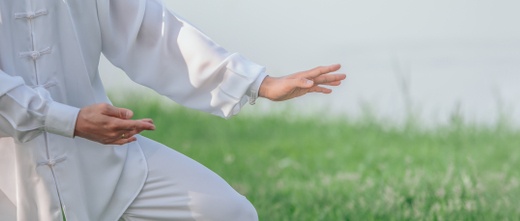
Qu'est-ce que la marche Tai Chi - et cela vaut-il la peine d'essayer ?
Revu par Dr Colin Tidy, MRCGPRédigé par Victoria RawPublié à l'origine 1 avr. 2026
Respecte les directives éditoriales
- TéléchargerTélécharger
- Partager
- Language
- Discussion
- Version audio
- Ajouter aux sources préférées sur Google
The martial art of Tai Chi has been around for centuries. Originally developed as a form of self-defensive combat, it’s still going strong today - though its greatest strength now lies in its ability to support overall health and wellbeing.
For something so ancient, it’s impressive that Tai Chi is still finding new relevance in today’s wellness world. One of the latest ways it’s being embraced - particularly across online platforms - is through a more accessible adaptation of the practice known as Tai Chi Walking.
Inscrivez-vous à notre cours gratuit de 10 semaines sur le vieillissement en bonne santé
Faites le premier pas pour vous sentir au mieux de votre forme en vieillissant. Chaque semaine, nous nous concentrerons sur différents domaines pour vous aider à bien vieillir et à maintenir un corps et un esprit sains, y compris l'exercice, l'alimentation, les compléments anti-âge, le vieillissement cérébral sain, ainsi que la santé des os et des articulations.
En vous abonnant, vous acceptez notre Politique de confidentialité. Vous pouvez vous désabonner à tout moment. Nous ne vendons jamais vos données.
What is Tai Chi?
Tai Chi, also known as Tai Chi Chuan (Taijiquan), originated in China as a form of martial arts training. Over time, it has evolved into one of the most respected practices in Chinese culture for promoting health, balance, and longevity.
Dr Mao Shing Ni, Tao of Wellness, California, USA, is a Tai Chi master and a board-certified specialist in longevity. He explains that the term Tai Chi refers to the ultimate balance of yin and yang - the dynamic harmony between opposing forces such as movement and stillness, strength and softness, and effort and relaxation.
“In practice, Tai Chi consists of slow, flowing movements performed with awareness of breath, posture, and internal energy, which Chinese medicine calls Qi,” says Ni.
“Unlike many exercises that isolate muscles, Tai Chi trains your entire body as one integrated system. The mind guides the movement, the breath regulates the rhythm, and the body follows smoothly. In this way, Tai Chi becomes a form of moving meditation - strengthening the body while calming and focusing the mind.”

Learning Tai Chi the right way
Ni recommends that if you’re interested in learning Tai Chi, the best way to practise it correctly is with a qualified teacher.
He points out that while Tai Chi may look simple from the outside, the internal principles are actually quite subtle. A skilled teacher can guide you through key elements, such as proper alignment of your spine and joints, coordinating breath with movement, shifting weight safely and efficiently, and maintaining stability while staying relaxed.
“Without direct guidance from a teacher, beginners often rely only on imitation,” says Ni. “You may tense your body, collapse posture, or move mechanically, which reduces the benefits and sometimes creates strain.”
He adds that, traditionally, Tai Chi was taught through direct transmission, with the teacher guiding posture and helping students sense the internal flow of movement. This kind of hands-on feedback speeds up learning and helps practitioners develop the deeper aspects of the art.
How Tai Chi supports mind and body wellbeing
With consistent practice and guidance, Tai Chi offers a wide range of health benefits. Beginners often start to feel confident with the basic movements after just a few weeks of regular practice. While mastering a complete form can take several months, the positive effects on health can be noticed much earlier.
Ni explains that Tai Chi is often described as “meditation and healing in motion”.
He adds that practising it regularly can benefit your:
Joint mobility and flexibility.
Circulation and heart health.
Muscle coordination and strength.
Posture and spinal alignment.
“Because movements are performed with focused attention, Tai Chi also helps improve your concentration, enhance your body awareness and sharpen your memory and cognitive function,” says Ni. “Modern studies even suggest Tai Chi may support brain health and neuroplasticity.
“From a Chinese medicine perspective, Tai Chi helps regulate Qi and calm the spirit, which we call Shen. Practitioners often experience reduced stress and anxiety, improved emotional resilience, and a greater sense of inner balance.”
Staying safe while practising Tai Chi
According to Ni, Tai Chi is generally considered a very safe practice, which is why it’s often recommended for older adults and those recovering from illness.
However, for the best results and to ensure safety, it really should be mastered under the guidance of a teacher. Without proper instruction, people can sometimes lock their knees or joints, lean too far forwards or backwards, or move with unnecessary tension.
Ni explains that these habits can occasionally put strain on your knees, hips, or lower back. That said, injuries from Tai Chi are extremely rare, and it is considered safe for most people.
“People who should be especially careful include those with severe balance disorders, those recovering from major joint surgery or those with acute injuries,” says Ni. “For them, Tai Chi can still be beneficial, but it should be modified and taught carefully.”
Exploring Tai Chi Walking for beginners and beyond
Tai Chi Walking - sometimes called the Tai Chi walking method - is a trend that has spread across social media, and as a result, more and more people have started practising it. This allows them to enjoy some of the health benefits of Tai Chi, even without committing to the full traditional practice.
Ni describes Tai Chi Walking as a simplified approach that brings the principles of Tai Chi to life through walking.
“Instead of performing a full sequence of movements, practitioners walk slowly and intentionally while maintaining upright posture, smooth weight transfer, relaxed breathing, and awareness of each step,” he says.
“Each step is placed with mindfulness and balance, almost as if the foot is gently 'testing the ground’. Compared to full Tai Chi forms, Tai Chi walking is simpler and easier to learn, making it accessible to beginners.”
Why Tai Chi Walking has become a wellness trend
Tai Chi Walking draws from traditional walking practices designed to enhance balance and provide a deep sense of grounding. Closely linked to mindful walking meditation, it uses simple, intentional movements to foster greater awareness and promote internal harmony.
Ni explains that many people today are feeling overwhelmed by stress, technology, and constant stimulation. Tai Chi offers something very appealing - a simple way to slow down and reconnect with your body.
“It requires no equipment, no special location like a gym and no athletic ability,” he says. “People can practice it in a park, on a trail, or even in their backyard. In a world that often pushes us to move faster, Tai Chi Walking reminds us that health sometimes begins by slowing down.”
A simple guide to Tai Chi Walking
Tai Chi Walking is an easy and accessible way to practice mindfulness and improve your balance. While it's a good idea to check in with a professional for formal training, you can safely practice these simple steps on your own:
Starting stance
Footwear - wear comfortable shoes with a flat sole or thin socks on a non-slip surface.
Position - stand naturally with your feet parallel and hip-width apart, knees slightly bent.
Posture - keep your head up, chin tucked, and spine lengthened.
Shifting your weight
The shift - gradually shift your weight to your right leg, making it feel light.
The lift - lift your left leg slowly while keeping your knee bent and bring your foot forwards.
The forward step
Heel first - step forwards gently with your heel, toes pointed slightly upwards.
The roll - roll your foot from heel to ball until flat on the ground.
The transfer - shift your weight onto your left leg as your right heel lifts.
The arm movement
The push - as you shift your weight, coordinate your hands to ‘push’ the air from your chest.
Soft joints - keep your elbows and wrists rounded and unlocked.
Sync - your hands should finish the push when your weight settles on your front foot.
Continuing the flow
Repeat - with your weight on your left leg, lift your right leg, step forwards, roll your foot down, and shift your weight again.
Respiration - inhale as you lift your foot and exhale as you shift your weight and push.
Is Tai Chi Walking good for you?
Walking is one of the easiest forms of exercise and comes with a wide range of health benefits. Tai Chi Walking, however, takes it a step further by incorporating posture, balance, and mindful awareness.
Ni explains that because steps are slower and weight shifts are more deliberate, Tai Chi Walking may improve balance and fall prevention, joint stability, leg strength, and coordination and awareness of posture.
“For heart health, it is typically lower intensity than brisk walking, but it can still support circulation and metabolic health,” he says. “It may be especially helpful for people with arthritis, balance issues, long-term stress and early neurological conditions affecting coordination.”
He adds that Tai Chi Walking naturally helps to quiet the mind. As your focus settles on the rhythm of your breath and steps, your nervous system gradually shifts from a state of fight-or-flight to one of relaxation and restoration.
“Many practitioners report reduced anxiety, improved focus and better emotional regulation,” says Ni.
Tai Chi Walking is especially helpful for older adults looking for low-impact exercise, anyone feeling stressed, those on the road to recovery, and anyone wanting a gentle introduction to mind-body practices.
Ni advises that anyone with significant mobility or balance challenges should start slowly.
He suggests helpful modifications, such as practising near a wall or rail for support, taking smaller steps, and moving at a comfortable pace. The aim isn’t to push your body, but to encourage smooth, natural movement.
“In Taoist philosophy, the highest form of practice is not intensity, but harmony,” Ni concludes. “Allowing the body to breath, and mind to move together with ease.”
Sélections des patients pour Exercice et activité physique

Mode de vie sain
Marche japonaise : des étapes simples vers une version plus saine de vous-même ?
Du jeffing au rucking, certaines tendances fitness d’aujourd’hui portent des noms plutôt intéressants. La marche japonaise, également connue sous le nom de marche par intervalles, ne fait pas exception. Développée au Japon, c’est une forme de marche adaptée à la plupart des niveaux de forme physique et offrant une gamme d’avantages pour la santé. Mais ne vous contentez pas de nous croire sur parole - écoutons les experts pour y voir de plus près.
par Victoria Raw
Mode de vie sain
7 étirements du matin pour bien commencer la journée
La plupart d'entre nous aiment la sensation d'étirement dès le matin. Cependant, il est probable que vous ne réfléchissiez pas beaucoup aux étirements que vous faites. Mais saviez-vous qu'il existe des étirements spécifiques qui commenceront votre journée du bon pied ?
par Lynn Stephen
Questions fréquemment posées
Quelle est la principale différence entre le Tai Chi et les exercices conventionnels ?
Contrairement à de nombreux exercices qui isolent les muscles, le Tai Chi entraîne votre corps entier comme un système intégré. L'esprit guide le mouvement, la respiration régule le rythme, et le corps suit en douceur, en faisant une forme de méditation en mouvement qui renforce le corps tout en calmant et en concentrant l'esprit.
À quelle vitesse peut-on s'attendre à voir les bienfaits de la pratique du Tai Chi ?
Avec une pratique régulière et des conseils, les débutants commencent souvent à se sentir confiants avec les mouvements de base après seulement quelques semaines de pratique régulière. Bien que maîtriser une forme complète puisse prendre plusieurs mois, les effets positifs sur la santé peuvent être remarqués bien plus tôt.
Quels sont les bienfaits de la marche Tai Chi pour les personnes âgées ?
La marche Tai Chi est particulièrement bénéfique pour les personnes âgées recherchant un exercice à faible impact. Elle peut améliorer l'équilibre et la prévention des chutes, la stabilité des articulations, la force des jambes, ainsi que la coordination et la conscience de la posture, ce qui soutient également la circulation et la santé métabolique.
Existe-t-il des adaptations pour la marche Tai Chi pour les personnes ayant des problèmes de mobilité ?
Oui, les personnes ayant des difficultés importantes de mobilité ou d'équilibre devraient commencer lentement. Des modifications utiles incluent la pratique près d'un mur ou d'une rampe pour le soutien, faire des pas plus petits et se déplacer à un rythme confortable. L'objectif est de favoriser un mouvement fluide et naturel plutôt que de pousser le corps.
Pourquoi la marche Tai Chi devient-elle une tendance bien-être populaire ?
La marche Tai Chi gagne en popularité car elle offre un moyen simple de ralentir et de se reconnecter avec le corps dans un monde souvent submergé par le stress et la technologie. Elle ne nécessite aucun équipement spécial, lieu ou capacité athlétique, ce qui la rend accessible à beaucoup, et nous rappelle que la santé peut commencer par ralentir.
Comment la marche Tai Chi aide-t-elle à apaiser l'esprit ?
La marche Tai Chi aide naturellement à apaiser l'esprit en déplaçant votre attention vers le rythme de votre respiration et de vos pas. Ce processus déplace progressivement votre système nerveux d'un état de lutte ou de fuite à un état de relaxation et de restauration. De nombreux pratiquants rapportent une réduction de l'anxiété, une concentration améliorée et une meilleure régulation émotionnelle.
À propos de l'auteurVoir la biographie complète

Victoria Raw
Auteur de chroniques
Licence (Hons), Littérature anglaise
Victoria est rédactrice de contenu chez Patient, avec des intérêts particuliers pour le bien-être mental, les tendances sociétales et l'impact de la technologie sur notre santé.
À propos du critiqueVoir la biographie complète

Dr Colin Tidy, MRCGP
Médecin généraliste, Auteur médical
MBBS, MRCGP, MRCP (Paediatrics), DCH
Le Dr Colin Tidy est un médecin du NHS, basé dans l'Oxfordshire.
Historique de l'article
Les informations sur cette page sont examinées par des cliniciens qualifiés.
Article également disponible en Anglais, Allemand, Espagnol, Français, Italien, Portugais, Hindi, Hébreu, Arabe, and Suédois.
Prochaine révision prévue : 1 avr. 2029
1 avr. 2026 | Publié à l'origine
Écrit par :
Victoria RawRevu par
Dr Colin Tidy, MRCGP

Demandez, partagez, connectez-vous.
Parcourez les discussions, posez des questions et partagez vos expériences sur des centaines de sujets de santé.

Vous ne vous sentez pas bien ?
Évaluez vos symptômes en ligne gratuitement
Inscrivez-vous à la newsletter Patient
Votre dose hebdomadaire de conseils de santé clairs et fiables - rédigés pour vous aider à vous sentir informé, confiant et maître de la situation.
En vous abonnant, vous acceptez notre Politique de confidentialité. Vous pouvez vous désabonner à tout moment. Nous ne vendons jamais vos données.
Plus sur la vie saine
- 5 façons de tirer le meilleur parti de chaque pas que vous faites sur le chemin d'une meilleure santé
- Trouble bipolaire, personnalités publiques et la frontière entre explication et responsabilité
- Établir des limites saines pour un nouveau départ en début d'année
- Pouvez-vous faire confiance à l'IA pour votre santé ?
- Avez-vous vraiment besoin de marcher 10 000 pas par jour ?
- Aider votre enfant à gérer le stress et l'inquiétude pendant Noël
- Comment s'endormir rapidement : 5 méthodes simples pour un sommeil rapide
- Comment améliorer votre estime de soi et être plus bienveillant envers vous-même
- Comment repérer les signes de cyberharcèlement
- Mis à jourComment s'entraîner sans avoir l'impression de faire de l'exercice
- Améliorez votre vie réelle : 6 conseils santé indispensables pour chaque joueur
- Davantage de preuves que les réseaux sociaux sont associés à la dépression chez les adolescents
- Projecteur sur Movember : la santé mentale des hommes noirs
- Devez-vous « faire votre coming-out » auprès de votre médecin ?
- Marche, jogging, répétition : qu'est-ce que le Jeffing ?
- NouveauQu'est-ce que le bain de forêt et peut-il améliorer votre santé ?
- Qu'est-ce que l'exercice somatique ? Explorer la connexion corps-esprit
- Que faire si vous vous sentez seul
- Pourquoi promener votre chien peut améliorer votre santé mentale