Oreilles et vol
Aeroplane ear
Revu par Dr Philippa Vincent, MRCGPDernière mise à jour par Dr Doug McKechnie, MRCGPDernière mise à jour 23 Jun 2024
Respecte les directives éditoriales
- TéléchargerTélécharger
- Partager
- Language
- Discussion
- Version audio
- Ajouter aux sources préférées sur Google
Dans cette série :Conseils de santé pour voyager à l'étrangerVoyager vers des lieux éloignésDécalage horaireMal des transportsMal des montagnes
Aeroplane ear, or the feeling of blocked or painful ears while flying, is caused by pressure changes. Usually your ears will settle soon after landing. Occasionally pain or a feeling of blockage drags on; if it does, see your doctor.
En un coup d'œil
Le barotraumatisme de l'oreille est une douleur ou un inconfort lors d'un vol dû à une pression d'air inégale dans votre oreille.
Cela se produit généralement lorsque l'avion descend et s'améliore souvent après l'atterrissage.
Les trompes d'Eustache, qui relient votre oreille moyenne et votre nez, aident à équilibrer la pression de l'air.
Avaler, bâiller, mâcher ou souffler doucement avec la bouche fermée peut aider à soulager les symptômes.
Les médicaments en vente libre ou les bouchons d'oreilles peuvent également aider si vous êtes sujet à l'oreille d'avion.
Vous devriez consulter un médecin si votre douleur à l'oreille ou votre audition diminuée ne disparaît pas dans quelques jours.
What is aeroplane ear?
Aeroplane ear refers to the pain and discomfort that some people experience when flying on an aeroplane. It occurs when the air pressure in your middle ear and the air pressure in the environment are out of balance.
This happens as the plane descends to land. The pain may get worse the lower the plane gets and can be quite severe on landing. The pain usually goes away soon after landing.
It's all due to pressure changes. As the plane starts to lose height, the pressure in the air around you changes. Until the pressure inside the tubes behind your eardrum adapts, the pressure inside and outside your ear is different. This pushes the eardrum in, stretching it and giving you pain.
Aeroplane ear is a mild and temporary form of ear barotrauma.
Does aeroplane ear happen to everyone?
The pressure change is happening to everyone, but in some people the pain or blockage is worse than others - some may not feel it at all. In particular, if you are congested (because of a cold or allergies such as hay fever), it is harder for your ears to adapt. If this is the case, you may be more aware of pain or blocked ears than the person sitting next to you.
What causes aeroplane ear?
The pain is caused by unequal pressure that develops between the air in the middle ear and the air outside the ear during takeoff and landing.
Ear cross-section diagram: pressure build-up during flying
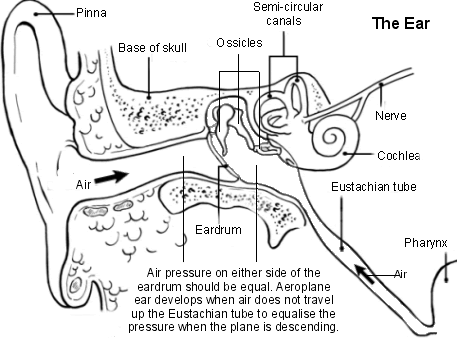
The small space in the middle ear behind the eardrum is normally filled with air. This air space is connected to the back of the nose by a tiny channel called the Eustachian tube. The air on either side of the eardrum should be at the same pressure.
Air pressure is highest nearer the ground. So as a plane descends, the air pressure becomes higher. This pushes the eardrum inwards which can be painful. To relieve this, the pressure in the middle ear has to rise quickly too. Air needs to travel up the Eustachian tube into the middle ear to equalise the pressure.
What is the treatment for aeroplane ear?
Ideally, anyone with an infection de l'oreille, cold or respiratory infection, etc, should not fly. However, some people may feel that they need to fly anyway as the reason for the trip is so important.
The following may help people who develop ear pain when flying.
Suck sweets or chew chewing gum
Do this when the plane begins to descend. Air is more likely to flow up the Eustachian tube if you swallow, yawn or chew. For babies, it is a good idea to feed them or give them a drink or dummy at the time of descent to encourage them to swallow.
Valsalva manoeuvre
Try doing the following: take a breath in. Then, try to breathe out gently with your mouth closed and whilst pinching your nostrils shut (the Valsalva manoeuvre). In this way, no air is blown out but you are gently pushing air into the Eustachian tube.
If you do this you may feel your ears go 'pop' as air is pushed into the middle ear. This often cures the problem. Repeat this every few minutes until landing - whenever you feel any ear discomfort.
Stay awake when the plane is descending to land
Ask the air steward or stewardess to wake you when the plane starts to descend. If you are awake you can make sure that you suck and swallow to encourage air to get into the middle ear.
The above usually works for most people. However, if you are particularly prone to develop aeroplane ear, you may wish also to consider the following in addition to the tips above:
Comprimés antihistaminiques (available at pharmacies). Take the recommended dose the day before and the day of travel. This may help to limit the amount of mucus that you make.
Decongestant tablets or syrup. For example, a medication called pseudoephedrine. This can be obtained from a pharmacy, without a prescription. Take the dose recommended half an hour before take-off, and if necessary repeat according to the instructions.
Decongestant nasal sprays and drops are sometimes recommended, but there is little evidence that they are effective.
Air pressure-regulating ear plugs. These are cheap, reusable ear plugs that are often sold at airports and in many pharmacies. These ear plugs slow the rate of air pressure change on the eardrum.
Blowing up a special balloon. Products such as Otovent® are balloons which you blow up through your nose, by blocking off one nostril at a time and blowing through the other. These can be bought from pharmacies, and some people find they help stop the pain during flying or unblock ears afterwards.
Take paracetamol
If the measures above fail to help, although the pain may be severe, it normally goes quickly. If it does not settle, take painkillers such as paracétamol until it does go.
You should see a doctor if the pain or dulled hearing does not clear within a few days.
How can I help my child?
Kids are also going to get these pressure changes in their ears, and there is invariably a baby bawling as the plane starts to descend and they notice their ears start to hurt.
You can help babies and young children by:
Feeding your baby with a bottle
This as the sucking and swallowing action will help equalise the pressures for them.
Encouraging them to suck a dummy
Sucking on a dummy (pacifier) may have the same effect as feeding a baby.
Give them a sweet to suck
Avoid boiled sweets in very young children because of the choking risk, but in older kids this may be a remedy which will make you a popular parent.
Have them drink from a straw sports bottle
A drink which has a straw or which is in a sports bottle might also be useful as it encourages the sucking action as with the other methods.
Give them paracetamol or ibuprofen
If your child has a cold and is therefore likely to have more of a problem on the flight, a dose of paracetamol or ibuprofène an hour before landing might make for a more peaceful flight.
Some of the measures described above may be helpful, but decongestants are not generally recommended for children.
Are there any complications of aeroplane ear?
Complications are extremely unusual, or millions of people wouldn't be flying on a regular basis. Very occasionally, the eardrum can be put under so much pressure that it bursts (perforates), leaving a hole in the eardrum. If this does happen, the pain usually goes away immediately. Perforated eardrums usually heal well without any treatment.
Can I fly with an ear infection?
It is advisable NOT to fly if you have an ear infection, such as otite moyenne ou otite externe If you do fly, the pain in your ear may be worse and it may take longer to settle. You may be more likely to have a perforated eardrum.
If you absolutely do have to fly with an ear infection and cannot delay your travel or go by an alternative mode of transport, decongestant medicines may help prevent problems. (These are not suitable for children under the age of 6 years, and only with the advice of a pharmacist for children aged 6-12 years.) It may also be worth taking regular painkillers such as paracétamol ou ibuprofène during the flight.
Sélections des patients pour Travel related problems

Voyages et vaccinations
Mal des montagnes
Le mal d'altitude peut affecter les personnes qui grimpent ou voyagent (montent) à plus de 2500 mètres (8 000 pieds) d'altitude, en particulier si elles montent trop rapidement.
par Dr Philippa Vincent, MRCGP

Voyages et vaccinations
Mal des transports
Le mal des transports (cinétose) est courant, surtout chez les enfants. Il est causé par des mouvements répétés lors des voyages qui envoient des signaux forts (parfois déroutants) aux capteurs d'équilibre et de position dans le cerveau.
par Dr Philippa Vincent, MRCGP
Questions fréquemment posées
Le vol peut-il causer des infections de l'oreille ?
Non, le vol en lui-même ne provoque généralement pas d'infections de l'oreille. Cependant, les changements de pression pendant un vol peuvent aggraver des conditions existantes comme les rhumes ou les allergies, rendant l'oreille d'avion plus perceptible et potentiellement plus douloureuse si vous êtes déjà congestionné ou si vous avez un problème d'oreille sous-jacent.
L'oreille d'avion peut-elle entraîner une perte auditive permanente ?
Le barotraumatisme de l'oreille est une condition temporaire, et les complications sont extrêmement rares. Une perte auditive permanente n'est pas un résultat typique. Très occasionnellement, une pression sévère peut provoquer la rupture du tympan, mais celles-ci guérissent généralement sans problèmes à long terme.
Y a-t-il des effets à long terme si je ressens fréquemment le barotraumatisme de l'oreille?
L'article ne suggère aucun effet à long terme lié à l'expérience fréquente de l'oreille d'avion. La condition est généralement bénigne et temporaire, avec une douleur qui disparaît généralement peu après l'atterrissage.
Est-il sûr de prendre l'avion avec une oreille bouchée qui n'est pas due à une infection ?
Si votre oreille est bouchée en raison d'une congestion due à un rhume ou à des allergies, prendre l'avion peut aggraver l'inconfort car il est plus difficile pour vos oreilles de s'adapter aux changements de pression. Cependant, l'article n'indique pas que voler avec des oreilles non congestionnées mais bouchées est intrinsèquement dangereux, mais plutôt que cela peut entraîner une douleur ou un blocage plus perceptible.
Lectures complémentaires et références
- Wright T; Middle-ear pain and trauma during air travel. BMJ Clin Evid. 2015 Jan 19;2015. pii: 0501.
- Ryan P, Treble A, Patel N, et al; Prevention of Otic Barotrauma in Aviation: A Systematic Review. Otol Neurotol. 2018 Jun;39(5):539-549. doi: 10.1097/MAO.0000000000001779.
À propos de l'auteurVoir la biographie complète

Dr Doug McKechnie, MRCGP
Rédacteur Médical
MA, MBBS, MSc, DRCOG, MRCP(UK), MRCGP(2021), FHEA
Le Dr Doug McKechnie est un médecin généraliste du NHS travaillant à Londres. Il travaille à plein temps en clinique et est également le chef adjoint du module de Pratique Clinique et Professionnelle à l'École de Médecine de l'University College London.
À propos du critiqueVoir la biographie complète

Dr Philippa Vincent, MRCGP
Médecin généraliste, Auteur médical
MB BS, Bsc, MRCGP (2000), DCH, DFSRH, DRCOG
Dr Philippa Vincent est un médecin généraliste du NHS travaillant dans le nord de Londres.
Historique de l'article
Les informations sur cette page sont rédigées et examinées par des cliniciens qualifiés.
Article également disponible en Anglais, Allemand, Espagnol, Français, Italien, Portugais, Hindi, Hébreu, Arabe, and Suédois.
Next review due: 22 Jun 2027
23 Jun 2024 | Dernière version

Demandez, partagez, connectez-vous.
Parcourez les discussions, posez des questions et partagez vos expériences sur des centaines de sujets de santé.

Vous ne vous sentez pas bien ?
Évaluez vos symptômes en ligne gratuitement
Inscrivez-vous à la newsletter Patient
Votre dose hebdomadaire de conseils de santé clairs et fiables - rédigés pour vous aider à vous sentir informé, confiant et maître de la situation.
En vous abonnant, vous acceptez notre Politique de confidentialité. Vous pouvez vous désabonner à tout moment. Nous ne vendons jamais vos données.