Les blessures et troubles de la coiffe des rotateurs
Revu par Dr Toni Hazell, FRCGPDernière mise à jour par Dr Philippa Vincent, MRCGPDernière mise à jour 24 mai 2023
Respecte les directives éditoriales
- TéléchargerTélécharger
- Partager
- Language
- Discussion
- Version audio
- Ajouter aux sources préférées sur Google
Les blessures et troubles de la coiffe des rotateurs sont les causes les plus courantes de douleur à l'épaule. Il existe trois affections courantes pouvant affecter la coiffe des rotateurs : déchirures de la coiffe des rotateurs, conflit sous-acromial et tendinite calcifiante. La plupart des personnes souffrant de problèmes de la coiffe des rotateurs peuvent être traitées avec succès grâce à une combinaison d'exercices (en évitant les activités en hauteur), d'analgésiques, de physiothérapie et parfois d'injections de corticostéroïdes. La chirurgie est parfois une option.
En un coup d'œil
Une blessure de la coiffe des rotateurs provoque des douleurs à l'épaule en raison d'une déchirure, d'une inflammation ou d'un rétrécissement au sein de l'articulation.
La coiffe des rotateurs est un groupe de quatre muscles qui stabilisent et mobilisent l'articulation de l'épaule.
Les symptômes courants incluent une douleur autour de l'épaule, des mouvements douloureux du bras et une faiblesse.
Vous pouvez réduire votre risque de blessure en renforçant les muscles des épaules et en vous échauffant avant l'exercice.
Le traitement peut impliquer d'éviter les activités aggravantes, des analgésiques, des exercices de physiothérapie ou des injections de stéroïdes.
Un rétablissement complet peut prendre au moins six mois et souvent plus longtemps.
What is a rotator cuff injury?
A rotator cuff injury is an event that causes pain in the area of the rotator cuff of the shoulder. This can be due to a tear, inflammation or narrowing of the space within the shoulder joint.
What is the rotator cuff?
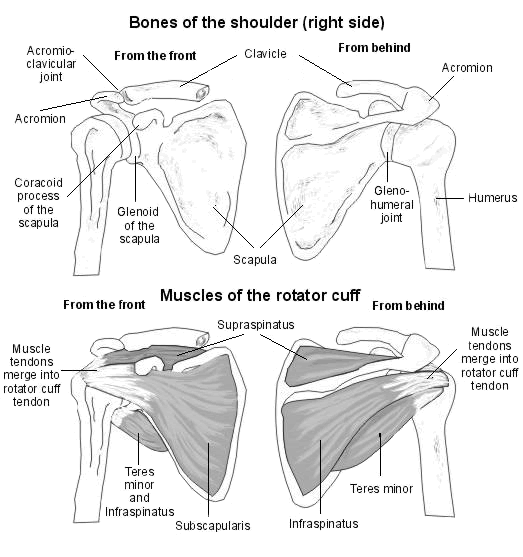
The rotator cuff is a group of four muscles that are positioned around the shoulder joint. The muscles are named:
Supraspinatus.
Infraspinatus.
Subscapularis.
Teres minor.
The shoulder joint
There are three bones in the shoulder region: the collarbone (clavicle), the shoulder blade (scapula) and the upper arm bone (humerus). The scapula is a triangular-shaped bone that has two important parts to it: the acromion and the glenoid. The three bones in the shoulder region form part of two main joints:
The acromioclavicular joint between the acromion of the scapula and the clavicle.
The glenohumeral joint between the glenoid of the scapula and the humerus.
There are also a number of ligaments, muscles and tendons around the shoulder. Ligaments are fibres that link bones together at a joint. Tendons are fibres that attach muscle to bone.
What does the rotator cuff do?
The rotator cuff muscles interlock to work as a unit. They help to stabilise the shoulder joint and also help with shoulder joint movement. The four tendons of the rotator cuff muscles join together to form one larger tendon, called the rotator cuff tendon. This tendon attaches to the bony surface at the top of the upper arm bone (the head of the humerus).
There is a space underneath the acromion of the scapula, called the subacromial space. The rotator cuff tendon passes through here. The subacromial space is filled by the subacromial bursa. This is a fluid-filled sac which helps the rotator cuff to move smoothly. It has a large number of pain sensors.
Rotator cuff
Rotator cuff injuries and disorders usually cause subacromial pain, and the term subacromial pain is now often used to cover all causes of rotator cuff disorders. It is the most common cause of shoulder problems.
What causes rotator cuff injuries and disorders?
There are a number of types of rotator cuff disorders. The most common problems include:
Rotator cuff tears.
Subacromial impingement.
Calcific tendonitis.
Les déchirures de la coiffe des rotateurs
The rotator cuff is very vulnerable to being damaged within the subacromial space. This can lead to a tear that is not only painful but also makes the shoulder weak. It can happen suddenly after a single injury or can develop gradually due to long-term wear and tear.
Torn rotator cuffs can be due to a minor/partial tear or full/complete tear, depending on the degree of damage to the tendon. Minor tears to the rotator cuff are very common and may not cause any symptoms at all; however, it is possible for small tears to be very painful and larger ones less so. A tear can be seen on an ultrasound or an MRI scan but not on an X-ray.
Subacromial impingement
Also known as subacromial pain syndrome, tendinitis, tendonitis, bursitis, trapped tendon.
As the arm moves upward, the rotator cuff pushes the top of the upper arm bone (humeral head) under the acromion. Anything that affects the cuff, such as minor tears or overuse after a period of inactivity, can lead to the humeral head not being pushed down properly. It therefore moves too close to the acromion and this causes pain. It can also happen due to problems with the bone of the acromion. These can include l'arthrite and bone spurs (protrusions).
Calcific tendonitis
Calcific tendonitis is the name given when calcium builds up in the rotator cuff tendon. It can cause an increase in pressure in the tendon and a chemical irritation. It can be very painful. The cause is not known but it can eventually go away without any treatment. It tends to be more common in people between 30 and 60 years of age.
The calcium deposit may affect the way the rotator cuff works, causing subacromial impingement, but calcium deposits are also seen in people with no symptoms.
How common are rotator cuff injuries?
Rotator cuff injuries are extremely common and can happen to anyone. Sometimes they are caused by falling on to the affected arm; this is more likely to be the cause in someone aged under 40. Overuse, either through sport or profession, may be a cause but they can also occur without any obvious cause.
Rotator cuff injury symptoms
The main symptoms of rotator cuff injury are:
Pain in and around the shoulder joint.
Painful movement of the shoulder.
Pain that is worse when using the arm above shoulder level.
Weakness in the shoulder or arm.
Clicking or catching when moving the shoulder.
If there has been an injury, the pain may come on suddenly. The pain can affect the ability to lift your arm up - for example, to comb hair or dress oneself. Swimming, basketball and painting can be painful but writing and typing may produce little in the way of pain. Pain may also be worse at night and affect sleep.
Rotator cuff injury diagnosis
A doctor, or other professional such as a physiotherapist, may be able to find out what is causing a rotator cuff disorder just by talking about symptoms (for example, when the problems started, whether there was an initial injury and what aggravates the problem) and examining the shoulder.
They will then perform an examination of the shoulders which usually involves moving the shoulder in various positions and comparing it with the unaffected side. They may also examine the neck, as douleurs au cou can sometimes cause pain in the shoulder.
Sometimes a clinician may suggest an radiographie of your shoulder to rule out other causes of shoulder pain. A clinician may request an échographie which is a good way of looking at the shoulder joint or, very occasionally, a imagerie par résonance magnétique (IRM).
Épaule gelée is a different relatively common cause of shoulder pain. .
Rotator cuff injury treatment
Activities that aggravate the pain should be avoided, for example, overhead activities, such as that performed by plasterers or painters and decorators. This may mean that work activities need to be modified or changed. However, the shoulder should not be completely rested. Strengthening the shoulder is good but it is important not to try to work or play through the pain.
A physiotherapist or a referral to a specialist in orthopaedics or sports medicine may be needed for further assessment and treatment.
Soulagement de la douleur
Analgésiques tel que paracétamol are usually helpful.
Anti-inflammatories are painkillers too but they also reduce any inflammation and are commonly prescribed. They include ibuprofène, diclofénac et naproxène. Side-effects sometimes occur with anti-inflammatories. Always read the leaflet that comes with the medicine packet for a full list of cautions and possible side-effects. If they don't help fairly quickly stop taking them. Over the age of 40, it is usual to have a "stomach protector" such as omeprazole or lansoprazole prescribed with anti-inflammatory medication.
Stronger painkillers: these may occasionally be needed for a short time.
Compresses de glace: these can also help to reduce pain, especially if there has been a sudden injury. A bag of frozen peas is an easy ice pack to use in the home.
Physiothérapie
It is really important to keep the shoulder strong and mobile. It can be very useful to see a physiotherapist for advice and to be prescribed an exercise programme to do at home if the symptoms aren't settling quickly.
Injection de stéroïdes
This can help to reduce the pain, allowing exercises to be done more easily. It may reduce the inflammation in the subacromial space. A second injection de corticostéroïdes can be given if the response to the first one was good. More than two steroid injections are
not recommended.
Chirurgie
Les déchirures de la coiffe des rotateurs - rotator cuff surgery may be required if the tear followed a sudden injury and when pain and weakness have not improved with steroid injections and physiotherapy.
Subacromial impingement - surgery is rarely required. If necessary an arthroscopic subacromial decompression (ASD) can be performed. This is done to increase the amount of space between the acromion and the rotator cuff by surgically removing bone and other tissue from part of the shoulder blade. However, recent research suggests that this operation is not as effective as previously thought:
In a study of over 300 people with subacromial shoulder pain, a third had no treatment, a third had 'sham' surgery (that is they had an operation but didn't have any tissue removed) and a third had an ASD.
The two surgical groups, whether tissue was removed or not, did a bit better than no treatment but not enough to consider surgery to be more effective.
It has been suggested that the slight benefit of both ASD and 'sham' surgery might be due to the physiotherapy following the operation or to a placebo effect.
Calcific tendonitis - 'ultrasound-guided barbotage' may be performed. This involves injecting the calcium deposit with salt water and sucking it out through a syringe. The calcium deposit may also be removed by surgery if the pain is extremely severe. An ASD will be carried out at the same time.
How long does a rotator cuff injury take to heal?
If rotator cuff injuries are adequately treated, there can be complete recovery. This will involve daily exercises to strengthen the shoulder and to keep it strong. Full recovery can take at least six months and often takes longer than this.
How to avoid rotator cuff injury
The risk of a rotator cuff injury can be reduced by:
Strengthening the muscles and tendons in the shoulder. Shoulder exercises also improve flexibility as well as reducing the risk of rotator cuff injury.
Doing simple shoulder stretches, with or without using resistance bands. This can improve flexibility and endurance.
Always warming up properly before any sport activity.
Having physiotherapy or chiropractic treatment. These treatments can help to promote function, mobility, and range of motion.
Sélections des patients pour Douleur articulaire

Os, articulations et muscles
Problèmes de hanche
Les problèmes de hanche sont assez courants. La cause peut être évidente, comme une blessure survenant soudainement lors de la pratique d'un sport. Parfois, la cause n'est pas aussi claire et vous devrez être examiné par un médecin ou un physiothérapeute.
par Dr Rachel Hudson, MRCGP

Os, articulations et muscles
Luxation
Une luxation est une blessure dans laquelle les os d'une articulation sont forcés de se séparer et de sortir de leur position habituelle. Déloger les os d'une grande articulation nécessite généralement une force considérable (bien qu'il existe des exceptions).
par Dr Philippa Vincent, MRCGP
Questions fréquemment posées
Qu'est-ce que la douleur sous-acromiale ?
La douleur sous-acromiale est un terme souvent utilisé pour décrire une douleur provenant de troubles de la coiffe des rotateurs. Elle affecte principalement la zone située sous l'acromion de l'épaule. Ce type de douleur est la cause la plus courante des problèmes d'épaule, indiquant des problèmes avec les structures dans cette région spécifique de l'articulation de l'épaule.
Puis-je prévenir une blessure de la coiffe des rotateurs ?
Oui, vous pouvez prendre des mesures pour réduire votre risque de blessure de la coiffe des rotateurs. Cela inclut le renforcement des muscles et des tendons de votre épaule et l'exécution d'étirements simples de l'épaule, éventuellement en utilisant des bandes de résistance, pour améliorer la flexibilité et l'endurance. Il est également important de bien s'échauffer avant toute activité sportive pour préparer vos muscles. De plus, la physiothérapie ou le traitement chiropratique peuvent aider à promouvoir la fonction, la mobilité et l'amplitude de mouvement de l'épaule, réduisant ainsi davantage le risque.
Existe-t-il différents types de médicaments pour la douleur de la coiffe des rotateurs ?
Oui, plusieurs options sont disponibles. Les analgésiques en vente libre comme le paracétamol peuvent être utiles. Les médicaments anti-inflammatoires tels que l'ibuprofène, le diclofénac et le naproxène sont également utilisés pour réduire à la fois la douleur et l'inflammation. Si ceux-ci ne sont pas suffisants, des analgésiques plus puissants peuvent être prescrits pour une courte période. En plus des médicaments, les packs de glace peuvent aider à réduire la douleur, surtout après une blessure soudaine.
Quel est le but d'une injection de stéroïdes pour une blessure de la coiffe des rotateurs ?
Une injection de stéroïdes peut aider à réduire la douleur et l'inflammation dans l'espace sous-acromial, facilitant ainsi l'exécution des exercices recommandés. Si la première injection est efficace, une deuxième peut être administrée, mais généralement plus de deux ne sont pas recommandées. Ce traitement est souvent utilisé pour faciliter d'autres thérapies comme la physiothérapie.
La chirurgie est-elle toujours nécessaire pour une blessure de la coiffe des rotateurs ?
Non, la chirurgie n'est pas toujours nécessaire. Pour les déchirures de la coiffe des rotateurs, elle peut être envisagée si la blessure a suivi un événement soudain et si la douleur et la faiblesse ne se sont pas améliorées avec la physiothérapie et les injections de stéroïdes. Pour le conflit sous-acromial, la chirurgie est rarement requise. Dans les cas de tendinite calcifiante, une procédure appelée 'barbotage guidé par échographie' peut être effectuée pour éliminer les dépôts de calcium, ou la chirurgie peut être une option si la douleur est extrêmement sévère.
Lectures complémentaires et références
- Beard DJ, Rees JL, Cook JA, et al; Arthroscopic subacromial decompression for subacromial shoulder pain (CSAW): a multicentre, pragmatic, parallel group, placebo-controlled, three-group, randomised surgical trial. Lancet. 2018 Jan 27;391(10118):329-338. doi: 10.1016/S0140-6736(17)32457-1. Epub 2017 Nov 20.
- Kulkarni R, Gibson J, Brownson P, et al; Subacromial shoulder pain. Shoulder Elbow. 2015 Apr;7(2):135-43. doi: 10.1177/1758573215576456. Epub 2015 Mar 31.
- Douleur à l'épaule; NICE CKS, novembre 2022 (accès réservé au Royaume-Uni)
- Rotator Cuff Tears; Ortho Info
- Rotator Cuff and Shoulder Conditioning Program; Ortho Info
À propos de l'auteurVoir la biographie complète

Dr Philippa Vincent, MRCGP
Médecin généraliste, Auteur médical
MB BS, Bsc, MRCGP (2000), DCH, DFSRH, DRCOG
Dr Philippa Vincent est un médecin généraliste du NHS travaillant dans le nord de Londres.
À propos du critiqueVoir la biographie complète

Dr Toni Hazell, FRCGP
MBBS, BSc, FRCGP, DFSRH, Dip GU med, DRCOG, DCH (London, UK, 2000)
Le Dr Toni Hazell a obtenu son diplôme de l'École de médecine de l'hôpital St. Mary et a effectué son VTS à l'hôpital Northwick Park.
Historique de l'article
Les informations sur cette page sont rédigées et examinées par des cliniciens qualifiés.
Article également disponible en Anglais, Allemand, Espagnol, Français, Italien, Portugais, Hindi, Hébreu, Arabe, and Suédois.
Prochaine révision prévue : 12 mai 2028
24 mai 2023 | Dernière version

Demandez, partagez, connectez-vous.
Parcourez les discussions, posez des questions et partagez vos expériences sur des centaines de sujets de santé.

Vous ne vous sentez pas bien ?
Évaluez vos symptômes en ligne gratuitement
Inscrivez-vous à la newsletter Patient
Votre dose hebdomadaire de conseils de santé clairs et fiables - rédigés pour vous aider à vous sentir informé, confiant et maître de la situation.
En vous abonnant, vous acceptez notre Politique de confidentialité. Vous pouvez vous désabonner à tout moment. Nous ne vendons jamais vos données.
Plus sur les os, les articulations et les muscles
- Spondyloarthrite axiale
- Douleur au dos et à la colonne vertébrale
- Douleur dorsale chez les enfants
- Bisphosphonates
- Côtes cassées ou contusionnées
- Calcium pyrophosphate deposition
- Spondylose cervicale
- Chondrocalcinose
- Syndrome de douleur du grand trochanter
- Douleur articulaire
- dystrophie musculaire
- Myasthénie grave
- Maladie osseuse de Paget
- Fourmillements
- Polymyalgie rhumatismale
- Prévenir l'ostéoporose induite par les stéroïdes
- Lésion par effort répétitif
- Rhabdomyosarcome
- Sclérodermie systémique
- Trouble de l'articulation temporo-mandibulaire (ATM)