Sprains and strains
Peer reviewed by Dr Colin Tidy, MRCGPLast updated by Dr Doug McKechnie, MRCGPLast updated 13 Mar 2023
Meets Patient’s editorial guidelines
- DownloadDownload
- Share
- Language
- Discussion
- Audio Version
- Add to preferred sources on Google
In this series:Sports injuriesHamstring injuryGroin strainAnkle injuryKnee ligament injuriesMeniscal tears
A sprain is an injury to the band (ligament) which connects two or more bones to a joint. A sprain is usually caused by the joint being forced suddenly outside its usual range of movement. A severe sprain may look and feel like a break (fracture), and it can be difficult for health professionals to tell the difference between the two.
A strain refers to an overstretching and tearing of muscles or tendons.
Following a sprain or strain the usual advice is to pay the PRICE (Protection, Rest, Ice, Compression, and Elevation) and avoid HARM (Heat, Alcohol, Running, and Massage) for the first 48-72 hours after injury. Most sprains and strains heal within a few weeks.
Note: this leaflet does not advise on how to distinguish what injury you have. For example, it is sometimes difficult to tell if you have a bone fracture, or other more serious injury. Therefore, see a doctor or nurse if you suspect that you have a fracture or other more serious injury. This leaflet assumes you know that you have a sprain or strain (for example, having been told by a doctor or nurse) and nothing more serious.
At a glance
A sprain is an injury to a ligament, often caused by overstretching during sudden movement.
A strain is a muscle injury, usually from overstretching or over-contracting muscle fibres.
Symptoms include pain, swelling, and bruising around the affected joint or muscle.
Treatment involves PRICE (Protect, Rest, Ice, Compression, Elevation) and avoiding HARM (Heat, Alcohol, Running, Massage).
Most sprains and strains heal themselves, but severe cases may need medical attention or physiotherapy.
See a doctor for severe pain, inability to bear weight, limb deformity, or if symptoms worsen.
What is a sprain?
A sprain is an injury to a ligament. It's a type of soft tissue injury. Ligaments are strong band-like structures around joints, which are a type of tissue that connects bones together and gives support to joints. A ligament can be injured, usually by being overstretched during a sudden abnormal movement. The ligaments at the side of the ankle are the ones most commonly sprained.
What does a sprained ankle look like?
A damaged ligament causes inflammation, swelling, and bleeding (which shows as bruising) around the affected joint. Moving of the joint is painful. The picture shows a sprained ankle with bruising. For more information, particularly about a sprained ankle, see the separate leaflet called Ankle Injury (Sprained or Broken Ankle).
Sprained ankle
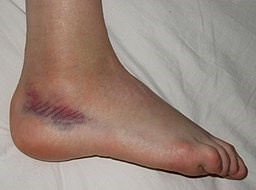
© Boldie, Public domain, via Wikimedia Commons
The severity of a sprain is graded according to how badly the ligament has been damaged and whether or not the joint has been made unstable. The joint can become unstable when the damaged ligament is no longer able to give it the normal support:
Grade I - mild stretching of the ligament (only a few fibres torn) without joint instability.
Grade II - partial tear (rupture) of the ligament but without joint instability (or with mild instability).
Grade III - a severe sprain: complete rupture of the ligament with instability of the joint.
How long does a sprain take to heal?
Mild sprains usually take about two weeks to heal. In more severe sprains, it can take up to 12 weeks for the ligament to heal.
What is a strain?
A strain is a non-medical term for a muscle injury. Sometimes it is used to describe the problem of overuse or awkward use of a muscle causing pain in that muscle but usually it refers to an overstretching or tear of muscle fibres (or very rarely of a tendon). A hamstring injury is the most common type of muscle strain. See the separate leaflet called Hamstring Injuries.
How do muscle strains happen?
Most strains occur either because the relevant part has been stretched beyond its limits, or it has been forced to pull (contract) too strongly, usually when playing sports. The severity of a muscle strain is graded into:
First-degree strain - a mild strain when only a few muscle fibres are stretched or torn. The injured muscle is tender and painful but has normal strength.
Second-degree strain - a moderate strain with a greater number of injured fibres. There is more severe muscle pain and tenderness. There is also mild swelling, some loss of strength, and a bruise which may develop.
Third-degree strain - this strain tears the muscle all the way through. There is a total loss of muscle function.
Repetitive strain injury is a term used to describe several conditions that can affect the muscles and tendons. It isn't discussed here. See the separate leaflet called Repetitive Strain Injury (RSI).
Tendinopathy and tenosynovitis are other types of tendon injury. See the separate leaflet called Tendinopathy and Tenosynovitis (Tendinosis).
How long does a muscle strain last?
First-degree muscle strains usually heal within two weeks of the injury.
Second-degree muscle strains can take between four to eight weeks to heal.
Third-degree muscle strains can take several months to heal. They may require surgery to repair, which can require a lengthy rehabilitation time.
What is the aim of treatment?
The main aims of treatment are:
To keep any inflammation and pain to a minimum and reduce swelling.
To get you back to normal, and returning to your sport if appropriate, as quickly as possible.
Usually, the damaged ligament or muscle heals by itself over time. Some scar tissue may be produced where there has been a tearing of tissues.
How to treat a sprain or strain
The usual initial treatment is described as paying the PRICE (Protect, Rest, Ice, Compression, and Elevation), together with avoiding HARM (Heat, Alcohol, Running, and Massage).
These are commonly advised for the first 48-72 hours after a sprain or strain. This treatment must be balanced with early controlled use of the affected part of the body. This helps to keep the strength of the muscles and flexibility in the joints. Painkillers may be needed.
Pay the PRICE
Protect from further injury (for example, protect the ankle by a support or high-top boots).
Rest the joint for 48-72 hours following injury. For example, consider the use of crutches for a few days if it is your leg that you have injured.
Ice should be applied as soon as possible after injury, for 15-20 minutes every two or three hours (during daytime) for the first 2-3 days. Make an ice pack by wrapping ice cubes in a plastic bag or towel, or by using a bag of frozen peas. Do not put ice directly next to skin, as it may cause ice burn. Gently press the ice pack on to the injured part. The cold is thought to reduce blood flow to the damaged ligament. This may limit pain, inflammation and bruising. Do not leave ice on while asleep.
Compression with a bandage will limit swelling, and help to rest the joint or muscle. A tubular compression bandage or an elastic bandage can be used on a limb. The bandage should not be too tight - mild pressure that is not uncomfortable and does not stop blood flow is the aim. A pharmacist will advise on the correct size. Remove the bandage before going to sleep. You will usually be advised to remove the bandage for good after 48 hours.
Elevation aims to limit and reduce any swelling. For example, keep your leg up on a chair to at least hip level when you are sitting, if it is your leg you have injured. Or if it is your arm, use a sling for a day or two.
Avoid HARM for 72 hours after injury
That is, avoid:
Heat - for example, hot baths, saunas, heat packs. Heat encourages blood flow which will tend to increase bruising and inflammation. So, heat should be avoided when inflammation is developing. However, after about 72 hours, no further inflammation is likely to develop and heat can then be soothing.
Alcohol, - drinking alcohol can increase bleeding and swelling and decrease healing.
Running - or any other activity that uses the affected part of the body, which may cause further damage.
Massage - may increase bleeding and swelling. However, after 72 hours, gentle massage may be soothing.
Other treatments
Your healthcare professional will advise. The advice may typically include:
Do not stop moving the affected joint or muscle. Avoid doing anything that causes much pain, but gently get your affected part moving again to prevent it becoming stiff.
Consider wearing a joint support for a sprain until symptoms have gone. There are various forms of supports which can be used - from an elasticated bandage to a specialised brace. The aim is to give some support to the joint whilst the damaged ligament is healing, but to allow the joint to move to a reasonable degree.
Physiotherapy (physical therapy) may help for more severe sprains or strains, or if symptoms are not settling. A physiotherapist can advise on exercises. The aim of physiotherapy includes:
To get the joint back to a full range of normal movement.
To improve the strength of the surrounding muscles. The stronger the muscles, the less likely it is that a sprain or strain will happen again.
Improving proprioception. This means the ability of your brain to sense the position and movement of your joints and is important following sprains. Good proprioception helps you to make immediate, unconscious minor adjustments to the way you move - for example, when walking over uneven ground. This helps to prevent further sprains and is achieved through particular types of exercises which a physiotherapist or sports therapist can show you.
You will probably not be able to play sport or do vigorous exercise involving the injured part for at least 3-4 weeks after a sprain or serious strain. However, this does depend on how bad the injury was.
What is the treatment for a severe sprain or strain?
Severe sprain
Extra treatment may be needed for severe sprains (where the ligaments are badly torn (ruptured) or the joint is unstable).
There is some evidence that these types of sprain may heal more quickly if treated with a short period of immobilisation. This means wearing a brace or a plaster cast for 10 days or so.
In some cases, if ligaments are very badly torn or the joint is too unstable, surgery may be advised. Your doctor will assess if this is necessary (but it is not needed in most cases).
If the sprain is still very painful six weeks after the original injury, you may be advised to have additional tests on the joint, such as a further X-ray or scan. Sometimes there are torn ligaments or small breaks (fractures) which do not show up when the injury first happens. The joint may initially have been very swollen and small additional areas of damage might have been difficult to detect.
Severe strain
For severe strains (badly torn muscles or tendons), surgery is used very rarely - usually only if there is a complete tear in which the muscle is completely torn or has become unattached to the bone (for example, a severe hamstring injury). Muscles are less easy than ligaments to repair surgically because the muscle fibres do not hold stitches easily.
What about medication for a sprain or strain?
You may not need any medication if the injury is light, such as a mild sprain or strain, and you can tolerate the pain. If needed, paracetamol is the safest choice, especially immediately after the injury. Painkiller options include the following:
Paracetamol
Paracetamol is useful to ease pain. It is best to take paracetamol regularly, for a few days or so, rather than every now and then. An adult dose is two 500 mg tablets, four times a day. If the pain is more severe, a doctor may prescribe stronger painkillers such as codeine, which is more powerful but can make some people drowsy and constipated.
Anti-inflammatory painkillers
These medicines are also called non-steroidal anti-inflammatory drugs (NSAIDs). They relieve pain and may also limit inflammation and swelling. Some clinicians recommend that they shouldn't be taken for the first 48 hours after an injury.
This is partly because some inflammation is a necessary part of the healing process, and partly because they may very slightly increase bleeding. However, the evidence for this is old and not of very good quality. More recent studies suggest the benefits of taking NSAIDs for the first few days of an injury, outweigh the risks.
You can buy some types (eg, ibuprofen) at pharmacies, without a prescription. You need a prescription for some others - eg, naproxen. Side-effects sometimes occur. Stomach pain, and bleeding from the stomach, are the most serious. Some people with asthma, high blood pressure, chronic kidney disease, and heart failure may not be able to take anti-inflammatory painkillers. So, check with your doctor or pharmacist before taking them, to make sure they are suitable for you.
If you take anti-inflammatory medication, ibuprofen is recommended as the one least likely to cause side-effects.
Rub-on (topical) anti-inflammatory painkillers
Again, there are various types and brands of topical anti-inflammatory painkillers. You can buy one containing ibuprofen or diclofenac at pharmacies, without a prescription. You need a prescription for the others.
There is debate as to how effective rub-on anti-inflammatory painkillers are compared to tablets. Some studies suggest that they may be as good as tablets for treating sprains. Other studies suggest they are no better than an embrocation. However, the amount of the medicine that gets into the bloodstream is much less than with tablets, and there is less risk of side-effects.
When to worry about a sprain or strain
A person with a sprain or strain is advised to seek medical advice if there is:
Lack of expected improvement after trying basic home management (for example, they have difficulty walking).
Worsening of symptoms (for example, increased pain or swelling).
You should see a doctor if there is any concern about the injury, or if the injury is severe. In particular, see a doctor if:
You suspect a bone may be broken or a ligament is ruptured.
You have a lot of tenderness over a bone.
Your arm or leg looks out of shape (deformed) rather than just swollen. This may mean there is a break (fracture) or dislocation which needs urgent treatment.
There is loss of circulation in the hand or foot (it is numb and cold with pale or bluish skin). If this occurs, treatment is needed urgently.
The pain is severe.
You cannot walk or weight bear because of the injury or you cannot hold anything, if you have a wrist sprain..
Bruising is severe.
The joint does not seem to work properly or feels unstable after the pain and swelling have gone down. This may be a sign of an additional injury such as a torn tendon.
Symptoms and swelling do not gradually settle. Most sprains and strains improve after a few days, although the pain often takes several weeks to go completely, especially for sprains.
Preventing sprains and strains
It isn't always possible to prevent injury - sometimes it's just bad luck. However, you are less likely to get a sprain or strain when exercising if:
Your muscles are strong.
You warm up with gentle aerobic exercise to gradually get the heart beating a bit quicker and get the body ready for exercise.
You cool down after exercise.
You use proper equipment and appropriate footwear.
You don't exercise or play sport when tired or unwell (especially contact sports).
Also by avoiding falls, if possible:
Ensure rugs and carpets can't slip.
Clear away ice and snow from paths.
Avoid getting drunk.
Take extra care if you are taking medications that cause drowsiness.
The ankle is the most commonly sprained joint. For information on preventing ankle sprains, see the separate leaflet called Ankle Injury (Sprained or Broken Ankle).
The hamstrings - muscles at the back of the thigh - are the most common muscles to strain. To read about hamstring injury prevention exercises, see the separate leaflet called Hamstring Injuries.
Dr Mary Lowth is an author or the original author of this leaflet.
Patient picks for Sports injuries

Bones, joints and muscles
Groin strain
Anyone can experience having a pulled groin (groin strain) but it's much more common when running, jumping and playing sports.
by Dr Hayley Willacy, FRCGP
Bones, joints and muscles
Sports injuries
Regular exercise has many benefits for your body. However, exercise does come with risks. Most people only experience minor sports-related injuries such as strained muscles and blisters. A few will experience more serious injuries such as torn cartilages or even broken bones. This leaflet describes some of the more common sports injuries, how to recognise them and how to avoid them.
by Dr Colin Tidy, MRCGP
Frequently asked questions
What is the difference between an overstretched muscle and a torn muscle fibre in terms of how they are considered 'strains'?
A strain usually refers to an overstretching or tear of muscle fibres. Sometimes, it can also describe the problem of overuse or awkward use of a muscle causing pain, which suggests an overstretched muscle without necessarily a tear.
When can I use heat therapy for a sprain or strain?
Heat, such as hot baths or heat packs, should be avoided for the first 72 hours after an injury as it encourages blood flow which can increase bruising and inflammation. However, after about 72 hours, when no further inflammation is likely to develop, heat can then be soothing for the injured area.
How can I tell if my sprain or strain has caused a torn tendon?
You should see a doctor if your joint does not seem to work properly or feels unstable after the pain and swelling have gone down. This could be a sign of an additional injury, such as a torn tendon.
Are there any specific exercises to help strengthen muscles around an injured joint?
Yes, physiotherapy can help improve the strength of the surrounding muscles after a sprain or strain. Stronger muscles make it less likely for a sprain or strain to happen again. A physiotherapist can advise on suitable exercises.
What are some ways to improve joint stability after a sprain, especially for ankles?
Physiotherapy can help improve proprioception, which is your brain's ability to sense the position and movement of your joints. Good proprioception helps you make unconscious adjustments to movement (like walking on uneven ground), preventing further sprains. A physiotherapist or sports therapist can teach you specific exercises for this.
Further reading and references
- Sprains and strains; NICE CKS, September 2020 (UK access only)
About the authorView full bio

Dr Doug McKechnie, MRCGP
Medical Writer
MA, MBBS, MSc, DRCOG, MRCP(UK), MRCGP(2021), FHEA
Dr Doug McKechnie is an NHS GP working in London. He works full-time clinically and is also the Deputy Lead for the Clinical and Professional Practice module at University College London Medical School.
About the reviewerView full bio

Dr Colin Tidy, MRCGP
General Practitioner, Medical Author
MBBS, MRCGP, MRCP (Paediatrics), DCH
Dr Colin Tidy is an NHS Doctor, based in Oxfordshire.
Article history
The information on this page is written and peer reviewed by qualified clinicians.
Article also available in English, German, Spanish, French, Italian, Portuguese, Hindi, Hebrew, Arabic, and Swedish.
Next review due: 11 Mar 2028
13 Mar 2023 | Latest version
Join the conversation
Share your thoughts or experiences with others in our patient communities.

Ask, share, connect.
Browse discussions, ask questions, and share experiences across hundreds of health topics.

Feeling unwell?
Assess your symptoms online for free
Sign up to the Patient newsletter
Your weekly dose of clear, trustworthy health advice - written to help you feel informed, confident and in control.
By subscribing you accept our Privacy Policy. You can unsubscribe at any time. We never sell your data.