Méralgie paresthésique
Revu par Dr Colin Tidy, MRCGPDernière mise à jour par Dr Toni Hazell, FRCGPDernière mise à jour 15 sept. 2023
Respecte les directives éditoriales
- TéléchargerTélécharger
- Partager
- Language
- Discussion
- Version audio
- Ajouter aux sources préférées sur Google
La méralgie paresthésique est une affection nerveuse (neurologique) qui provoque des douleurs à l'extérieur de la cuisse. Elle est causée par la compression d'un nerf appelé le nerf cutané latéral de la cuisse. Ce nerf fournit la sensation (sensibilité) à l'extérieur de la cuisse. Dans de nombreux cas, la cause est inconnue. Habituellement, la condition s'améliore avec un traitement conservateur (non chirurgical) - tel que des anti-inflammatoires, des analgésiques ou des injections de stéroïdes.
En un coup d'œil
La méralgie paresthésique est une affection nerveuse provoquant douleur, engourdissement ou picotements à l'extérieur de la cuisse.
Elle est causée par la compression ou le piégeage du nerf cutané latéral de la cuisse.
Les symptômes sont souvent pires en position debout ou en marchant et s'améliorent en position allongée.
Les facteurs de risque incluent l'obésité, la grossesse et l'ascite.
Le traitement implique souvent des options non chirurgicales telles que le repos, la perte de poids ou les analgésiques.
What is meralgia paraesthetica?
Meralgia paraesthetica is a nerve (neurological) condition that causes an area of skin over the upper outer thigh to become painful, numb or tingly.
Meralgia paraesthetica is known as a nerve entrapment syndrome. This means it is a collection of symptoms caused by a trapped or compressed nerve. The trapped nerve in question is called the lateral cutaneous nerve of the thigh (also known as the lateral femoral nerve).
Meralgia paraesthetica symptoms
The most common symptoms are burning pain or numbness in the upper thigh, on the outer side. Children and younger people may just have pain that limits normal activities.
Other symptoms include altered sensation of that part of the thigh, or tingling/des picotements. Symptoms tend to be made worse by walking and standing but relieved by lying down with the hip flexed. (Hip flexion is movement of the leg towards your tummy (abdomen); this can be with your knee bent or straight - but on your back it is easiest to draw your bent knee up to your chest.)
Other reported symptoms include aching in the groin, pain in the buttocks and an area of skin that seems super-sensitive to heat and light touch (as opposed to firm pressure).
Meralgia paraesthetica causes
Most cases have no identifiable cause.
Meralgia paraesthetica can, however, be caused by direct injury to the lateral cutaneous nerve of the thigh accidentally. For example:
A seat belt injury from a car accident.
Inadvertently, during medical or surgical procedures - for example, keyhole (laparoscopic) hernia repairs.
Various sports and physical activities can be associated with meralgia paraesthetica. These include gymnastics, baseball, soccer, bodybuilding and strenuous exercise.
Rarer causes include a neuroma. Neuromas are non-cancerous (benign) growths (tumours) on a nerve. Pelvic or intra-abdominal tumours (including cancerous ones) could also compress the nerve and cause this problem. This is rare.
Other possible causes include lying down for long periods of time in a curled-up position. Diabète can affect nerves in general and, although it would be unusual simply to have this one nerve affected, the lateral cutaneous nerve of the thigh puisse potentially be damaged by diabetes.
What is the lateral cutaneous nerve of the thigh?
Meralgia Paraesthetica
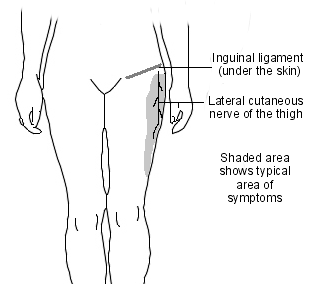
The lateral cutaneous nerve of the thigh is found in the upper leg. It provides sensation to an area of skin on the upper outer thigh. If this nerve is trapped or compressed, burning pain, numbness or tingling might be felt in the area of skin supplied by the nerve. These symptoms constitute meralgia paraesthetica.
The lateral cutaneous nerve of the thigh is a sensory nerve that supplies the skin. It starts off in the lower part of the spinal cord, in the lumbar region. It has to pass over the front of the hip bones and under the inguinal ligament before reaching the thigh. The inguinal ligament is a tough fibrous band in the groin. This is the site at which the nerve is most commonly compressed or trapped.
Who develops meralgia paraesthetica?
Anyone can develop meralgia paraesthetica. It is more common in men than in women. Generally it occurs between the ages of 30-40 years. It is much rarer in children.
Risk factors include obesity, pregnancy and ascites. Ascites is the term used for a tense swelling of the tummy (abdomen) due to fluid.
How common is meralgia paraesthetica?
Meralgia paraesthetica is a very uncommon condition. It most often affects people between the ages of 30-40 years. The condition is thought to be much rarer in children. It occurs more often in men than in women.
How is meralgia paraesthetica diagnosed?
A doctor can make the diagnosis based on your symptoms and examination of your body. The diagnosis is likely to be suspected if you have typical pain or sensory symptoms affecting the upper outer thigh. The condition can, occasionally, affect both sides at the same time (about 1 in 5 cases).
Examination might show altered sensation in the area of skin supplied by the lateral cutaneous nerve of the thigh. The pain can usually be provoked by getting you to extend your hip. Hip extension is the movement of the leg backwards. The main buttock muscle (gluteus maximus) tightens when you make this movement.
Because the lateral cutaneous nerve of the thigh is a sensory nerve, it affects feeling and sensation. It does not affect movement of the leg or hip. Your doctor will check to see that there is no weakness of the muscles - if there is, the diagnosis is not meralgia paraesthetica.
Ai-je besoin d'examens ?
Often no investigations (such as blood tests, X-rays and scans) are needed for the diagnosis of meralgia paraesthetica. However, an échographie may be used if there is concern that a mass in the pelvis is causing the symptoms.
Further tests may be done if an underlying problem or alternative diagnosis is suspected. If you have meralgia paraesthetica arising from an accident or injury (such as a pelvic fracture) then other tests will be needed.
In some cases, nerve conduction tests are performed if surgery for meralgia paraesthetica is planned. Nerve conduction tests look at the electrical activity running through a nerve. This is adversely affected if a nerve is compressed or trapped.
Meralgia paraesthetica treatment
Treatments can be grouped into conservative treatments (which are non-surgical) and surgical treatment (operations). In most cases, only conservative treatments are needed.
Examples of conservative treatments include:
Repos - meralgia paraesthetica is aggravated by standing and walking. Reduction in physical activity may be advised in severe cases. It may even be necessary to rest in bed.
Perte de poids - if obesity is thought to be the cause.
Physical therapies - manipulation, massage and stretching exercises sometimes help.
Painkillers (analgesics) - tel que paracétamol ou codéine.
Médicaments anti-inflammatoires non stéroïdiens (AINS) - tel que ibuprofène, naproxène et diclofénac.
Corticosteroid injections - commonly referred to as steroid injections. A steroid and, usually some local anaesthetic, can be injected around the lateral cutaneous nerve to numb it and reduce inflammation.
Autres médicaments - sometimes medications are used that act as nerve painkillers. Some types of antidepressant medications (antidépresseurs tricycliques) such as amitriptyline ou anticonvulsant drugs can be useful for nerve-related pain (also called neuralgia or douleur neuropathique). Examples of these drugs include gabapentin (brand name Neurontin®), pregabalin (brand name Lyrica®) et carbamazepine (brand name Tegretol®).
If you have meralgia paraesthetica it is also advisable to avoid tight clothing, such as belts or corsets, that presses on the upper thigh/hip area.
Surgical treatment involves taking the pressure off the nerve (surgical decompression) and releasing any entrapment.
What is the outlook (prognosis) for meralgia paraesthetica?
Generally, the prognosis is good. Often, the symptoms of pain and pins and needles resolve with time but sometimes the numbness and altered sensation can remain long-term. However, if there is a serious underlying cause of the entrapment (this is rare) then the prognosis will depend on the underlying cause.
Sélections des patients pour Faiblesse et engourdissement des membres
Cerveau et nerfs
Sclérose en plaques
La sclérose en plaques est un trouble du cerveau et de la moelle épinière. Elle peut provoquer divers symptômes. Dans la plupart des cas, les épisodes de symptômes vont et viennent pendant plusieurs années. Avec le temps, certains symptômes peuvent devenir permanents et entraîner un handicap. Bien qu'il n'existe pas de remède pour la sclérose en plaques, divers médicaments et thérapies peuvent réduire le nombre de poussées et aider à atténuer les symptômes et le handicap.
par Dr Hayley Willacy, FRCGP

Cerveau et nerfs
Syndrome de la queue de cheval
Cauda equina syndrome is a particularly serious type of nerve root problem. This is a rare disorder where there is pressure on the nerves at the very bottom of the spinal cord. The collection of nerves at the bottom of the spinal cord is called the cauda equina because it is said to look like a horse's tail. Cauda equina means horse's tail in Latin. The condition may cause low back pain and problems with bowel and bladder function (usually not being able to pass urine), numbness in the saddle area, which is around the back passage (anus), and weakness in one or both legs. It needs urgent investigation and treatment to prevent the nerves to the bladder and bowel from becoming permanently damaged. See a healthcare professional immediately if you suspect CES.
par Dr Colin Tidy, MRCGP
Questions fréquemment posées
Can meralgia paraesthetica affect both of my thighs at the same time?
Oui, la méralgie paresthésique peut parfois affecter les deux côtés du corps simultanément. Cela se produit dans environ 1 cas sur 5.
Si j'ai une méralgie paresthésique, cela signifie-t-il que j'ai une faiblesse musculaire dans ma jambe ?
Non, si vous avez une méralgie paresthésique, cela ne provoquera pas de faiblesse musculaire dans votre jambe ou votre hanche. Le nerf cutané latéral de la cuisse est un nerf sensoriel, ce qui signifie qu'il n'affecte que le ressenti et la sensation, pas le mouvement musculaire. S'il y a une faiblesse musculaire, cela suggère un diagnostic différent.
Existe-t-il des exercices ou des activités physiques spécifiques qui peuvent aider avec la méralgie paresthésique ?
Les thérapies physiques telles que la manipulation, le massage et les exercices d'étirement spécifiques sont parfois utiles pour gérer les symptômes de la méralgie paresthésique.
Quels types de médicaments non chirurgicaux sont utilisés pour la méralgie paresthésique si les analgésiques standard ne suffisent pas ?
Si les analgésiques standard ne sont pas suffisants, d'autres médicaments agissant comme des analgésiques pour les nerfs peuvent être utilisés. Ceux-ci peuvent inclure certains types de médicaments antidépresseurs, tels que les antidépresseurs tricycliques comme l'amitriptyline, ou des médicaments anticonvulsivants comme la gabapentine, la prégabaline et la carbamazépine, qui sont utiles pour la douleur liée aux nerfs.
Lectures complémentaires et références
- Treatment for meralgia paraesthetica; Cochrane Library, 2012
- Cheatham SW, Kolber MJ, Salamh PA; Meralgia paresthetica: a review of the literature. Int J Sports Phys Ther. 2013 Dec;8(6):883-93.
- Klauser AS, Abd Ellah MM, Halpern EJ, et al; Meralgia paraesthetica: Ultrasound-guided injection at multiple levels with 12-month follow-up. Eur Radiol. 2016 Mar;26(3):764-70. doi: 10.1007/s00330-015-3874-1. Epub 2015 Jun 21.
- Chopra PJ, Shankaran RK, Murugeshan DC; Meralgia paraesthetica: Laparoscopic surgery as a cause then and a cure now. J Minim Access Surg. 2014 Jul;10(3):159-60. doi: 10.4103/0972-9941.134883.
- Solomons JNT, Sagir A, Yazdi C; Meralgia Paresthetica. Curr Pain Headache Rep. 2022 Jul;26(7):525-531. doi: 10.1007/s11916-022-01053-7. Epub 2022 May 27.
À propos de l'auteurVoir la biographie complète

Dr Toni Hazell, FRCGP
MBBS, BSc, FRCGP, DFSRH, Dip GU med, DRCOG, DCH (London, UK, 2000)
Le Dr Toni Hazell a obtenu son diplôme de l'École de médecine de l'hôpital St. Mary et a effectué son VTS à l'hôpital Northwick Park.
À propos du critiqueVoir la biographie complète

Dr Colin Tidy, MRCGP
Médecin généraliste, Auteur médical
MBBS, MRCGP, MRCP (Paediatrics), DCH
Le Dr Colin Tidy est un médecin du NHS, basé dans l'Oxfordshire.
Historique de l'article
Les informations sur cette page sont rédigées et examinées par des cliniciens qualifiés.
Article également disponible en Anglais, Allemand, Espagnol, Français, Italien, Portugais, Hindi, Hébreu, Arabe, and Suédois.
Prochaine révision prévue : 13 sept. 2028
15 sept. 2023 | Dernière version

Demandez, partagez, connectez-vous.
Parcourez les discussions, posez des questions et partagez vos expériences sur des centaines de sujets de santé.

Vous ne vous sentez pas bien ?
Évaluez vos symptômes en ligne gratuitement
Inscrivez-vous à la newsletter Patient
Votre dose hebdomadaire de conseils de santé clairs et fiables - rédigés pour vous aider à vous sentir informé, confiant et maître de la situation.
En vous abonnant, vous acceptez notre Politique de confidentialité. Vous pouvez vous désabonner à tout moment. Nous ne vendons jamais vos données.
Plus sur le cerveau et les nerfs
- TDAH chez les enfants
- Outil d'auto-évaluation du TDAH
- Aphasie
- Syndrome du canal carpien
- Paralysie cérébrale
- Neuropathie diabétique
- Encéphalite
- Épilepsie
- Épilepsie et contraception
- Hématome extradural
- Vivre avec l'épilepsie
- Ponction lombaire
- Traitement de la migraine
- la maladie de Parkinson
- Fourmillements
- Zona
- Lésions du lobe temporal
- Syndrome de Tourette
- Accident ischémique transitoire
- Névralgie du trijumeau