Gastroscopie
Endoscopie
Revu par Dr Hayley Willacy, FRCGP Dernière mise à jour par Dr Philippa Vincent, MRCGPDernière mise à jour 3 juil. 2024
Respecte les directives éditoriales
- TéléchargerTélécharger
- Partager
- Language
- Discussion
- Version audio
- Ajouter aux sources préférées sur Google
Dans cette série :IndigestionGastriteDyspepsie fonctionnelleUlcère de l'estomacUlcère duodénalHelicobacter pylori
Gastroscopy is a test to look inside the gullet (oesophagus), the stomach and the first part of the gut (small intestine) known as the duodenum.
Remarque: the information below is a general guide only. The arrangements, and the way tests are performed, may vary between different hospitals and areas. Always follow the instructions given by your doctor or local hospital.
En un coup d'œil
A gastroscopy is a test to look inside your oesophagus, stomach, and first part of the small intestine.
A thin, flexible tube with a camera is passed through your mouth down to your stomach.
It can help identify causes of indigestion, heartburn, tummy pain, or difficulty swallowing.
The procedure usually takes about 10 minutes, but allow at least two hours for your appointment.
You will be asked not to eat or drink for 4-6 hours before the test.
Seek immediate medical help if you have worsening tummy pain, fever, difficulty breathing, or vomit blood after the test.
What is a gastroscopy?
Gastroscopie
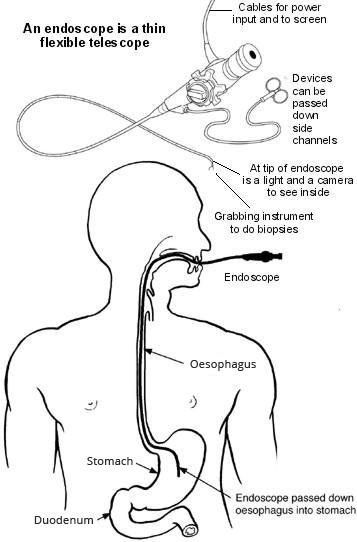
A gastroscopy is a test where an operator - usually a doctor or nurse - looks into the upper part of the gut (the upper gastrointestinal tract) with a camera.
The upper gut consists of the gullet (oesophagus), the stomach and the first part of the gut (small intestine) known as the duodenum. The operator uses an endoscope to look inside the gut.
An endoscope is a thin, flexible telescope. It is about as thick as a little finger. The endoscope is passed through the mouth, down the food pipe into the oesophagus and down towards the stomach and duodenum.
The tip of the endoscope contains a light and a tiny video camera so the operator can see inside the gut.
The endoscope also has a side channel down which various instruments can pass. These can be manipulated by the operator. For example, the operator may take a small sample (biopsie) from the inside lining of the stomach by using a thin 'grabbing' instrument which is passed down a side channel.
The procedure is sometimes called an "upper GI endoscopy" - this refers to the upper gastro-intestinal tract.
Why do I need a gastroscopy?
A gastroscopy may be advised for symptoms such as:
Repeated (recurring) indigestion.
Recurring heartburn.
Pains in the upper tummy (abdomen).
Être malade à plusieurs reprises (vomissements).
Difficulté à avaler.
Other symptoms thought to be coming from the upper gut, stomach or oesophagus.
What is a gastroscopy looking for?
Inflammation of the gullet (oesophagus), called oesophagitis. The operator will see areas of redness on the lining of the oesophagus.
Ulcère de l'estomac et ulcère duodénal. An ulcer looks like a small, red crater on the inside lining of the stomach or on the first part of the gut (small intestine) known as the duodenum.
Inflammation of the duodenum (duodenitis) and inflammation of the stomach (gastrite).
Estomac et oesophageal cancer.
Hernie hiatale
Various other rare conditions.
What happens during a gastroscopy?
Gastroscopy is usually done as an outpatient 'day case'. It is a routine test which is commonly done. Before the test the operator will explain what is going to happen and ask for a consent form to be signed.
The operator may numb the back of the throat by spraying on some local anaesthetic or giving an anaesthetic lozenge to suck. A sedative may also be given to help relaxation. This is usually given by an injection into a vein in the back of the hand. The sedative causes drowsiness but is not a general anaesthetic and does not put someone to sleep.
You lie on your side on a couch. You are asked to put a plastic mouth guard between your teeth. This works to protect your teeth and stops you biting the endoscope. The operator will then ask you to swallow the first section of the endoscope. Modern endoscopes are quite thin but some people may find this difficult.
The operator then gently pushes it further down the gullet (oesophagus) and into the stomach and the first part of the gut (small intestine) known as the duodenum. The video camera at the tip of the endoscope sends pictures to a screen.
The operator watches the screen for abnormalities of the oesophagus, stomach and duodenum. Air is passed down a channel in the endoscope into the stomach to make the stomach lining easier to see. This may cause a bloating sensation and belching.
The operator may take one or more small tissue samples (biopsies) of parts of the inside lining of the gut - depending on why the test is done and what they see on the screen. This is painless. The biopsy samples are sent to the laboratory for testing and to look at under the microscope. The endoscope is then gently pulled out.
How long does a gastroscopy take?
A gastroscopy usually takes about 10 minutes. However, at least two hours should be allowed for the whole appointment. This is to prepare, give time for the sedative to work, for the gastroscopy itself and to recover. A gastroscopy may be quite uncomfortable but it does not usually hurt.
How do you prepare for a gastroscopy?
You should receive instructions from the hospital department before your test. The sort of instructions given commonly include:
Avoid eating or drinking for 4-6 hours before the test. The stomach needs to be empty. (Small sips of water may be allowed up to two hours before the test.)
If you have a sedative you will need somebody to accompany you home.
Advice about medication which may need to be stopped before the test.
What can I expect after a gastroscopy?
Most people are ready to go home after resting for half an hour or so.
Si vous avez pris un sédatif - you may take a bit longer to be ready to go home. The sedative will normally make you feel quite pleasant and relaxed. However, you should not drive, operate machinery or drink alcohol for 24 hours after having the sedative. You will need somebody to accompany you home and to stay with you for 24 hours until the effects have fully worn off. Most people are able to resume normal activities after 24 hours.
The operator writes a report and sends it to the doctor who requested the gastroscopy, usually a gastroenterologist but occasionally another specialist or GP. The result from any sample (biopsy) may take some days or even weeks, which can delay the report being sent. The operator may inform you about what they saw before you leave. However, if you have had a sedative you may not remember afterwards what you were told. Therefore, you may wish to have a relative or close friend with you who may be able to help remember what was said.
Is gastroscopy reliable?
Gastroscopy is a good test for seeing abnormalities in the upper gut. However, it is not fool-proof. For example, gastroscopy may not detect a small number of cases of early ulcers or early cancer. Sometimes a repeat gastroscopy may be advised if symptoms persist or become worse, even if a previous gastroscopy was reported as normal.
Is a gastroscopy dangerous?
Most gastroscopies are done without any problem. Some people have a mildly sore throat for a day or so afterwards. You may feel tired or sleepy for several hours if you have a sedative. There is a slight risk of developing a chest infection or pneumonia following a gastroscopy.
Occasionally, the endoscope causes some damage to the gut. This may cause bleeding, infection and rarely a hole (perforation). If any of the following occur within 48 hours after a gastroscopy, seek immediate medical help:
Douleur abdominale. (In particular, if it becomes gradually worse, and is different from or more intense than any 'usual' indigestion pains or heartburn.)
Température élevée (fièvre).
Difficulté à respirer.
Vomiting blood.
A small number of people have a crise cardiaque ou AVC during, or soon after, a gastroscopy. These tend to be older people who are already in poor health. These serious complications are rare in most people who are otherwise reasonably healthy.
Rarely, some people have an allergic reaction to the sedation.
Sélections des patients pour Endoscopie

Chirurgie et procédures
Sigmoïdoscopie
Une sigmoïdoscopie est un examen qui examine le rectum et la partie inférieure du gros intestin. Remarque : les informations ci-dessous sont uniquement un guide général. Les modalités et la manière dont les examens sont effectués peuvent varier d’un hôpital à l’autre. Suivez toujours les instructions données par votre médecin ou votre hôpital local.
par Dr Claudia Berty, MRCGP

Chirurgie et procédures
Bronchoscopie
Une bronchoscopie est un examen qui peut aider à diagnostiquer et traiter les affections de votre respiration. Elle consiste pour un médecin à introduire un tube-caméra flexible dans vos poumons. Remarque : Les informations ci-dessous sont uniquement un guide général. Les dispositions et la manière dont les tests sont effectués varient souvent d'un hôpital à l'autre.
par Dr Toni Hazell, FRCGP
Questions fréquemment posées
What is the purpose of the plastic mouth guard used during a gastroscopy?
During a gastroscopy, a plastic mouth guard is placed between your teeth. Its purpose is to protect your teeth and prevent you from accidentally biting the endoscope during the procedure.
How does the doctor see inside the gut during a gastroscopy?
The endoscope, which is a thin, flexible tube, has a tiny video camera and light at its tip. This camera sends live pictures to a screen, allowing the operator to view the inside lining of your gullet, stomach, and the first part of the small intestine.
What happens to the tissue samples (biopsies) taken during a gastroscopy?
If small tissue samples (biopsies) are taken during the gastroscopy, they are sent to a laboratory for testing. There, they are examined under a microscope to help in diagnosing any abnormalities.
Why might I experience bloating or belching during a gastroscopy?
During the procedure, air is passed down a channel in the endoscope into your stomach. This is done to help make the stomach lining easier for the operator to see, but it may cause you to feel a sensation of bloating and lead to belching.
Can I get the results of my gastroscopy immediately after the procedure?
The operator may inform you about their findings immediately after the procedure. However, if you received a sedative, you might not remember what was discussed. Also, if any tissue samples (biopsies) were taken, the full report may be delayed as it can take several days or even weeks for those results to come back from the laboratory.
If my gastroscopy results are normal, does that mean I definitely don't have a problem?
While gastroscopy is generally reliable, it's not always foolproof. In a small number of cases, it might not detect very early ulcers or early-stage cancer. If your symptoms continue or get worse, even after a normal gastroscopy, your doctor might recommend a repeat procedure.
Lectures complémentaires et références
À propos de l'auteurVoir la biographie complète

Dr Philippa Vincent, MRCGP
Médecin généraliste, Auteur médical
MB BS, Bsc, MRCGP (2000), DCH, DFSRH, DRCOG
Dr Philippa Vincent est un médecin généraliste du NHS travaillant dans le nord de Londres.
À propos du critiqueVoir la biographie complète

Dr Hayley Willacy, FRCGP
Médecin généraliste, Auteur médical
MBChB (1992), DRCOG, DFFP, MRCOG (Part 1) MRCGP (2007), DFSRH (2013), MSc - medical education (2020)
Le Dr Hayley Willacy était médecin généraliste au NHS travaillant dans le nord-ouest de l'Angleterre, qui a pris sa retraite de la pratique clinique en 2022 après 30 ans.
Historique de l'article
Les informations sur cette page sont rédigées et examinées par des cliniciens qualifiés.
Article également disponible en Anglais, Allemand, Espagnol, Français, Italien, Portugais, Hindi, Hébreu, Arabe, and Suédois.
Prochaine révision prévue : 2 juil. 2027
3 juil. 2024 | Dernière version

Demandez, partagez, connectez-vous.
Parcourez les discussions, posez des questions et partagez vos expériences sur des centaines de sujets de santé.

Vous ne vous sentez pas bien ?
Évaluez vos symptômes en ligne gratuitement
Inscrivez-vous à la newsletter Patient
Votre dose hebdomadaire de conseils de santé clairs et fiables - rédigés pour vous aider à vous sentir informé, confiant et maître de la situation.
En vous abonnant, vous acceptez notre Politique de confidentialité. Vous pouvez vous désabonner à tout moment. Nous ne vendons jamais vos données.
Plus en chirurgie et procédures
- Anesthésie
- Anesthésie pour remplacement de la hanche ou du genou
- Botox
- Colposcopie et traitements cervicaux
- Pontage aortocoronarien
- Décès ou lésions cérébrales dues à l'anesthésie
- Thrombose veineuse profonde
- Biopsie de l'endomètre
- Soulagement de la douleur par epidurale après la chirurgie
- Laparoscopie et chirurgie laparoscopique
- Chirurgie oculaire au laser
- Amélioration des lèvres
- Anesthésie locale pour votre opération des yeux
- Lésion nerveuse après injection épidurale
- Chirurgie de réduction du nez (rhinoplastie)
- Embolie pulmonaire
- Sigmoïdoscopie
- Anesthésie spinale
- Chirurgie thoracoscopique assistée par vidéo
- Chirurgie de perte de poids