
Eczema, psoriasis, and ringworm: what's the difference?
Peer reviewed by Dr Krishna Vakharia, MRCGPAuthored by Dr Colin Tidy, MRCGPOriginally published 11 Aug 2023
Meets Patient’s editorial guidelines
- DownloadDownload
- Share
- Language
- Discussion
- Audio Version
- Add to preferred sources on Google
Red skin rashes are very common but it's often difficult to find what causes them because their symptoms are often similar. Three of the most common causes are eczema, psoriasis and ringworm. Getting the diagnosis right is important because the treatment for each of them is very different.
What's the difference between eczema, psoriasis and ringworm?
Atopic eczema
Atopic eczema - on legs
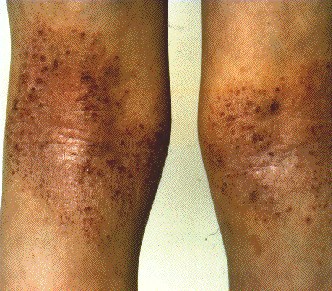
Atopic eczema - also known as atopic dermatitis - is when your skin is inflamed. It affects people of all ages, but usually starts in early childhood before 5 years of age. People with atopic eczema usually have periods when symptoms are mild, as well as periods when symptoms become more severe (flare-ups)
Eczema is caused by a problem with the immune system and children with eczema are more likely to get asthma or hay fever.
Psoriasis
Psoriasis on the hands
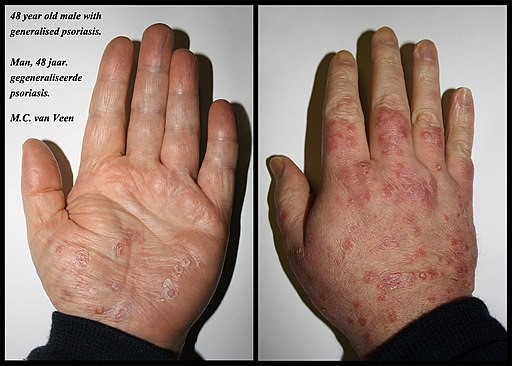
© MCvanVeen, CC BY-SA 4.0 via Wikimedia Commons
Psoriasis is an autoimmune disease, which is caused by our immune system attacking healthy skin cells. Psoriasis causes areas of inflammation in the skin, which can get worse and better. It can also affect the finger nails and people with psoriasis may also develop psoriatic arthritis.
The most common type is chronic plaque psoriasis which affects around 9 in 10 people with the condition. Other types include flexural psoriasis, guttate psoriasis and, less commonly, localised pustular psoriasis which affects the the palms of the hands and soles of the feet.
Ringworm
Ringworm (tinea corporis)
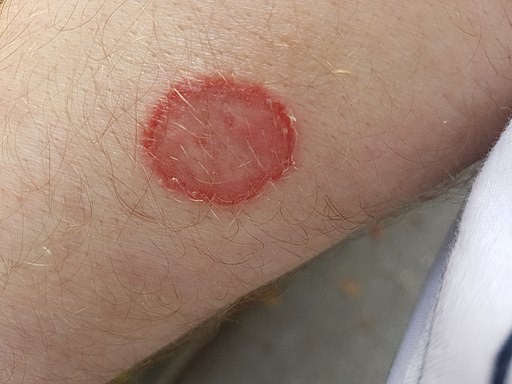
© Asurnipal, CC BY-SA 4.0, via Wikimedia Commons
Ringworm (tinea) is a rash caused by a fungal infection. It may look red, silver or darker than surrounding skin, depending on your skin tone. Ringworm gets its name because the area of skin affected looks like circular worms - but ringworm is not caused by worms. Ringworm affecting the body is called tinea corporis. Fungal skin infections can also affect the foot (athlete's foot or tinea pedis), the groin (tinea cruris) or the scalp (tinea capitis). Ringworm often spreads by direct skin-to-skin contact with an infected person or animal.
What is the difference between eczema and psoriasis?
Atopic eczema causes itchy skin that is also dry, cracked and sore. Some people with eczema only have small patches of dry skin, but others may have widespread red, swollen, sore and cracked (inflamed) skin affecting large areas of the body.
The inflamed skin usually looks red on lighter skin, but can be darker brown, purple or grey on darker skin.
Atopic eczema can affect any part of the body but mostly affects the hands, front of the elbows and back of the knees - and on the face and scalp in children. In Black and Asian children, atopic eczema can affect the front of the legs and back of the arms rather than the knees. Circular shaped patterns, often found around the hair follicles, are more common.
The areas (skin lesions) with psoriasis typically have a very clear boundary, and are red and often scaly - usually silver-white in colour.
Chronic plaque psoriasis typically causes patches (plaques) on the scalp, behind the ears, on the trunk, buttocks, around the belly button, and the back of the arms and front of the legs. The affected skin areas are typically distributed symmetrically and can group together to form larger patches. On white skin, the plaques are pink or red and on darker skin, they usually have a grey colour. Most patches are 1-2cms in diameter, with an oval or irregular shape. There is usually a clear boundary between normal and affected skin. The thickness of the scale varies, but it can be very thick.
Therefore, although eczema and psoriasis may often look similar, there are some important differences, such as:
Appearance:
Eczema is very itchy and the skin may be very sore and dry. Eczema makes your skin red and inflamed. It may be scaly, oozing, or crusty. You may see rough, leathery patches that are sometimes dark. It can also cause swelling.
Psoriasis could also be itchy, but your skin may also sting or burn. Psoriasis can also cause red patches. They may be silvery and scaly and raised. The skin is thicker and more inflamed than with eczema.
Distribution:
Eczema may appear at the front of your elbows or behind your knees, as well as your hands, feet, face and scalp..
Psoriasis often appears at the back of your elbows and front of your knees. Patches may also occur on fingernails and toenails, mouth and lips, eyelids, ears, and skin folds.
Triggers:
Eczema is usually aggravated by things that irritate your skin, like soaps or detergents. Things that cause allergies can also set off eczema, like dust, pets, pollen, mold, dandruff or some foods. Infections, stress, sweating, heat, and humidity can all start up eczema.
Psoriasis shares some of these triggers, like stress and infection. But you can also get flare-ups when your skin is injured, such as with sunburn or scratches.
Age:
Eczema usually starts in babies or children under 5 years old. Often, symptoms improve with time and it's much less common to first get it as an adult.
Psoriasis usually shows up between ages 15 and 35. But you can get it at other ages too. It's rare for a baby to have psoriasis.
Other conditions:
Eczema is more likely to occur if there is a history of asthma or hay fever in the family and a child with eczema is also more likely to develop these conditions.
Psoriasis may be linked to other health conditions, such as diabetes or heart disease.
Can eczema turn into psoriasis?
Eczema and psoriasis are different skin conditions and eczema cannot turn into psoriasis. However, it is possible that you can have both eczema and psoriasis at the same time, but this is uncommon.
Can you treat eczema and psoriasis in the same way?
Eczema treatment depends on how severe it is. If the eczema is mild, a moisturiser (emollient) is used all the time to treat dry skin, and a short course of a topical steroid, which is put onto the skin to reduce inflammation when the skin becomes red and inflamed. More severe eczema my need other treatments and you may be referred to a skin specialist (dermatologist). These other treatments may include medicines that are taken by mouth - that are more effective but also have more possible side effects - bandages and wet wraps, or light-therapy (phototherapy) using ultraviolet light.
Mild psoriasis may also be treated with treatments rubbed directly onto the skin, such as emollients and steroid creams - vitamin D analogues (calcipotriol, calcitriol or tacalcitol), coal tar preparations or dithranol may also be used. If more severe, psoriasis treatment may also need to be provided by a dermatologist and may include phototherapy or medicines that are taken by mouth.
Can ringworm be mistaken for psoriasis?
Ringworm can be mistaken for psoriasis but there are usually differences that help to tell them apart.
Psoriasis is usually a long term condition and the affected skin patches can appear salmon-coloured with silvery white scale, and with a clear boundary between the affected area and normal skin. On darker skin tones, psoriasis may look violet with gray scale. Or it can also appear dark brown and difficult to see. It is often found on the knees, elbows, genitals, and toenails.
Ringworm is a temporary circular rash that appears red or pink on light skin tones and brown or gray on skin of colour. The skin areas affected do not tend to be scaly but the colour tends to fade towards the middle of the patch. You can develop ringworm if your skin comes in contact with the skin of someone who has the fungal infection.
Ringworm typically looks like a ring, so there may be fine scale on the 'ring' but the middle is clear skin. This helps to differentiate between this and eczema or psoriasis as these commonly do not have an area in the middle that is clear.
Patient picks for Psoriasis

Skin, nail and hair health
Can changing your diet help psoriasis?
According to the British Skin Foundation, around 2 in 100 people in the UK live with the skin condition psoriasis. It is not infectious, nor does it lead to cancer. But it may be highly distressing or uncomfortable. This has led people with the condition to try various remedies, including changes to diet or lifestyle. We look for evidence that eating or avoiding certain foods could help.
by Dr Carrie Ruxton, PhD, Child Nutrition

Skin, nail and hair health
What to do if psoriasis is getting you down
Psoriasis affects approximately 1.8 million people in the UK, around 2% of the population. Red, flaky patches of skin covered in silvery scales are typical of the condition, which comes and goes throughout life. Its frequency and severity can vary greatly from person to person, from causing minor irritation to seriously affecting their quality of life.
by Kerry Taylor-Smith
About the authorView full bio

Dr Colin Tidy, MRCGP
General Practitioner, Medical Author
MBBS, MRCGP, MRCP (Paediatrics), DCH
Dr Colin Tidy is an NHS Doctor, based in Oxfordshire.
About the reviewerView full bio

Dr Krishna Vakharia, MRCGP
Chief Medical Officer for Health, Optum UK
MBChB, MRCGP(2013), BMedSci (hons), DFSRH, DRCOG, PGDipDerm (Distn)
Dr Krishna Vakharia is an NHS GP. She is also a regular examiner for the postgraduate Diploma in Practical Dermatology at Cardiff University as well as being the Chief Medical Officer for health at Optum UK.
Article history
The information on this page is peer reviewed by qualified clinicians.
Article also available in English, German, Spanish, French, Italian, Portuguese, Hindi, Hebrew, Arabic, and Swedish.
11 Aug 2023 | Originally published
Authored by:
Dr Colin Tidy, MRCGPPeer reviewed by
Dr Krishna Vakharia, MRCGP
Join the conversation
Share your thoughts or experiences with others in our patient communities.

Ask, share, connect.
Browse discussions, ask questions, and share experiences across hundreds of health topics.

Feeling unwell?
Assess your symptoms online for free
Sign up to the Patient newsletter
Your weekly dose of clear, trustworthy health advice - written to help you feel informed, confident and in control.
By subscribing you accept our Privacy Policy. You can unsubscribe at any time. We never sell your data.
More in skin, nail and hair health
- AI skin analysis: what it is and why experts warn against it
- Are skincare products putting you at risk of sunburn?
- Can hair transplants improve mental health?
- Can vitamins really prevent hair loss?
- Here's how to protect a bald head from the sun
- How the seasons affect your eczema
- How to prevent and soothe skin cysts: a simple guide
- How to treat sunburn blisters
- How to wash your hands if you have eczema or dry skin
- How your environment affects skin conditions
- Is there a link between diet and acne?
- Retinol: skincare benefits, side effects and more
- Scarlet fever: a doctor's advice
- The 'second puberty': why you might be breaking out in your thirties
- The mental health impact of skin conditions
- Tick bites: how to recognise and treat
- What are the benefits of collagen, and can it prevent skin ageing?
- What are the dangers of drinking in hot weather?
- Which natural remedies help soothe eczema?
- Why is my facial eczema worse in summer?