Constipation
Revu par des pairs Dr Toni Hazell, FRCGPDernière mise à jour par Dr Caroline Wiggins, MRCGP Dernière mise à jour 31 mars 2026
Respecte les directives éditoriales
- TéléchargerTélécharger
- Partager
- Language
- Discussion
- Version audio
- Ajouter aux sources préférées sur Google
Dans cette série :Constipation chez les enfantsFibres et compléments de fibresLaxatifsMaladie de Hirschsprung
Constipation means you are pooing less than normal, are struggling to poo, or are having painful poos. It is usually caused by not eating enough fibre, or not drinking enough fluids.
Points clés
Constipation is a common digestive problem that can affect people of any age. It involves infrequent bowel movements (pooing), hard or painful poos, straining, or a feeling of incomplete emptying.
It is commonly caused by dietary and lifestyle factors such as not eating enough fibre, not drinking enough fluid, a lack of physical activity, and changes in routine.
Most constipation can be relieved by increasing fibre and fluids, staying active, responding to the urge to open your bowels, and taking over-the-counter laxatives.
What is constipation?
Constipation means having difficulty pooing (passing stools), having fewer poos than usual, or having poos that are hard, dry, or painful to pass.
Some people with constipation can feel the need to strain to pass the poo, or feel that their bowels have not emptied completely.
This information leaflet discusses constipation in adults. For constipation in children, see our information leaflet called Constipation chez les enfants.
What is constipation?
Constipation symptoms
You may be constipated if:
Your poo is hard and difficult or painful to pass.
You're pooing less frequently than usual.
You have stomach ache or cramps.
You feel bloated or sick.
It does not feel as though you have emptied your bowel or 'finished' after pooing.
How long does constipation last?
Constipation can last for just a day, or several days, depending on the cause and if steps are taken to improve it.
Chronic constipation lasts for at least 12 weeks out of the past 6 months.
What causes constipation?
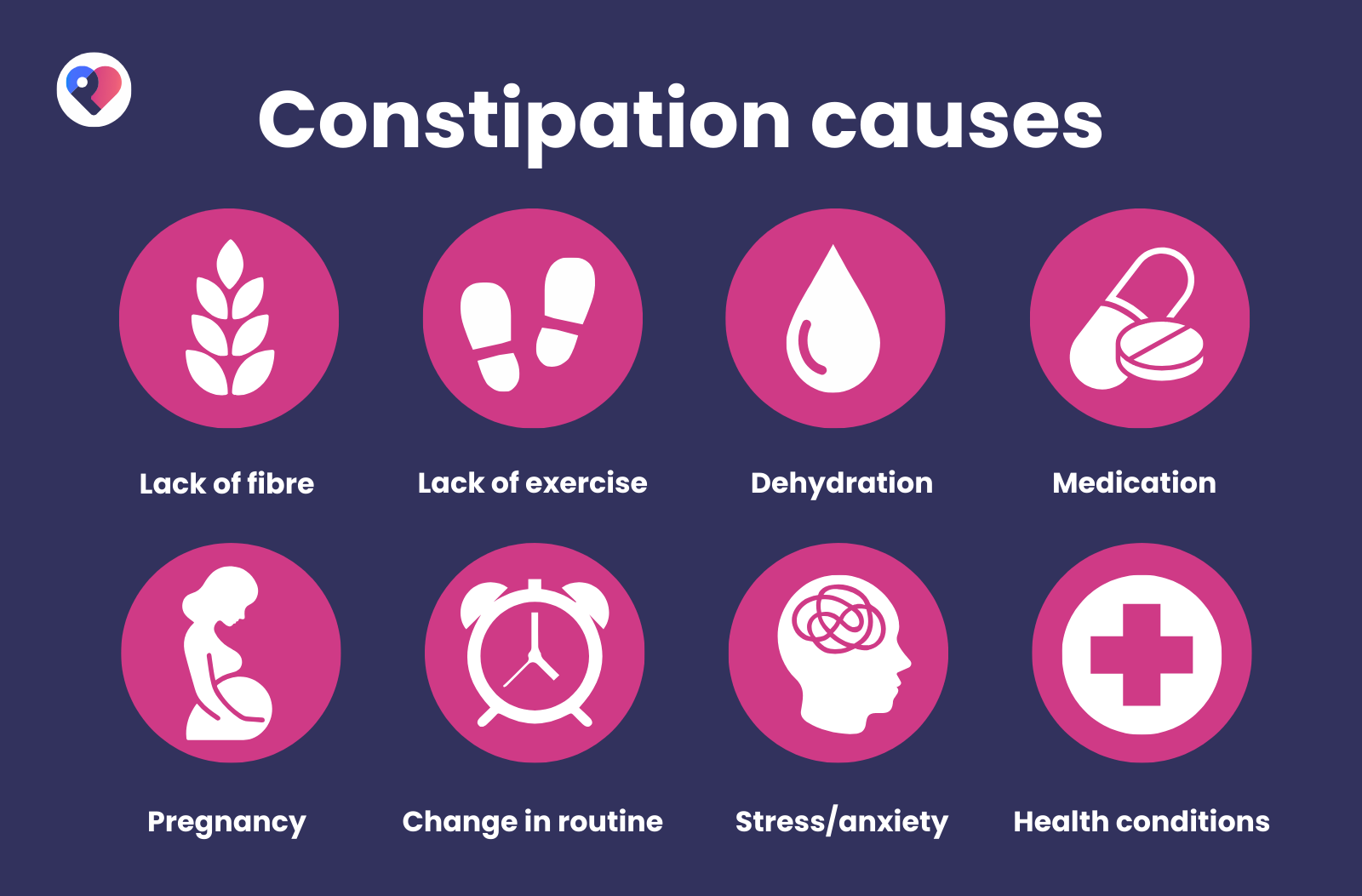
Common causes of constipation include:
Not eating enough fibres - this is found in foods such as fruits, vegetables, and cereals.
Not drinking enough fluids - which can lead to déshydratation.
Lack of physical activity.
Certain medicines – such as painkillers (especially ones with codéine), antiacides, antidepressants such as amitriptyline, iron tablets, and some blood pressure medicines.
Medical conditions - such as an glande thyroïde sous-active, le syndrome du côlon irritable, maladie diverticulaire et colon cancer.
Pregnancy - caused by hormonal changes and pressure from the growing womb. About 1 in 5 pregnant women will become constipated.
Constipation can also be caused by:
Ignoring the urge to poo when you need to go to the toilet.
Changes to your routine.
Changes to your diet.
Stress, l'anxiété, and dépression.
Difficulty accessing a toilet.
Functional constipation
Some people develop constipation despite a healthy diet, good fluid intake, and no underlying illness or medicines. It causes chronic (long term) constipation and has no identifiable cause. This is known as functional (primary) constipation.
It is common, affects women more often than men and it usually begins in childhood or early adulthood.
How to treat constipation
Lifestyle and diet changes
Gradually increase the fibre in your diet to 30g daily. Wholegrains, fruit and vegetables are higher in fibre than other foods. For information on increasing fibre in your diet see the information sheet on fibre by the British Dietetic Association (BDA) in Further Reading below.
Ensure you drink enough water each day to stay hydrated. The BDA information sheet on Fluid in Further Reading below shows why water is important and how much you need to drink.
Être actif physiquement encourages your bowel to move food along through your gut, avoiding constipation.
Go to the toilet to poo as soon as you feel the need to.
Médicament en vente libre
Some medicines to help short term constipation can be bought over the counter at a pharmacy or supermarket. These medicines can be used for up to one week. If your constipation lasts longer than a week you should see a doctor. If you are pregnant or breastfeeding you should discuss your constipation with a pharmacist so they can advise you which laxatives are safe to use.
Quand consulter un médecin
You should see a doctor:
If your constipation lasts longer than one week.
If you have severe tummy pain.
You are regularly experiencing constipation and cannot identify an obvious cause.
You are sick (vomiting) and constipated.
You are losing weight.
You notice bleeding from your bottom (anus).
The feeling of not emptying your bowels completely after you have a poo continues once the constipation has got better.
How to prevent constipation
You can help prevent constipation by following the diet and lifestyle advice in the section "How to treat constipation" above.
Questions fréquemment posées
Can paracetamol cause constipation?
No, paracetamol does not cause constipation.
Are bananas good for constipation?
Ripe bananas can help improve constipation as they are high in fibre, but unripe bananas may contribute to constipation.
What foods should you avoid when constipated?
There are no particular foods to avoid, but try to focus on increasing wholegrain foods which are high in fibre and making sure you are drinking enough water.
How long should I sit on the toilet if I'm constipated?
There are no set rules. Instead, make sure you are relaxed when sitting on the toilet, sitting upright with your feet flat on a steady surface and stay on the toilet until you feel you have emptied your bowels.
Sélections des patients pour Conditions intestinales
Recherche en santé
Participez à une étude sur un nouveau produit bactérien multi-souches pour la constipation
La constipation peut causer un inconfort significatif et perturber la vie quotidienne. Une nouvelle étude de recherche menée par The Functional Gut Clinic examine si un produit alimentaire bactérien multi-souches peut aider à améliorer la régularité intestinale et la fonction digestive. L'étude a été approuvée par un comité d'éthique indépendant et respecte les Bonnes Pratiques Cliniques. De nombreuses personnes souffrant de constipation essaient différents traitements avant de trouver quelque chose qui les aide. Cette étude vise à explorer si un produit bactérien ciblé pourrait offrir des avantages pour le transit intestinal et le confort digestif.
par Thomas Andrew Porteus, MBCS
Santé des enfants
Constipation chez les enfants
La constipation est un problème très fréquent chez les enfants. Pour la plupart des enfants, la constipation signifie avoir des selles dures (fèces), avec difficulté, moins souvent que la normale. Des accidents réguliers (souvent confondus avec une diarrhée liquide) peuvent indiquer qu’un enfant souffre d’une constipation sévère provoquant une obstruction de la partie inférieure de l’intestin (impaction). Lorsqu’aucune maladie ou affection particulière n’est à l’origine de la constipation, on parle de constipation idiopathique. Il est important de reconnaître la constipation tôt pour éviter qu’elle ne devienne un problème à long terme (chronique). Note : pour les adultes, voir la fiche séparée intitulée Constipation.
par Dr Hayley Willacy, FRCGP
Lectures complémentaires et références
- Constipation; NICE CKS, novembre 2025 (accès réservé au Royaume-Uni)
- Fibre; The Association of UK Dietitians (BDA)
- Fluid. British Dietetic Association.
- Gastrointestinal tract (lower) cancers - recognition and referral; NICE CKS, août 2023 (accès réservé au Royaume-Uni)
À propos de l'auteurVoir la biographie complète

Dr Caroline Wiggins, MRCGP
Médecin généraliste, Auteur médical
MBBS Honours (with Distinction), MRCGP (2016), MSc.SEM (with Distinction), BSc (Hons)
Dr Caroline Wiggins est médecin généraliste remplaçante actuellement dans le sud-ouest de l'Angleterre.
À propos du critiqueVoir la biographie complète

Dr Toni Hazell, FRCGP
MBBS, BSc, FRCGP, DFSRH, Dip GU med, DRCOG, DCH (London, UK, 2000)
Le Dr Toni Hazell a obtenu son diplôme de l'École de médecine de l'hôpital St. Mary et a effectué son VTS à l'hôpital Northwick Park.
Historique de l'article
Les informations sur cette page sont rédigées et examinées par des cliniciens qualifiés.
Article également disponible en Anglais, Allemand, Espagnol, Français, Italien, Portugais, Hindi, Hébreu, Arabe, and Suédois.
Next review due: 31 Dec 2030
31 mars 2026 | Dernière version

Demandez, partagez, connectez-vous.
Parcourez les discussions, posez des questions et partagez vos expériences sur des centaines de sujets de santé.

Vous ne vous sentez pas bien ?
Évaluez vos symptômes en ligne gratuitement
Inscrivez-vous à la newsletter Patient
Votre dose hebdomadaire de conseils de santé clairs et fiables - rédigés pour vous aider à vous sentir informé, confiant et maître de la situation.
En vous abonnant, vous acceptez notre Politique de confidentialité. Vous pouvez vous désabonner à tout moment. Nous ne vendons jamais vos données.
Plus sur la santé digestive
- Masses abdominales
- Diarrhée due aux acides biliaires
- Polypes intestinaux
- Pancréatite chronique
- Clostridioides difficile
- Constipation chez les enfants
- E. coli
- Gastrite
- Gastroparesie
- Hépatite A
- Hépatite B
- Invagination intestinale et volvulus chez les enfants
- Prurit anal
- Laxatifs
- Douleur dans le quadrant supérieur gauche
- Préparations locales pour les troubles anaux
- Inhibiteurs de la pompe à protons
- Salmonella
- Diarrhée du tout-petit
- Diarrhée du voyageur