Hernies inguinales
Revu par Dr Toni Hazell, FRCGPDernière mise à jour par Dr Philippa Vincent, MRCGPDernière mise à jour 1 oct. 2026
Respecte les directives éditoriales
- TéléchargerTélécharger
- Partager
- Language
- Discussion
- Ask Patient
- Version audio
- Ajouter aux sources préférées sur Google
Professionnels de la santé
Les articles de référence professionnelle sont conçus pour être utilisés par les professionnels de la santé. Ils sont rédigés par des médecins britanniques et basés sur des preuves de recherche, des directives britanniques et européennes. Vous pouvez trouver le Hernie article plus utile, ou l'un de nos autres articles de santé.
Qu'est-ce qu'une hernie inguinale ?
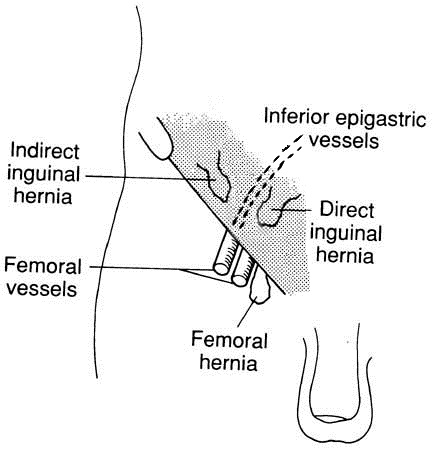
An abdominal hernia comprises a protrusion of abdominal contents through the fascia of the abdominal wall; an inguinal hernia is where this protrudes through the internal inguinal ring. Hernias contain a portion of peritoneal sac and may contain viscera, usually small bowel and omentum.
Hernie inguinale
Épidémiologie de la hernie inguinale
Inguinal hernias are common, making up 75% of all abdominal hernias.
Inguinal hernias are more common in men (the lifetime risk of an inguinal hernia is 27-43% in men and 3-6% in women).1 Although they are much more common in men, women with a groin hernia are still more likely to have an inguinal than a femoral hernia.2
As well as male sex, risk factors include increasing age (although there is also a significant spike in cases below the age of 5 years) and a genetic predisposition.2
Other risk factors are thought to include: smoking, chronic obstructive pulmonary disease, lower body mass index, high intrabdominal pressure, thoracic or abdominal aortic aneurysm, patent processes vaginalis, history of open appendectomy, peritoneal dialysis, and collagen vascular disease.2
Présentation de la hernie inguinale
An inguinal hernia will usually present as a swelling in the groin that may appear with lifting and be accompanied by sudden pain.
There may be a cough impulse. The hernia may not be visible when lying flat but may appear on standing.
The hernia may be reducible.
Indirect hernias can cause pain in the scrotum and cause a 'dragging sensation'.
Les hernies inguinales congénitales sont généralement détectées à la naissance et nécessitent toutes une référence urgente en consultation externe pour une réparation chirurgicale.
Inguinal hernias in older children and adults usually develop gradually but can occur suddenly with an episode of heavy lifting:
À première vue, une hernie est généralement facilement réductible lorsque le patient s'allonge. Cependant, elle peut nécessiter un remplacement manuel si elle est grande.
Avec le temps, la hernie s'agrandit et devient plus difficile à replacer, en raison de la formation d'adhérences fibreuses.
Lorsqu'elle ne peut plus être réduite, elle est irréductible ou incarcérée. Cela peut se produire à tout moment, tout comme l'étranglement. Cela se produit lorsque le contenu viscéral de la hernie se tord ou se retrouve piégé par l'ouverture étroite. Cela compromet l'apport sanguin, provoquant un gonflement et éventuellement une infarctus. L'étranglement conduit généralement à une obstruction intestinale.
Il existe deux types de hernie inguinale :
Indirect: a protrusion through the internal inguinal ring passes along the inguinal canal through the abdominal wall, running laterally to the inferior epigastric vessels. This is the more common form accounting for 80% of inguinal hernias, especially in children. It is associated with failure of the inguinal canal to close properly after passage of the testis in utero or during the neonatal period.
Direct: la hernie fait saillie directement à travers une faiblesse de la paroi postérieure du canal inguinal, se dirigeant médialement vers les vaisseaux épigastriques inférieurs. Elle est plus fréquente chez les personnes âgées et rare chez les enfants.
Évaluation3
Examinez le patient à la fois debout et allongé et demandez-lui de tousser ou de se contracter.
Insérez un doigt à travers le haut du scrotum dans l'anneau inguinal externe et palpez pour détecter une masse lors de la toux - impulsion de toux.
Les hernies glissantes sont probables avec de grandes hernies scrotales.
Diagnostic différentiel
Voir également le document séparé Masse dans l'aine et le scrotum article.
Hydrocèle (lors de la différenciation d'une hernie inguinoscrotale, notez qu'il est possible de passer au-dessus d'un hydrocèle lors de l'examen).
Hydrocèle du cordon spermatique.
Gonflement des ganglions lymphatiques.
Abcès.
Saphena varix.
Saignement.
Enquêtes
Whilst most specialists agree that imaging is not necessary to make the diagnosis, in the UK there are often local constraints on referrals for hernia repair which mean that the diagnosis needs to be confirmed by imaging. Ultrasound scan is the imaging option of choice.34
Traitement et gestion de la hernie inguinale
Adultes5 2
If the inguinal hernia is small, the patient may only need reassurance. There is good recent evidence that "watchful waiting" is a safe option for many adults with inguinal hernias. Long-term follow-up of these patients suggests that around 68% proceed to surgical management eventually, usually due to worsening pain or lifestyle limitations from progression.2
Patients with pain, reduced mobility or other symptoms should be offered surgical management. Many patients with chronically incarcerated hernias may be asymptomatic but patients with obstruction or strangulation are a surgical emergency.
However, there is always the chance of it becoming a surgical emergency through obstruction and incarceration. Episodes of pain and tenderness suggest the need for urgent treatment but when these become prolonged and severe then emergency surgery is indicated for possible strangulation. The fundamentals of indirect inguinal hernia treatment are the same regardless of the patient's age. Reduction or excision of the sac and closure of the defect with minimal tension are the essential steps in any hernia repair.
Surgical guidelines recommend tailoring the choice of surgery to individual patient factors. Surgical options include either an open (tissue- or mesh-based) procedure or a minimally invasive (laparoscopic or robotic) procedure.
An open repair with mesh is associated with a 50%-75% lower risk of hernia recurrence, lower risk of chronic pain post-operatively, and an earlier return to work compared with a sutured repair. A tissue (sutured) repair is usually used where mesh is contraindicated, for example where there may be potential for infection from a contaminated field. Laparoscopic repair is recommended for bilateral inguinal hernias as the same port sites can be used.
Studies have shown no significant difference between mesh, laparoscopic and robotic procedures in terms of post-operative haematoma, surgical site infection, urinary retention, or hospital length of stay. However post-operative chronic pain appears to be lower in patients who have undergone laparoscopic procedures, though studies have been of questionable quality.
Hernies inguinales chez les enfants
The incidence of incarcerated or strangulated hernias in paediatric patients is higher than in adults, at around 7-11%.6 It is higher in infants than in older children. The risk increases with waiting time from diagnosis to procedure.67
Surgical repair is usually recommended as early as possible in paediatric patients because of these risks.
Laparoscopic repair has been shown to have better outcomes than open repair though both have low risks of complications.8910
Complications
Ceux-ci incluent :
Post-operative chronic pain is reported to occur in between 8 and 16% of patients, though laparoscopic repair appears to reduce the risk.2
Récurrence : 1,0 % - la plupart se produisent dans les cinq ans d'exploitation. Le taux de récidive augmente :
Chez les enfants âgés de moins de 1 an.
Chez les patients âgés.
Après les incarcérations.
Chez ceux ayant une pression intra-abdominale augmentée persistante.
Où il y a un échec de croissance.
Avec prématurité.
Où il y a des problèmes respiratoires chroniques.
Chez les filles avec des hernies glissantes.
Testicule ou ovaire infarci avec atrophie.
Infection de la plaie.
Lésion de la vessie.
Lésion intestinale.
Un hydrocèle dû à une accumulation de liquide dans le sac distal se résout généralement spontanément, mais nécessite parfois une aspiration.
Pronostic
C'est généralement très bon, selon la comorbidité.
Mises à jour exclusives pour les professionnels de la santé
Restez informé des dernières mises à jour cliniques, des perspectives professionnelles et des conseils fondés sur des preuves. La newsletter Patient Pro sélectionne des contenus essentiels pour les professionnels de santé—livrés directement dans votre boîte de réception.
En vous abonnant, vous acceptez notre Politique de confidentialité. Vous pouvez vous désabonner à tout moment. Nous ne vendons jamais vos données.
Lectures complémentaires et références
- Jorgenson E, Makki N, Shen L, et al; Une étude d'association à l'échelle du génome identifie quatre nouveaux loci de susceptibilité sous-jacents à la hernie inguinale. Nat Commun. 21 déc. 2015;6:10130. doi: 10.1038/ncomms10130.
- Gudigopuram SVR, Raguthu CC, Gajjela H, et al; Réparation de la Hernie Inguinale avec Prothèse : Les Facteurs à Considérer Lors du Choix entre Réparation Ouverte et Laparoscopique. Cureus. 2021 Nov 16;13(11):e19628. doi: 10.7759/cureus.19628. eCollection 2021 Nov.
- Tigora A, Radu PA, Garofil DN, et al; Modern Perspectives on Inguinal Hernia Repair: A Narrative Review on Surgical Techniques, Mesh Selection and Fixation Strategies. J Clin Med. 2025 Jul 9;14(14):4875. doi: 10.3390/jcm14144875.
- Current status of inguinal hernia management; P J McBee et al; International Journal of Abdominal Wall and Hernia Surgery
- Hassler KR, Saxena P, Baltazar-Ford KS; Open Inguinal Hernia Repair.
- LeBlanc KE, LeBlanc LL, LeBlanc KA; Hernies inguinales : diagnostic et prise en charge. Am Fam Physician. 15 juin 2013;87(12):844-8.
- Groupe HerniaSurge; Directives internationales pour la gestion des hernies inguinales. Hernia. 2018;22(1):1-165. doi:10.1007/s10029-017-1668-x
- Olesen CS, Mortensen LQ, Oberg S, et al; Risk of incarceration in children with inguinal hernia: a systematic review. Hernia. 2019 Apr;23(2):245-254. doi: 10.1007/s10029-019-01877-0. Epub 2019 Jan 12.
- Retrospective Cohort Study on Inguinal Hernia in Children: Infant Vulnerability to Incarceration and Pediatricians’ Awareness; A G Grewal et al; CHRISMED Journal of Health and Research
- Ma Q, Liu X, Zou Z, et al; Surgical methods and outcomes of inguinal hernia repair in children, adolescents and young adults in a retrospective cohort study. Sci Rep. 2025 Mar 17;15(1):9220. doi: 10.1038/s41598-025-93841-5.
- Morgado M, Holland AJ; Inguinal hernias in children: Update on management guidelines. J Paediatr Child Health. 2024 Nov;60(11):648-653. doi: 10.1111/jpc.16677. Epub 2024 Sep 25.
- A 10-year review of pediatric inguinal hernia management at a tertiary center; B Yu et al; Frontiers in Pediatrics
À propos de l'auteurVoir la biographie complète
Mis à jour par

Dr Philippa Vincent, MRCGP
Médecin généraliste, Auteur médical
MB BS, Bsc, MRCGP (2000), DCH, DFSRH, DRCOG
Dr Philippa Vincent est un médecin généraliste du NHS travaillant dans le nord de Londres.
À propos du critiqueVoir la biographie complète

Dr Toni Hazell, FRCGP
MBBS, BSc, FRCGP, DFSRH, Dip GU med, DRCOG, DCH (London, UK, 2000)
Le Dr Toni Hazell a obtenu son diplôme de l'École de médecine de l'hôpital St. Mary et a effectué son VTS à l'hôpital Northwick Park.
Accès simple à des traitements fiables et à des services de santé en ligne.
Common conditions
Get help with common conditions through the NHS, without a GP appointment.





Plus dans l'histoire et l'examen
- Douleur abdominale aiguë chez les enfants
- Coma
- Diplopie et lésions des nerfs crâniens III, IV et VI
- Infections fongiques des ongles
- Perte progressive de la vision
- Hernie hiatale
- Antécédents et examen physique
- Syndrome de Horner
- Ictère
- Symptômes des voies urinaires inférieures chez les femmes
- Narcolepsie et cataplexie
- Tachycardies à complexes étroits
- Douleur cervicale (cervicalgie) et torticolis
- Gonflements orbitaux
- Érythème palmaire
- Saignement rectal chez les enfants
- Examen de l'épaule
- Chorée de Sydenham
- Défauts du champ visuel
- Sifflement chez les enfants