Prostatite aiguë
Revu par des pairs par Dr Philippa Vincent, MRCGPDernière mise à jour par Dr Toni Hazell, FRCGPDernière mise à jour 22 mai 2023
Respecte les directives éditoriales
- TéléchargerTélécharger
- Partager
- Language
- Discussion
- Version audio
- Ajouter aux sources préférées sur Google
Lorsque la glande prostatique est infectée par un germe (une infection bactérienne), la condition est connue sous le nom de prostatite aiguë. 'ite' signifie inflammation, donc la prostatite est une inflammation de la prostate - toutes les formes de prostatite ne sont pas bactériennes, mais cette brochure couvrira principalement la prostatite bactérienne. Les symptômes incluent des douleurs, principalement à la base du pénis et autour de l'anus. Une infection de la vessie survient souvent en même temps. Le traitement comprend une cure de quatre semaines de médicaments antibiotiques.
En un coup d'œil
Acute prostatitis is an infection of the prostate gland in men.
Symptoms typically develop quickly and can include pain, fever, and urinary problems.
Pain may be felt at the base of the penis, around the anus, above the pubic bone, or in the lower back.
It is often treated with a course of antibiotics, usually lasting four weeks.
Taking the full course of antibiotics is important to prevent the infection from becoming persistent.
Acute prostatitis symptoms
In acute prostatitis, symptoms develop quickly - typically over a few days or so. It usually occurs at the same time as a urine infection. Therefore, you may also have a bladder infection (cystitis). Germs (bacteria) are found in your urine if a urine sample is taken. Symptoms include:
Pain from your prostate, which may be severe. You feel this mainly at the base of your penis, around your anus, just above your pubic bone and/or in your lower back. Pain may spread to your penis and testicles (testes). Passing stools (faeces) can be painful.
Symptoms of a urine infection. For example: pain when you pass urine, passing urine frequently, an urgent desire to pass urine, and sometimes having blood in your urine. Some people can develop problems so that they are unable to pass urine and the urine builds up in the bladder (this is called urinary retention). Voir la brochure séparée intitulée Rétention Urinaire.
Température élevée (fièvre). General aches and pains. You generally feel ill.
A small amount of thick fluid (discharge) may come out of your penis from your urethra.
Your prostate feels tender if a doctor examines it with a gloved finger in your back passage (rectum) - this is known as a digital rectal examination, a type of physical examination.
Qu'est-ce que la glande prostatique ?
Diagramme en coupe de la prostate et des organes voisins
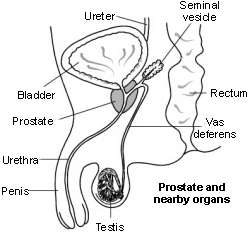
Only men have a prostate gland (just referred to as the 'prostate' from now on here). It lies just beneath the bladder. It is normally about the size of a chestnut. The urethra is the tube that urine travels along from the bladder to the outside and it runs through the middle of the prostate and then through the penis. The prostate helps to make semen but most semen is made by another gland nearby (the seminal vesicle).
Causes of acute prostatitis
Infection by germs (bacteria) that normally live in your bowel
Some bacteria that live harmlessly in the bowel commonly get on to the skin near to the anus when we pass stools (faeces). In some people they may then multiply. Some of these bacteria may then travel up the urethra and cause infection anywhere in the urinary tract - that is, the kidneys, bladder, prostate, or urethra. This is called a 'infection urinaire'.
A prostate infection may also occur with or without other parts of the urinary tract being infected. Some conditions that cause pooling or blockage of urine increase the risk of a urinary tract infection. For example, having an enlarged prostate gland ou calculs rénaux. This is because bacteria often thrive and multiply quickly in pooled urine.
Causes moins courantes
Damage to the prostate makes it more prone to infection - for example, after prostate surgery.
A thin, flexible, hollow tube (a catheter) passed into the bladder through the urethra may sometimes let bacteria travel to the prostate. This can also happen after a telescopic instrument is passed through the urethra into the bladder (as happens during investigation of the prostate gland and the bladder).
Sometimes the prostate is infected by bacteria in the bloodstream that have travelled from other infections in the body.
Acute prostatitis is not considered a sexually transmitted infection, so a sexual partner is not at risk.
How common is acute prostatitis?
Symptoms of prostatitis affect around 8% of men at some point in their life, but only about 10% of these have a proven bacterial cause, though it is possible that more are bacterial but we never find out exactly which bacteria it is.
Diagnosing acute prostatitis
Diagnostic tests to assess for infection will likely include:
A urine test may detect germs (bacteria) if you have acute prostatitis and should definitely be positive if you have a infection urinaire. Your doctor will usually be able to do a quick test on your urine in the surgery (a dipstick urine test). This can show if infection is likely to be present. They may then send your urine sample to the laboratory to be tested further and to confirm infection.
Autres tests tel qu'un échographie ou tomodensitométrie (TDM) ou IRM may be advised following acute prostatitis. This is to rule out any problem with your urinary tract that may have contributed to causing the infection. CT and MRI scans are usually arranged by a hospital consultant rather than the GP.
Analyses de sang may or may not be done, depending on your exact symptoms. Sometimes this may include a prostate specific antigen (PSA) test, which is more usually done when concerned about prostate cancer. If it is raised, this does not necessarily mean that you have cancer - the test may become normal after you have antibiotics.
Acute prostatitis can produce similar symptoms to a sexually transmitted infection. For this reason, if you are at risk of a sexually transmitted infection, your doctor may suggest that you have some swab or urine tests to exclude this. Remarque: acute prostatitis is not a sexually transmitted infection.
Acute prostatitis treatment
Antibiotiques. A four-week course is usually needed, though the recommendation is for an initial two-week course and then a review and consideration of giving another two weeks' worth. Antibiotics are generally started before the confirmatory urine test results are back. The first antibiotic may be changed after the result of the urine test is back. The urine test may find exactly which germ (bacterium) is causing the infection and the best antibiotic to treat it, but this does not always happen - sometimes the result is less specific. Four weeks of antibiotics are thought to be necessary to reduce the chance that you develop persistent (chronic) prostatitis. If you are very unwell, you may need to go into hospital to have the antibiotics given through a vein.
Paracétamol ou ibuprofène ease pain and high temperature (fever). They are best taken regularly rather than now and then. Stronger painkillers are sometimes needed.
Laxatifs can keep your stools (faeces) soft, if needed. They may help to ease pain if you have hard stools in your back passage (rectum), pressing on your infected prostate.
Complications of acute prostatitis
Rarely, apart from chronic bacterial prostatitis, other complications of acute prostatitis can occur. These include:
Sudden-onset (acute) urinary retention. Because it may be so painful to pass urine, urine can build up in your bladder, causing pain in your lower tummy (abdomen) and inability to pass urine at all. To relieve this, a thin, flexible, hollow tube (a catheter) is needed. This is usually inserted through a small cut in your tummy (abdomen) directly into your bladder to drain the urine. The catheter can usually be removed once the antibiotics have started working and the infection of the prostate is clearing.
Prostate abscess. If the antibiotics do not effectively treat the prostate infection, rarely you can develop an abcès of your prostate. Your doctor may suspect this if your symptoms do not improve despite antibiotic treatment. Further tests are needed to confirm a prostate abscess, such as an ultrasound or CT scan of your prostate. If an abscess is present, an operation is needed to drain it.
Perspectives (pronostic)
Acute prostatitis usually clears with a course of antibiotics. However, it is important to take the full course to clear the infection completely. There is a risk that an acute infection may become a persistent (chronic) infection if you do not take the full course of antibiotics - this can lead to chronic pelvic pain syndrome. See the separate leaflet called Chronic Prostatitis for further details.
Sélections des patients pour Troubles de la prostate

Santé des hommes
Prostatite chronique
Prostatitis means that you have inflammation of your prostate gland. There are two main types of prostatitis: short-lived (acute) or persistent (chronic). It can also be caused by an infection (infective) or be non-infective. Less than 1 in 10 cases of prostatitis are due to bacterial infection. For the diagnosis of chronic prostatitis, symptoms need to have been present for at least three months. In acute prostatitis, symptoms usually come on and go away much more quickly. About 9 in 10 men with chronic prostatitis have chronic prostatitis/chronic pelvic pain syndrome (CPPS). About 1 in 10 men with chronic prostatitis have chronic bacterial prostatitis.
par Dr Toni Hazell, FRCGP
Santé des hommes
Hypertrophie de la prostate
La glande prostatique devient souvent plus grande chez les hommes âgés. Les femmes n'ont pas de glande prostatique. Cet agrandissement de la glande prostatique est également appelé hypertrophie bénigne de la prostate (ou hyperplasie). Cela peut causer des problèmes pour uriner. Les symptômes sont souvent légers. Sans traitement, les symptômes ne s'aggravent pas toujours et peuvent même s'améliorer avec le temps. Si les symptômes deviennent gênants ou pénibles, ils peuvent être améliorés par des médicaments ou une chirurgie.
par Dr Toni Hazell, FRCGP
Questions fréquemment posées
Can acute prostatitis be mistaken for a sexually transmitted infection?
Yes, acute prostatitis can produce similar symptoms to a sexually transmitted infection (STI). Because of this, if you are at risk of an STI, your doctor may suggest some swab or urine tests to rule out an STI, even though acute prostatitis itself is not considered an STI.
What is the purpose of laxatives in treating acute prostatitis?
Laxatives can be used to keep your stools soft if needed. This helps ease pain, especially if you have hard stools in your back passage (rectum) that might be pressing on your infected prostate.
Why is a full course of antibiotics important for acute prostatitis?
It is crucial to take the full course of antibiotics to completely clear the infection. There is a risk that an acute infection could become a persistent (chronic) infection if the full course of antibiotics is not completed, which can lead to chronic pelvic pain syndrome.
What happens if antibiotics don't work for acute prostatitis?
If antibiotics do not effectively treat the prostate infection, a prostate abscess can rarely develop. Your doctor might suspect this if your symptoms do not improve despite antibiotic treatment. Further tests, such as an ultrasound or CT scan, would be needed to confirm an abscess, and if present, an operation would be required to drain it.
Why might a catheter be used if I can't pass urine?
If you experience sudden-onset urinary retention due to the pain of acute prostatitis, a catheter may be needed. This is a thin, flexible tube inserted through a small cut in your tummy directly into your bladder to drain the urine. It can usually be removed once the antibiotics start working and the infection clears.
Lectures complémentaires et références
- Coker TJ, Dierfeldt DM; Acute Bacterial Prostatitis: Diagnosis and Management. Am Fam Physician. 2016 Jan 15;93(2):114-20.
- Prostatitis - acute; NICE CKS, août 2021 (accès réservé au Royaume-Uni)
- Infections urologiques; Association Européenne d'Urologie (2022 - mis à jour 2024)
À propos de l'auteurVoir la biographie complète

Dr Toni Hazell, FRCGP
MBBS, BSc, FRCGP, DFSRH, Dip GU med, DRCOG, DCH (London, UK, 2000)
Le Dr Toni Hazell a obtenu son diplôme de l'École de médecine de l'hôpital St. Mary et a effectué son VTS à l'hôpital Northwick Park.
À propos du critiqueVoir la biographie complète

Dr Philippa Vincent, MRCGP
Médecin généraliste, Auteur médical
MB BS, Bsc, MRCGP (2000), DCH, DFSRH, DRCOG
Dr Philippa Vincent est un médecin généraliste du NHS travaillant dans le nord de Londres.
Historique de l'article
Les informations sur cette page sont rédigées et examinées par des cliniciens qualifiés.
Article également disponible en Anglais, Allemand, Espagnol, Français, Italien, Portugais, Hindi, Hébreu, Arabe, and Suédois.
Prochaine révision prévue : 14 avr. 2028
22 mai 2023 | Dernière version

Demandez, partagez, connectez-vous.
Parcourez les discussions, posez des questions et partagez vos expériences sur des centaines de sujets de santé.

Vous ne vous sentez pas bien ?
Évaluez vos symptômes en ligne gratuitement
Inscrivez-vous à la newsletter Patient
Votre dose hebdomadaire de conseils de santé clairs et fiables - rédigés pour vous aider à vous sentir informé, confiant et maître de la situation.
En vous abonnant, vous acceptez notre Politique de confidentialité. Vous pouvez vous désabonner à tout moment. Nous ne vendons jamais vos données.