Tests IST
Revu par Dr Krishna Vakharia, MRCGPDernière mise à jour par Dr Hayley Willacy, FRCGP Dernière mise à jour 30 janv. 2023
Respecte les directives éditoriales
- TéléchargerTélécharger
- Partager
- Language
- Discussion
- Version audio
- Ajouter aux sources préférées sur Google
Si vous présentez un symptôme que vous pensez être dû à une infection sexuellement transmissible - IST - ou si vous n'avez pas de symptômes mais craignez d'avoir une IST, vous devriez contacter un professionnel de santé.
En un coup d'œil
STI testing depends on the type of infection suspected.
Some STIs are diagnosed by examination, others by swabs, urine or blood tests.
Swabs can be taken from the vagina, penis, throat, or rectum, sometimes by yourself.
Blood tests are typically used for HIV, hepatitis B and C, and syphilis.
You can get tested at your GP, a GUM clinic, or sometimes by post.
GUM clinics are specialist sexual health services where diagnosis and treatment occur.
Do not have sex until you are checked and, if necessary, treated to prevent spreading infection.
How to test for an STI
How do you find out if you have an STI?
This depends on which sexually transmitted infection (STI) is involved. Conditions such as verrues anogénitales et pubic lice are usually diagnosed during an examination by a doctor and may not need any laboratory tests to confirm the diagnosis.
Testing for trichomonas, chlamydia et gonorrhée usually involves taking 'swabs'. A swab is a small ball of cotton wool on the end of a thin stick, rather like a long cotton bud - see image below. It can be gently rubbed in various places to obtain a sample of mucus, discharge, or some cells. These samples can be taken from the vagina, penis, throat and/or back passage (rectum). You may be able to take the sample yourself in many situations.
The sample can then be looked at under a microscope and sent away to the laboratory for testing. A test kit with a swab sample can also detect le muguet, la vaginose bactérienne and various other germs (bacteria) which are not STIs.
Sterile swab testing kit
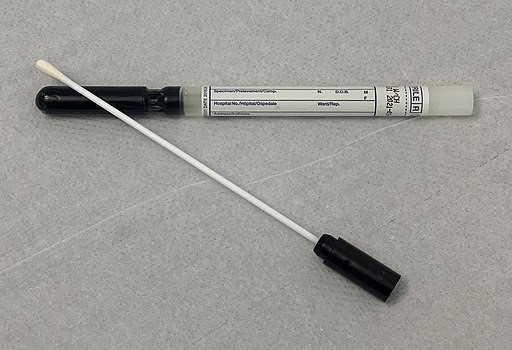
© Whispyhistory, CC BY-SA 4.0, via Wikimedia Commons
Chlamydia can also be detected using samples of urine.
VIH, hépatite B, hépatite C et syphilis are usually tested for using a échantillon de sang which is sent to a laboratory for analysis.
How can I get checked for sexually transmitted infections?
If you have a symptom that you think is due to an STI, or if you have no symptoms but are worried you have caught an STI, you should see a health professional. You can:
See your own GP. Your GP can give advice and may examine you. However, if your GP suspects that you may have an STI, in the UK he or she is likely to refer you to a genitourinary medicine (GUM) clinic. Some GPs may do tests and manage the situation without a referral to a GUM clinic; ou
Go to a GUM clinic directly. You do not need a referral from your GP to go to a GUM clinic; ou
Check to see if you can send your own sample to a laboratory by post. This service may be offered by the NHS to certain age groups, or by private companies via the internet.
Until you are checked out, and treated if necessary, you should not have sex. This is to prevent you passing on any infection.
What are genitourinary medicine clinics?
GUM clinics are special sexual health services in the UK that help people who have, or may have, an STI or certain other problems with their genitals or urine system. Staff in most GUM clinics include doctors, specially trained nurses and sexual health advisors. Many GUM clinics are attached to hospitals but some are based in community settings. Other names that have been given to GUM clinics include STI clinics, STD clinics (STD is short for sexually transmitted disease), VD clinics (VD is short for venereal disease), and sexual health clinics.
Most STIs are diagnosed and treated at GUM clinics. Some people are diagnosed with an STI in another type of clinic - for example, at a GP surgery, or in a family planning clinic. In these situations you are still likely to be referred to a GUM clinic for treatment, and for any follow-up or counselling that may be required.
Anyone can attend a GUM clinic. You do not have to be aged over 16. If you want, you can take a friend or relative with you when you attend. You can go to any GUM clinic - it does not have to be the one nearest to you.
Do I need to make an appointment to attend a genitourinary medicine clinic?
This may vary depending on the clinic. For many, you do not need to forward book an appointment but can just turn up. However, you may have to wait some time to be seen depending on how busy it is. It may be best to give the clinic a call in advance to check if you can just turn up without an appointment, and the times the clinic is open. Some clinics can become quite busy.
How do I find a genitourinary medicine clinic?
If you suspect that you have an STI, then contact your local GUM clinic or see your GP. In the UK you can go to the local GUM clinic without a referral from your GP. You can ring your local hospital or your GP and ask where the nearest clinic is. Local and national information is also available on the internet - for example, from the NHS 'Find a clinic' service - link provided in Further Reading section below.
What can I expect when I attend a genitourinary medicine clinic?
Registration
When you arrive at a clinic you will have to register. You will be asked for your name, address, date of birth, contact telephone number and the name of your GP. This information is treated confidentially. The clinic will not contact you at home or contact your GP without your permission. Also, any records from GUM clinics will not go on your main medical record without your permission.
However, if you have a concern, you do not have to give any details. You can even give a false name. The important thing is that whatever name you do use, you should use the same name for any follow-up appointment, to avoid any confusion; for example, when you return for the result of any tests. To help identify you as the correct person for any follow-up, you will be given a card with your clinic number on it, which you should bring back to any follow-up appointment.
Initial assessment
You will be seen initially by a doctor, a specially trained nurse or a sexual health adviser. They will ask you some questions to try to assess the situation and to determine what tests (if any) you may need. You may find some of the questions quite personal but they are all necessary to ensure the correct diagnosis and treatment are given.
Examples of questions that you may be asked include:
What symptoms and/or concerns do you have?
How many people have you had sex with in the last few weeks and were they male or female?
What type of sex have you had - vaginal, oral, anal?
Have you previously had an STI?
What is the state of your general health?
Do you take any regular medication?
Do you have any allergies?
If you are a woman you may be asked about the date of your last period and whether there is a chance that you may be pregnant, as this might affect treatment options. You may also be asked about whether you have had a test de frottis cervical. This test looks for virus du papillome humain (VPH) which is known to be a major factor in the development of cancer du col de l'utérus. This is sensible as part of a general sexual health check.
After the initial assessment you will be advised what will happen next. You will normally be examined and at the same time some tests may be taken.
What happens during a sexual health examination?
A doctor will usually examine you. You can ask for a male or female doctor, but you may have to return at a different time (or even to a different clinic) if a doctor of a particular sex is not currently available. The examination includes looking carefully at your genitals for signs of unusual discharge, redness, lumps or ulcers. The doctor may also feel the tops of your legs (your groins) to check for enlarged or tender glands called lymph nodes. If necessary, the doctor may also do a general examination to check on your general health.
In women, your doctor may also examine your vagina and womb (uterus) by gently inserting a lubricated, gloved finger.
Men may have their testicles (testes) examined.
How are STI tests done?
After the examination is complete your doctor may also take some tests.
Les femmes
The way in which tests are done can vary from clinic to clinic; the following is a general guide.
After the examination of the outside of the genitals the doctor will ask your permission to insert a speculum. This is a plastic or metal device which is also used to take a cervical smear when screening for cervical cancer. It helps the doctor to see the neck of the womb (the cervix) and allows some samples to be taken.
The doctor will usually warm the speculum if it is metal and cover the tip in lubricating jelly. Once the speculum has been inserted it is slowly opened and held in place by a catch. The doctor will then look closely at the walls of the vagina for any discharge or redness. A swab is usually taken from the vagina and from the cervix. A swab is a small ball of cotton wool on the end of a thin stick, used to collect samples. The doctor will then slowly remove the speculum.
After this has been done a small plastic spatula may be used to take cells from the urethra (the opening which allows urine to pass from the bladder to the outside of the body). This may feel a little scratchy. Depending on the information you have given initially it may also be necessary to take swabs from the back passage (rectum) or the throat. After all the swabs are taken you will be able to get dressed. You may be asked to provide a urine sample.
Hommes
After the examination of the outside of the genitals the doctor will ask for your permission to insert a swab into the urethra. This may feel a little uncomfortable but most people do not find it painful. Depending on the information you have given initially it may also be necessary to take swabs from the rectum or the throat.
If there is any possibility of infections that may affect the rectum, your doctor may ask your permission to examine this area more closely. Sometimes this is done using a proctoscope. This is a small tube, usually made of plastic, that makes it possible to see inside the rectum. After all the swabs are taken you will be able to get dressed. You may be asked to provide a urine sample.
Men and women - blood tests
A sample of blood from a vein may be taken. This is mainly used to test for syphilis, hépatite B, hépatite C et VIH. Sometimes you may be advised to delay having a blood test. For example, following an initial infection of HIV it can take several weeks for a blood test to become positive. So, for example, if within the previous few days you had sex with someone who is HIV-positive, you may be advised to wait several weeks to have a blood test to see if you have become infected.
Sponsorisé
Test de dépistage des IST à domicile Confidante
Confidante est rapide, facile et discret à utiliser, de l'achat aux résultats. Testez 10 IST courantes, y compris les infections qui ne présentent aucun symptôme, pour fournir un profil complet de votre santé sexuelle.

How long do STI test results take?
If you are seen at your GP surgery, the swabs and blood tests will be sent to a laboratory for further testing. Your doctor will advise you about when the test results will be available; this can take up to a fortnight and are usually sent to you via text message.
If you are seen in a GUM clinic some of your results may be available on the same working day of your test.
Your doctor or nurse will take the swabs and smear them on to special slides. This allows him/her to look at the cells taken from the swabs under the microscope. Some germs (bacteria) that cause infections can be seen in the cells you have provided by having swabs done. For example, the bacteria that cause gonorrhoea can sometimes be identified by looking through a microscope. This may mean you are given a positive result on the day, if you have the infection.
However, even though the bacteria can be detected under the microscope, they are not always seen, even if they are present. To make sure the test result is reliable, the sample you give is put into a special pot. This pot also contains a substance that allows the bacteria to grow. The pot, known as a plate, is then put into an incubator allowing any bacteria present to grow. The plates are then checked to see if any bacteria which cause STIs have grown. It takes a while for the bacteria to grow; this is why you may be asked to check back with the clinic for more results in a few weeks' time. Trichomonas can also be seen under the microscope.
The results of tests for chlamydia and blood tests for syphilis, hepatitis B and hepatitis C are usually not available on the same day.
Some clinics offer same-day HIV testing. This means you get the result of the test on the day your blood sample is taken. Most clinics ask you to make an appointment for this service, as it may only take place at certain times.
The swabs that are taken sometimes show other infections which are not considered to be STIs. This includes bacterial vaginosis and thrush. These infections can also be seen by looking at the samples you give under the microscope.
What about the results from a genitourinary medicine clinic?
After your doctor or nurse has checked your samples they will call you back into the consulting room. They will give you any results available from checking the cells under the microscope.
You will also be advised about how long it should take to get any other test results back to the clinic. Each clinic has a different method of giving test results. Some may ask you to come back or ring the clinic; some work on a 'no news is good news' policy. It is important you understand how you will get your results and that the contact information you give is reliable.
My test results show I have a sexually transmitted infection - what now?
If you have a positive test result for an STI on the day of your attendance at clinic you will be given treatment and advice on the same day. You will also be asked to speak to a sexual health advisor to help trace any of your sexual partners who may have come into contact with the infection.
If the test results come after you have left the clinic you will be given advice about what to do next when you receive your result.
How are sexually transmitted infections treated?
The treatment that you will be offered depends on what STI is found. For example, a short course of antibiotic medicine can usually clear away chlamydia, gonorrhée, syphilis et trichomonas. A cream or lotion can clear pubic lice et gale. Topical treatments can usually clear most verrues anogénitales. Treatments for herpès génital, hepatitis B, hepatitis C, and HIV are more involved and complex. You will be given advice about what treatment options you have and given time to ask questions.
If you are prescribed antibiotics then it is important to finish the full course of tablets, or else the infection may not be fully cleared. If you develop side-effects then seek advice from the GUM clinic or from your GP surgery as to what to do. Do not simply stop taking the medication. For some infections you will be asked to return after a course of treatment to check that the infection has gone.
Remarque: do not have sex again until the time advised by the clinic. Depending on the infection, this may be for a certain length of time after treatment is finished or it may be until you are given the 'all clear' from a repeated test. The aim is to prevent you from passing on the infection to others.
Sélections des patients pour Tests et investigations générales

Tests et investigations
Aspiration à l'aiguille fine
L'aspiration à l'aiguille fine utilise une aiguille fine et creuse pour prélever un échantillon de cellules d'un organe ou d'une masse sous la peau. Les cellules sont ensuite analysées au microscope. Remarque : les informations ci-dessous sont uniquement un guide général. L'organisation et la manière dont les tests sont effectués peuvent varier d'un hôpital à l'autre. Suivez toujours les instructions données par votre médecin ou votre hôpital local.
par le Dr Roger Henderson, MBBS

Tests et investigations
Spirométrie
La spirométrie est un test qui peut aider à diagnostiquer diverses affections pulmonaires, le plus souvent la maladie pulmonaire obstructive chronique (MPOC). La spirométrie peut également être utilisée pour surveiller la gravité de certaines autres affections pulmonaires et leur réponse au traitement. Bien que la spirométrie soit très utile pour aider à diagnostiquer certaines affections et à surveiller leur traitement, un test de spirométrie normal n'exclut pas nécessairement certaines formes de maladies pulmonaires, car il peut y avoir des périodes où les tests de spirométrie peuvent être normaux même lorsqu'une affection pulmonaire existe, comme l'asthme. Remarque : les informations ci-dessous ne sont qu'un guide général. Les dispositions et la manière dont les tests sont effectués peuvent varier entre différents hôpitaux. Suivez toujours les instructions données par votre médecin ou votre hôpital local.
par Dr Colin Tidy, MRCGP
Questions fréquemment posées
Can I be tested for other infections that are not STIs at a GUM clinic?
Yes, a test kit with a swab sample used for STI testing can also detect infections like thrush, bacterial vaginosis, and various other germs (bacteria) that are not considered STIs. If these non-STI infections are found, you will be given results and advice. However, if the results for such things are available same day, not all treatments for non-STI infections are given on the spot; some are referred and processed on the same timeframe as non-urgent STI results.
If I am pregnant, will this affect my STI treatment options?
Yes, if you are a woman, the healthcare professional will ask about the date of your last period and if there is a chance you may be pregnant. This information is important because it might affect the treatment options available to you for any sexually transmitted infection. It is important to disclose this information to ensure you receive appropriate and safe care.
What is the purpose of asking about my cervical smear test history during an STI check?
When attending a GUM clinic, you may be asked if you've had a cervical smear test. This test looks for human papillomavirus (HPV), which is a key factor in the development of cervical cancer. This question is considered a sensible part of a general sexual health check-up, even though HPV is an STI, it will be discussed with you as part of your overall health. If you are offered a smear test, it is your choice to either have one or decline it.
Can I request a male or female doctor for my examination at a GUM clinic?
Yes, you can ask for a male or female doctor for your examination. However, depending on availability, you may need to return at a different time or even go to a different clinic if a doctor of your preferred sex is not currently available. It's best to discuss this when you register or make an inquiry.
Why would I be advised to delay a blood test for certain STIs?
For some infections, like HIV, it can take several weeks after the initial infection for a blood test to show a positive result. If you've had recent sexual contact with someone who is HIV-positive, for example, you might be advised to wait several weeks before having a blood test to ensure accurate results. This 'window period' is important for reliable testing outcomes.
What is the 'no news is good news' policy some clinics use for test results?
Some GUM clinics operate on a 'no news is good news' policy regarding test results. This means that if you do not hear back from the clinic within a certain timeframe, your test results are negative for the infections tested. It is crucial to understand if your clinic uses this policy and how you will be informed if your results are positive, and to ensure the contact information you provide is reliable.
Why would I be asked to check back with the clinic for more results weeks after my initial visit?
Some STI tests, especially those involving culturing bacteria, require time for any present bacteria to grow sufficiently in a laboratory setting to be detected reliably. While some initial results might be available sooner from a microscope examination, a follow-up check ensures the most accurate diagnosis for certain infections like gonorrhoea or trichomonas. It’s why you might be asked to return in a few weeks for comprehensive results.
If I'm prescribed antibiotics for an STI, is it important to complete the entire course?
Yes, if you are prescribed antibiotics for an STI, it is very important to finish the full course of tablets as instructed. If you stop taking the medication early, the infection may not be fully cleared, potentially leading to treatment failure. If you experience side-effects, you should seek advice from the GUM clinic or your GP surgery rather than simply stopping the medication.
Lectures complémentaires et références
- Infections Sexuellement Transmissibles en Soins Primaires; Collège Royal des Médecins Généralistes et Association Britannique pour la Santé Sexuelle et le VIH (avr. 2013)
- BASHH Clinical Effectiveness Group Guidelines; British Association for Sexual Health and HIV
- Trouvez une clinique de santé sexuelle près de chez vous; Services du NHS
À propos de l'auteur

Dr Rachel Hoad-Robson
À propos du critiqueVoir la biographie complète

Dr Krishna Vakharia, MRCGP
Médecin-chef pour la santé, Optum UK
MBChB, MRCGP(2013), BMedSci (hons), DFSRH, DRCOG, PGDipDerm (Distn)
Le Dr Krishna Vakharia est un médecin généraliste du NHS. Elle est également examinatrice régulière pour le diplôme de troisième cycle en dermatologie pratique à l'Université de Cardiff, ainsi que médecin-chef pour la santé chez Optum UK.
Historique de l'article
Les informations sur cette page sont rédigées et examinées par des cliniciens qualifiés.
Article également disponible en Anglais, Allemand, Espagnol, Français, Italien, Portugais, Hindi, Hébreu, Arabe, and Suédois.
Prochaine révision prévue : 29 janv. 2028
30 janv. 2023 | Dernière version
26 May 2010 | Publié à l'origine
Écrit par :
Dr Rachel Hoad-Robson

Demandez, partagez, connectez-vous.
Parcourez les discussions, posez des questions et partagez vos expériences sur des centaines de sujets de santé.

Vous ne vous sentez pas bien ?
Évaluez vos symptômes en ligne gratuitement
Inscrivez-vous à la newsletter Patient
Votre dose hebdomadaire de conseils de santé clairs et fiables - rédigés pour vous aider à vous sentir informé, confiant et maître de la situation.
En vous abonnant, vous acceptez notre Politique de confidentialité. Vous pouvez vous désabonner à tout moment. Nous ne vendons jamais vos données.
Plus dans les tests et enquêtes
- Amniocentèse
- Gaz du sang artériel
- Cathétérisme cardiaque
- Électroencéphalographe
- Aspiration à l'aiguille transbronchique guidée par échographie endobronchique
- Échographie endoscopique
- Scintigraphie au gallium
- Tests auditifs
- Urographie intraveineuse
- Tests de fonction hépatique
- Ponction lombaire
- Scintigraphie de perfusion myocardique
- Test auditif néonatal
- Osmolalité, osmolarité et homéostasie des fluides
- Test épicutané pour la dermatite de contact
- Test sanguin de routine pour la fonction rénale
- Test de sperme
- Spirométrie
- Thalassémie
- Scintigraphies thyroïdiennes et tests d'absorption