Problèmes courants du col de l'utérus
Revu par des pairs par Dr Surangi Mendis, MRCGPDernière mise à jour par Dr Toni Hazell, FRCGPDernière mise à jour 17 sept. 2024
Conforme aux directives éditoriales
- TéléchargerTélécharger
- Partager
- Language
- Discussion
- Version audio
- Ajouter aux sources préférées sur Google
There are many different conditions that can affect the neck of the womb (cervix), ranging from mild inflammation to cervical cancer. Some conditions affecting the cervix are more common than others; some are more serious than others. They can all cause different symptoms, such as abnormal bleeding or discharge from your vagina, or may not cause any symptoms at all.
Some conditions are normal and do not need any treatment. The type of treatment, if needed, will depend on the underlying condition. Your doctor will be able to discuss the most appropriate treatment for you.
En un coup d'œil
Les problèmes affectant le col de l'utérus peuvent inclure l'ectropion cervical, les kystes de Naboth et les infections.
Les symptômes peuvent inclure des douleurs dans le bas-ventre, des saignements vaginaux anormaux et des douleurs pendant les rapports sexuels.
Certaines femmes peuvent ne présenter aucun symptôme, avec des problèmes détectés lors d'un test de frottis cervical.
Les infections sont une cause fréquente de problèmes cervicaux, y compris les infections sexuellement transmissibles (IST).
De nombreux problèmes cervicaux peuvent être diagnostiqués par un examen, parfois avec des prélèvements ou une biopsie.
Une colposcopie peut être réalisée si un test de frottis cervical montre des changements cellulaires.
Uterus and cervix
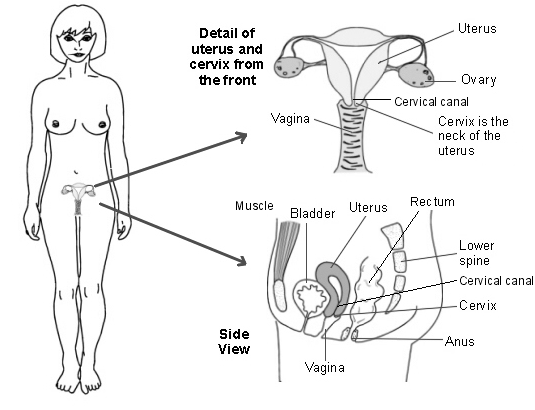
Problems affecting the cervix
Endométriose. This can also affect the uterus, fallopian tubes and other sites in the pelvis and around the body.
Cervical ectropion. Cervical ectropion (or erosion) is a harmless change. It is related to oestrogen and is therefore more common in young women, pregnant women and those taking combined oral contraceptive pills. It may cause increased vaginal discharge or bleeding. If an ectropion is causing no symptoms it does not need treating, but if a healthcare professional is not sure that what they are seeing is definitely an ectropion they may refer you for a further opinion to be sure. An ectropion which is causing symptoms can be safely treated with a burning technique (cautery), using an electrical current (diathermy). This treatment is under local anaesthetic (when you are awake).
Nabothian cysts. Nabothian cysts are tiny cysts that form on the surface of the neck of the womb (cervix). They are fairly common and do not usually cause any symptoms. They do not usually need any treatment, but if a healthcare professional is not sure that what they are seeing is definitely a Nabothian cyst, they may refer you for a further opinion to be sure.
Infections.
Polyps of the cervix (cervical polyps). A polyp is a small growth which arises from a stalk on either the surface or the inside of the neck of your womb (cervix). They are not usually cancerous, although very rarely they can be due to cancer. For this reason, any polyp which is removed must be sent to the lab to check that it is benign (not caused by cancer).
Symptoms of common cervical problems
The symptoms you may experience will depend on the underlying condition. Some women will not have any symptoms at all. A problem with the neck of the womb (cervix) may be detected by the doctor or nurse who is examining them for another reason. For example, when a test de frottis cervical is taken.
Symptoms may include:
Abnormal vaginal bleeding. For example, bleeding after having sex (intercourse) or bleeding in between your periods.
Diagnosing cervical problems
Most conditions that affect your cervix can be diagnosed by examining you. However, it is sometimes necessary for other tests to be undertaken. For example:
Internal swabs may be taken by your GP or in a hospital clinic. A swab is a small ball of cotton wool on the end of a thin stick. It can be gently rubbed on your cervix to obtain samples.
A biopsy may be carried out. In this procedure, done in hospital, a small sample of tissue is taken from a lump. The sample can then be examined under a microscope in the laboratory.
Other tests may also be carried out, depending on your symptoms. These tests may include blood tests and an ultrasound of your womb and ovaries.
Colposcopy is a test to look at your cervix in more detail. A colposcopy is often done if your cervical smear test finds any changes to the cells of your cervix. See also the separate leaflet called Colposcopy and cervical treatments.
Causes of problems affecting the cervix
Infections are caused by germs such as bacteria and viruses and lead to inflammation of the neck of the womb (cervix). Inflammation of your cervix is called cervicitis. The most common symptom in women with cervicitis is vaginal discharge. Other symptoms can include pain on passing urine, lower tummy (abdominal) pain and bleeding in between periods.
Infections sexuellement transmissibles
Infections of your cervix are usually caught through having sex. The most common infections sexuellement transmissibles (IST) which affect the cervix are:
Human papilloma virus
Human papillomavirus (HPV) is transmitted by sex but is not thought of in the same way as other STIs. 80% of people who are sexually active will get HPV at some point in their life, and their body may clear it naturally. No treatment is needed and you do not need to tell their partner or suggest that they are tested, as you would do with any other STI.
Some types of HPV can lead to changes in the cells of the cervix; 99.7% of all cervical cancer is linked to HPV. The NHS cervical screening programme now has a different process to in the past - the process is as follows:
The sample is tested for HPV - if this is negative, it is discarded and you go back to normal recall (three or five years depending on your age and the country of the UK in which you live, one year if you have HIV).
If the HPV test is positive then your sample is examined under the microscope (cytology), where abnormal cells (called squamous or glandular cells) may be found.
If the cytology shows abnormalities then you will be referred to a colposcopy clinic.
If the cytology is normal then you will have another smear in one year. If this happens three years in a row (positive HPV test but negative cytology) then you will also be referred to a colposcopy clinic.
Vaginose bactérienne
Vaginose bactérienne is not an STI, but can cause a smelly discharge - typically described as a fishy smell. It is caused by an overgrowth of normal germs in your vagina and is usually treated with antibiotics.
Other causes of inflammation of the cervix
Inflammation of the neck of the womb (cervix), called cervicitis, can also be caused by other conditions. These include:
Allergies - for, example to condoms or to spermicides.
Irritation - for example, from tampons, particularly if one is left in for a long time.
Radiothérapie - cervicitis can be a side-effect of radiotherapy which is used to treat some cancers.
Symptoms of cervicitis include discharge, bleeding between the periods or after sex, and pelvic pain.
For cervicitis not caused by infections, there is usually no treatment. They settle when the cause is removed.
See the links for further information about endometriosis and cancer of the cervix.
Sélections des patients pour Cervix and uterus problems

Santé des femmes
Prolapsus des organes pelviens
The organs inside a woman's pelvis include the womb (uterus), the bladder and the back passage (rectum). Normally, these are supported and held in position by certain structures including ligaments and the muscles at the bottom of the pelvis (pelvic floor muscles). Pelvic organ prolapse (also known as genitourinary prolapse) occurs when these normal support structures are weakened and are no longer effective. The result is that one (or more) of the organs inside the pelvis drops down (prolapses). The space available for the organ(s) to drop down into is the vagina. There can be different degrees of prolapse, depending on how much, or how far, the organ(s) might have dropped down into the vagina. Sometimes, the prolapse can be so much that it causes the walls of the vagina, or the uterus, or both, to protrude outside the opening of the vagina.
par Dr Toni Hazell, FRCGP

Santé des femmes
Fibromes
A fibroid is a non-cancerous (benign) growth of the womb (uterus). They are also called uterine myomas, fibromyomas or leiomyomas. Their size can vary. Some are the same size as a pea and some can be as big as a melon. Fibroids are common and usually cause no symptoms. However, they can sometimes cause heavy periods, tummy (abdominal) swelling and urinary problems.
par Dr Colin Tidy, MRCGP
Questions fréquemment posées
Quelle est la fonction du col de l'utérus ?
L'article se réfère au col de l'utérus comme le 'cou de l'utérus'. Bien qu'il ne décrive pas ses fonctions spécifiques, sa localisation suggère qu'il relie l'utérus au vagin, jouant un rôle dans la reproduction et la menstruation.
Les kystes de Naboth doivent-ils parfois être retirés ?
Les kystes de Naboth ne nécessitent généralement aucun traitement car ils ne provoquent généralement pas de symptômes. Cependant, si un professionnel de santé a des doutes sur le diagnostic, il peut vous orienter vers une évaluation plus approfondie pour s'assurer qu'il s'agit bien d'un kyste de Naboth.
Les polypes cervicaux peuvent-ils revenir après avoir été enlevés ?
L'article indique que les polypes cervicaux sont de petites excroissances provenant d'une tige à la surface ou à l'intérieur du col de l'utérus. Il mentionne qu'ils ne sont généralement pas cancéreux et sont envoyés à un laboratoire pour confirmer qu'ils sont bénins après leur retrait. Cependant, il ne précise pas s'ils peuvent réapparaître.
Quels sont les symptômes courants propres à la cervicite ?
La cervicite, qui est une inflammation du col de l'utérus, provoque couramment des pertes vaginales. D'autres symptômes peuvent inclure des douleurs lors de la miction, des douleurs abdominales basses et des saignements entre les règles ou après les rapports sexuels. Ces symptômes peuvent également se chevaucher avec d'autres problèmes cervicaux.
Si mon frottis cervical est positif pour le VPH mais ne montre pas de cellules anormales, quelle est la prochaine étape ?
Si votre test HPV est positif mais que la cytologie (examen des cellules au microscope) est normale, on vous demandera de passer un autre test de frottis dans un an. Si vous avez un test HPV positif mais une cytologie normale trois années de suite, vous serez alors orienté vers une clinique de colposcopie.
La vaginose bactérienne est-elle considérée comme une infection sexuellement transmissible ?
Non, la vaginose bactérienne n'est pas une IST. Elle est causée par une prolifération de bactéries normales déjà présentes dans votre vagin et entraîne souvent des pertes avec une odeur de poisson caractéristique. Elle est généralement traitée avec des antibiotiques.
Que se passe-t-il si un ectropion provoque des symptômes ?
Si un ectropion provoque des symptômes tels qu'une augmentation des pertes vaginales ou des saignements, il peut être traité en toute sécurité. Le traitement implique une technique de brûlure appelée cautérisation, qui utilise un courant électrique (diathermie), et est réalisée sous anesthésie locale pendant que vous êtes éveillée.
Lectures complémentaires et références
- Casey PM, Long ME, Marnach ML; Abnormal cervical appearance: what to do, when to worry? Mayo Clin Proc. 2011 Feb;86(2):147-50; quiz 151. doi: 10.4065/mcp.2010.0512. Epub 2011 Jan 26.
- CKS Cervical cancer and HPV; NICE CKS, février 2022 (accès réservé au Royaume-Uni)
- Dépistage du col de l'utérus; NICE CKS, septembre 2022 (accès réservé au Royaume-Uni)
- Chlamydia - génitale non compliquée; NICE CKS, avril 2022 (accès réservé au Royaume-Uni)
- Gonorrhée; NICE CKS, mars 2024 (accès réservé au Royaume-Uni)
- Endométriose; NICE CKS, novembre 2024 (accès réservé au Royaume-Uni)
À propos de l'auteurVoir la biographie complète

Dr Louise Newson, MRCGP
BSc (Hons) Pathology, MB, ChB (Hons), MRCP, MRCGP, DFFP, FRCGP
Louise a obtenu son diplôme de l'Université de Manchester en 1994 et est médecin généraliste et experte en ménopause à Solihull, West Midlands.
À propos du critiqueVoir la biographie complète

Dr Surangi Mendis, MRCGP
Consultant et Auteur Médical
MBBS, BSc (1st), MRCGP (2014), DFSRH, PGcert otology and audiology
Surangi Mendis est consultante en médecine audiovestibulaire et neuro-otologie aux hôpitaux Royal National ENT et Eastman Dental, UCLH.
Historique de l'article
Les informations sur cette page sont rédigées et examinées par des cliniciens qualifiés.
Article également disponible en Anglais, Allemand, Espagnol, Français, Italien, Portugais, Hindi, Hébreu, Arabe, and Suédois.
Prochaine révision prévue : 16 sept. 2027
17 sept. 2024 | Dernière version
8 mai 2015 | Publié à l'origine
Écrit par :
Dr Louise Newson, MRCGP

Demandez, partagez, connectez-vous.
Parcourez les discussions, posez des questions et partagez vos expériences sur des centaines de sujets de santé.

Vous ne vous sentez pas bien ?
Évaluez vos symptômes en ligne gratuitement
Inscrivez-vous à la newsletter Patient
Votre dose hebdomadaire de conseils de santé clairs et fiables - rédigés pour vous aider à vous sentir informé, confiant et maître de la situation.
En vous abonnant, vous acceptez notre Politique de confidentialité. Vous pouvez vous désabonner à tout moment. Nous ne vendons jamais vos données.
Plus sur la santé des femmes
- Méthodes de contraception barrières
- Contraception pour les femmes de plus de 40 ans
- Méthodes de contraception
- Anneau vaginal contraceptif
- Cystite chez les femmes
- Fibromes
- Dispositif intra-utérin au lévonorgestrel
- Migraine et contraception hormonale combinée
- Maladie inflammatoire pelvienne
- Prolapsus des organes pelviens
- Douleur menstruelle
- Règles et problèmes menstruels
- Dépression postnatale
- Endométrite du post-partum
- Psychose post-partum
- Grossesse et activité physique
- Bébés prématurés
- Pilule contraceptive uniquement progestative
- Cystite récurrente chez les femmes
- Infection urinaire pendant la grossesse