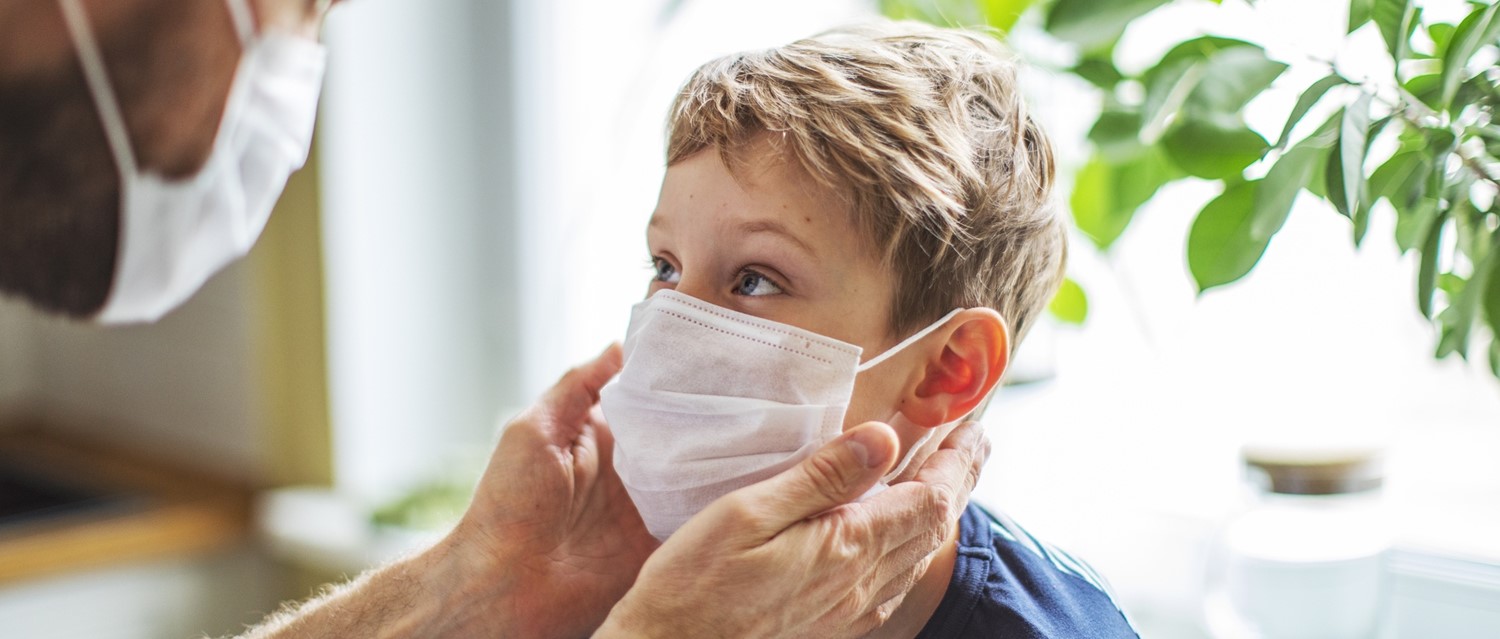
Conseils pour aider vos enfants à s'habituer aux masques et couvre-visages
Revu par Dr Sarah JarvisDernière mise à jour par Gillian HarveyDernière mise à jour 7 Oct 2020
Respecte les directives éditoriales
- TéléchargerTélécharger
- Partager
- Language
- Discussion
- Version audio
- Ajouter aux sources préférées sur Google
Comme de nombreuses écoles exigent désormais que les élèves de plus de 11 ans portent des masques dans certaines situations, beaucoup de nos enfants porteront un masque pour la première fois. Mais comment les masques doivent-ils être portés ? Et comment pouvons-nous aider nos enfants à les utiliser efficacement ?
Face masks have become a regular sight for all of us, whether we're popping to the shops, using public transport or going to a GP appointment. But wearing a face covering is still unfamiliar to most of us. To kids it can feel even more alien, but they're mandatory in certain situations for over-13s in Irlande du Nord, over-11s in Angleterre et Pays de Galles and over-5s in Écosse. That's why it's important to take the time to get them comfortable with their masks, so they're more likely to wear one properly.
Explain why
Children will have been exposed to information about masks and coronavirus from a variety of sources - some reliable, others less so. It's important that your child understands the reasons masks have been recommended or made compulsory, and the situations in which they are effective.
It's also advisable to remind children that, although they must try their best to follow the instructions for using and wearing their mask as well as they can, they must not panic if they make a mistake - for example, touching their mask while wearing. Children need to understand that masks help as part of a collective effort and that even the best intentioned adults have made the odd error when wearing one - especially for the first time.
Ensure comfort
As your child is likely to be wearing their mask for extended periods of time, it's important that you ensure their mask is comfortable. Geraldine Joaquim, a radiologist used to wearing masks on a regular basis, suggests you get your child to try out their mask in a non-school setting to get used to how it feels.
"Although masks might be comfortable to wear initially, it's important to make sure the banding is comfortable when worn for longer periods," she says. "If necessary, you can purchase special clips to put underneath the elastic to make the mask more comfortable."
Joaquim feels that 30 minutes should be sufficient to ensure comfort. "Doing something while you're wearing it to distract you could be helpful," she says.
Adequate coverage
We've all seen people walking around with their masks covering their mouth and not their nose. While wearers may have the best of intentions, this is not an effective way to wear a mask. In order to prepare our children effectively, it's important that we explain the coverage they should aim for.
"Your mask should rest quite high on your nose - many have an adaptable fitting that will enable you to mould that part of the mask to the bridge of your nose - and should finish under your chin for maximum effectiveness," explains Val Edwards-Jones, Professor of Medical Microbiology who has recently developed her own range of protective masks. She also advises that parents check there are no large gaps at the sides by adjusting the elastic fittings.
Anxiété
If your child deals with anxiety or is worried about wearing a mask, it's important to ensure them that, while the mask may feel a bit 'stuffy' at times, masks of this kind do not affect oxygen levels in the blood.
Joaquim, who also works as a hypnotherapist, suggests that if anxiety begins to rise, a breathing exercise may help. "Go somewhere where you can safely remove your mask," she advises. "Take two minutes to do some deep breathing. Breathe in for a count of five, hold it for a count of five and breathe out for a count of seven. Doing this ten times will help to slow your breathing down and help you feel better."
Hands off!
When we're wearing something new - particularly on our face - it is natural to want to touch and adjust it. However, it's important we explain to children that they must not touch their mask unless absolutely necessary. It may take children a while to adjust to wearing their mask, so if they do handle their mask, make sure they know to wash their hands afterwards.
La Organisation mondiale de la Santé (OMS) also advises that fabric masks be placed in a sealed container if it is not possible to wash them immediately on removal, so try to furnish your child with a sealable plastic bag or other suitable container.
Mask-free moments
In England, face coverings are actively discouraged inside the classroom on the basis that they '... can have a negative impact on learning and teaching and so their use in the classroom should be avoided'. In Scotland the advice is that 'face coverings will not generally be necessary in the classroom'. But secondary school children will be moving between classrooms (face coverings are mandatory in corridors) much more than their younger counterparts, so they will have to get used to taking them off and putting them back on. It's important to explain to your child that masks need to be removed properly to ensure protection from potential contamination.
"Don't pull at the front of the mask," advises Edwards-Jones. "Instead, loop your fingers into the ear elastic and take it off that way." Edwards-Jones also advises not pulling the mask down under the chin, as this is likely to cause the front of the mask (where potentially blocked viral particles may rest) to make contact with the skin of the face.
It's also crucial that children understand they must wash hands or use antibacterial gel after removing or touching their mask and before touching their face. And, remind your child that if they do remove their mask and need to put it back on, to make sure they store it somewhere clean and - when reattaching - ensure it is the same way around as before.
Take a spare
The effectiveness of your mask will deteriorate during the day as your breath makes the mask moist. It's important, if possible, to change the mask during the day if you've been wearing it for a long period. "Change your mask as regularly as possible," advises Dr Stephen Griffin, Chair of the Virus Division of the Microbiology Society. "If you can, children should take 2 or 3 to use per day."
If this is not practical, Griffin advises that we should at least wear a clean mask every day.
Cleaning and disposing
Although it's possible to chuck reusable masks in the washing machine, the World Health Organization advises they be washed at "highest permitted washing temperature" to ensure that any viral particles on the mask are destroyed. Check with the manufacturer about recommended temperatures before your first wash. If hot water is not permitted, WHO recommends washing with soap and cleansing with 0.1% chlorine, ensuring the mask is thoroughly rinsed afterwards.
Fabric masks will deteriorate over time, and many manufacturers recommend we renew our mask after a certain number of washes. Whilst there is no definitive answer to how many washes a fabric mask can endure, make sure you dispose of your mask within the time recommended by the manufacturer, or if the mask becomes ill-fitting or feels loose. It's important to ask your child if their mask feels OK, and whether they have any problems with it.
In an ideal (and pandemic-free) world, it would clearly be better if children didn't have to wear masks at all. But with the right preparation we can ensure our kids experience minimal discomfort and maximum protection for themselves and others.
Sélections des patients pour articles sur la pandémie
COVID-19
Assouplissement du confinement : quel est le plan et est-il réaliste ?
Après une année entière de confinements successifs et nos vies bouleversées, c'est un soulagement pour beaucoup d'entendre le gouvernement annoncer ses plans pour assouplir les restrictions liées au COVID-19 au cours des prochains mois. Mais sont-ils réalistes ?
par Milly Evans
COVID-19
19 juillet : rester en sécurité alors que les restrictions COVID-19 s'assouplissent
Malgré le relâchement des restrictions le 19 juillet, nous ne sommes pas encore sortis d'affaire. Avec une augmentation du nombre de cas de coronavirus, nous devons tous faire notre part pour nous protéger et protéger les autres contre la COVID-19.
par Milly Evans
À propos de l'auteurVoir la biographie complète

Gillian Harvey
Rédacteur Indépendant
Licence (Hons) en Anglais
Gillian est une écrivaine indépendante et chroniqueuse pour divers journaux et magazines nationaux.
À propos du critiqueVoir la biographie complète

Dr Sarah Jarvis
Consultant Clinique
MA (Cantab), BM, BCh (Oxon), DRCOG, FRCGP, MBE
Après avoir suivi une formation en médecine à Cambridge et Oxford, le Dr Sarah Jarvis MBE est devenue médecin généraliste.
Historique de l'article
Les informations sur cette page sont examinées par des cliniciens qualifiés.
Article également disponible en Anglais, Allemand, Espagnol, Français, Italien, Portugais, Hindi, Hébreu, Arabe, and Suédois.
7 Oct 2020 | Dernière version

Demandez, partagez, connectez-vous.
Parcourez les discussions, posez des questions et partagez vos expériences sur des centaines de sujets de santé.

Vous ne vous sentez pas bien ?
Évaluez vos symptômes en ligne gratuitement
Inscrivez-vous à la newsletter Patient
Votre dose hebdomadaire de conseils de santé clairs et fiables - rédigés pour vous aider à vous sentir informé, confiant et maître de la situation.
En vous abonnant, vous acceptez notre Politique de confidentialité. Vous pouvez vous désabonner à tout moment. Nous ne vendons jamais vos données.
Plus sur la COVID-19
- Sommes-nous prêts pour une autre pandémie ?
- COVID-19 : Les confinements peuvent-ils changer nos personnalités ?
- COVID-19 : Devez-vous annuler vos plans de Noël à cause d'Omicron ?
- Comment aider votre enfant à s'adapter à un monde post-COVID
- Comment maintenir un mode de vie sain pendant le confinement
- Comment rester en bonne santé en travaillant à domicile
- Tester et tracer : comment ça fonctionne ?
- L'avenir des vaccinations contre la COVID-19
- Conseils pour reprendre votre routine d'exercice après le confinement
- Quelles sont les dernières règles concernant les masques faciaux au Royaume-Uni ?
- Quelles sont les options de traitement du COVID à domicile ?
- Quels sont les symptômes de la variante Pirola du COVID-19 ?
- Ce que nous savons sur les nouveaux variants COVID-19 Eris et Pirola
- Pourquoi il est normal de se sentir anxieux face à un avenir post-COVID
- Aurons-nous besoin d'un rappel de vaccin COVID-19 chaque année ?