Signes et symptômes précoces de la grossesse
Revu par Dr Krishna Vakharia, MRCGPDernière mise à jour par Dr Colin Tidy, MRCGPDernière mise à jour 18 mai 2023
Respecte les directives éditoriales
- TéléchargerTélécharger
- Partager
- Language
- Discussion
- Ask Patient
- Version audio
- Ajouter aux sources préférées sur Google
Pregnancy tests are very sensitive so it is common to find out that you are pregnant before you develop any signs or symptoms of pregnancy. However, as your pregnancy continues you may experience these early symptoms and signs of pregnancy.
For further advice about having a healthy pregnancy, see also the leaflet Prévoir de devenir enceinte, which includes information about prenatal vitamin recommendations.
En un coup d'œil
Early pregnancy signs vary greatly between women, with some having severe symptoms and others few.
Les signes précoces courants incluent la fatigue, les mictions fréquentes, la constipation, la sensibilité des seins et les nausées.
Certaines femmes peuvent ressentir des saignements légers ou des pertes de sang autour de la période d'un retard de règles.
Vous pouvez ressentir des symptômes de grossesse avant un retard de règles, tels que des crampes ou des sautes d'humeur.
Des symptômes similaires peuvent survenir sans être enceinte, par exemple, avant une période ou en raison d'un traitement de fertilité.
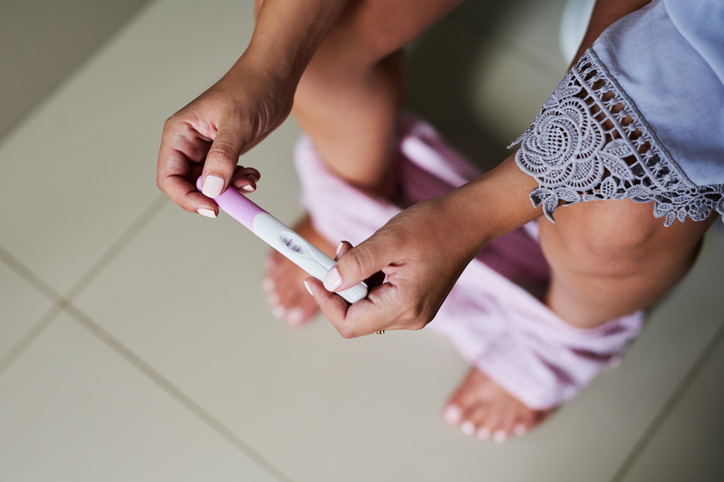
A home pregnancy test confirms pregnancy by detecting the beta-hCG hormone in your urine.
Contactez votre médecin ou sage-femme une fois que votre grossesse est confirmée.
Inscrivez-vous à notre cours gratuit de 8 semaines sur la grossesse en santé !
Chaque semaine, nous partagerons des informations utiles et des conseils essentiels sur des sujets tels que la nutrition, l'exercice, la santé mentale, les symptômes à surveiller et la préparation à l'accouchement, pour vous aider à naviguer dans votre parcours de grossesse, quel que soit le stade où vous en êtes.
En vous abonnant, vous acceptez notre Politique de confidentialité. Vous pouvez vous désabonner à tout moment. Nous ne vendons jamais vos données.
Quels sont les premiers signes de grossesse ?
The signs of early pregnancy vary tremendously between women. Some women hardly have any symptoms, whereas others have very severe symptoms. It is impossible to predict which women will have more severe symptoms. However, in general, if you are expecting twins or triplets then it is likely that your symptoms will be more severe.
Fatigue
Extrême fatigue is often the most common sign of an early pregnancy. Although it is common to become more tired in the later stages of pregnancy, this extreme tiredness and lack of energy (lethargy) usually last for the first twelve weeks (first trimester). The symptoms usually then improve.
Frequent urination
You may notice that you need to pass urine more frequently than you used to. This is actually due to the effect of the beta-hCG hormone which makes your kidneys work harder to produce more urine. This is different to the reason you will need to pass urine more often in the later stages of pregnancy, which is due to the baby's head pressing on your bladder.
Remarque: if you experience any burning, stinging or a high temperature (fever) with these urinary symptoms, contact your doctor or midwife. Urine infections are common when you are pregnant. Your doctor or midwife will arrange to test your urine for an infection.
See the separate leaflet called Urine Infection in Pregnancy for more information.
Constipation and bloating
Constipation is more common in the early stages of pregnancy. This is due to the chemical (hormone) progesterone making your bowel more relaxed and sluggish. It is important to have a healthy diet throughout your pregnancy.
If you do become constipated then you should eat more foods with lots of fibre in them, like wholemeal bread, fruit and vegetables. Make sure you are drinking enough fluids, especially water.
Breast tenderness
Another very early sign of pregnancy is breast tenderness. You may find that just the water from your shower on your breasts makes them feel uncomfortable and very tender. You may also find that you wake in the night when you roll on to your front because your breasts are tender.
Your breasts may tingle at times or even have stabbing pains in them. You may also notice that you may have swollen breasts or breasts become bigger over the first few weeks of pregnancy. As your pregnancy develops it is common to notice some veins under the surface of your skin over your breasts. This is entirely normal.
After a few weeks you may notice that the coloured skin around your nipples (the areolae) becomes darker.
Morning sickness and dizziness (nausea)
Although most women think that feeling sick is the first sign of being pregnant, it is more common to develop other symptoms first. Feeling sick usually starts around the sixth week of your pregnancy. It is more common to experience feeling sick only in the mornings. However, you may find that this feeling continues throughout the afternoons and even into the evenings.
This can, however, vary between pregnancies in the same woman as well as between different women. You may find that you are being sick (vomiting) as well as feeling sick. The amount, frequency and time of the day really do vary between women and can also be different (worse or better) in later pregnancies.
This sickness is commonly referred to as morning sickness. It is more common to experience feeling sick only in the mornings. However, you may find that this feeling continues throughout the afternoons and even into the evenings.
See the separate leaflet called Morning Sickness in Pregnancy for more information.
Food cravings and aversions
You may find that you crave certain foods during your pregnancy or even go off some foods (food aversions). Some women experience a metallic taste in their mouth.
Smell sensitivity
You are likely to have a heightened sense of smell during your early pregnancy. This may make any feelings of sickness that you have worse.
Mood swings and irritability
The changes in hormone levels in early pregnancy may make you have more mood swings and feel irritable than usual.
Spotting and missed period
Although this has always been the most obvious sign of pregnancy, many women now find out they are pregnant before they miss their first period.
Many women may have a light period with small amount of bleeding (spotting) at the time of their missed period. This is sometimes called an 'implantation bleed'. It happens when the fertilised egg attaches and fixes itself (implants itself) in the wall of your womb (uterus). It is harmless.
However, if you have any spotting or heavy bleeding when you are pregnant then you should let your doctor or midwife know. In some cases further tests (for example, a scan) are necessary. This is because bleeding can sometimes be a sign of a miscarriage.
See the separate leaflet called Miscarriage and Bleeding in Early Pregnancy for more information.
Less commonly it can be the first symptom of an ectopic pregnancy. 'Ectopic' refers to a pregnancy which occurs outside the womb.
See the separate leaflet called Ectopic Pregnancy for more information.
Brûlures d'estomac
Indigestion (dyspepsia) is common in pregnancy and is often due to acid reflux from the stomach into the gullet (oesophagus). See also the leaflet called Indigestion and Acid Reflux in Pregnancy.
Cramping
It is common to have cramps that feel lime menstrual cramps.
Cramps in the legs are also common in pregnancy. They occur in late pregnancy and are usually worse at night. Massaging the affected leg and elevation of the foot of the bed may help. Always see a midwife or doctor if you are concerned, particularly as leg pain and swelling may be caused by a thrombose veineuse profonde.
Raised body temperature
It is normal to have a body temperature that is slightly above your normal body temperature (basal body temperature) when you're pregnant. However an abnormally high or low body temperature could also be a sign of an illness, especially if you feel generally unwell or have any other symptoms. It's also very important to avoid overheating during hot weather or when you exercise.
Prise de poids
It is normal to put on 10-16 kg in weight during your pregnancy. The weight gain is mainly due to your baby growing, but your body also stores more fat during pregnancy. Too much or too little weight gain during pregnancy can lead to health problems for you or your unborn baby.
You should see your midwife or doctor if you have any concerns. It is essential that you eat a régime alimentaire sain during your pregnancy.
Pregnancy glow or acne (skin changes)
Pregnancy often causes skin changes due to rising hormone levels and increasing blood flow. Pregnancy hormonal changes may promote healthier skin, hair and nails, and pregnancy is often associated with a healthy glow. But pregnancy can also cause skin problems such as l'acné, unwanted hair growth, hair thinning, skin pigmentation, spider veins and stretch marks.
Congestion
Pregnancy can cause nasal congestion, which is sometimes called pregnancy rhinitis. The lining of your nose may also swell, causing further nasal obstruction.
Increased heart rate
An increased heart rate is common during pregnancy. During the first few months of pregnancy (first trimester), it is normal for your heartbeat to increase by around 15 or 20 beats per minute.
When can early signs of pregnancy start?
If you have a regular monthly menstrual cycle, the earliest and most reliable sign of pregnancy is a missed period. The time of your first missed period is usually about 2 weeks after conception, which is when the sperm fertilizes the egg.
Early pregnancy symptoms, such as morning sickness, usually start when you’re about 4-6 weeks pregnant. The number of weeks of your pregnancy is usually taken from the first day of your last menstrual period.
Can you feel pregnant before you miss your period?
Although a missed period is often the first sign of pregnancy, other symptoms may occur before the missed period. These include:
A small amount of bleeding (spotting).
Écoulement vaginal: The discharge is usually thin, clear or milky white, and doesn't have an unpleasant smell.
Cramping, which may feel similar to menstrual cramps.
Breast changes: your breasts tend to feel full and become sore, swollen, tingly, and tender. The area around the nipple (areola) may get darker.
Morning sickness.
Food cravings or aversions.
Raised body temperature can be an early signifier of pregnancy as well.
Feeling very tired.
Sautes d'humeur.
An urge to urinate more often.
Constipation.
Vertiges and fainting may be caused when blood pressure and blood sugar levels fall.
Can you experience pregnancy symptoms and not be pregnant?
It's not uncommon to experience pregnancy symptoms without being pregnant. Similar symptoms may occur before a period (premenstrual), at the time of ovulation, or as a side effect of medicines used in fertility treatments.
The symptoms may also occur if you want to be pregnant so badly that you focus on any change so much that you convince yourself you are pregnant, even though you're not.
How do I know I am pregnant?
If you're experiencing early signs of pregnancy then the next thing to do is a home pregnancy test to confirm it. These are are available from chemists and supermarkets and are very sensitive. They test for the presence of a hormone called beta human chorionic gonadotrophin (beta-hCG) in your urine. Beta-hCG is produced by your body when an egg (which has been fertilised by a sperm) attaches and fixes itself (implants itself) into the wall of your womb (uterus).
Different makes of pregnancy tests vary in how sensitive they are. The more sensitive ones can become positive only a few days after conception. However, a negative test does not mean that you are not pregnant; it may just mean that the levels of this hormone are not high enough to be detected by the test.
As pregnancy tests vary in how you use them, it is important to read the instructions carefully before you do the test.
If your first pregnancy test is negative but you think you may be pregnant then you should repeat the pregnancy test one week later. If you have a positive pregnancy test, this does not need to be repeated by a doctor or a midwife.
What should I do when I find out that I am pregnant?
Once your pregnancy has been confirmed by a pregnancy test then you should contact your doctor's surgery. They will arrange for you to see your doctor or midwife. Usually you will be seen by a midwife at around twelve weeks of your pregnancy. They will see you at your surgery, at a children's centre or at home. It is rare nowadays to have to go to a hospital to see a midwife.
It is important to have a healthy lifestyle during your pregnancy. This includes healthy eating and taking folic acid and vitamin D supplements.
See the separate leaflet called Diet and Lifestyle during Pregnancy for more details.
Sélections des patients pour General pregnancy information
Grossesse
Infertilité
L'infertilité signifie des difficultés à concevoir naturellement (tomber enceinte) malgré des rapports sexuels réguliers non protégés lorsque vous n'utilisez pas de contraception. Il n'existe pas de seuil précis pour déterminer quand un couple est infertile. Beaucoup de couples mettent plusieurs mois à concevoir. Environ 84 couples sur 100 conçoivent en un an d'essais. Environ 92 couples sur 100 conçoivent en deux ans. Autrement dit, environ 1 couple sur 7 ne conçoit pas en un an d'essais. Cependant, plus de la moitié de ces couples concevront au cours de l'année suivante, sans traitement. Les médecins recommandent généralement certains examens si un couple n'a pas conçu après un an, malgré des rapports sexuels réguliers. Des tests ou un traitement peuvent commencer plus tôt si la femme est plus âgée, ou s'il existe une raison évidente pour laquelle un couple particulier ne concevra pas, quelle que soit la durée de leurs essais. Il est généralement conseillé de consulter votre médecin si vous n'avez pas conçu après un an d'essais. Un médecin peut rechercher certaines causes courantes, en discuter avec vous et évoquer les options possibles. Vous pouvez également consulter votre médecin plus tôt si la femme du couple a plus de 36 ans ou si l'un des partenaires a des antécédents de problèmes de fertilité, ou une condition comme l'endométriose ou le syndrome des ovaires polykystiques, qui sont connues pour être liées à des problèmes de fertilité.
par Dr Toni Hazell, FRCGP

Grossesse
Prévoir de devenir enceinte
Cette brochure offre des conseils aux femmes qui envisagent de tomber enceintes. L'objectif est de planifier à l'avance pour réduire le risque de tout dommage pour le bébé et de complications pendant la grossesse. Les femmes sous traitement régulier ou souffrant d'une maladie chronique peuvent avoir besoin de consulter un médecin pour discuter des éventuels changements à apporter. Cela doit idéalement être fait avant la grossesse. Un résumé sous forme de liste de contrôle est disponible à la fin de la brochure.
par Dr Philippa Vincent, MRCGP
Questions fréquemment posées
Puis-je faire confiance à un test de grossesse à domicile si mes règles sont en retard mais que le test est négatif ?
Si vous manquez vos règles et que votre premier test de grossesse à domicile est négatif, il est possible que les niveaux d'hormones détectables par le test ne soient pas encore suffisamment élevés. Il est recommandé de répéter le test de grossesse une semaine plus tard si vous pensez toujours être enceinte. Différents tests ont des sensibilités variées, alors lisez attentivement les instructions.
Que dois-je faire immédiatement après un test de grossesse positif à domicile ?
Une fois qu'un test de grossesse à domicile confirme que vous êtes enceinte, vous devriez contacter le cabinet de votre médecin. Ils organiseront pour vous une consultation avec un médecin ou une sage-femme, généralement vers la 12e semaine de votre grossesse. Ce rendez-vous peut avoir lieu dans votre cabinet, dans un centre pour enfants ou à domicile.
Pourquoi est-il important d'adopter un mode de vie sain pendant la grossesse ?
Maintenir un mode de vie sain est crucial pendant la grossesse. Cela inclut de manger une alimentation équilibrée et de prendre des suppléments recommandés comme l'acide folique et la vitamine D. Votre médecin ou sage-femme peut vous fournir des conseils plus détaillés sur l'alimentation et le mode de vie pendant cette période.
Des changements cutanés peuvent-ils survenir pendant la grossesse ?
Oui, la grossesse entraîne souvent divers changements cutanés. Ceux-ci peuvent survenir en raison des fluctuations des niveaux hormonaux et de l'augmentation du flux sanguin. Alors que certaines femmes ressentent un 'éclat de grossesse' avec une peau, des cheveux et des ongles plus sains, d'autres peuvent développer des problèmes tels que l'acné, une croissance accrue des cheveux, un amincissement des cheveux, des changements de pigmentation de la peau, des varicosités ou des vergetures.
Est-il normal de ressentir une congestion nasale en début de grossesse ?
Oui, la congestion nasale est un symptôme courant pendant la grossesse, parfois appelée 'rhinite de grossesse.' La muqueuse de votre nez peut gonfler, entraînant une sensation de nez bouché ou encombré.
Lectures complémentaires et références
- Al-Memar M, Vaulet T, Fourie H, et al; Early-pregnancy events and subsequent antenatal, delivery and neonatal outcomes: prospective cohort study. Ultrasound Obstet Gynecol. 2019 Oct;54(4):530-537. doi: 10.1002/uog.20262.
- Soins prénatals; Recommandations NICE (août 2021)
- Soins prénatals - grossesse sans complications; NICE CKS, janvier 2025 (accès réservé au Royaume-Uni)
À propos de l'auteurVoir la biographie complète
Mis à jour par

Dr Colin Tidy, MRCGP
Médecin généraliste, Auteur médical
MBBS, MRCGP, MRCP (Paediatrics), DCH
Le Dr Colin Tidy est un médecin du NHS, basé dans l'Oxfordshire.
À propos du critiqueVoir la biographie complète

Dr Krishna Vakharia, MRCGP
Médecin-chef pour la santé, Optum UK
MBChB, MRCGP(2013), BMedSci (hons), DFSRH, DRCOG, PGDipDerm (Distn)
Le Dr Krishna Vakharia est un médecin généraliste du NHS. Elle est également examinatrice régulière pour le diplôme de troisième cycle en dermatologie pratique à l'Université de Cardiff, ainsi que médecin-chef pour la santé chez Optum UK.
Historique de l'article
Article également disponible en Anglais, Allemand, Espagnol, Français, Italien, Portugais, Hindi, Hébreu, Arabe, and Suédois.
Prochaine révision prévue : 12 mai 2028
18 mai 2023 | Dernière version
Partagez vos pensées ou expériences avec les autres dans notre communautés de patients.
Accès simple à des traitements fiables et à des services de santé en ligne.
Common conditions
Get help with common conditions through the NHS, without a GP appointment.





Inscrivez-vous à la newsletter Patient
Votre dose hebdomadaire de conseils de santé clairs et fiables - rédigés pour vous aider à vous sentir informé, confiant et maître de la situation.
En vous abonnant, vous acceptez notre Politique de confidentialité. Vous pouvez vous désabonner à tout moment. Nous ne vendons jamais vos données.