Vertiges
Revu par des pairs par Dr Philippa Vincent, MRCGPDernière mise à jour par Dr Doug McKechnie, MRCGPDernière mise à jour 7 oct. 2024
Respecte les directives éditoriales
- TéléchargerTélécharger
- Partager
- Language
- Discussion
- Version audio
- Ajouter aux sources préférées sur Google
Dans cette série :VertigeNévrite vestibulaire et labyrinthiteVertige positionnel paroxystique béninÉvanouissementPrévention des chutes chez les personnes âgées
Le vertige est une sensation d'instabilité. Les gens utilisent le mot 'vertige' pour désigner différentes sensations - la distinction la plus importante est entre la sensation de tête légère et la sensation de rotation qui est médicalement connue sous le nom de vertige. Ce dépliant donne un aperçu des causes des vertiges. Il existe des dépliants séparés et plus détaillés pour certaines des conditions énumérées.
En un coup d'œil
Le vertige décrit des sensations telles que se sentir faible, étourdi ou instable.
Il peut inclure des vertiges (une sensation de rotation), une sensation de tête légère ou une perte d'équilibre.
Les causes varient, allant de problèmes d'oreille interne et d'hypotension à l'anxiété ou aux effets secondaires des médicaments.
Consultez un médecin pour des étourdissements récurrents ou si vous avez d'autres symptômes comme des maux de tête ou une faiblesse.
Les tests peuvent inclure des contrôles de la pression artérielle, des examens des oreilles ou des scanners.
Le traitement dépend de la cause, et certains types de vertiges se résolvent d'eux-mêmes.
Qu'est-ce que le vertige ?
Qu'est-ce que le vertige ?
Dizziness is a term used to describe a range of sensations, such as feeling faint, weak or unsteady. People use "feeling dizzy" to mean different things. It's usually used to describe one of the following sensations:
Vertige, which is a feeling of spinning around, or feeling like everything is spinning around you.
Feeling faint or light-headed, as if about to pass out or collapse.
Loss of normal balance, ie being unsteady but without feeling faint or whirly.
Sometimes, people have a symptom of 'dizziness' that doesn't clearly fit into any of these categories, which can be difficult to diagnose.
Vertigo (a spinning sensation) is usually a problem of the inner ear or brain. It may be due to infection or nerve problems. Balance issues without dizziness may be due to pression artérielle basse, anxiety, nerve problems and heart issues. It is important to consult your doctor to investigate the problem. Feeling faint or light-headed has a variety of causes, which are sometimes related to the heart, but it can also be a normal reaction for example if you are out on a hot day and haven't eaten or drunk anything.
What causes dizziness?
Vertigo, feeling faint or light-headed, and feeling unsteady all have very different causes, which is why healthcare professionals try to work out which of these symptoms people are feeling when they describe 'dizziness'.
If you feel faint or light-headed, then conditions originating anywhere in your body may be the cause. For example:
Avoir un température élevée (fièvre).
Very hot weather.
Side-effects of certain medicines.
Attaques de panique and anxiety.
Problems with your heart rate - for example, your heart going too fast, too slow or not regularly.
Low iron levels (and other causes of anaemia).
A drop in your blood pressure when you stand up (orthostatic hypotension).
If you have vertigo, ie you feel as if you or the world around you is spinning or moving, then the most common causes are inner ear problems.
Other causes of vertigo include:
Inner ear infections, such as labyrinthitis or vestibular neuritis.
Benign paroxysmal positional vertigo (BPPV), a condition where certain movements of your head set off a spinning sensation.
Certain types of AVC.
Feeling unsteady ('disequilibrium') can have many different causes, such as:
Ageing. Older people often develop problems with their balance, which is usually due to a combination of different problems, like those listed below.
Inner ear problems, such as labyrinthitis or vestibular neuritis.
Head injuries.
Some medications, particularly ones that cause drowsiness.
Alcohol use.
Problems affecting the brain, such as a AVC, ou sclérose en plaques.
Common causes of dizziness
The following things are common causes of feeling lightheaded, or like you're about to faint.
Hypotension orthostatique
This means your blood pressure drops when you sit up from lying, or when you stand up from sitting or lying, in particular if you jump up out of bed after a night's sleep.
This causes people to feel light-headed and as if they are about to faint or collapse after standing up. Sometimes, people go on to faint and lose consciousness briefly.
The fall in blood pressure is just for a short time as the blood pressure quickly adjusts to your new posture. However, in some people the fainting feeling can be more severe and last for a few minutes.
This problem tends to get more troublesome as you become older. It has also been associated with brochure sur le COVID long.
Anémie
Symptom of l'anémie include tiredness and shortness of breath. However, if you have anaemia you may not get sufficient oxygen to the brain. This can make you feel light-headed.
Arrhythmias and other heart problems
An arrhythmia is an abnormal heart rhythm. It occurs when the heart may suddenly beat too fast, too slowly, or in an abnormal way. There are various causes.
One of the symptoms of an arrhythmia is to feel faint or light-headed as there may be a sudden decrease in blood supply to the brain as the arrhythmia develops. See the separate leaflet called Abnormal heart rhythms (Arrhythmias) for more details.
Various other heart disorders may cause a reduced flow of blood to the brain and cause you to feel faint or light-headed.
Anxiété
In particular, if you have l'anxiété avec attaques de panique you can feel light-headed. This can get worse if you over-breathe (hyperventilate) due to the anxiety or panic attack.
Médication
Feeling faint and/or light-headed is sometimes a side-effect of some medicines. It is always worth reading the information leaflet that comes in the drug packet to check if dizziness is a recognised side-effect.
And if you mean the type of dizziness where you don't feel you or the room are spinning and you don't feel faint, but you just feel unbalanced, then there are yet more possible causes.
These also can start from problems of various body organs and systems, such as your ear, your brain, your nervous system and your general state of health. Alcohol, street drugs and various medicines can also make you feel off-balance, and affect different people differently.
Should I worry about dizziness?
Dizziness due to a temporary infection is usually not harmful. See your doctor if you have:
Acouphènes (ringing or pulsing in ears, particularly if only in one ear).
Visual and hearing loss.
Loss of consciousness or memory.
Maux de tête, worsening or worse when lying down.
Headache, worse when coughing.
Numbness, movement or speech problems.
Irregular, slow or fast pulse.
If you are getting recurring dizzy spells, or a constant dizziness for which there is no obvious cause, then see your doctor. If you have dizziness with other alarming symptoms (such as sudden weakness in your arms, legs or face muscles, or chest pain or feeling very breathless), then call an ambulance or consult a doctor urgently.
Complications of dizziness
The complications will depend on the type of dizziness and the cause.
Dizziness can sometimes cause people to fall and injure themselves. This is a particular problem in older people.
When do I need to see a doctor for dizziness?
It is usually best to have an explanation for dizziness. If you have a prolonged episode of dizziness, or recurring episodes of dizziness and are not sure what is causing them, then it is wise to contact a doctor. In particular, if you have other symptoms in addition to the dizziness, such as:
Headache, especially if it is severe, or a different kind of headache to ones you usually get.
Hearing or visual loss.
Problems with speech.
Weakness of arms or legs.
Difficulty walking.
Collapse, or periods of unconsciousness.
Numbness in areas of your body.
Douleur thoracique.
An abnormally slow or fast pulse.
An irregular pulse.
Any other symptom that you cannot explain.
If any of these symptoms have come on suddenly, contact a doctor immediately. Dizziness associated with a loss of consciousness that occurs during exercise needs urgent medical attention.
What tests are done for dizziness?
A doctor is likely to examine you. Sometimes the doctor can tell you the cause of the dizziness from your symptoms and the result of the examination.
In some cases, various tests may be organised to find the cause of the dizziness. These might include:
Taking your temperature.
Examining your ear.
Examining your eyes and their movements.
Checking your pulse and blood pressure.
Checking your balance and co-ordination.
Looking for any weakness in the muscles of your arms, legs or face.
Tests which look for dizziness in certain positions or position changes.
Depending on what has been established from the above, further tests might be relevant. These will differ depending on which diagnosis is suspected, but might include:
Des hearing test.
Des test sanguin - for example, to test you for anaemia.
Des imagerie par résonance magnétique (IRM) ou un tomodensitométrie (TDM).
Specialist tests for inner ear function and balance.
Heart tests: a tracé cardiaque (électrocardiogramme, ou ECG), a échographie cardiaque (échocardiogramme) or a heart monitor.
Dizziness treatment
The treatment depends on the cause. Your doctor will be able to advise you regarding this. It will entirely depend on the type of dizziness and what has caused it. For example:
Labyrinthitis usually improves on its own over time.
Benign paroxysmal positional vertigo (BPPV) can be cured by a series of manoeuvres involving tilting your head in certain ways to move debris in the semicircular canals of the inner ear. You can do these at home - an example is in the further reading section of this leaflet.
Dizziness caused by a problem with the heart rhythm or rate is treated by putting the heart rate right - for example, by medicines, a pacemaker or a procedure done directly on the heart.
Dizziness caused by medication is usually easily solved by reducing the dose of, changing or stopping the medicine in question.
Dizziness due to panic attacks or anxiety is solved by treating these conditions directly with talking treatments or medicines. Examples of possible treatments include la thérapie cognitivo-comportementale, beta-blocker medicines or antidepressant medicines.
Médicaments
Sometimes you need a medicine for the symptom of dizziness. This might be while you wait for it to get better (for example, labyrinthitis) or while you are waiting for tests to find out the cause, or because you have a condition which can't easily be cured.
For the vertigo type of dizziness, tablets called prochlorpérazine ou cinnarizine are often prescribed. These do not cure the underlying problem but they help you feel better until it goes away. These do not work so well for the light-headed/faint type of dizziness or for loss of balance.
Can dizziness be prevented?
Staying well hydrated and not leaving too long between meals can help prevent some types of light-headedness, but as dizziness has so many different meanings and causes, it isn't correct to say that it can always be prevented.
What is meant by dizziness due to balance problems?
In this type of dizziness you do not have vertigo and are not light-headed or feeling faint. However, you feel unsteady on your feet and feel as if you may fall over when you walk, due to unsteadiness.
How do we keep our balance?
Your brain constantly receives nerve messages from various parts of the body to tell you where you are and what position you are in. The three main sources of these nerve messages are:
Your eyes - what you look at helps your brain to tell what position you are in and how you are moving.
Nerve messages from your skin, muscles and joints help your brain to tell the positions of your arms, legs and other parts of your body.
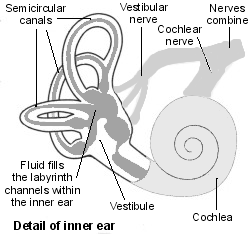
Your inner ears. The inner ear includes the cochlea, vestibule and the labyrinth. The cochlea is concerned with hearing. The three semicircular canals help to control balance and posture. Head movements are sensed because when moving your head, the fluid in the labyrinth within the semicircular canals moves too. The movement of the fluid moves tiny fine hairs that are on the inside lining of the labyrinth. When the hairs move, this triggers messages to be sent to the brain via a nerve called the vestibular nerve. This gives the brain information about the movement and position of your head, even when your eyes are closed.
Coupe transversale de l'oreille
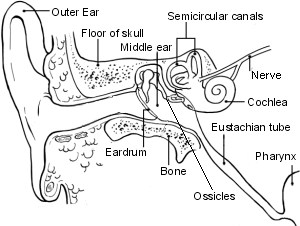
Diagramme de l'oreille interne
To be free of dizziness and to have good balance, it is best to have all of these (eyes, nerve signals from the skin muscles and joints, and inner ears) working normally.
What can cause loss of balance?
This can be caused by various conditions. These include the following.
Ear problems
Some inner ear conditions can cause balance problems without the spinning sensation of vertigo - for example, an inner ear injury.
Troubles nerveux
Various disorders which cause the nerves in the legs not to work properly can cause unsteadiness. For example, neuropathie périphérique, sclérose en plaques, etc.
Brain disorders
Various problems in the brain, such as a AVC, or a tumeur cérébrale, can cause balance problems. These occur if the affected part of the brain is a part that helps to control posture and balance. There will usually be other symptoms too.
General frailty
General frailty and/or being seriously ill with another illness may lead to loss of balance. You will usually have other symptoms in addition to problems with balance.
Alcohol and drugs
Your balance can be affected by boire trop d'alcool or taking some street drugs.
Sélections des patients pour Vertiges

Signes et symptômes
Évanouissement
Évanouissement est une perte de conscience temporaire qui se produit lorsque le cerveau ne reçoit pas assez d'oxygène en raison d'une réduction du flux sanguin vers le cerveau. Cela survient soudainement, ne dure que peu de temps et vous vous rétablissez complètement en peu de temps. On l'appelle aussi souvent un malaise. Le terme médical est syncope. Ce n'est pas la même chose qu'une crise qui provoque généralement des secousses. Il est important de consulter un médecin si vous faites des malaises. Les évanouissements peuvent être causés par un problème grave. Cependant, cela est inhabituel. Les causes les plus courantes sont mentionnées ci-dessous.
par Dr Colin Tidy, MRCGP

Signes et symptômes
Vertige positionnel paroxystique bénin
Le vertige paroxystique positionnel bénin provoque généralement de courts épisodes de vertiges intenses ou de vertige lorsque la tête est déplacée dans certaines directions. Le vertige est la sensation que vous (ou votre environnement) êtes en mouvement. Cela est souvent décrit comme "la pièce qui tourne autour". Le vertige paroxystique positionnel bénin est supposé être causé par de minuscules fragments solides (otoconies) dans le labyrinthe de l'oreille interne. Dans la plupart des cas, la condition s'améliore d'elle-même après plusieurs semaines. Un traitement simple consistant à déplacer la tête dans diverses positions pendant quelques minutes peut guérir la condition dans de nombreux cas. Ce traitement utilise la gravité pour déplacer les minuscules fragments loin de l'endroit où ils causent des problèmes.
par Dr Philippa Vincent, MRCGP
Questions fréquemment posées
Quelle est la différence entre étourdissement, vertige et instabilité ?
Le vertige est un terme général décrivant des sensations telles que se sentir faible ou instable. Le vertige se réfère spécifiquement à une sensation de rotation, soit de vous-même, soit de votre environnement. L'instabilité, ou le déséquilibre, signifie perdre votre équilibre normal sans nécessairement se sentir faible ou comme si les choses tournaient.
Comment les attaques de panique peuvent-elles provoquer des étourdissements ?
Les attaques de panique, et l'anxiété qui les accompagne, peuvent vous donner des vertiges. Cette sensation peut s'aggraver si vous hyperventilez, ce qui est courant lors d'une attaque de panique.
Certains mouvements ou positions peuvent-ils déclencher des vertiges ?
Oui, des conditions comme le vertige positionnel paroxystique bénin (VPPB) provoquent des sensations de vertige lorsque vous effectuez des mouvements spécifiques de la tête. De plus, une chute de la pression artérielle lorsque vous vous levez (hypotension orthostatique) peut vous donner une sensation de tête légère.
Que signifie le fait de se sentir étourdi sans avoir de vertige ou de sensation de tête légère ?
Si vous vous sentez déséquilibré mais que vous n'avez pas l'impression que vous ou la pièce tournez, et que vous ne vous sentez pas faible, cela est souvent décrit comme un sentiment d'instabilité ou un problème d'équilibre. Cela peut être causé par des problèmes avec votre oreille, votre cerveau, votre système nerveux, votre santé générale, ou même l'alcool et certains médicaments.
Comment les médecins déterminent-ils la cause des vertiges ?
Les médecins essaient de déterminer le type spécifique de vertige que vous ressentez, tel que le vertige, l'évanouissement ou l'instabilité, car chacun a des causes différentes. Ils prendront en compte vos symptômes et effectueront des examens, qui peuvent inclure la vérification de votre température, de vos oreilles, de vos yeux, de votre pouls, de votre tension artérielle et de votre équilibre. Des tests supplémentaires comme des analyses de sang, des scanners ou des tests cardiaques peuvent être effectués en fonction de ce qui est suspecté.
Pourquoi les vertiges peuvent-ils entraîner une chute, surtout chez les personnes âgées ?
Les étourdissements peuvent parfois amener les gens à perdre l'équilibre et à tomber, entraînant des blessures. Cela est particulièrement préoccupant pour les personnes âgées, car elles peuvent déjà avoir des problèmes d'équilibre liés à l'âge qui les rendent plus vulnérables.
Lectures complémentaires et références
- Kaski D, Bronstein AM; Making a diagnosis in patients who present with vertigo. BMJ. 2012 Sep 3;345:e5809. doi: 10.1136/bmj.e5809.
- Post RE, Dickerson LM; Dizziness: a diagnostic approach. Am Fam Physician. 2010 Aug 15;82(4):361-8, 369.
- Huh YE, Kim JS; Bedside evaluation of dizzy patients. J Clin Neurol. 2013 Oct;9(4):203-13. doi: 10.3988/jcn.2013.9.4.203. Epub 2013 Oct 31.
- Kerber KA, Baloh RW; The evaluation of a patient with dizziness. Neurol Clin Pract. 2011 Dec;1(1):24-33.
- Vertige; NICE CKS, décembre 2022 (accès réservé au Royaume-Uni)
- Home treatments of benign paroxysmal positional vertigo (BPPV); Dizziness and balance, 2023
À propos de l'auteurVoir la biographie complète

Dr Doug McKechnie, MRCGP
Rédacteur Médical
MA, MBBS, MSc, DRCOG, MRCP(UK), MRCGP(2021), FHEA
Le Dr Doug McKechnie est un médecin généraliste du NHS travaillant à Londres. Il travaille à plein temps en clinique et est également le chef adjoint du module de Pratique Clinique et Professionnelle à l'École de Médecine de l'University College London.
À propos du critiqueVoir la biographie complète

Dr Philippa Vincent, MRCGP
Médecin généraliste, Auteur médical
MB BS, Bsc, MRCGP (2000), DCH, DFSRH, DRCOG
Dr Philippa Vincent est un médecin généraliste du NHS travaillant dans le nord de Londres.
Historique de l'article
Les informations sur cette page sont rédigées et examinées par des cliniciens qualifiés.
Article également disponible en Anglais, Allemand, Espagnol, Français, Italien, Portugais, Hindi, Hébreu, Arabe, and Suédois.
Prochaine révision prévue : 6 oct. 2027
7 oct. 2024 | Dernière version

Demandez, partagez, connectez-vous.
Parcourez les discussions, posez des questions et partagez vos expériences sur des centaines de sujets de santé.

Vous ne vous sentez pas bien ?
Évaluez vos symptômes en ligne gratuitement
Inscrivez-vous à la newsletter Patient
Votre dose hebdomadaire de conseils de santé clairs et fiables - rédigés pour vous aider à vous sentir informé, confiant et maître de la situation.
En vous abonnant, vous acceptez notre Politique de confidentialité. Vous pouvez vous désabonner à tout moment. Nous ne vendons jamais vos données.
Plus sur les signes et symptômes
- Essoufflement et difficulté à respirer
- Symptômes du cancer
- Bouche sèche
- Mal d'oreille
- Kystes épidermoïdes et pilaires
- Convulsion fébrile
- Surcharge hydrique
- Épaule gelée
- Problèmes de hanche
- genou de la femme de ménage
- Ictère
- Douleur articulaire
- Perte de goût et d'odorat
- Pneumothorax
- Psychose
- Ganglions lymphatiques enflés
- Acouphènes
- Hypothyroïdie
- Sténose urétrale
- Verrues et verrues plantaires