Your essential skin cancer checklist
Peer reviewed by Dr Colin Tidy, MRCGPLast updated by Victoria RawLast updated 3 Jul 2025
Meets Patient’s editorial guidelines
- DownloadDownload
- Share
- Language
- Discussion
- Audio Version
- Add to preferred sources on Google
Skin cancer can kill you, so it's essential to know the signs and get any suspicious skin changes checked out quickly. Here we show what to look for and what to do to try and prevent it happening.
Melanoma skin cancer cases in the UK have reached an all time high, according to Cancer Research UK. There are also more than 230,000 case of non-melanoma skin cancer in the UK each year.
Skin cancer is divided into two groups:
Melanoma cancers.
Non-melanoma cancers.
Melanoma is around 20 times less common than non-melanoma, but far more serious. That's because it's much more likely to spread to other parts of your body.
The two types of non-melanoma cancers are basal cell cancer and squamous cell cancer. They affect more than 200,000 people in the UK every year. Basal cell cancer is the most commonly diagnosed cancer in the UK - if spotted and treated early this presents a very low hazard to your health.
With 20,800 cases in the UK in 2024, melanoma diagnosis is not common, but it is increasing. By 2038-2040, melanoma skin cancer rates in the UK are projected to rise by 9% compared to 2023-2025 levels. While it does affect younger people, it definitely gets more common with age - around one third of people diagnosed are over 75.
The areas of your body most prone to malignant melanomas:
Women - occur most often on your legs, but they can develop on any part of your skin.
Men - most likely to get them on your back or chest, but they can occur anywhere.
It's important to have any new or changing mole with any of the warning signs listed below checked out.
Who's most at risk of melanoma?
Melanoma is a subject close to my heart, because unfortunately I tick all the boxes for having a high chance of developing it. I have red hair - some blondes are more susceptible too - freckles and the sort of pale skin that only has to look at a sun ray to turn red.
What's more, I had several episodes of severe sunburn in childhood, when the highest sun protection factor (SPF) in sun cream that existed was factor 12. Children's skin is particularly sensitive, and melanoma can develop many years after episodes of sunburn in childhood. Frequent or severe sunburn in childhood can lead to a higher likelihood of developing skin cancer in later life.
Your vulnerability to non-melanoma skin cancers largely depends on your lifetime sun exposure.
Numerous non-sun-related factors, including family history, alcohol intake, smoking and taking medicine which suppresses your immune system, can all increase your vulnerability further.
Melanomas, on the other hand, seem to be more closely related to how often you've been burned. Any colouring of your skin is your body's reaction to sun damage, but sunburn is particularly dangerous. People who have naturally dark skin have higher levels of melanin in the skin, which protects against both burning and melanoma.
But sun exposure isn't the only hazard. You're more likely to get a melanoma if other people in your family have it. Of course, this can be partly explained by inheriting pale skin and freckles, but there does seem to be another genetic link too. Around 1 in 10 people who get melanoma have a relative who had it.
Spotting non-melanoma skin cancer
Scalp and face are the most common sites for non-melanoma skin cancers, but like melanomas, they can appear anywhere.
Squamous cell cancers most often start as a pink or red area covered by a crust or scales. As they progress, they can become tender and raised - a bit like a wart - and can ulcerate. The surface is delicate and may bleed easily.
Basal cell cancers usually start with a lump which can be pearly, pink or red. Like squamous cell cancers, basal cell cancers can crust or bleed, but this often takes more time as they tend to grow very slowly. As a rule, they are not painful or tender.
Know your ABCDE
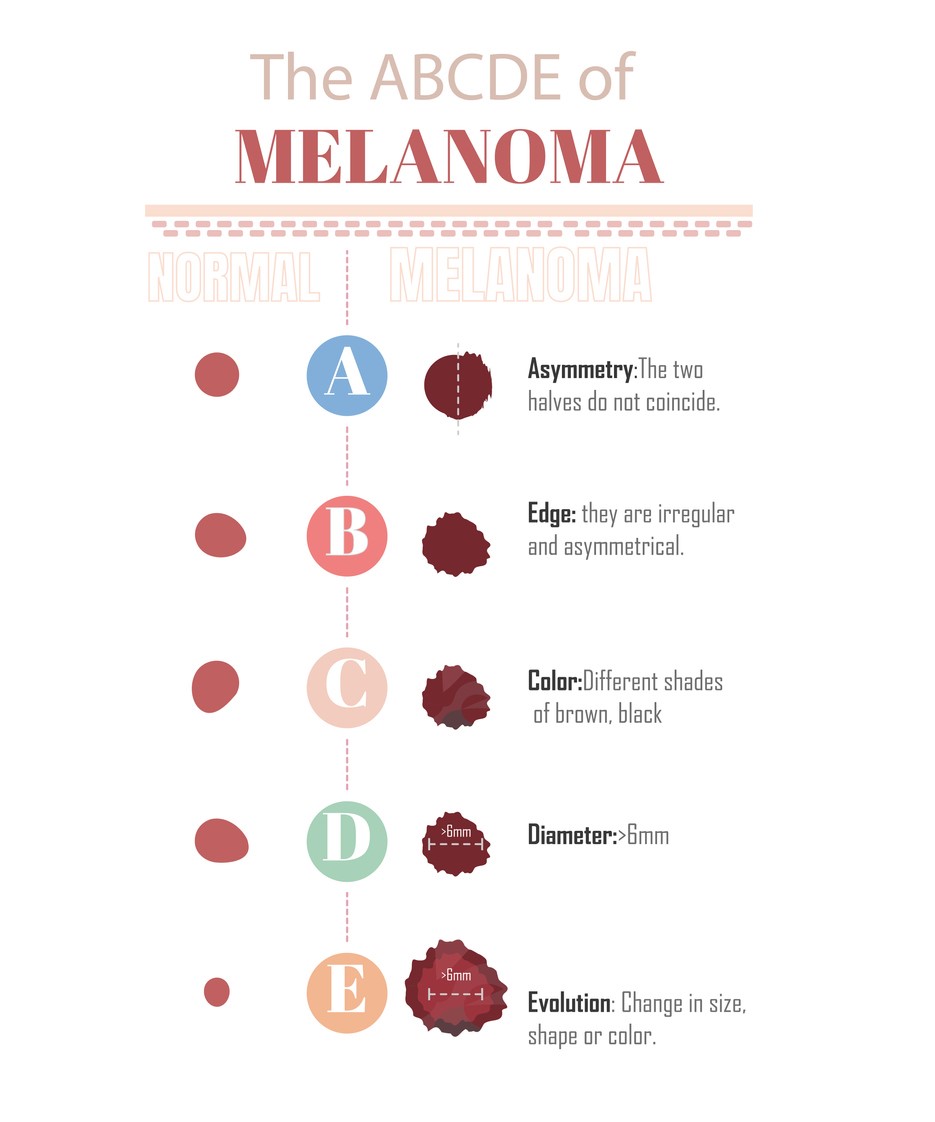
The key to spotting melanoma early is to know your alphabet - or at least your ABCDE. Most melanomas don't develop in an existing mole, but do look out for these changes in an existing mole, as well as any new mole which appears:
Asymmetry - most moles are circular or oval, while melanomas often have an irregular shape.
Border - look for irregular edges, or blurring of the borders so you can't see where the mole ends and normal skin begins.
Colour - a range of colours - browns and black - rather than a single colour.
Diameter - over 6 millimetres across.
Evolution - a quickly changing mole.
ABCDE melanoma
You should also watch out for redness and inflammation, crusting, itching, a change in sensation of the skin, bleeding or oozing.
Protecting yourself against skin cancer
Even if you've had sunburn as a child or have freckled, pale skin, it's never too late to protect yourself against skin cancer. While you need some sun to top up your vitamin D levels, you should always avoid burning, and ideally tanning - this includes sunbeds, which emit UV light.
Covering up with a wide-brimmed hat and shirt - ideally long-sleeved - in bright sunlight will help prevent harm. Sun damage can affect your eyes and you can get melanoma in them - wraparound sunglasses work very well for this. Stay inside when sun is at its strongest between 11 am and 3 pm. And apply high sun protection factor cream - at least factor 30, or factor 50 if you're pale or freckled.
Practice 'slip, slop, slap':
Slip on a shirt.
Slop on sunscreen regularly.
Slap on a hat.
Think pale and interesting - it really is healthier.
Patient picks for Skin cancer

Cancer
Why is skin cancer on the rise among older adults?
The number of people in the UK being diagnosed with skin cancer has hit a record high, with 17,500 cases of melanoma recorded every year1. In particular, there has been a sharp rise in cases among adults over 55. But why is this - and how can you spot the early symptoms of skin cancer?
by Lydia Smith

Skin, nail and hair health
Why it's so important to know your skin type this summer
Do you tan easily? Do you start to go pink as soon as you step out in the sun? Then take a look at the Fitzpatrick scale - a handy tool to assess your skin's sensitivity and help shield your body from burns this summer.
by Heather Ainsworth
About the authorView full bio

Dr Sarah Jarvis
Clinical Consultant
MA (Cantab), BM, BCh (Oxon), DRCOG, FRCGP, MBE
After training in medicine at Cambridge and Oxford, Dr Sarah Jarvis MBE became a GP.
About the reviewerView full bio

Dr Colin Tidy, MRCGP
General Practitioner, Medical Author
MBBS, MRCGP, MRCP (Paediatrics), DCH
Dr Colin Tidy is an NHS Doctor, based in Oxfordshire.
Article history
The information on this page is peer reviewed by qualified clinicians.
Article also available in English, German, Spanish, French, Italian, Portuguese, Hindi, Hebrew, Arabic, and Swedish.
Next review due: 3 Jul 2028
3 Jul 2025 | Latest version
10 Jul 2019 | Originally published
Authored by:
Dr Sarah Jarvis
Join the conversation
Share your thoughts or experiences with others in our patient communities.

Ask, share, connect.
Browse discussions, ask questions, and share experiences across hundreds of health topics.

Feeling unwell?
Assess your symptoms online for free
Sign up to the Patient newsletter
Your weekly dose of clear, trustworthy health advice - written to help you feel informed, confident and in control.
By subscribing you accept our Privacy Policy. You can unsubscribe at any time. We never sell your data.
More in cancer
- Breast cancer videos
- Cancer fatigue: what it is and how to cope
- How to check yourself for testicular cancer
- How to cope with metastatic breast cancer
- How to look after your hair during chemotherapy
- How to spot the signs of mouth cancer
- Ivermectin explained: facts, evidence and common myths
- Just one year of being overweight lowers chances of cancer survival
- Less survivable cancers are more likely to have late diagnoses
- Should you wear sunscreen even when it's cloudy?
- Spotting the signs of ovarian cancer: why acting early matters
- Urine test for prostate cancer could reveal who needs urgent treatment
- What are the common myths and facts about cervical screening?
- What are ultra processed foods and do they cause cancer?
- What is Movember?
- What it's like to have breast cancer when you're a man
- What it's like to live with cancer fatigue
- What not to say to someone who is dying
- Why are Black men more likely to die from prostate cancer?
- Why are men less likely to wear sun cream?