Rupture du tendon d'Achille
Revu par Dr Hayley Willacy, FRCGP Dernière mise à jour par Dr Doug McKechnie, MRCGPDernière mise à jour 31 Jul 2023
Respecte les directives éditoriales
- TéléchargerTélécharger
- Partager
- Language
- Discussion
- Version audio
- Ajouter aux sources préférées sur Google
Dans cette série :Fasciite plantaireTendinopathie d'AchilleMétatarsalgieFractures métatarsiennesNévrome de MortonPieds plats et voûtes plantaires affaissées
Le tendon d'Achille se trouve à l'arrière du talon. Il peut être rompu par une force soudaine sur le pied ou la cheville. Si votre tendon d'Achille est rompu, vous ne pourrez pas vous tenir sur la pointe des pieds et vous aurez une démarche à plat. Il est important de diagnostiquer et de traiter cette blessure dès que possible pour favoriser la guérison. Le traitement implique de porter un plâtre ou une attelle (orthèse) pendant plusieurs semaines, et éventuellement de subir une opération.
En un coup d'œil
An Achilles tendon rupture is a tear in the tendon connecting the calf muscle to the heel bone.
Il provoque souvent un bruit sec, une douleur aiguë, un gonflement et des difficultés à se tenir sur la pointe des pieds.
Elle peut être causée par des poussées de pied vigoureuses, des mouvements brusques du pied vers le haut ou des tendons affaiblis.
Le diagnostic est généralement basé sur les symptômes, l'historique des blessures et l'examen d'un médecin.
Consultez un médecin de toute urgence si vous suspectez une rupture, car un traitement rapide améliore la récupération.
Treatment options include surgery or resting the tendon in a brace or plaster cast.
La récupération peut prendre plusieurs mois, avec de la physiothérapie incluse pour retrouver la force.
What is an Achilles tendon rupture?
Foot and heel pain - Achilles tendon
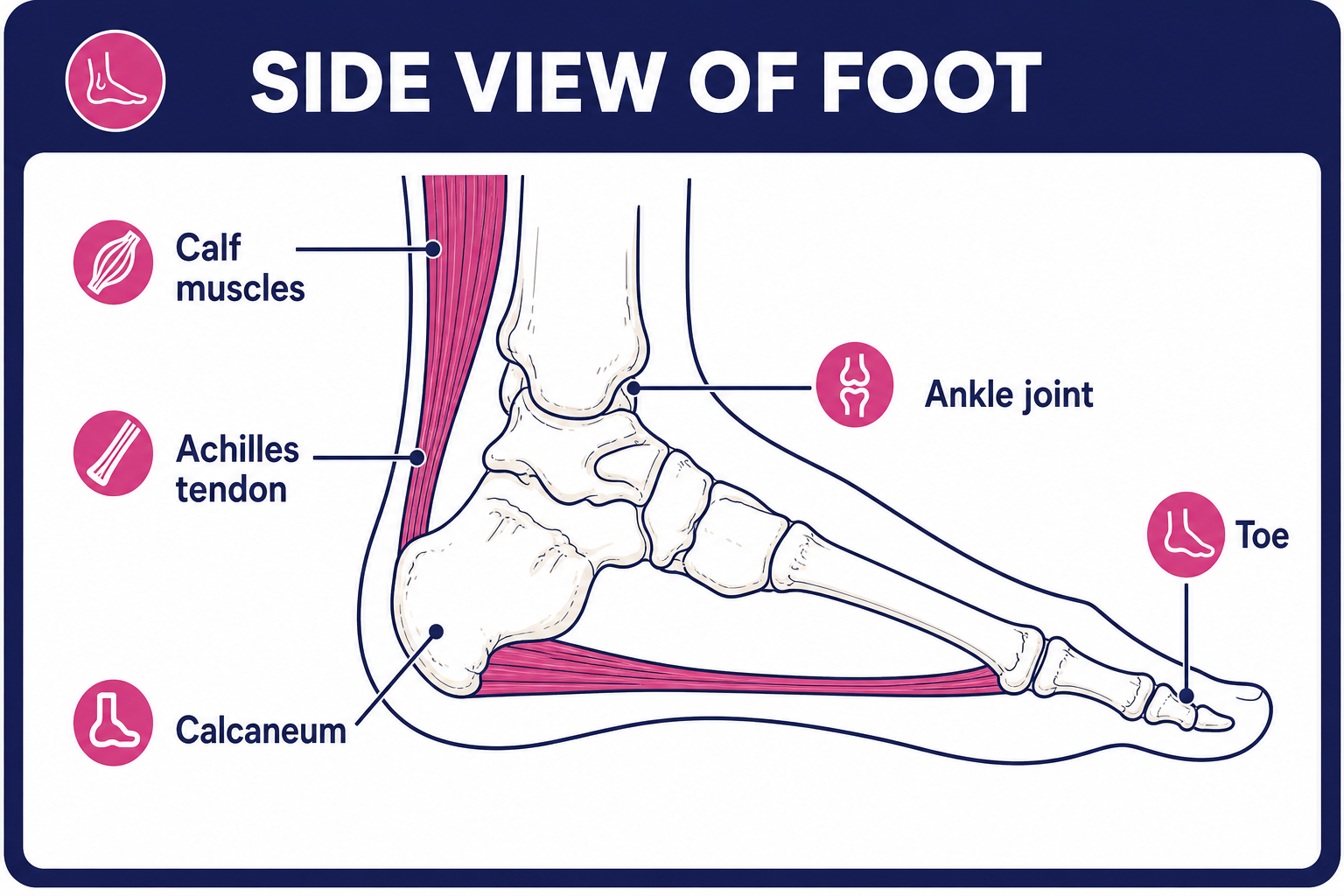
If the Achilles tendon is torn, this is called an Achilles tendon rupture. The tear may be either partial or complete. In a partial tear, the tendon is partly torn but still joined to the calf muscle. With complete tears, the tendon is completely torn so that the connection between the calf muscles and the ankle bone is lost.
The Achilles tendon is an important part of the leg. It is located just behind and above the heel. It connects the calf muscle to the heel bone. Its function is to help in bending the foot downwards at the ankle (this movement is called plantar flexion).
Causes of an Achilles tendon rupture
As with any muscle or tendon in the body, the Achilles tendon can be torn if there is a high force or stress on it. This can happen with activities which involve a forceful push off with the foot - for example, in football, running, jumping, basketball, diving and tennis. The push off movement uses a strong contraction of the calf muscles which can stress the Achilles tendon too much.
The Achilles tendon can also be damaged by injuries such as falls, if the foot is suddenly forced into an upward-pointing position - this movement stretches the tendon. Another possible injury is a deep cut at the back of the ankle, which might go into the tendon.
Sometimes the Achilles tendon is weak, making it more prone to rupture. Factors that weaken the Achilles tendon are:
Corticosteroid medication (such as prednisolone) - mainly if it is used as long-term treatment rather than a short course.
Corticosteroid injection near the Achilles tendon.
Certain rare medical conditions, such as Cushing's syndrome, where the body makes too much of its own corticosteroid hormones. See the separate leaflet called Cushing's Syndrome for more information.
Tendinopathy of the Achilles tendon. See the separate leaflet called Achilles Tendinopathy for more information.
Other medical conditions which can make the tendon more prone to rupture; for example, polyarthrite rhumatoïde, goutte et lupus érythémateux systémique.
Certain antibiotic medicines may slightly increase the risk of having an Achilles tendon rupture. These are the quinolone antibiotics such as ciprofloxacine et ofloxacin. The risk of having an Achilles tendon rupture with these antibiotics is still low and mainly applies if you are also taking corticosteroid medication.
How common is an Achilles tendon rupture?
It affects about 4,500 people a year in the UK, It seem to be becoming more frequent due to more people taking up sport and training more intensely. It can occur at any age but is most common in people between the ages of 30 and 50.
Achilles tendon rupture symptoms
Common symptoms of an Achilles tendon rupture include:
Hearing a snapping sound and feeling a sharp pain when the tendon is torn (ruptured).
Some people describe this as feeling as if they have been kicked in the back of the ankle.
Aching at the back of the lower leg.
Swelling and bruising on your lower leg.
A flat-footed type of walk. You can walk and bear weight but cannot push off the ground properly on the side where the tendon is ruptured.
Inability to stand on tiptoe.
If the tendon is completely torn, you may feel a gap just above the back of the heel. However, if there is bruising then the swelling may disguise the gap.
If you suspect an Achilles tendon rupture, see a doctor urgently because the tendon heals better if treated sooner rather than later.
How is an Achilles tendon rupture diagnosed?
The Achilles tendon tear (rupture) diagnosis is usually made on the basis of symptoms, the history of the injury and a doctor's examination.
The doctor may look at your walking and observe whether you can stand on tiptoe. They may test the tendon using a method called Simmonds-Thompson's test (also known as the calf squeeze test). In this test, you will be asked to lie face down on the examination bench and to bend your knee.
The doctor will gently squeeze the calf muscles at the back of your leg and observe how the ankle moves. If the Achilles tendon is OK, the calf squeeze will make the foot point away from the leg (a movement called plantar flexion). If the tendon is torn, the foot won't move. This is quite an accurate test for Achilles tendon rupture.
If the diagnosis is uncertain, une échographie ou IRM may help.
Remarque: an Achilles tendon rupture is sometimes difficult to diagnose and can be missed on first assessment. It is important for doctors and patients to be aware of this and to look carefully for an Achilles tendon rupture if it is suspected.
Qu'est-ce que cela pourrait être d'autre ?
Similar symptoms can be caused by:
Overuse of the Achilles tendon (Achilles tendinopathy). See the separate leaflet called Achilles Tendinopathy for more information.
A strain or tear of the calf muscles.
A blood clot (thrombosis) of a deep vein in the calf. See the separate leaflet called Deep Vein Thrombosis for more information.
Achilles tendon rupture treatment
This condition should be diagnosed and treated as soon as possible because prompt treatment probably improves recovery. You may need to be referred urgently to see a doctor in an orthopaedic department or A&E department. Meanwhile, if a torn (ruptured) Achilles tendon is suspected, you should not put any weight on that foot, so do not walk on it at all. There are two options for treatment.
Chirurgie
The surgeon sews together the torn ends of the Achilles tendon, and perhaps may also use another tendon or a tendon graft to help with the repair. A plaster cast or brace (orthosis) is needed after the operation. The surgery can be done with a single, larger cut ('open' surgery), or, sometimes, with several small cuts and a tiny camera (called 'minimally invasive' surgery).
Brace or plaster cast
The other option is to allow time for the tendon to heal naturally, resting it in a brace or plaster cast. This is called conservative treatment. If the tendon does not heal on its own, a surgical repair can then be done later.
Both options will involve having a plaster cast or a brace for about eight weeks, to protect the tendon while it heals. The plaster cast or the brace is positioned so that the foot is pointing slightly downwards, which takes the strain off the tendon.
Traditionally, crutches were used to keep weight off the leg during the first few weeks of treatment. Now there is a trend towards using the leg normally early on (early mobilisation and weight bearing). This involves fitting a plaster cast or a brace which you can walk on. It is more convenient because you do not need to use crutches.
Physiotherapy will usually be provided as well to strengthen or stretch your calf muscles.
Which treatment is best?
There is debate as to which treatment is best: surgery or conservative treatment. This section summarises the research into treatment of Achilles tendon rupture.
Most of the research so far found that surgery has one advantage: it reduces the risk that the Achilles tendon will rupture again later (a problem known as re-rupture). The disadvantages of surgery are the risk of complications such as wound infection (see below), and the need for an operation.
For this reason, surgery may be recommended for younger people or those doing sports. Conservative treatment may be suggested for older or less active people and for people wishing to avoid surgery. The choice of treatment depends on individual preference and circumstances. Surgery may also be recommended if there has been a delay in starting treatment.
However, a new piece of research found that surgery and conservative treatment actually gave equally good results, when patients were also given early mobilisation treatment using a brace.
If an operation is needed, there is a type of surgery called percutaneous, which uses smaller cuts than the traditional operation. This seems to reduce the risk of developing a wound infection.
After surgery, a brace seems to be better than a plaster cast in terms of faster recovery and return to normal activities, a lower complication rate and patients preferring it.
Achilles tendon rupture recovery
Depending on the type of work, some people need several weeks off work after an Achilles tendon tear (rupture); the time taken to return to sport is between 4 and 12 months.
Generally, the outlook is good. However, the tendon does take time to heal, usually about six to eight weeks. More time will be needed after this to allow the muscles to regain their normal strength after being in a plaster cast or a brace (orthosis).
Complications
Possible complications during recovery include:
Whichever treatment option is used, there is a chance that the Achilles tendon will not heal fully and further treatment such as surgery may be needed.
Complications of surgery: these are usually minor complications such as a wound infection or reduced sensation near the operation site. About 4 in 100 people develop a wound infection following surgery to fix a ruptured Achilles tendon.
The tendon may scar or may become shorter during the healing process.
There is also a chance that the tendon could become torn again later (re-rupture). According to some research, the risk of a re-rupture is about 4 in 100 with surgical treatment and about 12 in 100 with conservative treatment.
A clot can form in the blood vessels in the leg and this is more common after an Achilles tendon rupture.
Can an Achilles tendon rupture be prevented?
Not always. However, here are some suggestions to help to prevent this injury:
Corticosteroid medication such as prednisolone should be used carefully and the dose should be reduced if possible. But note that there are many conditions where corticosteroid medication is important or life-saving.
Quinolone antibiotics should be used carefully in people aged over 60 or in those taking steroids.
There are also some general measures to help prevent Achilles problems, which may help:
Doing warm-up and cool-down exercises, before and after exercising, including calf stretches.
Maintenir un poids santé. Having overweight or obesity puts extra strain on the Achilles tendon.
Avoiding sudden increases in the amount or intensity of exercise you do. If you're starting a new exercise regime, build up gradually.
Wearing the right footwear. Choose shoes with good heel and arch support. Replace shoes that have worn out.
Avoiding or stopping activities that cause Achilles tendon pain; 'pushing through' usually makes it worse.
Trying to avoid changing your usual running surface; research suggests that many different types of running surface (firm, soft, and uneven) may be linked with different types of strain on the Achilles tendon, but that changing from one type to another may be particularly problematic.
Getting expert advice on exercise technique; for example, from a physiotherapist or running coach.
Maintenir un poids santé. Having overweight or obesity puts extra strain on the Achilles tendon.
Avoiding sudden increases in the amount or intensity of exercise you do. If you're starting a new exercise regime, build up gradually.
Wearing the right footwear. Choose shoes with good heel and arch support. Replace shoes that have worn out.
Avoiding or stopping activities that cause Achilles tendon pain; 'pushing through' usually makes it worse.
Trying to avoid changing your usual running surface; research suggests that many different types of running surface (firm, soft, and uneven) may be linked with different types of strain on the Achilles tendon, but that changing from one type to another may be particularly problematic.
Getting expert advice on exercise technique; for example, from a physiotherapist or running coach.
Sélections des patients pour Douleur au talon et au pied

Soin des pieds
Métatarsalgie
La métatarsalgie est le nom donné à la douleur dans la partie avant du pied sous les têtes des os métatarsiens, également connue sous le nom de plante du pied. La métatarsalgie peut être causée par un certain nombre de conditions différentes affectant le pied. Le traitement dépendra de la cause sous-jacente. Des mesures telles que des changements de chaussures, le repos et la perte de poids peuvent parfois aider.
par Dr Philippa Vincent, MRCGP

Soin des pieds
Fasciite plantaire
Les douleurs au talon et au pied sont très courantes. Une cause fréquente est la fasciite plantaire, qui provoque une douleur sous le talon. Elle disparaît généralement avec le temps, mais différents traitements peuvent aider.
par Dr Surangi Mendis, MRCGP
Questions fréquemment posées
Une déchirure du tendon d'Achille peut-elle entraîner d'autres problèmes dans la jambe ?
Oui, une complication possible est qu'un caillot peut se former dans les vaisseaux sanguins de la jambe, ce qui est plus fréquent après une rupture du tendon d'Achille.
If I suspect an Achilles tendon rupture, what should I do immediately?
Si vous soupçonnez une rupture du tendon d'Achille, vous ne devez pas mettre de poids sur ce pied, donc ne marchez pas dessus du tout. Il est important de consulter un médecin de toute urgence car un traitement rapide améliore généralement la récupération.
Est-il possible qu'un médecin diagnostique à tort une rupture du tendon d'Achille ?
Une rupture du tendon d'Achille est parfois difficile à diagnostiquer et peut être manquée lors de l'évaluation initiale. Tant les médecins que les patients doivent en être conscients et rechercher attentivement une rupture si elle est suspectée.
Quelle est la différence entre une déchirure partielle et complète du tendon d'Achille ?
Dans une déchirure partielle, le tendon d'Achille est partiellement déchiré mais reste connecté au muscle du mollet. Avec des déchirures complètes, le tendon est entièrement déchiré, ce qui signifie que la connexion entre les muscles du mollet et l'os de la cheville est perdue.
Existe-t-il des conditions médicales spécifiques qui pourraient me rendre plus susceptible à une rupture du tendon d'Achille ?
Oui, certaines conditions peuvent affaiblir le tendon d'Achille, le rendant plus susceptible de se rompre. Celles-ci incluent la tendinopathie du tendon d'Achille, la polyarthrite rhumatoïde, la goutte et le lupus érythémateux systémique. Des conditions rares comme le syndrome de Cushing, où le corps produit des hormones corticostéroïdes en excès, peuvent également être un facteur.
Lectures complémentaires et références
- Sode J, Obel N, Hallas J, et al; Use of fluroquinolone and risk of Achilles tendon rupture: a population-based cohort study. Eur J Clin Pharmacol. 2007 May;63(5):499-503. Epub 2007 Mar 3.
- Tendinopathie d'Achille; NICE CKS, juin 2020 (accès réservé au Royaume-Uni)
- Costa ML, Achten J, Wagland S, et al; Plaster cast versus functional bracing for Achilles tendon rupture: the UKSTAR RCT. Health Technol Assess. 2020 Feb;24(8):1-86. doi: 10.3310/hta24080.
- Mundi R, Madden K, Bhandari M; Cochrane in CORR(R): Surgical interventions for treating acute Achilles tendon ruptures (Review). Clin Orthop Relat Res. 2014 Jun;472(6):1703-8. doi: 10.1007/s11999-013-3350-7. Epub 2013 Oct 25.
- Westin O, Sjogren T, Svedman S, et al; Treatment of acute Achilles tendon rupture - a multicentre, non-inferiority analysis. BMC Musculoskelet Disord. 2020 Jun 8;21(1):358. doi: 10.1186/s12891-020-03320-3.
À propos de l'auteurVoir la biographie complète

Dr Doug McKechnie, MRCGP
Rédacteur Médical
MA, MBBS, MSc, DRCOG, MRCP(UK), MRCGP(2021), FHEA
Le Dr Doug McKechnie est un médecin généraliste du NHS travaillant à Londres. Il travaille à plein temps en clinique et est également le chef adjoint du module de Pratique Clinique et Professionnelle à l'École de Médecine de l'University College London.
À propos du critiqueVoir la biographie complète

Dr Hayley Willacy, FRCGP
Médecin généraliste, Auteur médical
MBChB (1992), DRCOG, DFFP, MRCOG (Part 1) MRCGP (2007), DFSRH (2013), MSc - medical education (2020)
Le Dr Hayley Willacy était médecin généraliste au NHS travaillant dans le nord-ouest de l'Angleterre, qui a pris sa retraite de la pratique clinique en 2022 après 30 ans.
Historique de l'article
Les informations sur cette page sont rédigées et examinées par des cliniciens qualifiés.
Article également disponible en Anglais, Allemand, Espagnol, Français, Italien, Portugais, Hindi, Hébreu, Arabe, and Suédois.
Next review due: 29 Jul 2028
31 Jul 2023 | Dernière version

Demandez, partagez, connectez-vous.
Parcourez les discussions, posez des questions et partagez vos expériences sur des centaines de sujets de santé.

Vous ne vous sentez pas bien ?
Évaluez vos symptômes en ligne gratuitement
Inscrivez-vous à la newsletter Patient
Votre dose hebdomadaire de conseils de santé clairs et fiables - rédigés pour vous aider à vous sentir informé, confiant et maître de la situation.
En vous abonnant, vous acceptez notre Politique de confidentialité. Vous pouvez vous désabonner à tout moment. Nous ne vendons jamais vos données.
Plus de soins des pieds
- Tendinopathie d'Achille
- Pieds vieillissants
- Blessure à la cheville
- Orteil cassé
- Hallux valgus
- Pied bot
- Ulcères du pied diabétique
- Neuropathie diabétique
- Pieds plats et voûtes plantaires affaissées
- Ampoules aux pieds
- Infection fongique des ongles
- Ongle incarné
- Fractures métatarsiennes
- Métatarsalgie
- Névrome de Morton
- Psoriasis des ongles
- Fasciite plantaire
- Pédicurie
- Maladie de Sever
- Verrues et verrues plantaires