Bronchite aiguë
Revu par Dr Colin Tidy, MRCGPDernière mise à jour par Dr Toni Hazell, FRCGPDernière mise à jour 18 janv. 2023
Respecte les directives éditoriales
- TéléchargerTélécharger
- Partager
- Language
- Discussion
- Ask Patient
- Version audio
- Ajouter aux sources préférées sur Google
Dans cette série :Infection thoraciquePneumoniePneumonie par aspirationInfection pulmonaire post-opératoireBronchoscopie
Acute bronchitis is a common chest infection that causes inflammation of the airways. It is usually caused by viral infections and often gets better on its own within a few weeks. See a doctor if symptoms don't improve or you have trouble breathing.
This leaflet explains the symptoms to look out for and how to manage them.
Points clés
Acute bronchitis is a lung infection that causes inflammation of the airways. It is mainly caused by viral infections such as the common cold or flu.
Common symptoms include a persistent cough with mucus, chest tightness, mild fever, wheezing, and tiredness.
Most cases often improve on their own with plenty of rest, fluids, and symptom management.
You should see a doctor if bronchitis symptoms are severe, last longer than three weeks, or include high fever, chest pain, or difficulty breathing.
What is acute bronchitis?
Acute bronchitis is an infection of the large airways (the bronchi). It is common and is usually due to a viral infection. A bacterial Infection is less common and causes around 1% to 10% of cases of bronchitis.
Respiratory tract
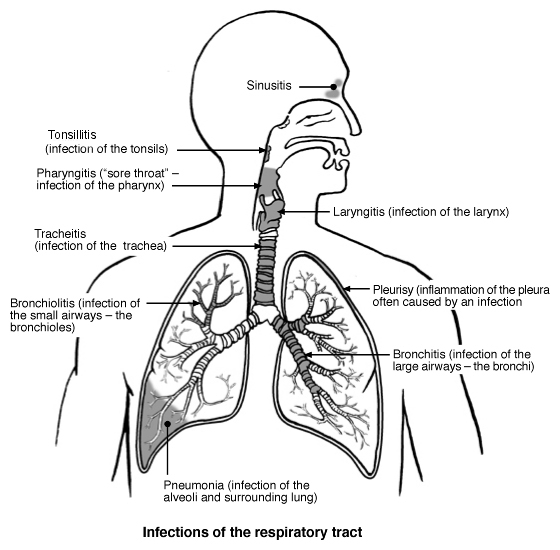
The diagram above shows the sites of a range of respiratory infections. This leaflet just deals with acute bronchitis. See the separate leaflets called Sinusite aiguë, Angine, Maux de gorge, Laryngite, Pleurésie, Bronchiolite, and Pneumonie for the other types of infection shown in the diagram.
Remarque: chronic bronchitis is a separate illness and is not dealt with here. See the separate leaflet called Chronic obstructive pulmonary disease (COPD) for more details.
Is bronchitis contagious?
As with any infection, bronchitis is contagious and so it is important to cough into a tissue and wash your hands regularly to reduce the risk of passing it to others.
You are usually contagious with acute bronchitis for as long as your symptoms, particularly the cough, are present. Most cases are caused by viruses, and the highest risk of spreading the infection is during the first few days.
Acute bronchitis symptoms
The main symptom of acute bronchitis is a toux. You may also develop:
Douleurs et courbatures générales.
Symptoms typically peak after 2-3 days and then gradually clear. However, it can take 2-3 weeks for the cough to go completely after the other symptoms have gone. This is because inflammation in the airways caused by the bronchitis infection may take some time to settle.
Emergency symptoms
Consult a doctor if any of the following occur:
If high temperature (fever), wheezing or headaches become worse or severe.
Si vous développez une respiration rapide, un essoufflement ou des douleurs thoraciques.
If you cough up blood or if your phlegm (sputum) becomes dark or rusty coloured.
Si vous devenez somnolent ou confus.
If a cough persists for longer than 3-4 weeks.
If you have repeated (recurring) bouts of acute bronchitis.
Si un autre symptôme se développe et vous inquiète.
Diagnosing acute bronchitis
Your doctor will listen to the history and examine you - this is usually enough to make a diagnosis and tests are rarely needed. If further tests are needed, they could include blood tests, a chest X-ray or sending a sample of sputum to the laboratory for analysis.
Acute bronchitis treatment
A main aim of treatment is to ease symptoms whilst your immune system clears the infection. The most useful treatments are:
Taking pain relievers tel que le paracétamol, l'ibuprofène, ou aspirine to reduce high temperature (fever) and to ease any aches, pains and headaches. (Children aged under 16 years should not take aspirin.)
Avoir beaucoup à boire if you have a fever, to prevent mild lack of fluid in the body (déshydratation).
If you smoke, trying to stop for good. Bronchitis, infections thoraciques and serious lung diseases are more common in smokers.
Taking plenty of rest.
What about cold and cough remedies?
You can buy many other 'cold and cough remedies' at pharmacies. There is little evidence of any impact on the infection but they may be useful for certain symptoms. For example, a decongestant nasal spray may help to clear a blocked nose.
Remember, cold and cough remedies often contain several ingredients. Some may make you drowsy. This may be welcome at bedtime if you have difficulty sleeping with a bronchitis. However, do not drive if you are drowsy. Some contain paracetamol, so be careful not to take more than the maximum safe dose of paracetamol if you are already taking paracetamol tablets. Always follow the advice of your pharmacist about which medicines can be used for children of different ages.
What about antibiotics?
The National Institute for Health and Care Excellence (NICE) has confirmed that otherwise healthy people who have acute bronchitis should not be prescribed antibiotics. Your immune system can usually clear the infection. Antibiotics do not kill viruses. Even if a germ (bacterium) is the cause, antibiotics usually do little to speed up recovery of an acute bronchitis. Antibiotics may even make symptoms worse, as some people develop side-effects such as loose or watery stools (diarrhoea), feeling sick (nausea) and rashes.
NICE recommends that your doctor should consider either an immediate prescription for antibiotics or a 'delayed prescription' (to be taken if symptoms do not improve or get worse) for the following people:
Over-80s who have been in hospital in the preceding year, are taking steroids, have diabète or have insuffisance cardiaque.
Over-65s who have two of the risk factors in the line above.
People with long-term kidney, liver, heart, lung or nervous system conditions.
People with cystic fibrosis.
People with conditions which can stop their immune system from working properly.
NICE does not recommend prescribing bronchodilators (to open up the airways) or steroids in either inhaled or tablet form.
It recommends that you should consult your doctor if your symptoms have not settled within 3-4 weeks, or if your symptoms get rapidly worse or you become very unwell in yourself.
Antibiotics may also be prescribed if a complication develops such as pneumonia - but this is unlikely to occur if you are otherwise healthy.
Preventing acute bronchitis
Washing your hands regularly is important to reduce the risk of catching bronchitis or other respiratory tract infections from those around you who may have them. Smoking causes lung problems such as COPD which predispose to bronchitis and so stopping smoking may help to reduce the risk of catching bronchitis.
Questions fréquemment posées
Can bronchitis go away on its own?
Most acute bronchitis cases improve on their own within a few weeks. Rest, fluids, and avoiding irritants can help, but see a doctor if symptoms worsen or persist.
How long does acute bronchitis last?
Acute bronchitis usually clears without complications within 3-4 weeks. Occasionally, the infection travels to the lung tissue to cause pneumonia.
What’s the difference between bronchitis and pneumonia?
Bronchitis and pneumonia are both infections of the lungs, but they affect different parts. Bronchitis affects the airways, whilst pneumonia infects the lung air sacs and causes more severe symptoms, often needing immediate medical care.
Is menthol vapour rub good for acute bronchitis?
Menthol vapour rub may ease symptoms of bronchitis, such as a blocked nose or chest congestion, by creating a cooling effect, but it does not treat the infection. You should always use it as instructed and do not apply it to babies or young children.
Can children get acute bronchitis?
Children are more likely to get bronchiolitis (an infection of the smaller parts of the respiratory tree) than bronchitis.
Sélections des patients pour Infections pulmonaires
Poitrine et poumons
Pneumonie
La pneumonie est une infection pulmonaire qui provoque une inflammation et un gonflement des sacs aériens (alvéoles). Ces sacs peuvent se remplir de liquide, rendant la respiration plus difficile et l'oxygène plus difficile à atteindre la circulation sanguine. Elle est généralement causée par des infections bactériennes, mais peut également être causée par des infections virales, et parfois par des champignons. Ce dépliant explique les types, les causes, les symptômes, le traitement et la prévention de la pneumonie.
par Dr Mohammad Sharif Razai, MRCGP

Poitrine et poumons
COVID-19
La COVID-19 est une maladie infectieuse causée par un virus qui a été identifié pour la première fois en décembre 2019 à Wuhan, en Chine. Ce dépliant traite des symptômes, des causes et du traitement de la COVID-19.
par Dr Doug McKechnie, MRCGP
Lectures complémentaires et références
- Toux (aiguë) : prescription d'antimicrobiens; Recommandations NICE (février 2019)
- Singh A, Avula A, Zahn E; Acute Bronchitis
- Chest infections - adult; NICE CKS, mai 2024 (accès réservé au Royaume-Uni)
À propos de l'auteurVoir la biographie complète
Mis à jour par

Dr Toni Hazell, FRCGP
MBBS, BSc, FRCGP, DFSRH, Dip GU med, DRCOG, DCH (London, UK, 2000)
Le Dr Toni Hazell a obtenu son diplôme de l'École de médecine de l'hôpital St. Mary et a effectué son VTS à l'hôpital Northwick Park.
À propos du critiqueVoir la biographie complète

Dr Colin Tidy, MRCGP
Médecin généraliste, Auteur médical
MBBS, MRCGP, MRCP (Paediatrics), DCH
Le Dr Colin Tidy est un médecin du NHS, basé dans l'Oxfordshire.
Historique de l'article
Article également disponible en Anglais, Allemand, Espagnol, Français, Italien, Portugais, Hindi, Hébreu, Arabe, and Suédois.
Prochaine révision prévue : 17 janv. 2028
18 janv. 2023 | Dernière version
Partagez vos pensées ou expériences avec les autres dans notre communautés de patients.
Accès simple à des traitements fiables et à des services de santé en ligne.
Common conditions
Get help with common conditions through the NHS, without a GP appointment.





Inscrivez-vous à la newsletter Patient
Votre dose hebdomadaire de conseils de santé clairs et fiables - rédigés pour vous aider à vous sentir informé, confiant et maître de la situation.
En vous abonnant, vous acceptez notre Politique de confidentialité. Vous pouvez vous désabonner à tout moment. Nous ne vendons jamais vos données.