Douleur menstruelle
Dysménorrhée
Revu par des pairs Dr Colin Tidy, MRCGPDernière mise à jour par Dr Doug McKechnie, MRCGPDernière mise à jour 13 mars 2023
Respecte les directives éditoriales
- TéléchargerTélécharger
- Partager
- Language
- Discussion
- Version audio
- Ajouter aux sources préférées sur Google
Most women have some pain during periods. The pain is often mild but, in about 1 in 10 women, the pain is severe enough to affect day-to-day activities. The pain can be so severe that they are unable to go to school or work. Doctors may call period pain 'dysmenorrhoea'. Period pain is one type of pelvic pain.
En un coup d'œil
Period pain, or dysmenorrhoea, is crampy pain in your lower tummy.
It can spread to your lower back or the top of your legs.
Primary dysmenorrhoea has no underlying cause, while secondary dysmenorrhoea is due to other conditions.
Painkillers like ibuprofen or paracetamol, warmth, and gentle exercise can help.
See a doctor if you have a fever, unusual vaginal discharge, or sudden severe pain.
Seek medical advice if your period pain changes or becomes more severe.
What does period pain feel like?
The main symptom is crampy pain in your lower tummy (abdomen). Often, the first few periods that you have are painless. Period pains may only begin 6-12 months after you have started your periods. The pain:
May spread to your lower back, or to the top of your legs.
Usually starts as the bleeding starts, but it may start up to a day before.
Usually lasts 12-24 hours but lasts 2-3 days in some cases.
Can vary with each period. Some periods are worse than others.
Tends to become less severe as you get older, or after having a baby.
In some women, other symptoms occur as well as pain - for example:
Maux de tête.
Fatigue.
Faintness.
Sensibilité des seins.
Sensation de malaise (nausée).
Ballonnements.
Feeling emotional or tearful.
Remarque: the following symptoms can indicate other medical conditions:
Température élevée (fièvre).
Sudden severe abdominal pain.
Pain when you have sex.
Vaginal bleeding between periods.
Vaginal bleeding after having sex.
You should see your doctor if any of these symptoms develop. Keeping a diary of your symptoms can help your doctor to better understand the cause of your period pain.
What is dysmenorrhoea?
"Dysmenorrhoea" is the medical term for painful menstrual periods.
Dysménorrhée primaire
This is the most common type of painful period. This occurs where there is no underlying problem of the womb (uterus) or pelvis. "Primary" means that there's no other health condition causing it. It often occurs in teenagers and in women in their 20s.
Secondary dysmenorrhoea
This is pain caused by a problem of the womb or pelvis. "Secondary" means that the pain is due to another medical condition. This is less common and is more likely to occur in women in their 30s and 40s.
What causes dysmenorrhoea?
The cause is often not clear (this is called primary dysmenorrhoea). In primary dysmenorrhoea, the womb (uterus) is normal. It is thought that normal body chemicals called prostaglandins build up in the lining of the womb. Prostaglandins help the muscular wall of the womb to contract and remove the lining of the womb during a period.
In women with period pain there seems to be a build-up of too much prostaglandin, or the womb may be extra sensitive to the prostaglandins. This may cause the womb to contract too hard. This reduces the blood supply to the womb and leads to pain.
Secondary dysmenorrhoea
A problem of the womb or pelvis sometimes causes painful periods. For example:
Infection of the womb and Fallopian tubes (maladie inflammatoire pelvienne).
Secondary dysmenorrhoea symptoms
Again, the main symptom is lower tummy pain during your periods (menstrual cramps). With secondary dysmenorrhoea, your periods tend to become more painful after several years of 'normal' periods (that is, periods with normal, mild, period pains).
The following may indicate secondary dysmenorrhoea:
If you have a change in your usual pattern of pain. For example, if your periods become more painful than they used to be, or the pain lasts longer than it used to. In some women with secondary dysmenorrhoea the pain starts several days before the period begins, and lasts all the way through the period. (This is uncommon with primary dysmenorrhoea.)
If you have other symptoms - for example:
Règles irrégulières.
Bleeding between periods.
Pains between periods.
The bleeding becomes heavier than previously.
Vaginal discharge.
Pain during sex.
Pain in your back passage (rectum).
You should see your doctor if you develop any of these problems.
What tests are needed for painful periods?
In many cases (particularly in teenagers) the symptoms are so typical that it can be confidently diagnosed by your doctor just by asking about your symptoms. Your doctor will probably also examine the front of your tummy (abdomen) just to check that it is normal (which it is in primary dysmenorrhoea).
Tests and an internal (pelvic) examination are not normally needed unless symptoms are unusual. In that case an underlying cause of painful periods (secondary dysmenorrhoea) may be suspected.
Secondary dysmenorrhoea
Your doctor will usually examine you if they suspect that you have secondary dysmenorrhoea. This may involve an internal examination to check your womb (uterus) and pelvis as well as an examination of your tummy. The idea is to look for possible causes of your painful periods, such as fibroids in your womb. Your doctor may also suggest that they take some samples (swabs) during the examination to look for any signs of infection.
If your GP feels that you have secondary dysmenorrhoea, they may arrange further tests (such as an ultrasound scan) or refer you to a specialist (usually a gynaecologist) for their opinion and other investigations. The investigations that are carried out depend on the likely underlying problem. They may include:
Une échographie of your womb and pelvis.
En utilisant un telescope to examine the inside of your womb (a hysteroscopy).
Using a telescope to examine the internal organs of your pelvis (a laparoscopy). See the separate leaflet called Laparoscopy and Laparoscopic Surgery for more detail.
How to ease period pain
Most women with painful periods have mild pain that they can treat themselves at home. However, if your pain becomes more severe and is interfering with your usual activities, you should see your doctor.
There are a number of treatments that may help if you have primary dysmenorrhoea:
Keep active
Try light exercise and try gentle massage and relaxation techniques.
Chaleur
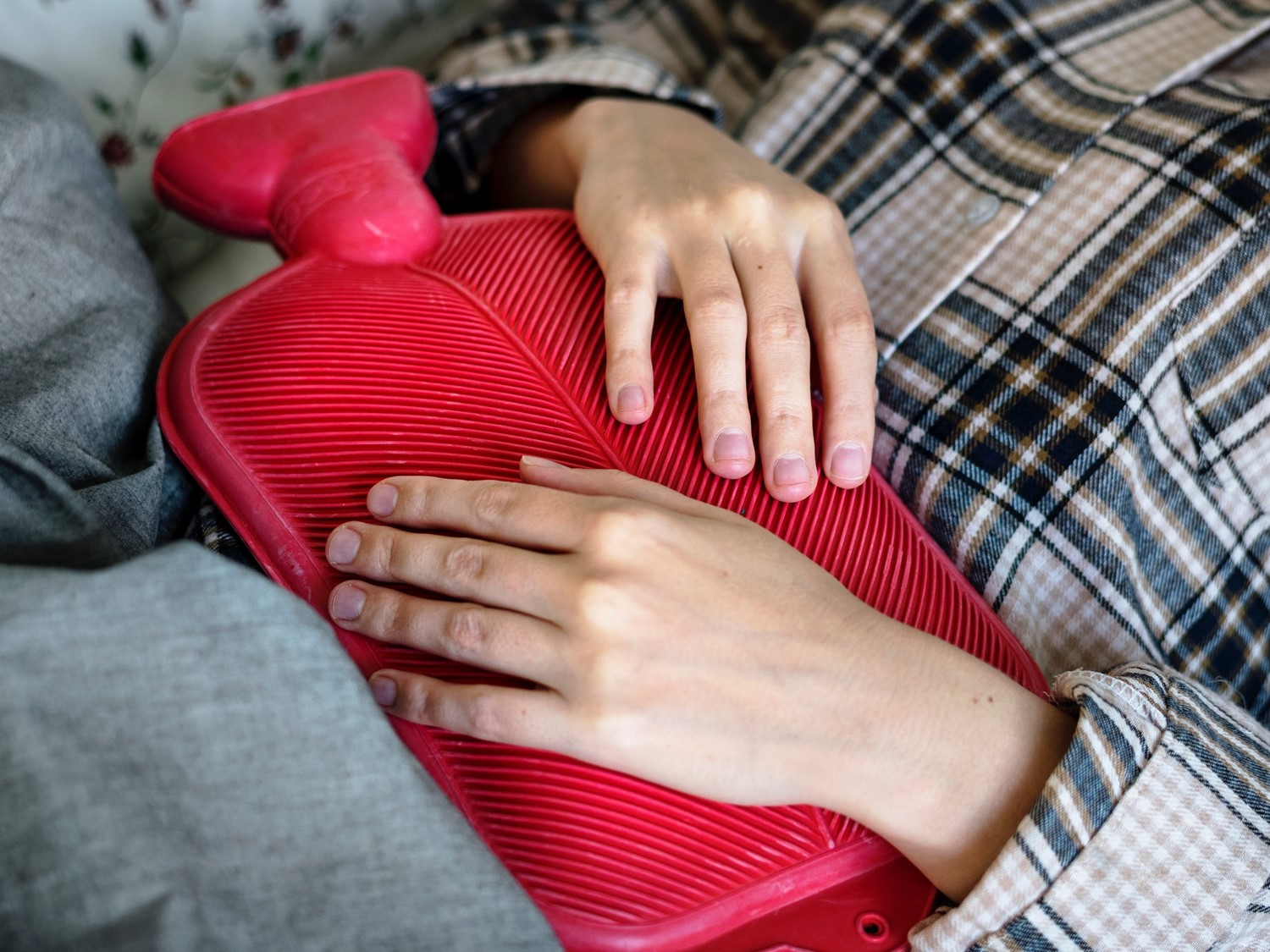
You may find it soothing to hold a hot water bottle against your lower tummy (abdomen), or to have a hot bath. The pain often does not last long, and this may be all that you need. (Be careful not to burn yourself with a hot water bottle which is too hot.)
Non-steroidal anti-inflammatory painkillers
Analgésiques anti-inflammatoires can greatly ease the pain in about 7 out of 10 cases. They work by blocking the effect of the prostaglandin chemicals that are thought to cause the pain. Also, non-steroidal anti-inflammatory painkillers usually reduce the amount of bleeding. There are several types and brands, and most need a prescription.
A commonly prescribed option is l'acide méfénamique. However, you can buy one type (ibuprofène) at pharmacies. Some tips when using an anti-inflammatory include the following:
Take the first dose as soon as your pain begins, or as soon as the bleeding starts, whichever comes first. Some doctors advise to start taking the tablets the day before your period is due. This may prevent the pain from building up.
Take the tablets regularly, for 2-3 days each period, rather than 'now and then' when pain builds up.
Take a strong enough dose. If your pains are not eased, ask your doctor or pharmacist if the dose that you are taking is the maximum allowed. An increase in dose may be all that you need.
Some people cannot take non-steroidal anti-inflammatory painkillers. For example, people with a stomach ulcer, and some people with asthma.
Side-effects are uncommon if you take a non-steroidal anti-inflammatory painkiller for just a few days at a time, during each period. Read the leaflet that comes with the tablets for a full list of possible side-effects and cautions.
Paracétamol
Paracétamol is an alternative painkiller that you can try if you cannot take non-steroidal anti-inflammatory painkillers. Also, paracetamol can be used in combination with a non-steroidal anti-inflammatory painkiller if the anti-inflammatory alone is not enough. Always read the details on the packet so that you do not exceed the maximum daily dose of either painkiller.
Combined hormonal contraceptive (CHC) in the form of 'the pill', the patch or the ring
These are called 'combined' hormonal contraceptives because they contain two hormones - oestrogen and progesterone. They provide contraception (preventing pregnancy), but are still a good option for heavy periods even if you don't need contraception. Heavy and painful periods are much less likely if you take CHC. You can also take them in a way so that you have fewer periods in a year, giving you control over when you have a period. This will reduce the number of times you have pain. See the separate leaflet called Contraceptive Hormone Pills, Patches and Rings for more detail.
The intrauterine system (IUS)
A special intrauterine contraceptive called the IUS is an option if you also need long-term contraception. This is a T-shaped plastic frame that is inserted into the womb (uterus). The IUS slowly releases a progestogen hormone called levonorgestrel. This 'thins' the lining of the womb. It is a very effective contraceptive, and also reduces the amount of pain and bleeding during periods. See the separate leaflet called Intrauterine System (IUS) which describes the IUS in more detail.
Other progestogen contraceptives
Another option if you also need contraception is to try another type of contraception that contains progestogen. These might also be recommended if you can't have combined hormonal contraception (some people have medical conditions that make it unsafe). Options include the progestogen only contraceptive pill, the progestogen implant, or an injectable progestogen contraceptive. See the separate leaflets called Progestogen-only Contraceptive Pill (POP), Contraceptive Implant, and Contraceptive Injection which describe these options in more detail.
A transcutaneous electrical nerve stimulation (TENS) machine
Des TENS machine can be an option for women who prefer not to use medication. These machines give out a small electrical current. They seem to work by interfering with pain signals which are sent to the brain from the nerves. However, you would normally have to buy a TENS machine, as they are not available on the NHS for the treatment of period pain. See the separate leaflet called TENS Machines for more details.
Secondary dysmenorrhoea treatment
The treatment of secondary dysmenorrhoea depends on the underlying cause. Read more about fibromes. See the separate leaflets called Endométriose et la Maladie Inflammatoire Pelvienne, which describe in more detail some of the problems that can cause secondary dysmenorrhoea. These leaflets also discuss treatment.
Si vous avez un intrauterine device (IUD - also known as 'the copper coil') and have painful periods, the treatments for primary dysmenorrhoea (described above) often help. However, some women prefer to have their IUCD removed if symptoms do not improve.
Sélections des patients pour Règles et problèmes menstruels

Santé des femmes
Comment retarder une période
Certaines femmes peuvent souhaiter retarder leurs règles. Cela peut être le cas si les règles doivent arriver à un moment qui serait inopportun - par exemple, pendant des vacances ou lors d'un examen.
par Dr Toni Hazell, FRCGP
Santé des femmes
Règles et problèmes menstruels
Commencer à avoir ses règles fait partie de la croissance. Les règles commencent à apparaître à peu près au même moment que d'autres changements se produisent dans le corps, comme le début du développement des seins ou la croissance des poils pubiens. L'âge moyen pour commencer les règles est de 13 ans, mais il est normal de commencer à tout moment entre 9 et 15 ans. Un petit nombre de filles peuvent commencer avant ou après cela. Les règles continuent jusqu'à la ménopause, qui survient généralement vers l'âge de 50 ans.
par Dr Hayley Willacy, FRCGP
Questions fréquemment posées
When can period pain start after I begin having periods?
It's common for the first few periods to be painless. Period pain may only begin 6-12 months after you've started your periods.
What is the difference between primary and secondary dysmenorrhoea?
Primary dysmenorrhoea is the most common type of painful period, occurring without any underlying problem of the womb or pelvis. Secondary dysmenorrhoea, on the other hand, is pain caused by another medical condition affecting the womb or pelvis, and is less common.
What kind of exercise can help ease period pain?
Light exercise and gentle massage, along with relaxation techniques, can help ease period pain.
Can period pain be treated without medication?
Yes, aside from pain relief medication, warmth (like a hot water bottle or a hot bath), light exercise, gentle massage, and relaxation techniques can help. A TENS machine, which uses a small electrical current to interfere with pain signals, is also an option for those who prefer not to use medication.
How do combined hormonal contraceptives help with painful periods?
Combined hormonal contraceptives, such as the pill, patch, or ring, contain two hormones (oestrogen and progesterone). They significantly reduce the likelihood of heavy and painful periods. You can also use them to have fewer periods in a year, which helps control when you experience pain.
Lectures complémentaires et références
- Marjoribanks J, Ayeleke RO, Farquhar C, et al; Nonsteroidal anti-inflammatory drugs for dysmenorrhoea. Cochrane Database Syst Rev. 2015 Jul 30;(7):CD001751. doi: 10.1002/14651858.CD001751.pub3.
- Pattanittum P, Kunyanone N, Brown J, et al; Dietary supplements for dysmenorrhoea. Cochrane Database Syst Rev. 2016 Mar 22;3:CD002124. doi: 10.1002/14651858.CD002124.pub2.
- Smith CA, Armour M, Zhu X, et al; Acupuncture for dysmenorrhoea. Cochrane Database Syst Rev. 2016 Apr 18;4:CD007854. doi: 10.1002/14651858.CD007854.pub3.
- Dysménorrhée; NICE CKS, octobre 2023 (accès réservé au Royaume-Uni)
À propos de l'auteurVoir la biographie complète

Dr Doug McKechnie, MRCGP
Rédacteur Médical
MA, MBBS, MSc, DRCOG, MRCP(UK), MRCGP(2021), FHEA
Le Dr Doug McKechnie est un médecin généraliste du NHS travaillant à Londres. Il travaille à plein temps en clinique et est également le chef adjoint du module de Pratique Clinique et Professionnelle à l'École de Médecine de l'University College London.
À propos du critiqueVoir la biographie complète

Dr Colin Tidy, MRCGP
Médecin généraliste, Auteur médical
MBBS, MRCGP, MRCP (Paediatrics), DCH
Le Dr Colin Tidy est un médecin du NHS, basé dans l'Oxfordshire.
Historique de l'article
Les informations sur cette page sont rédigées et examinées par des cliniciens qualifiés.
Article également disponible en Anglais, Allemand, Espagnol, Français, Italien, Portugais, Hindi, Hébreu, Arabe, and Suédois.
Prochaine révision prévue : 10 fév. 2028
13 mars 2023 | Dernière version

Demandez, partagez, connectez-vous.
Parcourez les discussions, posez des questions et partagez vos expériences sur des centaines de sujets de santé.

Vous ne vous sentez pas bien ?
Évaluez vos symptômes en ligne gratuitement
Inscrivez-vous à la newsletter Patient
Votre dose hebdomadaire de conseils de santé clairs et fiables - rédigés pour vous aider à vous sentir informé, confiant et maître de la situation.
En vous abonnant, vous acceptez notre Politique de confidentialité. Vous pouvez vous désabonner à tout moment. Nous ne vendons jamais vos données.