Angine
Revu par Dr Hayley Willacy, FRCGP Dernière mise à jour par Dr Philippa Vincent, MRCGPDernière mise à jour 26 Jun 2024
Respecte les directives éditoriales
- TéléchargerTélécharger
- Partager
- Language
- Discussion
- Version audio
Dans cette série :Maux de gorgeCalculs amygdaliensAmigdalectomiefièvre glandulaire
Tonsillitis is an infection of the tonsils that causes them to become swollen and sore. It is usually caused by a virus, but can also be caused by bacterial infections. Most cases improve within a week with rest, fluids, and pain relief, however, bacterial tonsillitis may require antibiotics. This leaflet discusses the symptoms, causes, treatments, and when to see a doctor.
Dans cet article:
Sélections de vidéos pour Gorge et amygdales
Points clés
Tonsillitis is an infection of the tonsils that is mainly caused by viral infections but can also be caused by bacterial infections.
Tonsillitis symptoms include sore throat, fever, pain when swallowing, and swollen tonsils (sometimes with white spots). It often clears up within a week.
Tonsillitis can be passed from person to person through coughing, sneezing, or close contact. Washing hands and good hygiene can help prevent it.
Most cases get better on their own with rest, plenty of fluids, and pain relief. For severe cases, antibiotics may be prescribed.
Continuez à lire ci-dessous
What are tonsils?
Tonsils are made of soft gland tissue and they are part of the body's defence against infections (the immune system). There are two tonsils, one on either side at the back of the mouth.
Tonsils and adenoids diagram
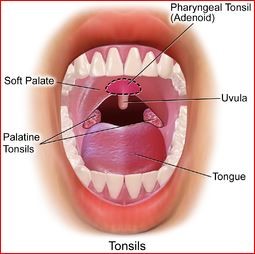
© BruceBlaus: Blausen.com staff (2014). "Medical gallery of Blausen Medical 2014", CC BY 3.0, via Wikimedia Commons
Tonsillitis symptoms
Retour au sommaireMaux de gorge.
Température élevée (fièvre).
Sensation de nausée.
Se sentir fatigué.
Pain when swallowing.
Swollen lymph nodes in the neck.
Swollen tonsils.
Red tonsils.
White spots (pus) on the tonsils.
Symptoms typically get worse over 2-3 days and then gradually go, usually within a week.
Continuez à lire ci-dessous
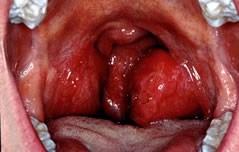
What does tonsillitis look like?
Retour au sommaireThe picture below shows inflamed tonsils.
Tonsil inflammation
How long does tonsillitis last?
Retour au sommaireTonsillitis normally goes after 4-5 days. Tonsillitis treatment can ease the symptoms until the infection goes. Medical advice should be sought if the symptoms are severe or don't get better quickly.
Continuez à lire ci-dessous
What causes tonsillitis?
Retour au sommaireTonsillitis can be caused by:
Viral infections such as colds and flu.
Bacterial infections such as group A streptococcus - which can cause la scarlatine, and very rarely in the UK, rhumatismale aiguë.
fièvre glandulaire
Glandular fever (infectious mononucleosis - or 'mono') is caused by a virus - the Epstein-Barr virus. It tends to cause a severe bout of tonsillitis as well as other symptoms. See the separate leaflet called Glandular fever (Infectious mononucleosis) for more details.
Is tonsillitis contagious?
Retour au sommaireContagious means that the infection can be passed to someone else. Tonsillitis is contagious so infection may spread by close physical contact with other people, or by droplets in the air, caused by sneezing or coughing.
As with coughs, colds, la grippe and other similar infections, the virus that has caused the tonsillitis can be passed to others. Normal hygiene advice such as washing hands after coughing or sneezing would apply.
Tonsillitis treatment
Retour au sommaireMild tonsillitis doesn't need any specific treatment. It is important to drink plenty of water. Also:
Paracetamol (acetaminophen) or ibuprofen will help to ease the pain, headache, and high temperature.
Gargles, lozenges, and sprays may help to soothe a sore throat but they do not shorten the illness.
Antibiotics can kill bacteria but do not kill viruses. Even when tonsillitis is caused by a bacteria, treatment with an antibiotic does not make much difference in terms of the length or severity of the illness. However, if the antibiotic prescribing criteria are met, a doctor may prescribe antibiotics.
With repeated bouts of tonsillitis, surgery may be considered to surgery to remove the tonsils (tonsillectomy).
Will tonsillitis go away on its own?
Yes. Most tonsil infections are mild and soon get better on their own. Even when the tonsillitis is caused by a bacterial infection, it will usually get better on its own.
At home treatments
Les options de traitement incluent :
Have plenty to drink. It is tempting not to drink very much if it is painful to swallow. If not drinking enough, this may cause mild dehydration, particularly alongside a high temperature (fever). This can make headaches and tiredness much worse.
Paracetamol or ibuprofen eases pain, headache and fever. To keep symptoms to a minimum it is best to take a dose at regular intervals as recommended on the packet of medication rather than now and then. For example, take paracétamol four times a day - at least 4-6 hours apart - until symptoms ease. Although either paracetamol or ibuprofène will usually help, there is some evidence to suggest that ibuprofen may be more effective than paracetamol at easing symptoms in adults. Paracetamol is usually the preferred first-line option for children, but ibuprofen can be used as an alternative. Remarque: some people with certain conditions may not be able to take ibuprofen. So, always read the packet label. See the leaflet Fever in children (High temperature) ou Fever treatment for children: a doctor's advice for further information.
Other gargles, lozenges and sprays that can be bought at pharmacies may help to soothe a sore throat. However, they do not shorten the illness.
Get plenty of rest.
See the separate article called 9 home remedies for tonsillitis pour plus de détails.
Tonsillitis antibiotics
Retour au sommaireMost throat and tonsil infections are caused by viruses, although some are caused by bacteria. Viral infections cannot be treated with antibiotics. A swab can identify whether the infection is caused by a virus or a bacteria.
Even if a bacterial infection is the cause of tonsillitis, an antibiotic does not make much difference in most cases. The body's defences (immune system) usually clear these infections within a few days whether caused it is by a virus or a bacterium. Also, antibiotics can often cause side-effects such as diarrhoea, rash and stomach upsets.
The bacteria which tends to cause tonsillitis is a streptococcus. This is why sometimes people refer to tonsillitis as a "strep throat".
People commonly think that tonsillitis needs to be treated with antibiotics. This is not true. Studies have shown that, in patients who were not prescribed antibiotics, 40 out of 100 of them were completely better in 3 days and 80 out of 100 were better in a week. This was the same whether or not their tonsillitis was caused by a bacteria (strep) or a virus. On average, the antibiotics reduced the length of symptoms by 16 hours but caused more side effects.
Another study showed that 200 people needed to be treated with antibiotics in order to prevent one complication and that the majority of these complications were very mild (for example, an ear infection). On the other hand, only 37 people need to be treated with antibiotics to cause harm from the antibiotics.
There is also evidence that the overuse of antibiotics for self-limiting conditions like tonsillitis can reduce the effectiveness of the immune system and make people more prone to future infections.
There are two scoring systems which may be used to help decide how likely an episode is bacterial. These are called the FeverPAIN score and the Centor score.
An antibiotic may be advised in certain situations. For example:
If the infection is severe.
If it is not easing after a few days.
If the immune system is not working properly (for example, if you have had your spleen removed, if you are taking chemotherapy, etc).
If living in an area of the world where rheumatic fever is common (some low-income countries in sub-Saharan Africa, the Middle East, South East Asia and the Western Pacific).
It can often feel as though antibiotics are needed because the tonsillitis settled quickly after getting antibiotics on a previous occasion - however, this is usually just because of the timeframe - people usually wait 2-3 days before seeking medical help and the vast majority of tonsillitis infections will settle within 3-5 days. For most people, fluids and painkillers are enough.
Recurrent tonsillitis
Guidelines suggest removing the tonsils may be an option (tonsillectomy) if there have been:
Seven or more episodes of tonsillitis in the preceding year; ou
Five or more such episodes in each of the preceding two years; ou
Three or more such episodes in each of the preceding three years.
And
The bouts of tonsillitis affect normal functioning. For example, they are severe enough to require time off work school. Read our article on how to manage tonsillitis in children.
Or
An episode of quinsy.
The tonsils and adenoids may be removed at the same time. The adenoids are also part of the body's defence against infections (the immune system). Adenoids hang from the upper part of the back of the nasal cavity. See the separate leaflet called What do tonsils do? for more details.
Although full-blown episodes of tonsillitis are prevented after tonsillectomy, other throat infections are not prevented. However, the overall number and severity of throat infections may be reduced.
Also, the risk of developing quinsy is reduced. Many people say they generally feel better in themselves after having their tonsils removed if they previously had frequent episodes of chronic tonsillitis.
Tonsillectomy risks
Tonsillectomy is usually a straightforward minor operation. But, as with all operations, there is a risk. There is a small risk of life-threatening severe bleeding from the throat during or just after the operation.
When should you contact a doctor about tonsillitis?
Retour au sommaireMedical advice should be sought if symptoms of a sore throat cause severe symptoms (despite painkillers), or if they do not ease within 3-4 days. In particular, urgent medical attention should be sought if there is:
Difficulté à respirer.
Difficulté à avaler la salive.
Difficulty opening the mouth.
Severe pain despite painkillers.
Une maladie grave, surtout lorsque les symptômes se manifestent principalement d'un côté de la gorge.
What is the outlook for tonsillitis?
Retour au sommaireIn nearly all cases, a tonsillitis or sore throat settles without leaving any problems. However, occasionally tonsillitis may progress to cause a complication. Also, a sore throat can sometimes be due to an unusual, but more serious, illness.
Sometimes the infection can spread from the tonsils to other nearby tissues. For example, to cause an infection de l'oreille, infection des sinus ou infection pulmonaire.
What is quinsy?
Retour au sommairePhlegmon amygdalien is also known as peritonsillar abscess. Quinsy is a condition where a collection of pus (abcès) develops next to a tonsil. This is caused by a bacterial infection.
It usually develops just on one side. It may follow a tonsillitis or develop without tonsillitis.
The tonsil on the affected side may be swollen or look normal, but is pushed towards the middle by the abscess next to the tonsil. Quinsy is very painful and can make you feel very unwell.
It is treated with antibiotics, but also the pus often needs to be drained with a small operation.
Quinsy needs to be treated in hospital.
Questions fréquemment posées
Retour au sommaireHow serious is tonsillitis in adults?
In most adults, tonsillitis is not serious and usually improves within a week. However, adults may experience more severe symptoms or complications than children.
What antibiotics are used to treat tonsillitis?
Most cases of tonsillitis do not need antibiotics because they are usually caused by a virus and clear up on their own. When needed, common antibiotics used in the UK are: penicillin, clarithromycin, or erythromycin.
What is the difference between tonsillitis and strep?
Tonsillitis is the inflammation of the tonsils, whereas strep throat is a specific infection caused by group A streptococcus that often leads to tonsillitis, but can also affect the throat more generally.
Does tonsillitis cause a cough?
Viral tonsillitis is often associated with symptoms like a cough and a cold. Bacterial tonsillitis however, does not usually cause a cough and it is one of the criteria that is used to decide how likely a bacterial infection is.
Is tonsillitis worse at night?
Sore throats often feel worse at night. This may because the painkillers have worn off. It may also be that people sleep with their mouth open and, therefore, their mouth tends to be dry, which can add to the pain. Having water by the bed and taking painkillers just before going to bed can help.
Sélections de patients pour Gorge et amygdales

Oreille, nez et gorge
Calculs amygdaliens
Tonsil stones are stones which can form at the back of the throat within the tonsils. They are not serious but can sometimes cause problems with a sore throat or bad breath.
par Dr Philippa Vincent, MRCGP

Oreille, nez et gorge
Amigdalectomie
A tonsillectomy is an operation to remove the tonsils from the back of the throat. Other leaflets explain more about tonsils, sore throats and throat infections. This leaflet covers risks and benefits of the operation and what to expect before, during and after a tonsillectomy. Note: the information below is a general guide only. The arrangements often vary between different hospitals. Always follow the instructions given by your doctor or local hospital.
par Dr Colin Tidy, MRCGP
Lectures complémentaires et références
- Burton MJ, Glasziou PP, Chong LY, et al; Tonsillectomy or adenotonsillectomy versus non-surgical treatment for chronic/recurrent acute tonsillitis. Cochrane Database Syst Rev. 2014 Nov 19;(11):CD001802. doi: 10.1002/14651858.CD001802.pub3.
- Maux de gorge (aiguës) : prescription d'antimicrobiens; Ligne directrice NICE (janvier 2018)
- Tonsillectomy - Commissioning Guide; ENT UK and Royal College of Surgeons, 2021
- Gorge irritée - aiguë; NICE CKS, septembre 2024 (accès réservé au Royaume-Uni)
- Anderson J, Paterek E; Tonsillitis.
- Wilcox CR, Moore M, Little P; Use of antibiotics for acute sore throat and tonsillitis in primary care. Br J Gen Pract. 2022 Feb 24;72(716):136-137. doi: 10.3399/bjgp22X718793. Print 2022 Mar.
- FeverPain score calculator
- Centor score calculator
- Exploring the collaboration between antibiotics and the immune response in the treatment of acute, self-limiting infections; P Ankomah, B Levin; Proceedings of the National Academy of Sciences, 2014
Continuez à lire ci-dessous
Historique de l'article
Les informations sur cette page sont rédigées et examinées par des cliniciens qualifiés.
Next review due: 25 Jun 2027
26 Jun 2024 | Dernière version

Demandez, partagez, connectez-vous.
Parcourez les discussions, posez des questions et partagez vos expériences sur des centaines de sujets de santé.

Vous ne vous sentez pas bien ?
Évaluez vos symptômes en ligne gratuitement
Inscrivez-vous à la newsletter Patient
Votre dose hebdomadaire de conseils de santé clairs et fiables - rédigés pour vous aider à vous sentir informé, confiant et maître de la situation.
En vous abonnant, vous acceptez notre Politique de confidentialité. Vous pouvez vous désabonner à tout moment. Nous ne vendons jamais vos données.