Douleur au dos et à la colonne vertébrale
Revu par Dr Philippa Vincent, MRCGPDernière mise à jour par Dr Toni Hazell, MRCGPDernière mise à jour 17 nov. 2024
Respecte les directives éditoriales
- TéléchargerTélécharger
- Partager
- Language
- Discussion
- Version audio
Dans cette série :Douleur lombaireSlipped discSténose spinaleSyndrome de la queue de chevalDouleur dorsale thoraciqueDouleur dorsale chez les enfants
Les douleurs dorsales sont extrêmement courantes ; la plupart d'entre nous en souffriront à un moment donné. Les enfants peuvent avoir des douleurs dorsales, mais elles sont plus fréquentes chez les adultes. Ce dépliant fournit des informations générales sur le dos et les douleurs dorsales. Il vous dirigera également vers des pages contenant des informations plus détaillées sur les différentes affections pouvant causer des douleurs dorsales.
Dans cet article:
Sélections de vidéos pour Dos et colonne vertébrale
What are the different types of back pain?
Continuez à lire ci-dessous
Understanding the back
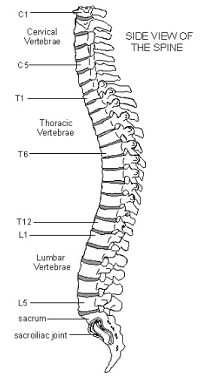
The spine is made up of many bones called vertebrae. These are roughly circular and between each vertebra is a disc. The discs are made of strong rubber-like tissue which allows the spine to be fairly flexible. A disc has a stronger fibrous outer part and a softer jelly-like middle part. The middle part is called the nucleus pulposus.
Strong ligaments also attach to next-door (adjacent) vertebrae to give extra support and strength to the spine. There are various muscles that are attached to the spine which enable the spine to bend and move in various ways. Small joints, called facet joints, help to attach the vertebrae to each other. The sacrum is formed from five vertebrae that are joined together (fused) to make one bone. The sacroiliac joints are the large joints that join the sacrum to the main bone of the pelvis (the ilium).
Spinal cord
Close-up diagram lumbar spinal cord
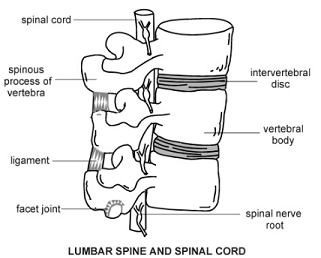
The spinal cord, which contains the nerves that come from the brain, is protected by the spine. Nerves from the spinal cord come out from between the vertebrae to relay messages to and from various parts of the body. The lower end of the spinal cord is at the level of the first or second lumbar vertebra. Below this, the nerves from the last part of the spinal cord branch to form what is called the cauda equina (from the Latin for a horse's tail).
Back pain causes (aetiology of back pain)
Retour au sommaireCommon causes
Simple or nonspecific/muscular lower back pain:
This is the most common type of back pain and is often felt more as discomfort in the back.
It isn't possible to say exactly what the cause is of lower back pain but there is rarely any serious problem with the back.
Slipped disc, sometimes called prolapsed disc or sciatica:
Often causes severe back pain.
Pain is due to the tissues from a disc pressing on the structures nearby - for example, nerves, when the pain is called nerve root pain. For this reason it is sometimes called a trapped nerve.
May cause sciatica, which is pain that goes down the leg to the foot.
See the separate leaflet called Slipped disc (Prolapsed disc).
Thoracic back pain:
Douleur dorsale thoracique is more likely than lower back pain to have a serious cause.
It is more common in young people, possibly due to carrying heavy school bags, when it is not serious.
Causes moins courantes
Arthritis (joint inflammation) of all types can cause back pain:
Arthrose is a common type of arthritis that affects people as they get older. It can be a cause of back pain.
Spinal stenosis is a common cause of pain in the buttocks and legs, although it doesn't always cause back pain:
It mainly affects people aged over 60 years.
It is often caused by osteoarthritis of the spine.
Polyarthrite rhumatoïde is a much less common type of arthritis. It can occasionally affect the spine.
Ankylosing spondylitis is a form of arthritis that mainly affects the spine:
It can affect other joints and other parts of the body.
Voir la brochure séparée intitulée Spondylarthrite ankylosante.
Fracture of a vertebra:
Road traffic accidents, falls, sports injuries and violent attacks can all lead to fractures of the spine causing back pain.
Causes bones to be more likely to break with a minor injury.
May cause thoracic back pain, as well as low back pain.
Is more common in the elderly, particularly women.
Is more common in people on steroid medication.
Shingles:
Zona is a common infection, which can cause pain before any sign of the typical rash.
Scoliosis of the spine:
Scoliosis causes the spine to curve to the left or right side.
It is often painless, but may cause back pain.
See the separate leaflet called Scoliosis and kyphosis (Curvature of the spine).
Rare causes
Tumeurs.
Infection - for example, la tuberculose.
Cauda equina syndrome:
This is a rare but serious type of nerve root problem.
The nerves at the bottom end of the spine are squashed causing:
Low back pain.
Problems with the bowel and bladder (usually not being able to pass urine).
Numbness in the 'saddle' area, which is around the back passage (anus).
Weakness in one or both legs.
Continuez à lire ci-dessous
Pain relief for back pain
Retour au sommaireUsually back pain settles down quickly, improving within a week or so and being gone by 4-6 weeks.
You should try to keep as active as you can and do your normal activities, if possible - the old advice of resting until the pain eases has been proven to be wrong and too much rest can be harmful.
If the pain is stopping you from being able to keep moving then you should take antalgiques regularly so that you can keep active.
Back pain treatment
Retour au sommaireAside from keeping active and taking painkillers if necessary, there are many other possible treatments. Which treatment is suitable for you may depend on the cause of your pain.
Structured exercise programme.
Manual therapy, including massage and spinal manipulation may help symptoms in some people.
Cognitive behavioural therapy (CBT) may be useful in some people with long-standing (chronic) back pain.
Spinal injections.
Chirurgie :
This is rarely needed.
About one person in every ten with a slipped disc (prolapsed disc) may benefit from surgery.
May be needed urgently for syndrome de la queue de cheval.
See separate leaflets on the different causes of back pain for more details of other possible treatments.
Continuez à lire ci-dessous
Questions Fréquemment Posées
Retour au sommaireWhat are the symptoms of back pain?
Back pain is pain that is felt anywhere from the bottom of the neck to your bottom. It can range from mild and fleeting to severe or long-lasting. It can come on for an obvious reason - such as after a fall or lifting something very heavy or awkward - or it can just come on for no reason at all.
Sometimes back pain causes other symptoms:
Pain in the leg or foot.
Pain in the buttock or thigh.
Weakness in one or both legs.
Fourmillements in one or both legs.
Other sensations in the legs, such as warmth or a burning feeling.
Who gets back pain?
Everyone can get back pain at some time in their life. The most common type of back pain, low back pain, affects about 8 in 10 people. Back pain even occurs in children: 3 out of every 10 young people have had pain in their back.
If you suspect cauda equina syndrome you should see a doctor immediately.
Ai-je besoin de tests ?
This depends on what is thought to be the cause of your back pain. Your doctor will usually be able to tell what the likeliest cause is of your pain, simply by talking to you and examining you. If you haven't had your back pain for very long and your doctor doesn't think it is serious, you are unlikely to need any tests. Most people do not need an MRI scan of their back - having an MRI can cause harm by finding something which is not actually related to the pain and which may lead to unnecessary treatment that can cause harm.
The pain is more likely to have a serious cause if it is constant and becoming worse, if it wakes you up at night, if you are older or if you are unwell in other ways, such as having a temperature or losing weight. In this case you may need further tests, such as:
Quand devrais-je consulter un médecin ?
Generally if your pain lasts longer than 4-6 weeks or if your symptoms change, you should see a doctor.
Other reasons for seeking medical advice are:
You suspect cauda equina syndrome (see above):
Seek immediate medical advice.
Your pain is constant and is not eased by lying down or resting.
Your pain is gradually becoming worse and worse.
You are experiencing weakness in any of your muscles in your leg or foot or you are tripping up (which can be a symptom of weak ankle muscles).
You have a lack of feeling (numbness) in any part of your bottom or leg.
Your pain started after a road accident or a fall.
You have been diagnosed with ostéoporose.
You have recently taken or are still taking steroid medication.
Your pain is worst in the early hours of the morning and on waking and is eased by activity.
How can I avoid back pain?
In general, you should try to keep fit and active and exercise regularly - swimming, walking, running and cycling are all excellent forms of exercise. However not all forms of back pain can be avoided. Also it isn't known why some people develop back pain and some people never do.
Quel est le pronostic ?
Most people with back pain that doesn't have a serious cause, get better fairly quickly, often within a week or so. If you have low back pain (including pain caused by a disc problem), you will recover quicker if you can get moving again quickly and get back to work as soon as you are able.
It is common to have further bouts (recurrences).
Sélections de patients pour Dos et colonne vertébrale
Os, articulations et muscles
Spondyloarthrite axiale
La spondyloarthrite axiale (également connue sous le nom de axSpA ou SpA axiale) est une arthrite douloureuse et chronique qui affecte principalement les articulations de la colonne vertébrale, ainsi que les articulations reliant chaque côté de la base de la colonne vertébrale au bassin (articulations sacro-iliaques). Elle peut également affecter d'autres articulations du corps, ainsi que les tendons et les ligaments. Elle se divise en : 1) Spondylarthrite ankylosante. 2) Spondyloarthrite axiale non radiographique.
par Dr Philippa Vincent, MRCGP
Os, articulations et muscles
Spondylose cervicale
Ce dépliant s'adresse aux personnes à qui l'on a diagnostiqué une spondylose cervicale comme cause de leurs symptômes au cou. La spondylose cervicale est une « usure » des vertèbres et des disques du cou. C'est une partie normale du vieillissement et elle ne provoque pas de symptômes chez de nombreuses personnes. Cependant, elle peut parfois être à l'origine de douleurs cervicales. Les symptômes ont tendance à aller et venir. Les traitements incluent le maintien de la mobilité du cou, des exercices et des analgésiques. Dans les cas graves, la dégénérescence peut provoquer une irritation ou une pression sur les racines nerveuses de la moelle épinière ou la moelle elle-même. Cela peut entraîner des symptômes dans les bras ou les jambes (détaillés ci-dessous). Dans ces cas graves, une intervention chirurgicale peut être envisagée.
par Dr Doug McKechnie, MRCGP
Lectures complémentaires et références
- Douleur lombaire et sciatique chez les plus de 16 ans : évaluation et gestion; Directives NICE (novembre 2016 - dernière mise à jour décembre 2020)
- Trompeter K, Fett D, Platen P; Prevalence of Back Pain in Sports: A Systematic Review of the Literature. Sports Med. 2017 Jun;47(6):1183-1207. doi: 10.1007/s40279-016-0645-3.
- Back pain - low (without radiculopathy); NICE CKS, septembre 2023 (accès réservé au Royaume-Uni)
- Sciatica (lumbar radiculopathy); NICE CKS, septembre 2023 (accès réservé au Royaume-Uni)
Continuez à lire ci-dessous
Historique de l'article
Les informations sur cette page sont rédigées et examinées par des cliniciens qualifiés.
Prochaine révision prévue : 16 nov. 2027
17 nov. 2024 | Dernière version

Demandez, partagez, connectez-vous.
Parcourez les discussions, posez des questions et partagez vos expériences sur des centaines de sujets de santé.

Vous ne vous sentez pas bien ?
Évaluez vos symptômes en ligne gratuitement
Inscrivez-vous à la newsletter Patient
Votre dose hebdomadaire de conseils de santé clairs et fiables - rédigés pour vous aider à vous sentir informé, confiant et maître de la situation.
En vous abonnant, vous acceptez notre Politique de confidentialité. Vous pouvez vous désabonner à tout moment. Nous ne vendons jamais vos données.